

What Is a Liberal Arts Education?
Choosing the right college path often introduces students to the term liberal arts education. However, many students misunderstand what this educational approach involves. Rather than preparing students for one specific trade, it builds broad intellectual foundations. These include the humanities, social sciences, natural sciences, and mathematics.
According to the American Association of Colleges and Universities, liberal education helps individuals navigate complexity, diversity, and change. These abilities are increasingly important in today’s rapidly changing global economy.
Understanding this educational model matters when comparing college programs and career options. Modern employers value adaptability, communication, and analytical problem-solving. These skills help professionals handle unfamiliar challenges and changing workplace demands.
Whether you are a high school student or a parent researching university programs, understanding this approach can help. It offers a different perspective on higher education and long-term career development.
In this guide, we explore the meaning and structure of liberal arts education. You will also learn how a BA differs from liberal arts, whether Harvard follows this model, and what the seven classical liberal arts are. Finally, we compare liberal arts colleges with universities and examine potential career opportunities.
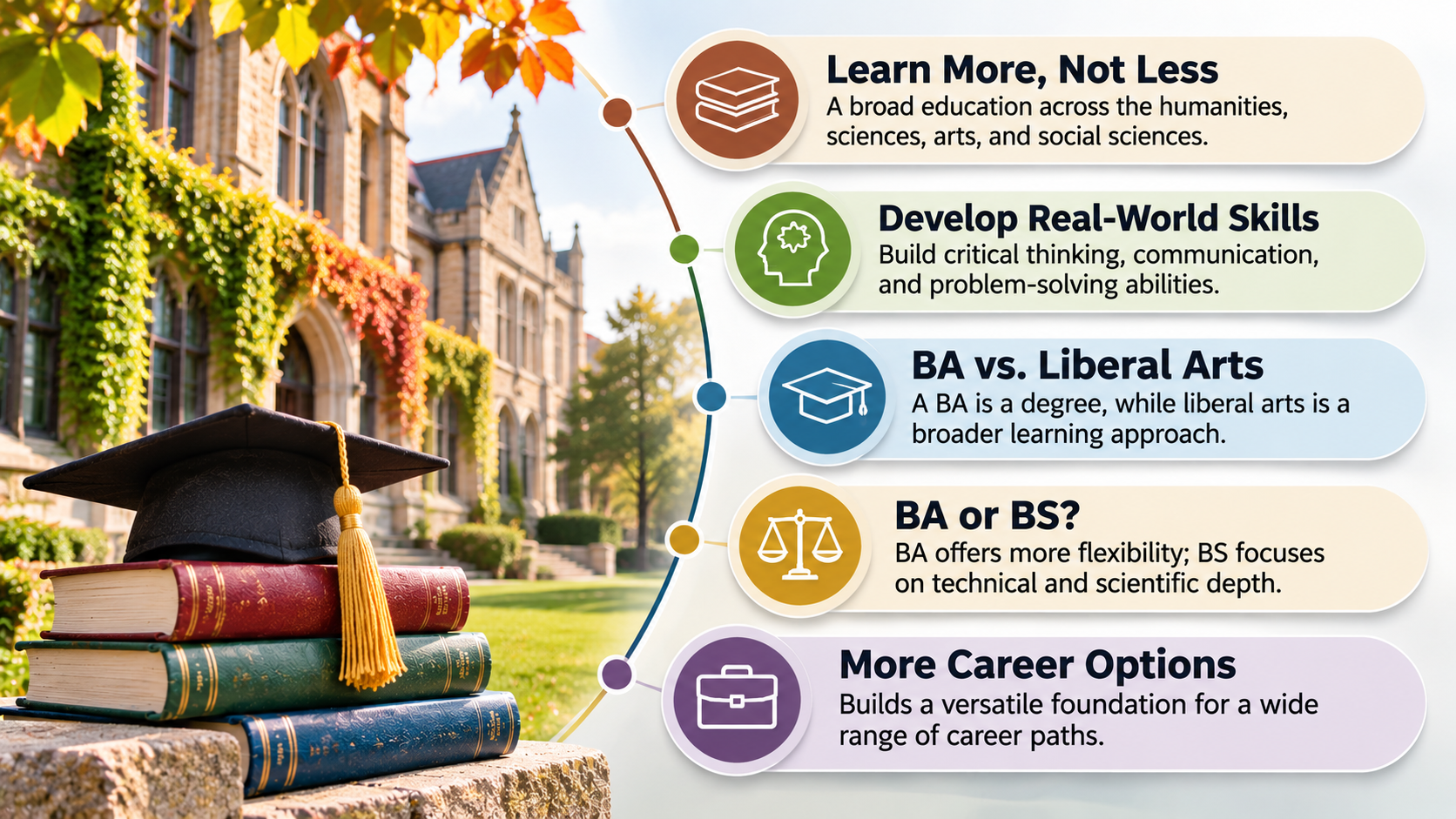
What is the meaning of a liberal education?
A liberal education is a broad learning approach that develops independent thinkers rather than narrow technical specialists. It encourages students to explore different subjects instead of following one rigid vocational path. These subjects include literature, history, science, mathematics, and the arts. Students can explore different types of education to understand how various learning approaches support their academic development.
The main goal is to teach students how to learn, question assumptions, and solve unfamiliar problems. Students examine complex texts, conduct scientific research, and discuss ethical questions. They also learn to connect ideas from different academic disciplines.
This approach develops intellectual flexibility and supports lifelong learning. It also prepares individuals for active participation in society and different career opportunities. Rather than focusing only on immediate employment requirements, liberal education builds knowledge that remains useful as industries change.
Core Skills Developed Through Liberal Learning
A liberal education develops several essential skills that students can apply throughout their professional and personal lives. These abilities extend beyond individual academic subjects and help graduates approach unfamiliar situations confidently.
Four important skills include:
-
Critical reading: Understanding complex information, evaluating arguments, and identifying assumptions.
-
Persuasive writing: Presenting ideas clearly through structured arguments and effective communication.
-
Quantitative reasoning: Interpreting numerical information, analyzing data, and understanding mathematical relationships.
-
Ethical judgment: Considering different perspectives and making responsible decisions.
These abilities help students adapt when industries, technologies, and workplace expectations change. For example, technology professionals need more than programming knowledge. They must also communicate with teams, understand user requirements, and evaluate potential consequences.
Employers across business, technology, and public policy value these transferable abilities. Liberal learning therefore provides a foundation for professional development across different industries.
Are BA and liberal arts the same?
No, a Bachelor of Arts (BA) and a liberal arts education are not the same thing. However, they frequently overlap in undergraduate programs. Liberal arts describes an educational philosophy and curriculum covering humanities, social sciences, natural sciences, and mathematics. A BA represents a specific undergraduate degree awarded after completing an academic program.
Students can earn a BA in subjects such as history, psychology, sociology, and English. These subjects commonly fall within the liberal arts curriculum. However, the relationship between these terms is not limited to humanities-based degrees.
Many liberal arts colleges also award Bachelor of Science (BS) degrees. Students may earn these qualifications in biology, chemistry, mathematics, or computer science. This demonstrates that liberal arts education can accommodate different academic interests and degree structures.
Understanding this distinction helps students compare undergraduate programs more accurately. Instead of judging a course by its degree title alone, examine its curriculum, academic requirements, and learning objectives.
Choosing Between a BA and a BS Degree
Choosing between a Bachelor of Arts and a Bachelor of Science depends on your academic interests and career objectives. Both qualifications provide undergraduate education, but their curriculum requirements can differ.
A Bachelor of Arts generally offers broader academic flexibility. Depending on the institution and major, students may complete additional coursework in writing, languages, humanities, or social sciences.
A Bachelor of Science usually emphasizes technical and scientific subjects. Its curriculum may include additional mathematics, laboratory work, research, and specialized major requirements.
Here are some common differences:
-
BA degree: Often provides broader elective choices and interdisciplinary coursework.
-
BS degree: Usually emphasizes technical knowledge, scientific methods, and quantitative skills.
-
Career preparation: Both degrees can support professional careers and further education.
-
Academic flexibility: Requirements depend on the university and selected major.
Neither degree is automatically better. Review individual course requirements before making your decision.
Is Harvard a liberal arts education?
Yes, Harvard College follows a liberal arts and sciences education model at the undergraduate level. However, it is important to distinguish Harvard College from the wider Harvard University system. Harvard University is a major research institution with several graduate and professional schools. These include schools focused on law, medicine, business, and other specialized fields.
At the undergraduate level, Harvard College emphasizes broad academic exploration alongside specialized study. Students select an academic concentration while completing general education requirements. This structure encourages students to understand different disciplines before focusing deeply on one subject.
Harvard’s undergraduate curriculum includes subjects involving ethics, aesthetics, science, and global cultures. Students also develop research, communication, and analytical abilities throughout their studies.
Undergraduate students can graduate with an Artium Baccalaureus (AB) or Scientiarum Baccalaureus (SB) degree. These qualifications correspond broadly to Bachelor of Arts and Bachelor of Science degrees.
Harvard therefore demonstrates how a leading research university can combine specialized academic study with a liberal arts foundation.
How Harvard Structures Its Undergraduate Curriculum
Harvard College combines general education, academic distribution, and specialized study within its undergraduate curriculum. This structure encourages students to explore different subjects while developing expertise in their chosen fields.
Its undergraduate requirements include three important academic components:
-
General Education: Courses introduce students to different perspectives, cultures, and intellectual challenges. Students examine subjects beyond their primary academic interests.
-
Distribution requirements: Students explore courses across different academic divisions, including arts, humanities, social sciences, and sciences.
-
Academic concentration: Students choose a primary field of study and develop deeper knowledge through specialized coursework.
Students may also pursue secondary fields and language citations. These options allow additional exploration beyond their main concentration.
This approach balances academic breadth with subject specialization. Students develop a wider understanding of the world while gaining expertise in a particular discipline. It also creates opportunities to connect classroom learning with research and practical academic projects.
What are the 7 liberal arts?
The seven liberal arts are foundational subjects from classical Western education. Their origins can be traced to ancient Greek intellectual traditions. Medieval educators later organized these disciplines into a formal educational framework.
The seven subjects are divided into two groups: the Trivium and the Quadrivium. Each group develops a different set of intellectual abilities.
The Trivium contains three language-based disciplines:
-
Grammar: Teaches the structure of language and effective communication.
-
Logic: Develops reasoning skills and helps students evaluate arguments.
-
Rhetoric: Focuses on presenting ideas persuasively through speaking and writing.
The Quadrivium contains four mathematical disciplines:
-
Arithmetic: Studies numbers and their relationships.
-
Geometry: Examines shapes, measurements, and spatial relationships.
-
Music: Explores harmony, rhythm, and mathematical relationships in sound.
-
Astronomy: Studies celestial objects and their movements.
Together, these seven subjects formed an important foundation for classical education. Students traditionally studied them before advancing to subjects such as philosophy, law, and theology.
What does “liberal arts” mean?
The term liberal arts describes academic subjects that develop intellectual abilities and encourage critical inquiry. These subjects focus on understanding the world rather than preparing students exclusively for specific trades or occupations.
Modern liberal arts education generally includes four major academic areas:
-
Humanities: Literature, history, philosophy, languages, and cultural studies.
-
Social sciences: Psychology, sociology, economics, political science, and anthropology.
-
Natural sciences: Biology, chemistry, physics, and environmental science.
-
Formal sciences: Mathematics, statistics, and logic.
Students explore different disciplines to understand how knowledge connects across academic fields. For example, studying economics can help explain social behavior and public policy. Learning biology can develop scientific reasoning and an understanding of environmental challenges. These connections also demonstrate why STEM education is important in schools today, particularly when students develop scientific and analytical thinking skills.
Unlike narrowly focused vocational programs, liberal arts courses emphasize transferable intellectual skills. These include communication, research, critical thinking, and problem-solving.
This interdisciplinary approach helps students understand human culture, scientific principles, and social structures. It also prepares them to approach complex questions from multiple perspectives.
What is the full meaning of liberal?
In the context of education, the word liberal comes from the Latin term liberalis. It means “appropriate for free human beings.” Historically, this concept was associated with education for individuals who needed knowledge to participate in public and civic life.
In ancient Greek and Roman societies, education helped free citizens develop reasoning and communication abilities. As a result, these skills allowed them to participate in public discussions and make informed decisions. Furthermore, this educational tradition differed from artes mechanicae, which referred to practical and mechanical occupations.
However, the meaning of liberal education is different from modern political labels. In other words, it does not automatically indicate progressive or conservative political beliefs.
Instead, the term represents intellectual freedom. Through this approach, individuals learn to question assumptions, examine evidence, and develop independent opinions.
Moreover, a liberal approach to education helps people understand different perspectives and challenge unsupported arguments. Consequently, it encourages thoughtful participation in society and informed decision-making.
Ultimately, the word liberal describes an educational tradition focused on developing informed, independent, and intellectually curious individuals.
Which is better, a liberal arts college or a university?
Neither a liberal arts college nor a large university is universally better. The right choice depends on your learning preferences, financial situation, academic interests, and career goals.
Liberal arts colleges generally focus on undergraduate education. They often have smaller classes, closer faculty relationships, and discussion-based teaching methods. Students receive more opportunities to participate in classroom conversations and interact directly with professors.
Major universities usually operate on a much larger scale. They combine undergraduate education with graduate programs, doctoral research, and specialized academic departments. Their resources may include extensive laboratories, research centers, libraries, and professional schools.
Here are some important differences:
| Factor | Liberal Arts College | Major University |
|---|---|---|
| Class size | Generally smaller | Often larger |
| Teaching | Discussion-focused | Mix of lectures and seminars |
| Faculty interaction | Often more direct | Varies by department |
| Research | Varies by institution | Often extensive |
| Academic options | Broad undergraduate programs | Wider specialized programs |
| Graduate programs | Usually limited | Often extensive |
Students who prefer smaller learning environments may consider liberal arts colleges. Those seeking extensive research facilities and specialized programs may prefer universities.
What Career Opportunities Are Available?
The scope of liberal arts education extends across numerous academic disciplines and professional industries. It is not limited to humanities subjects or traditional teaching careers. Students explore humanities, social sciences, natural sciences, mathematics, and creative arts. This broad curriculum develops skills that transfer across different professional environments and highlights the connection between education and career success.
Liberal arts graduates can pursue opportunities in several industries, including:
- Business and management: Marketing, human resources, administration, and business development.
- Technology: Technical communication, product management, research, and user experience.
- Healthcare: Healthcare administration, public health, and health communication.
- Law and public policy: Legal studies, policy research, and government services.
- Media and journalism: Content writing, editing, broadcasting, and communications.
- Education: Teaching, academic research, and educational administration. Students interested in this field can explore teaching career opportunities in modern education.
- Nonprofit organizations: Community development, program coordination, and social research.
However, a liberal arts degree does not automatically qualify graduates for every profession. Certain careers require additional qualifications, certifications, or specialized technical training.
The main advantage is its emphasis on transferable skills. Critical thinking, communication, data interpretation, and ethical decision-making remain useful as industries evolve.
With relevant experience and further professional development, graduates can build careers across different sectors. Their ability to understand complex problems and communicate effectively can also support progression into leadership and management positions.
Conclusion
Understanding what a liberal arts education is helps clear up decades of confusion surrounding higher education. In fact, this time-tested academic model is far from impractical or limited to artistic subjects. Instead, it combines the humanities, social sciences, natural sciences, and mathematics to develop adaptable, independent thinkers. Furthermore, its foundations connect ancient traditions, including the seven classical arts, with modern academic programs at institutions like Harvard. Despite these changes, its central mission remains the same: developing intellectual freedom through broad and rigorous learning.
Today, automation and artificial intelligence continue to reshape modern workplaces. As a result, the human skills developed through a liberal arts education are becoming increasingly valuable. These include critical reasoning, clear communication, creative problem-solving, and ethical judgment. Moreover, students do not need to sacrifice their career prospects to pursue intellectual curiosity. Instead, they can combine broad academic knowledge with specialized professional skills to prepare for changing career opportunities.
Therefore, if you are planning your college journey, look beyond institutional labels when comparing programs. First, examine course catalogs, class sizes, and general education requirements. Additionally, explore campuses and speak with current students to understand their learning experiences. Ultimately, choose an educational environment that challenges you to think critically, develop new skills, and grow throughout your academic and professional life.