
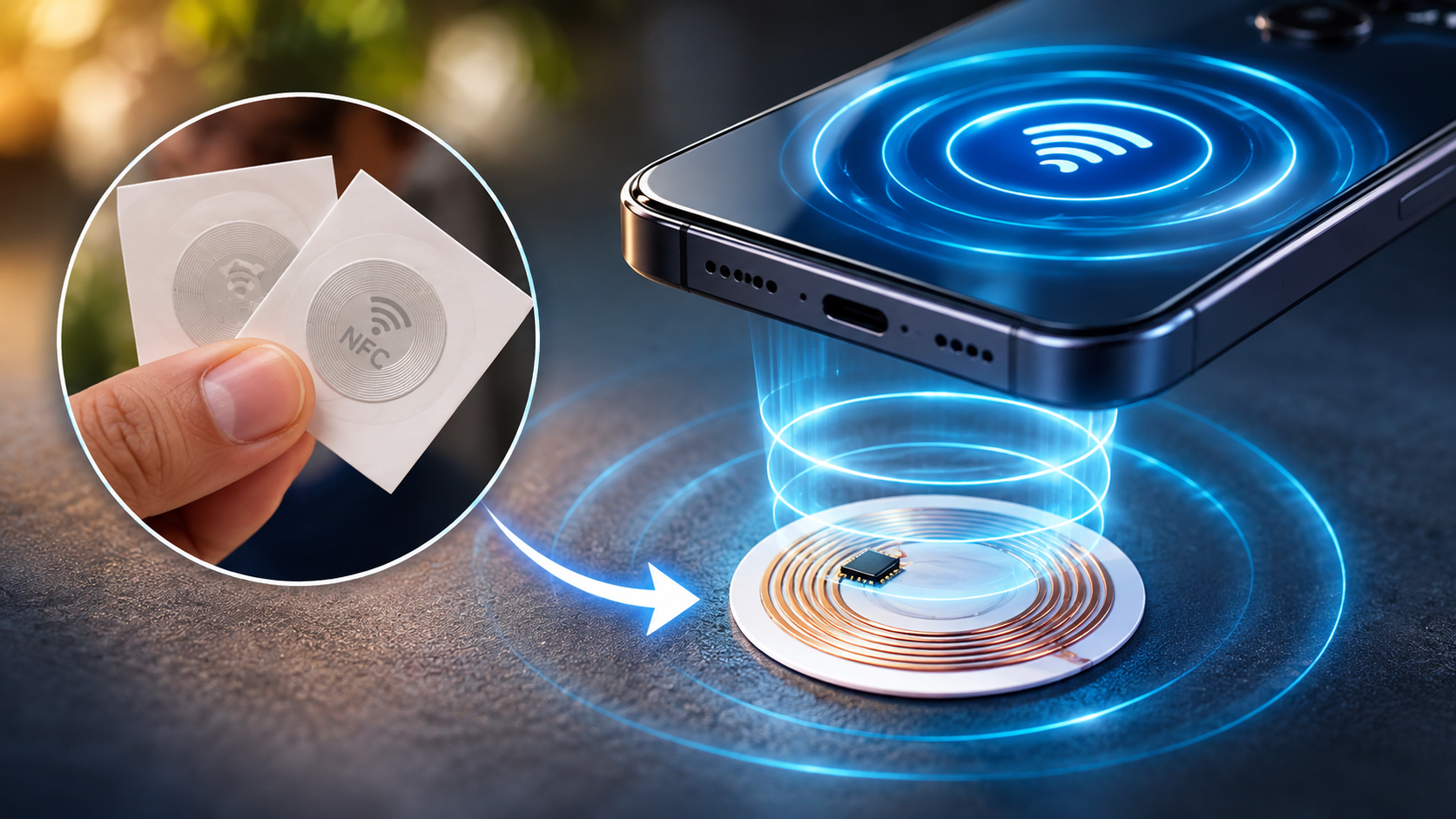
What Is an NFC Tag and How Does One Work?
Every time you tap your smartphone to pay for groceries or scan a transit card, you use contactless technology. One important part of this technology is an NFC tag. Supported by standards developed by the NFC Forum, these tiny chips have changed how we interact with everyday objects.
Despite their widespread use, many people still wonder how these small chips work without batteries. Understanding NFC technology can help you automate everyday tasks, share digital business cards, and verify product authenticity.
In this guide, we explore the most common questions about NFC technology. You will learn what NFC stands for, how an NFC tag works, and what it looks like. We will also explore its everyday applications and smartphone compatibility in India.
What Is the Main Use of NFC?
The main use of Near Field Communication (NFC) is to enable fast, short-range wireless communication. It connects two compatible devices or allows a smartphone to interact with a passive NFC tag. This technology makes everyday interactions faster and more convenient.
Most people encounter NFC through contactless payments. However, its applications extend far beyond financial transactions. Businesses use NFC for access control, public transportation, inventory management, and product authentication. These applications also connect with broader discussions about digital identity and Google Wallet, particularly how digital credentials can simplify identification
Consumers can also use programmable NFC tags to automate smartphone activities. For example, a tag beside your bed can activate silent mode or open your alarm application. Another tag can help guests connect to your Wi-Fi network.
NFC works over a very short distance, typically a few centimeters. This proximity helps control accidental connections. However, users should still follow appropriate security practices when handling payment information.
Contactless Payments and Everyday Automation
Contactless payments represent one of the most familiar applications of NFC. Instead of inserting a card or entering payment details, users simply bring their compatible smartphones near a payment terminal.
In India, NFC also supports UPI Tap & Pay through compatible Android devices and merchant terminals. Google Pay provides this feature for eligible users and supported payment methods. If you are unsure how Google’s payment services differ, explore the difference between Google Pay and Google Wallet.
Beyond payments, programmable NFC tags offer several practical applications:
- Smartphone automation: Activate silent mode, adjust settings, or launch specific applications.
- Wi-Fi sharing: Store network information so guests can connect quickly.
- Digital business cards: Share contact information through a simple smartphone tap.
- Product authentication: Provide access to product information and verification services.
- Smart access: Support compatible entry systems and identification processes.
These applications demonstrate how NFC connects physical objects with digital services. However, the available functions depend on the tag, smartphone, and supporting software.
What Does NFC Stand For and What Does It Do?
NFC stands for Near Field Communication. It is a short-range wireless communication technology based on radio-frequency identification (RFID). It allows compatible electronic devices to exchange information when brought close together.
Unlike Bluetooth or Wi-Fi, NFC usually requires very little setup. Users do not need to search for nearby devices or complete traditional pairing procedures. Instead, an NFC-enabled smartphone can communicate with a compatible tag almost instantly.
The technology operates at a standard radio frequency of 13.56 MHz. Its typical operating distance is approximately four centimeters or less. This short range makes NFC suitable for quick interactions involving small amounts of data.
Depending on the application, NFC can transfer website addresses, contact information, identification data, and payment-related information. However, the technology does not automatically make every transaction secure. Payment security also depends on authentication, encryption, and the payment system. For additional protection when accessing digital payment accounts, consider enabling two-factor authentication
How Electromagnetic Induction Powers Data Transfer
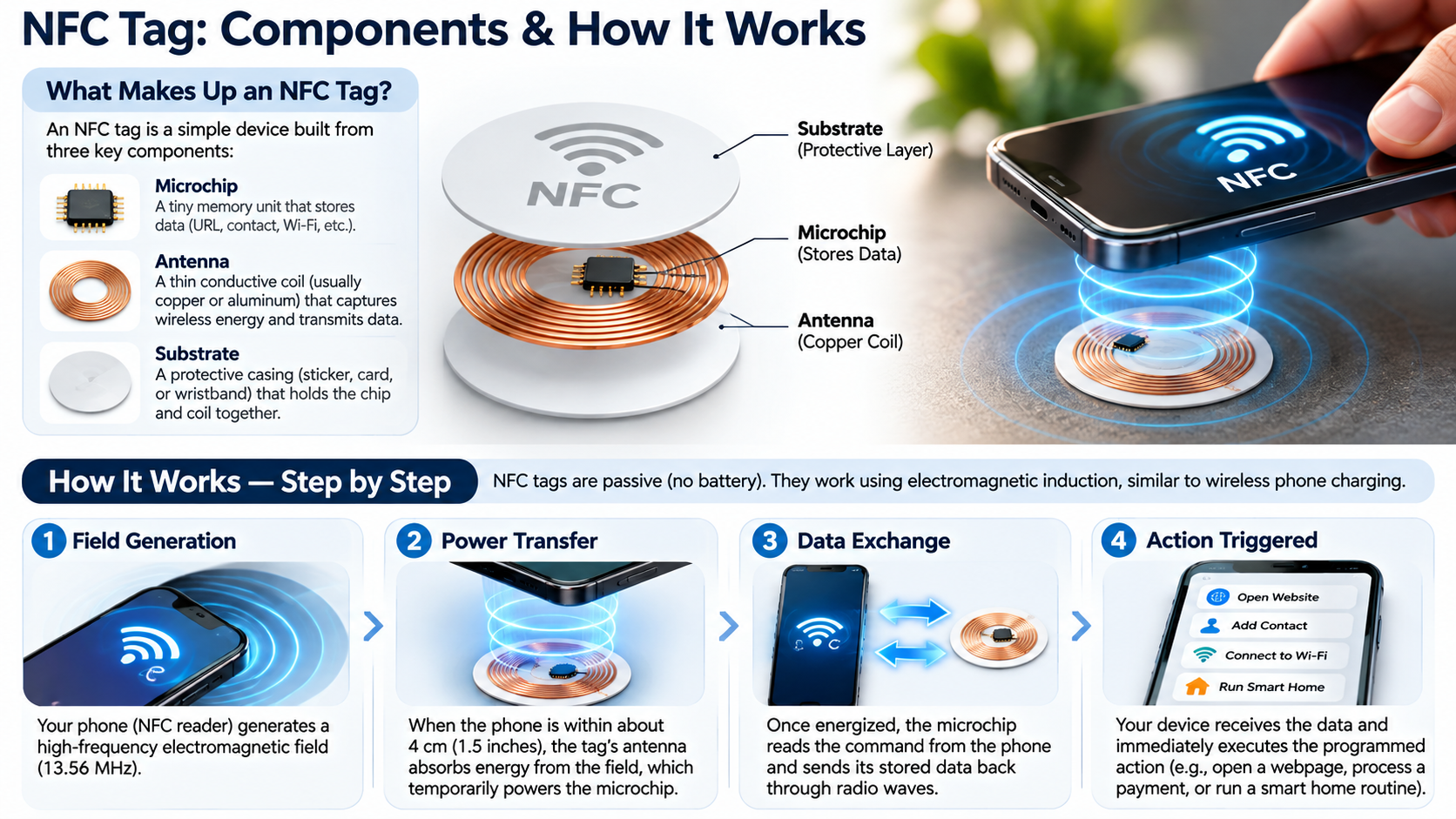
NFC uses electromagnetic induction to establish communication between compatible devices. This process allows a powered reader to activate certain passive tags without requiring an internal battery.
Here is how the process works:
- The reader generates a magnetic field: An NFC-enabled smartphone produces an electromagnetic field at 13.56 MHz.
- The tag enters the field: When a compatible passive tag approaches, its antenna captures energy from the magnetic field.
- The chip activates: The captured energy powers the tag’s microchip temporarily.
- Data gets transmitted: The tag communicates its stored information to the reader through the NFC connection.
- The smartphone processes the information: Depending on the stored data, the phone may open a website, display information, or trigger another supported action.
This process explains why most passive NFC tags do not need batteries. The reader supplies the energy required for communication.
What Is an NFC Tag?
An NFC tag is a small electronic device containing a microchip and an antenna. Manufacturers usually place these components inside paper, plastic, epoxy, or other protective materials. Most everyday NFC stickers and labels operate without batteries.
A passive NFC tag remains inactive until a compatible reader approaches. Once activated, it can transmit information stored inside its memory. This information might include a website address, contact details, or instructions for a supported smartphone application.
Some tags also support rewritable memory. This means users can update their stored information using compatible smartphones and NFC-writing applications. However, the available memory depends on the specific chip.
Popular NFC chip families include NTAG213, NTAG215, and NTAG216. Each offers different memory capacities and capabilities. Users can also permanently lock compatible tags against further writing.
These features make NFC tags useful for personal automation, advertising, product identification, and information sharing.
Passive vs. Writable Memory Capabilities
Most commercial NFC tags use passive technology. They receive power from an NFC-enabled reader rather than relying on an internal battery. Their memory stores information that compatible devices can retrieve.
Some tags support read-and-write operations. This allows users to change their stored information whenever necessary. For example, you can update a website address without purchasing another tag.
Common chip options include:
- NTAG213: Suitable for basic tasks, website links, and simple automation.
- NTAG215: Offers additional memory for more demanding applications.
- NTAG216: Provides greater memory capacity for larger data records.
The actual usable memory differs between chip models. Therefore, check the manufacturer’s specifications before purchasing.
Users can also configure certain tags as read-only. This prevents future modifications and helps protect stored information. Read-only tags are useful for public displays, product labels, and business information.
However, locking a tag may be permanent. Always verify the settings before applying this restriction.
How Does an NFC Tag Look?
An NFC tag typically looks like a small sticker, plastic coin, smart card, or keychain. Its appearance depends on its intended purpose and protective casing. Some tags are extremely thin, while others use thicker, more durable materials.
Inside a typical NFC sticker, you will find two main components. The first is a small silicon microchip that stores information. The second is a metallic antenna that enables wireless communication.
If you examine a transparent NFC sticker under bright light, you may notice a small chip surrounded by a spiral-shaped antenna. Manufacturers usually create this antenna using copper or aluminum.
Different designs serve different environments. Paper stickers work well for indoor applications, while waterproof PVC tags suit outdoor installations. Some specialized versions also include anti-metal layers. These layers help maintain NFC performance when attaching tags to metallic surfaces.
The right design depends on where and how you plan to use the tag.
Common Form Factors and Sizes
NFC manufacturers produce tags in several shapes and sizes. Each design serves a different purpose, from simple smartphone automation to industrial identification.
Common NFC tag formats include:
- Adhesive stickers: Thin labels designed for furniture, packaging, walls, and other smooth surfaces.
- Plastic coins: Compact circular tags suitable for personal automation and identification.
- Smart cards: Card-shaped tags used for access control, identification, and information sharing.
- Keychains: Portable tags that attach to keys or bags for convenient access.
- Silicone wristbands: Wearable tags commonly used for event access and identification.
- Waterproof tags: Protective designs intended for outdoor environments and demanding conditions.
Many standard adhesive tags measure approximately 25–30 mm in diameter. However, dimensions vary between manufacturers and product types.
Some tags also include protective ABS plastic casings. Others feature specialized adhesive materials or anti-metal backing. These variations help NFC tags operate reliably in different environments.
Before purchasing, consider the installation surface, required durability, and compatibility with your intended application.
Which Phones in India Have NFC?
Many flagship and upper-midrange smartphones sold in India include built-in NFC hardware. However, NFC availability depends on the specific model and regional variant. A smartphone’s international version may offer different connectivity features from its Indian counterpart.
Several manufacturers offer NFC-equipped devices across different price categories. Examples include the Samsung Galaxy A55 5G and Nothing Phone (2a). Both have documented NFC support.
Other smartphone families, including Samsung Galaxy S, Google Pixel, OnePlus, and Xiaomi, also offer NFC-equipped models. However, you should verify the exact Indian variant before purchasing.
iPhones also support NFC functionality. Apple introduced NFC tag reading support with the iPhone 7 generation. However, background tag reading is available on iPhone XS and later models. If you are interested in using an iPhone for contactless payments, read our guide to Apple Pay in India and its availability.
Remember that NFC hardware alone does not guarantee payment compatibility. Your smartphone, operating system, banking service, and payment application must also support the required feature.
Checking NFC Availability on Budget Models
Not every smartphone includes NFC hardware. Manufacturers sometimes exclude it from entry-level and budget devices to manage production costs. Therefore, never assume a phone supports NFC simply because it offers Bluetooth, Wi-Fi, or 5G connectivity.
Before purchasing a smartphone in India, follow these simple checks:
- Open Settings: Access your smartphone’s main settings menu.
- Search for NFC: Enter “NFC” in the settings search bar.
- Check connectivity options: Look for NFC under connection or wireless settings.
- Visit the manufacturer’s website: Review the official specifications for your exact model.
- Confirm regional compatibility: Check whether the Indian variant includes NFC hardware.
You can also check the manufacturer’s user manual for additional information.
For contactless payments, verify application and banking support as well. Google Pay requires an NFC-enabled Android device for its supported Tap & Pay features. Other payment services may have different compatibility requirements.
Checking these details before purchasing can prevent unnecessary confusion later.
Conclusion
NFC technology makes everyday digital interactions faster, simpler, and more convenient. From contactless payments and public transportation to smart access and smartphone automation, NFC tags connect physical objects with useful digital functions. Their small size, low cost, and battery-free operation make them practical for personal and business applications.
Understanding how an NFC tag works also helps you choose the right type for your needs. Whether you want to share Wi-Fi details, automate smartphone settings, or verify product information, a compatible NFC tag can make the process easier.
Before purchasing an NFC-enabled smartphone or tag in India, always check hardware compatibility and supported features. With the right devices and setup, you can make everyday tasks more efficient with just a simple tap.