

What Are Open Universities and How Do They Work?
An open university is a higher education institution that provides flexible learning opportunities without the strict admission requirements or daily campus attendance associated with traditional universities. According to the University Grants Commission (UGC), recognized open and distance learning institutions help expand access to higher education. They support working professionals, homemakers, and students living in remote areas.
Instead of attending daily classroom lectures, students use self-study materials, recorded lectures, digital learning platforms, and occasional contact sessions. These resources allow learners to study at their own pace while managing personal and professional responsibilities.
Understanding how an open university works is important before investing your time and money. Many prospective students wonder whether employers recognize these degrees or whether they offer the same opportunities as traditional qualifications. Choosing the wrong learning format can affect your academic progress and career plans.
In this guide, we explore the major advantages and disadvantages of open universities. You will discover whether their degrees are recognized, whether they qualify for jobs in India, and how they compare with regular universities and distance education. We also explain why institutions like The Open University in the UK can charge higher tuition fees.
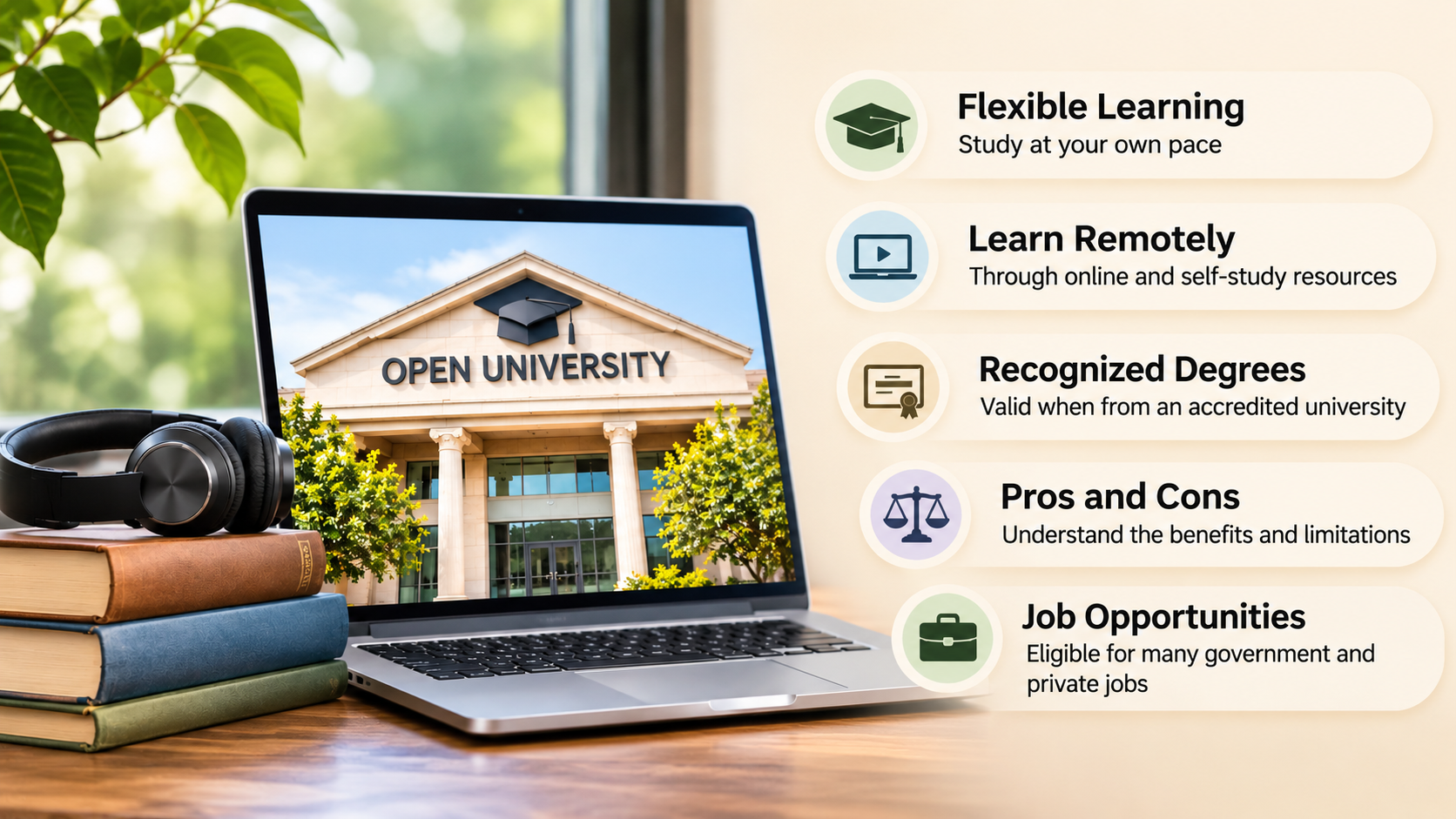
What are the disadvantages of an open university?
Although an open university offers flexibility, its learning environment comes with several limitations. The biggest disadvantage is the lack of regular face-to-face interaction with teachers and classmates. Students must manage most of their studies independently, which can become challenging without classroom discussions or daily academic guidance.
Another major concern is maintaining motivation. Without fixed lecture schedules, some learners struggle to follow study plans and complete assignments on time. Practical subjects involving laboratory experiments, workshops, or specialized equipment may also require additional in-person training.
Other common disadvantages include:
- Limited campus experience: Students have fewer opportunities to participate in campus activities and student events.
- Reduced networking: Building professional relationships with classmates and professors can require extra effort.
- Placement limitations: Some institutions offer fewer campus recruitment opportunities than established residential universities.
- Self-discipline requirements: Independent learning demands consistent time management and personal responsibility.
Additionally, some employers may prefer traditional university graduates for certain entry-level positions. However, these preferences vary by industry and employer. Researching the institution’s support services and career opportunities can help you make an informed decision.
Does open university give you a real degree?
Yes, an accredited open university awards a genuine academic degree. Its recognition depends on the institution and the specific programme’s approval status. In India, universities and programmes recognized by the University Grants Commission (UGC) and its Distance Education Bureau (DEB) can award valid qualifications through approved learning modes.
Students who successfully complete their academic requirements receive official documents. These may include degree certificates, mark sheets, and academic transcripts. Such qualifications can support applications for employment and further education, subject to applicable eligibility conditions.
Internationally, institutions such as The Open University in the UK also award recognized higher education qualifications. However, recognition rules differ between countries and education systems.
Before enrolling, check whether the university and your chosen programme have the required recognition for your admission session. You should also review these important questions to ask before taking admission to evaluate the institution, course structure, and available facilities. Do not assume that every course offered by an open university automatically carries the same recognition. Proper verification helps protect your educational investment and future career opportunities.
How to Verify Your University’s Accreditation
Before paying admission fees, verify your chosen institution’s recognition through the official education regulator. This step is particularly important when selecting an open university in India. Recognition can depend on the university, programme, learning mode, and academic session.
Follow these steps to check accreditation:
- Visit the official UGC website.
- Find the information related to recognized universities.
- Visit the UGC Distance Education Bureau portal.
- Check whether your university appears on the recognized institutions list.
- Confirm that your specific programme is approved for the relevant admission session.
Pay attention to programme-specific restrictions. Certain professional courses may have additional regulatory requirements or may not be permitted through distance learning.
Avoid relying entirely on advertisements, admission agents, or unofficial websites. An institution’s name alone does not guarantee that every programme is approved. Checking the official records before enrollment helps you avoid unrecognized qualifications and potential problems with employment or higher education applications.
Is an open university degree valid for jobs?
Yes, an open university degree can qualify you for government and private-sector jobs when the institution and programme meet the applicable recognition requirements. In India, degrees obtained through recognized open and distance learning programmes are generally treated as equivalent to corresponding conventional degrees, subject to UGC regulations and relevant eligibility conditions.
Government recruitment opportunities include civil services, banking, railways, and various state-level examinations. However, candidates must still satisfy the educational qualifications and other requirements mentioned in individual recruitment notifications.
Private employers also consider graduates from open universities. Many companies focus on practical knowledge, technical abilities, relevant experience, and interview performance rather than the learning format alone. Understanding the connection between education and career success can also help graduates make better decisions about their professional development.
However, certain technical and professional positions require specific practical training, licensing, or approved qualifications. An open degree may not automatically satisfy these conditions.
If you are planning to pursue employment after graduation, check the eligibility requirements of your target industry. Combining a recognized degree with relevant experience and professional certifications can strengthen your career prospects.
Boosting Your Employability as an Open Graduate
Graduating from an open university does not automatically guarantee employment. You must demonstrate that you have the knowledge and practical abilities required by employers. Building additional skills alongside your academic qualification can improve your competitiveness.
Start by identifying the skills commonly requested in your target industry. For example, IT graduates can learn programming languages, database management, or cloud computing. Business graduates can develop expertise in accounting software, project management, or data analysis.
Consider these practical steps:
-
Earn industry certifications: Complete relevant certifications that demonstrate your professional knowledge.
-
Build a portfolio: Include personal projects, freelance assignments, and practical work samples.
-
Gain work experience: Consider internships, part-time employment, or entry-level opportunities.
-
Improve communication: Develop clear written and verbal communication skills.
During interviews, explain how you balanced independent learning with other responsibilities. This can demonstrate discipline and accountability. Ultimately, employers need evidence of your abilities, not simply a degree certificate. A strong portfolio and relevant experience can help you stand out.
Which is better, an open university or a regular university?
Neither an open university nor a regular university is automatically better. The right choice depends on your financial situation, learning preferences, career objectives, and personal responsibilities.
A regular university is often suitable for students who want a structured academic environment. Daily lectures, classroom discussions, campus activities, and direct interaction with professors create opportunities for practical learning and networking. Students pursuing laboratory-based subjects may also benefit from access to specialized facilities.
An open university offers a different experience. It suits working professionals, homemakers, competitive examination candidates, and learners who cannot attend daily classes. Flexible schedules allow students to balance education with employment and family commitments. If you are still comparing learning formats, explore online or distance learning and which option is best for you before making your decision.
There are also differences in placement support and networking opportunities. Established residential universities may offer stronger campus recruitment networks, while open university students often need to search independently.
Consider your preferred learning environment before making a decision. If you need regular academic supervision, a conventional programme may work better. If flexibility is your priority, an open university may be more practical.
Are open university degrees respected in India?
Yes, degrees awarded by properly recognized open universities are respected across India. Their acceptance depends on the institution’s recognition, programme approval, and the requirements of the organization evaluating the qualification.
Institutions such as Indira Gandhi National Open University (IGNOU) and Dr. B.R. Ambedkar Open University have established reputations in India’s higher education system. Their recognized programmes provide opportunities for students who cannot attend conventional colleges.
UGC regulations provide for the equivalence of recognized open and distance learning qualifications with corresponding conventional degrees. This allows eligible graduates to pursue employment and further education, subject to applicable admission and recruitment rules.
However, recognition does not mean every employer evaluates all candidates identically. Some private companies may prefer graduates from particular universities, especially for competitive entry-level positions. Others place greater importance on professional experience and practical skills.
Government recruitment agencies generally follow their published eligibility criteria rather than personal preferences about learning formats. Therefore, check the relevant recruitment notification before applying. Choosing a reputable institution and an approved programme is essential for building a credible academic profile.
Why is The Open University so expensive?
The Open University (OU) in the United Kingdom can appear expensive compared with some other distance learning options. Its tuition fees reflect several factors, including academic support, course development, digital infrastructure, and the cost of delivering higher education across different locations.
Unlike basic correspondence courses, The Open University invests in professionally developed learning materials. Its courses may include interactive digital resources, specialized textbooks, recorded lectures, and online learning activities. Students also receive academic guidance through tutors and dedicated support services.
Another important factor is the UK’s higher education funding structure. Changes in government funding and tuition policies have influenced how universities finance their programmes. These costs can contribute to higher fees for students.
International students should also check the applicable fee category. Tuition costs may differ depending on residency, programme selection, and study arrangements.
Despite the higher overall cost, students can often study individual modules and spread payments across their qualifications. This approach provides financial flexibility compared with paying for an entire degree upfront. Always review the latest official fee schedule before enrolling.
Which is better, open or distance education?
Open education and distance education both provide alternatives to traditional classroom learning. However, they differ in their admission policies, academic structures, and approaches to student support.
An open university generally focuses on flexible access to higher education. Some institutions provide more flexible admission routes, allowing adult learners and students with non-traditional academic backgrounds to pursue further qualifications. Their programmes are designed around independent study and remote learning.
Distance education, on the other hand, describes a learning method rather than a separate type of university. Conventional universities may offer distance education programmes alongside their regular campus courses. These programmes can follow specific admission requirements, semester schedules, and examination arrangements.
Both learning formats use resources such as printed study materials, recorded lectures, online portals, and digital assignments. Neither necessarily requires daily classroom attendance.
However, the quality of student support depends on the individual institution. A dedicated open university may provide specialized services for remote learners, while a well-managed distance education department can offer equally effective academic assistance. Compare programme recognition, flexibility, and support before choosing.
Key Differences in Student Support Systems
Student support plays an important role in determining your experience with an open university or a distance education programme. Since remote learners spend much of their time studying independently, reliable academic and administrative assistance becomes essential.
Dedicated open universities usually design their services around students who cannot attend regular campus classes. Their support systems may include online learning portals, regional study centres, academic counselling, and examination assistance.
Distance education departments within conventional universities also provide these services. However, the quality and availability of support can vary between institutions. Some departments have well-developed digital systems, while others offer fewer resources for remote students.
Before enrolling, compare the following facilities:
- Online student portals: Check whether you can access assignments, study materials, announcements, and academic records.
- Academic guidance: Find out how easily you can contact tutors and subject specialists.
- Regional centres: Check whether physical assistance is available in your area.
- Examination flexibility: Review examination schedules, centres, and available arrangements.
- Administrative support: Confirm how the institution handles admissions, fee payments, and document requests.
Do not assume that every open university provides better support than every distance education department. Compare the actual services offered by your shortlisted institutions before making a final decision.
Conclusion
Choosing an open university gives you the freedom to earn a recognized degree without putting your career or personal responsibilities on hold. Throughout this guide, we explored how these institutions award real, legally valid degrees that hold strong value for government exams, higher education, and private sector careers. While remote learning requires high self-discipline and lacks daily campus networking, pairing your studies with practical work experience easily bridges that gap.
Whether you compare open learning against regular colleges or traditional distance wings, the best choice comes down to your schedule, budget, and learning style. Reputable institutions in India and abroad continue to prove that quality education does not require sitting in a physical classroom every day. Take time to verify your target university’s accreditation, review the curriculum, and enroll in a program that aligns with your long-term career goals.