Ways to End Class: 7 Proven Wrap-Up Strategies
The final minutes of a lesson can shape what students remember. When the bell rings without a clear ending, important ideas may get lost. Using intentional ways to end class gives students time to review concepts, check their understanding, and identify questions before leaving.
A strong lesson closure also gives teachers useful formative assessment information. A quick reflection can reveal what students understood and where confusion remains. This information can guide the next lesson and help teachers address learning gaps early. Teachers can learn more about formative assessment through EEF’s guidance on using formative assessment.
Effective closure does not need to take much time. A short exit ticket, peer discussion, confidence check, or verbal summary can provide a clear ending. The best approach depends on the subject, age group, lesson goal, and classroom needs.
This guide explores practical ways to end class, effective teaching strategies, classroom support techniques, and engaging closing activities for meetings. These approaches can help teachers create calmer transitions while giving students a meaningful opportunity to consolidate learning.
What are some effective ways to wrap up a lesson?
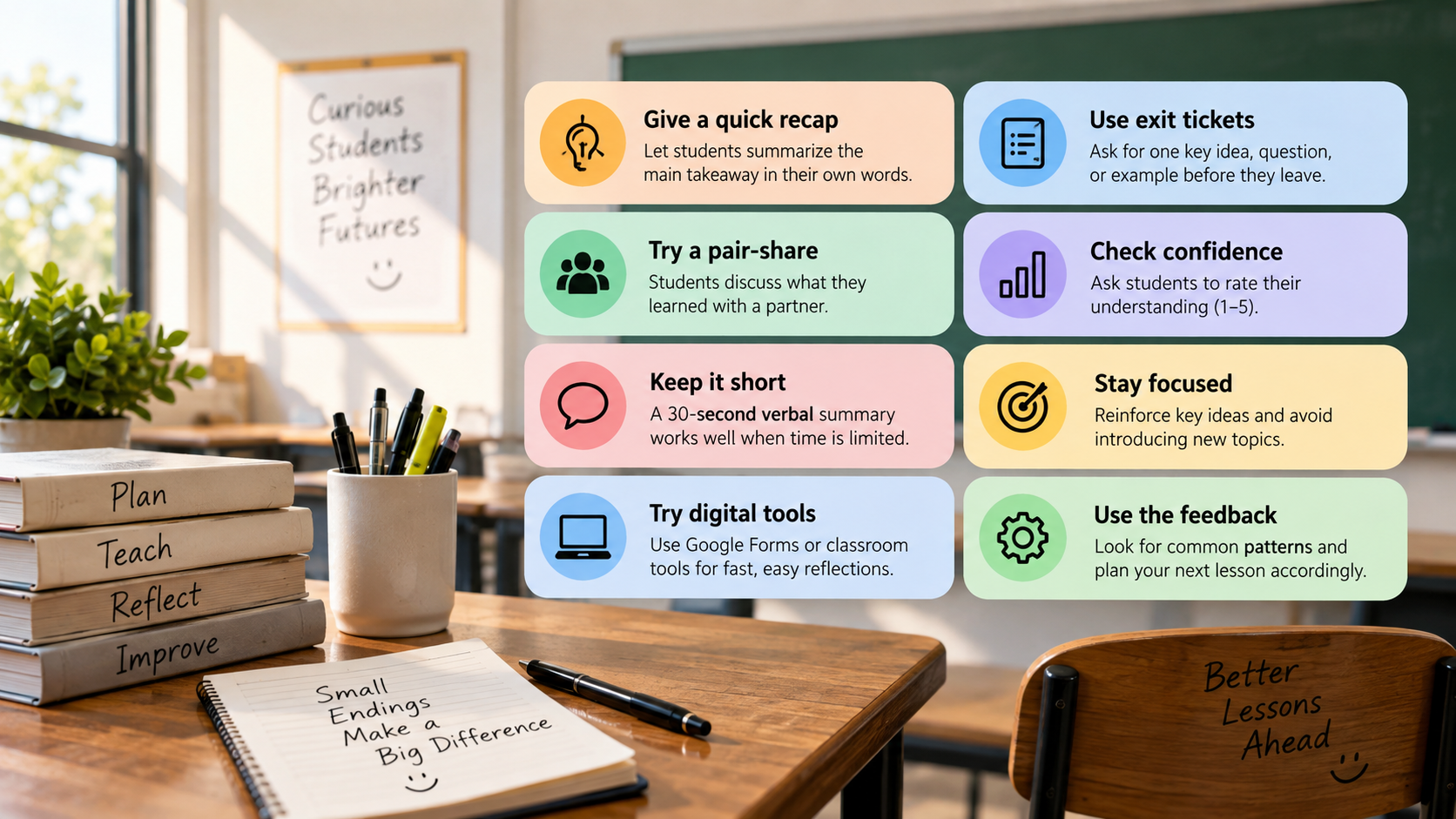
Effective lesson closure gives students a clear opportunity to review what they learned. One simple option is an exit ticket. Students can write one important idea, one question, or one example before leaving. Teachers can review these responses to identify common misunderstandings.
Pair-share discussions offer another useful approach. Students briefly explain the main lesson takeaway to a partner. This encourages them to organize information in their own words. A confidence check can also help students reflect on their understanding. For example, students can rate their confidence from one to five. Teachers can also explore student choice in learning to create more opportunities for active participation and reflection.
A short verbal summary works well when time is limited. Ask students to explain the lesson in thirty seconds. Teachers can also ask a focused question that connects the lesson to real-world situations.
The most effective ways to end class are brief, purposeful, and connected to the lesson objective. Avoid introducing new material during closure. Instead, use the final minutes to reinforce, assess, and reflect.
Implementing Digital Exit Slips Quickly
Digital exit slips can make lesson closure faster and easier to organize. Teachers can use tools such as Google Forms or classroom response platforms to collect student reflections before dismissal. Students can submit answers from computers, tablets, or other available devices.
A digital exit slip does not need to contain many questions. One or two focused prompts can provide useful information. For example, ask students to identify the most important concept they learned and explain what remains unclear.
Teachers can then review responses after class and identify patterns. If many students struggle with the same concept, the next lesson can begin with targeted review. If most students demonstrate understanding, the teacher can move forward.
Digital tools also create a searchable record of responses. This can help teachers track progress across multiple lessons. However, technology should support the learning goal rather than become the goal itself.
When devices are unavailable, paper exit tickets can provide the same basic function. The important element is the purposeful reflection, not the platform used to collect it.
What are the 10 effective teaching strategies?
Effective teaching usually combines several strategies rather than relying on one method. Common approaches include direct instruction, inquiry-based learning, differentiated instruction, and cooperative learning. Each method serves a different purpose and can be adapted to the lesson objective. These approaches can also be considered alongside personalized learning in education, particularly when adapting instruction to different learner needs.
Metacognitive modeling helps teachers demonstrate how they approach a problem. Spaced retrieval gives students repeated opportunities to recall important information. Formative assessment helps teachers identify misunderstandings during instruction rather than waiting for a final test.
Graphic organizers can make relationships between ideas easier to understand. Explicit scaffolding can also break complex tasks into manageable steps. Peer teaching gives students opportunities to explain concepts and learn through discussion.
These strategies work best when teachers select them deliberately. A science investigation may benefit from inquiry, while a new mathematical procedure may require direct modeling first. Teachers can also consider how traditional vs modern classrooms approach instruction and participation before choosing one of several ways to end class to check whether students understood the lesson.
The goal is not to use every strategy in one lesson. Instead, choose methods that match the content, learners, available time, and desired outcome.
Maximizing Structured Cooperative Learning Groups
Cooperative learning becomes more effective when students understand their responsibilities. Instead of simply placing students into groups, teachers can assign clear roles. One student might facilitate discussion, another might record ideas, and another might report the group’s conclusion.
Individual accountability also matters. Each student should have a reason to participate and demonstrate understanding. Without clear expectations, one student may complete most of the work while others remain passive.
Teachers can provide a specific task with a defined outcome. Groups might solve a problem, compare solutions, summarize a reading, or prepare a short explanation. Time limits can keep discussions focused and prevent activities from becoming unfocused.
A brief closing activity can then help students connect group work to the lesson objective. For example, each student can write one takeaway independently after the discussion.
This structure supports both collaboration and individual reflection. It also gives teachers an opportunity to observe communication, reasoning, and participation. Building an environment where students feel comfortable contributing can be strengthened through making students feel valued in modern classrooms.
When cooperative learning ends with a short assessment or reflection, students have a clearer transition from group activity to independent understanding.
What is the 70/30 rule in teaching?
The 70/30 rule in teaching is often used as a flexible guideline for balancing student participation and teacher instruction. The basic idea is that students should spend a substantial portion of class time actively participating, while teachers use less time for direct explanation and modeling.
This does not mean every lesson should follow an exact 70/30 split. Some topics require more direct instruction, especially when students are learning unfamiliar procedures. Other lessons may naturally involve more discussion, practice, investigation, or collaboration.
Student-centered activities can include solving problems, explaining ideas, asking questions, reading, writing, debating, and applying concepts. During these activities, teachers can circulate, provide feedback, and identify misconceptions. Using top STEM tools for modern classrooms can also support interactive activities when technology is appropriate for the learning objective.
Reducing unnecessary teacher talk can create more opportunities for students to demonstrate understanding. It can also make the final minutes more useful because students have more time to reflect before dismissal.
Teachers should therefore treat the 70/30 concept as a planning prompt rather than a strict formula. The appropriate balance depends on the subject, learners, lesson objective, and stage of instruction.
Reducing Teacher Talk Time Strategically
Reducing teacher talk does not mean eliminating explanations. The goal is to make teacher explanations clear, focused, and purposeful. A short explanation can introduce a concept before students apply it through practice or discussion.
Micro-lessons can help teachers communicate essential information without using most of the class period. After explaining a concept, teachers can ask students to solve a problem, discuss an example, or explain the idea in their own words.
Timers can also help maintain reasonable activity lengths. However, teachers should avoid treating time limits as more important than learning. If students need additional explanation, the lesson should adapt.
Active learning gives teachers useful opportunities to observe student thinking. Instead of spending the entire lesson explaining content, teachers can identify misconceptions while students work.
This approach also leaves more time for lesson closure. Students can complete an exit ticket, summarize a concept, or discuss a final question before leaving.
The result is a more balanced lesson structure. Teacher explanations provide direction, while student activities create opportunities to practice, apply, and demonstrate understanding.
What are the 7 classroom management strategies for students with learning disorders?
Students with learning disorders may benefit from classroom environments that provide consistency, clarity, and appropriate support. Teachers can begin with predictable routines and visual schedules. These tools make transitions easier to understand and reduce uncertainty.
Breaking complex directions into smaller steps can also make assignments more manageable. Instead of giving several instructions at once, teachers can present one step at a time and check understanding.
Specific positive feedback can reinforce productive behaviors. Quiet work areas may also help students who become distracted by classroom noise or activity. Teachers can reduce unnecessary visual clutter on boards, worksheets, and learning materials.
Multisensory resources can provide additional ways to process information. Graphic organizers, physical materials, diagrams, and written examples may support different learning needs.
Useful strategies include:
- Consistent routines for predictable transitions
- Short instructions for complex tasks
- Specific feedback that identifies successful behavior
- Low-distraction spaces when appropriate
- Visual supports such as schedules and organizers
- Flexible learning materials that provide multiple ways to engage
Support should always reflect the student’s individual needs. Teachers should work with families and relevant specialists when formal accommodations are required. Encouraging independent learning habits can also help students gradually develop greater responsibility for managing their own learning.
Fun closing activities for meetings
Meetings can benefit from a clear closing activity just as lessons can. A short one-word checkout asks each participant to describe their main feeling, takeaway, or reaction using one word. This gives everyone a chance to contribute without extending the meeting significantly. Similar participation-focused techniques can help create classrooms where students feel valued and encouraged to contribute.
An appreciation round provides another simple option. Participants can briefly recognize a colleague’s contribution or helpful action. This can reinforce collaboration without requiring a lengthy discussion.
Quick polls can help teams capture reactions to a proposal or decision. Digital voting tools can make this process fast when participants are meeting remotely. A short trivia question can also reinforce important information from the agenda.
Other useful closing activities include:
- One-sentence takeaway: Each person shares the most important point.
- Next-step check: Participants state their immediate action.
- Confidence check: Everyone rates how clear the next steps are.
- Plus-one reflection: Participants identify one useful idea and one addition.
- Final question: The facilitator answers one last important question.
The activity should match the meeting’s purpose. A decision-focused meeting may need clear next steps, while a team discussion may benefit from reflection.
The best closing routine is short, relevant, and easy for everyone to complete.
Frequently Asked Questions
How long should a classroom wrap-up take?
Most ways to end class should take about three to five minutes during a standard lesson. This gives students enough time to review key ideas, reflect on learning, and prepare for dismissal without reducing important instructional time. A timer can help teachers keep the activity focused and prevent the wrap-up from extending beyond the scheduled class period.
Can exit tickets be graded for accuracy?
Exit tickets are among the most useful ways to end class because they provide quick formative assessment. Teachers can grade them for completion or participation rather than strict accuracy, encouraging students to honestly identify confusion, questions, and misconceptions that may require additional explanation in the next lesson.
How do wrap-ups benefit classroom management?
Using consistent ways to end class gives students a predictable routine during the final minutes of a lesson. Clear closing expectations discourage early packing, reduce unnecessary movement, and help students remain focused until dismissal. These structured routines can create calmer transitions while maintaining an orderly and productive classroom environment.
What is the easiest closing activity for beginners?
Think-pair-share is one of the simplest ways to end class for teachers who are just beginning. Ask students one question connected to the lesson objective, provide brief individual thinking time, let them discuss their answer with a partner, and then invite several students to share their responses. This requires little preparation while encouraging active participation.
Conclusion
Intentional lesson closures transform standard classroom periods into memorable learning opportunities. Leaving dismissals up to chance invites disorder, weakens conceptual retention, and robs educators of invaluable diagnostic feedback. Adopting structured ways to end class helps students consolidate new ideas, celebrate small daily achievements, and develop authentic pride in their academic growth.
From rapid exit tickets and cooperative learning formats to sensory-friendly supports and dynamic meeting rituals, purposeful wrap-ups elevate engagement across all settings. When you allocate just five minutes at the end of class for deliberate reflection, you validate your students’ effort and lock in key insights. Start small by introducing one reliable wrap-up routine tomorrow, observe how your learners respond, and watch your daily classroom retention soar.