
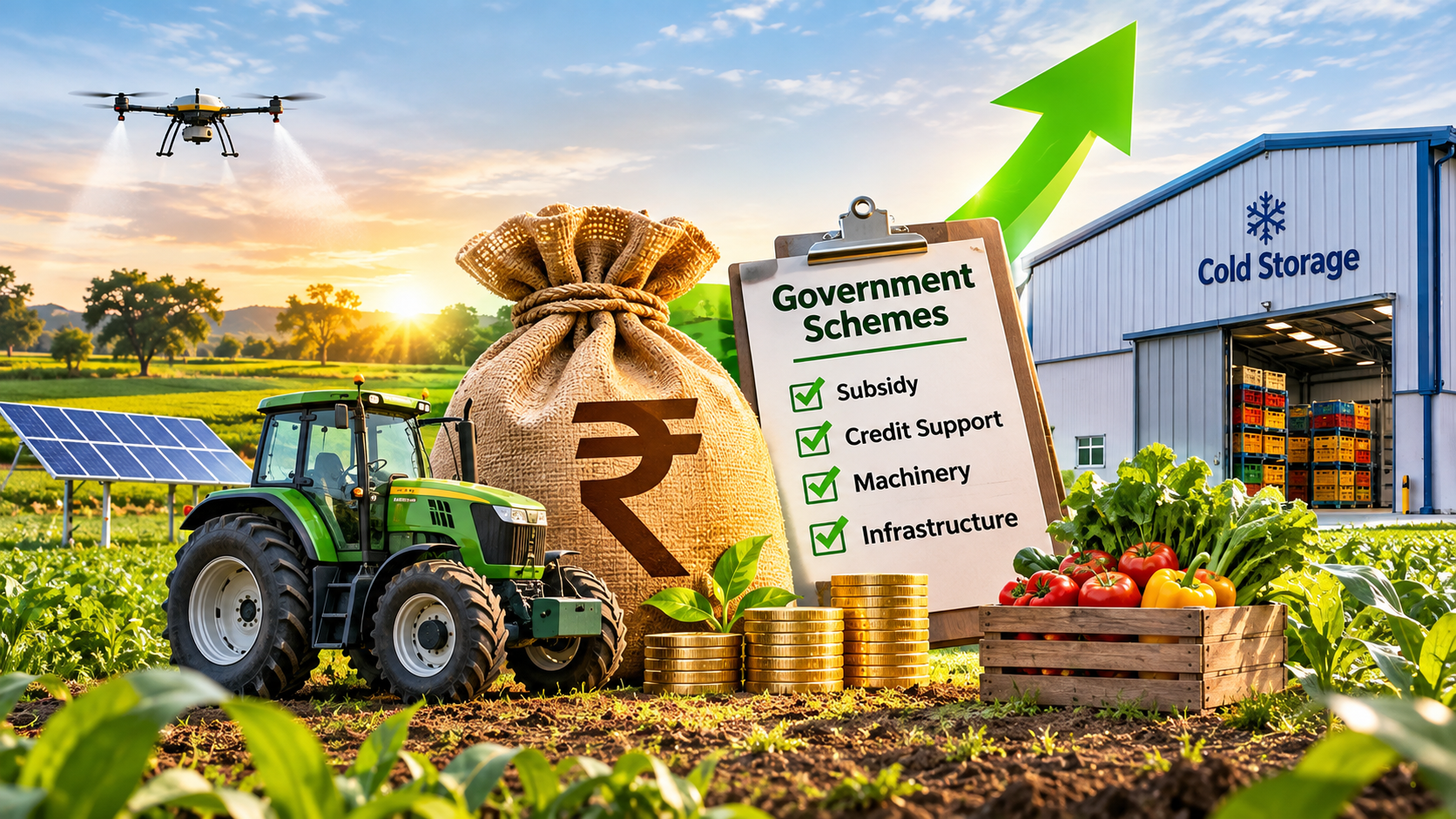
Top Government Subsidies and Financial Schemes for Agribusinesses
Building a profitable agricultural business requires more than fertile soil and favorable weather. It also demands capital, modern machinery, and reliable post-harvest infrastructure. Fortunately, Agribusiness Government Subsidies can help farmers and entrepreneurs reduce these investment costs. These financial programs support agricultural modernization, infrastructure development, and business expansion. You can explore available initiatives through the Ministry of Agriculture & Farmers Welfare portal.
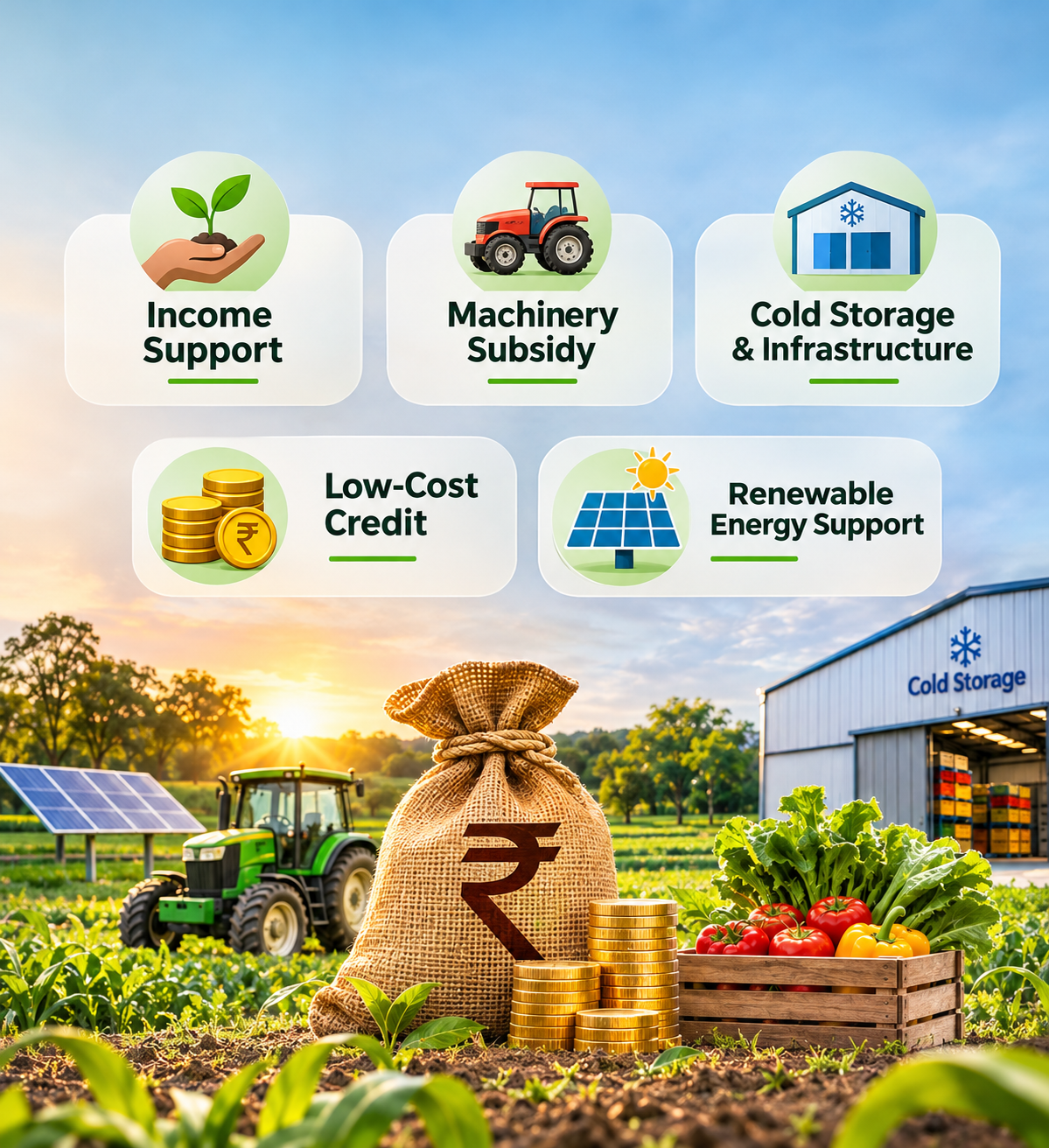
Rising input costs and unpredictable weather make financial assistance increasingly important. Government support can protect working capital while encouraging long-term business growth. Available benefits include direct income support, affordable agricultural credit, machinery subsidies, and assistance for cold storage facilities. Farmers and entrepreneurs can also explore agricultural financing and development opportunities through NABARD.
This guide explores the leading Agribusiness Government Subsidies and financial schemes available in India. You will discover major farmer welfare programs, commercial funding opportunities, equipment subsidies, and agricultural developments for 2026. We also examine high-value farming opportunities and their potential financial returns. Whether you operate a small family farm or manage an agricultural startup, understanding these initiatives can help you make better investment decisions.
What are the top 10 schemes for farmers?
India offers several government schemes that support farmers through income assistance, insurance, infrastructure, and market access. These programs address different agricultural challenges. Some provide direct financial benefits, while others reduce production costs and improve farming facilities. Understanding these initiatives is essential when exploring Agribusiness Government Subsidies for different farming requirements. Farmers planning long-term financial goals can also explore common saving mistakes to avoid for financial freedom.
The following ten schemes are particularly important:
- PM-KISAN: Provides eligible farmer families with ₹6,000 annually through direct benefit transfers.
- Pradhan Mantri Fasal Bima Yojana: Offers insurance protection against specified crop losses.
- Kisan Credit Card: Provides access to short-term agricultural credit.
- Agriculture Infrastructure Fund: Supports investments in warehouses, cold storage, and other agricultural infrastructure.
- Pradhan Mantri Krishi Sinchayee Yojana: Promotes irrigation facilities and efficient water management.
- Paramparagat Krishi Vikas Yojana: Encourages organic farming practices.
- National Mission for Sustainable Agriculture: Promotes climate-resilient and sustainable agricultural practices.
- e-NAM: Connects agricultural markets through a digital trading platform.
- Sub-Mission on Agricultural Mechanization: Helps eligible beneficiaries purchase agricultural machinery.
- PM-KUSUM: Supports solar-powered agricultural pumps and renewable energy installations.
Each scheme has different eligibility conditions and application procedures. Farmers should check the latest guidelines before applying.
What government subsidies are available for agriculture businesses in India?
Several Agribusiness Government Subsidies support commercial ventures through funding for infrastructure, food processing, horticulture, and agricultural logistics. These initiatives help entrepreneurs reduce investment costs and improve operational capacity. They also encourage private investment in agricultural value chains. Entrepreneurs should also explore the best places to keep their savings safely when planning their business finances.
The National Horticulture Board (NHB) offers credit-linked, back-ended capital subsidies for eligible horticulture and cold-storage projects. For specified cold-storage projects, assistance can reach 35% in general areas and 50% in eligible northeastern, hilly, and scheduled areas. Project capacity and technical conditions determine eligibility.
The Agriculture Infrastructure Fund (AIF) provides a 3% annual interest subvention on eligible loans up to ₹2 crore. This benefit is available for a maximum of seven years.
Food processing entrepreneurs can also explore the PM Formalisation of Micro Food Processing Enterprises (PMFME) scheme. Its individual-unit component provides a 35% credit-linked capital subsidy, subject to a maximum of ₹10 lakh.
These programs support different business activities. Applicants should compare project eligibility, financing requirements, and application windows before investing.
What is the 80% subsidy on agriculture equipment in India?
An 80% agricultural machinery subsidy is not automatically available to every farmer. It applies to specific beneficiary categories, machinery projects, and government assistance programs. The Sub-Mission on Agricultural Mechanization (SMAM) supports equipment purchases and community-based machinery facilities.
Individual farmers generally receive assistance according to prescribed machinery rates and beneficiary categories. The applicable percentage varies by equipment, state, and applicant eligibility. Some special programs offer higher assistance for eligible farmer groups and community projects.
Custom Hiring Centres (CHCs) and Farm Machinery Banks help small farmers access expensive agricultural equipment. Instead of purchasing machinery, farmers can rent equipment whenever required. This arrangement reduces individual investment costs and improves access to modern technology. Entrepreneurs considering equipment investments should also understand FD vs mutual fund returns and their wealth-building potential before allocating their savings.
Machinery assistance is an important component of Agribusiness Government Subsidies, particularly for farmers and organizations investing in modern equipment.
State governments may also provide additional assistance through crop residue management initiatives. These programs can have separate subsidy structures and application conditions. Therefore, applicants should verify the applicable percentage through their state agriculture department. The official Agricultural Mechanization Portal provides scheme information and application facilities.
Establishing Rural Custom Hiring Centres
Custom Hiring Centres help address the machinery shortage faced by small and marginal farmers. These facilities allow agricultural equipment to be shared among multiple farmers. They also create business opportunities for cooperatives, Farmer Producer Organisations (FPOs), and eligible rural entrepreneurs.
Under applicable agricultural mechanization programs, eligible organizations can receive financial assistance for establishing these centres. The exact subsidy depends on scheme guidelines, project categories, and beneficiary classifications. Applicants should confirm the latest requirements before preparing their investment plans.
A typical Custom Hiring Centre may provide:
- Combine harvesters and tractor-mounted implements.
- Seed drills and zero-tillage machines.
- Rotavators and power tillers.
- Sprayers and other crop management equipment.
- Laser land levelers and specialized machinery.
Farmers pay rental charges instead of purchasing expensive equipment. This arrangement reduces their initial investment and improves access to modern farming technology.
For operators, rental income can support maintenance and operating expenses. However, profitability depends on local demand, machinery utilization, pricing, and maintenance costs.
What are the new schemes for farmers in 2026?
Agricultural development in 2026 focuses on productivity, digital infrastructure, irrigation, and climate resilience. Several national initiatives support these priorities through existing programs and newly implemented frameworks. These developments create opportunities for businesses exploring Agribusiness Government Subsidies to adopt digital tools and sustainable farming technologies.
The Digital Agriculture Mission, approved in 2024, promotes digital farmer registries, crop-sown registries, and technology-driven agricultural services. It also supports better access to agricultural information and decision-making tools.
Another important initiative is the Prime Minister Dhan-Dhaanya Krishi Yojana (PM-DDKY). Launched in October 2025, it covers 100 selected agricultural districts. Its six-year implementation period began in 2025–26. The initiative focuses on productivity, crop diversification, irrigation, storage infrastructure, and agricultural credit.
Agricultural mechanization programs also provide assistance for eligible machinery purchases. Farmers can explore available application opportunities through the official agricultural mechanization portal.
These initiatives do not guarantee automatic financial assistance. Benefits depend on district coverage, approved activities, eligibility, and available funding. Applicants should check current government notifications before making investment decisions.
What is the Modi Yojana for farmers?
The term “Modi Yojana” does not refer to one specific agricultural subsidy. It commonly describes various farmer welfare and agricultural development schemes introduced under Prime Minister Narendra Modi’s government. These initiatives address income security, irrigation, insurance, and agricultural modernization.
One prominent program is PM-KISAN, which provides eligible farmer families with ₹6,000 annually. The amount is transferred directly into beneficiaries’ bank accounts through three equal instalments.
Other important initiatives include PM-KUSUM, Pradhan Mantri Fasal Bima Yojana, and PM Dhan-Dhaanya Krishi Yojana. Each program addresses a different agricultural requirement.
For example, PM-KUSUM supports solar-powered irrigation and renewable energy projects. Crop insurance helps eligible farmers manage financial losses caused by specified agricultural risks. PM-DDKY focuses on improving agricultural productivity and infrastructure in selected districts.
These programs strengthen agricultural livelihoods through financial assistance, improved infrastructure, and modern farming practices. They also form an important part of India’s broader Agribusiness Government Subsidies framework. However, eligibility varies across schemes. Farmers should check official guidelines and application requirements before submitting applications.
Empowering Rural Water Security via PM-KUSUM
The PM-KUSUM scheme promotes solar energy adoption across India’s agricultural sector. It helps eligible farmers reduce their dependence on conventional electricity and diesel-powered irrigation systems. The initiative also encourages renewable energy production across rural agricultural areas. Farmers interested in expanding renewable energy infrastructure can also explore this residential solar panel installation guide.
The program includes support for standalone solar agricultural pumps and solarisation of existing grid-connected pumps. Eligible beneficiaries can receive financial assistance according to the applicable component and state implementation guidelines.
Solar irrigation offers several potential benefits:
- Reduces dependence on diesel-powered irrigation.
- Helps lower electricity expenses.
- Provides access to renewable energy.
- Supports more reliable daytime irrigation.
- Creates opportunities to sell surplus electricity under applicable arrangements.
Farmers may also generate additional income by supplying surplus solar power to distribution companies. However, this depends on grid connectivity, state policies, and the relevant scheme component.
PM-KUSUM can support long-term agricultural energy savings. It also demonstrates how Agribusiness Government Subsidies can encourage renewable energy adoption. Applicants should check their state’s implementation status, subsidy structure, and approved equipment requirements before purchasing solar pumps.
Which farming gives more money?
High-value agriculture can generate better returns than traditional cereal cultivation. However, higher revenue does not automatically mean higher profit. Initial investment, production expenses, market demand, and crop losses all influence profitability. Entrepreneurs should evaluate these factors before choosing a commercial farming model.
Several agricultural businesses offer opportunities for higher earnings:
- Polyhouse farming: Supports controlled cultivation of capsicum, cherry tomatoes, cucumbers, and other high-value vegetables.
- High-density fruit cultivation: Provides opportunities through crops such as pomegranates and dragon fruit.
- Medicinal plant cultivation: Creates opportunities to supply herbal product manufacturers and specialized markets.
- Mushroom farming: Requires comparatively limited growing space and can support small-scale commercial production.
- Organic farming: Can attract premium buyers when certification and market access are available.
Drip irrigation and protected cultivation can improve water efficiency and production management. Government horticulture programs may also reduce eligible infrastructure investment costs.
Combining suitable farming methods with Agribusiness Government Subsidies can help entrepreneurs manage initial investments. However, there is no universally most profitable crop. Before selecting a farming business, assess local soil conditions, climate, buyer demand, transportation, and production costs. Prepare a detailed project report and calculate the expected return on investment before committing capital.
Frequently Asked Questions
How can a new entrepreneur apply for agribusiness subsidies?
Entrepreneurs can apply through dedicated national web portals like the Agri-Infra Fund or the National Horticulture Board platform. The process requires registering your entity, preparing a Detailed Project Report, and submitting land records alongside KYC documentation. Your partner bank reviews the commercial viability before authorities disburse credit-linked subsidies directly to your project account.
Are Farmer Producer Organisations eligible for higher subsidy rates?
Yes, Farmer Producer Organisations routinely qualify for preferential subsidy tiers across central and state programs. Because FPOs consolidate purchasing power for multiple smallholders, schemes like the Sub-Mission on Agricultural Mechanization and food processing grants allocate up to 75% to 80% assistance, compared to lower limits for solo entrepreneurs.
What documents are required to access central agricultural subsidies?
Applicants must provide verified identity proofs, land ownership papers or registered lease agreements, bank account details, and Aadhaar-linked records. For larger infrastructure grants, authorities also mandate a certified Detailed Project Report, environmental clearance where applicable, quotations for machinery from authorized manufacturers, and a formal bank sanction letter.
Can I combine multiple government agricultural schemes for one venture?
You can leverage complementary programs across different components of an agribusiness, provided you avoid claiming dual subsidies for the exact same physical asset. For example, a promoter may use the Agriculture Infrastructure Fund for interest subvention on cold storage while utilizing separate mission grants for field-level drip irrigation.
Conclusion
Navigating agricultural operations requires disciplined financial planning, modern operational equipment, and strong risk management. Utilizing available Government Subsidies and Financial Schemes for Agribusinesses helps producers reduce baseline capital expenditures, modernize sorting infrastructure, and expand commercial capacity. From smallholder safety nets like PM-KISAN to advanced capital grants under the National Horticulture Board, public frameworks actively support every phase of the farming journey.
Adopting these programs allows you to adopt advanced precision farming machinery, construct climate-resilient polyhouses, and transition toward high-yield horticultural crops with minimal financial strain. Review the updated eligibility guidelines, prepare comprehensive project reports, and engage with local agricultural extension offices or partner banking institutions. Taking advantage of these supportive public policies ensures long-term commercial competitiveness and operational security for your agribusiness.