
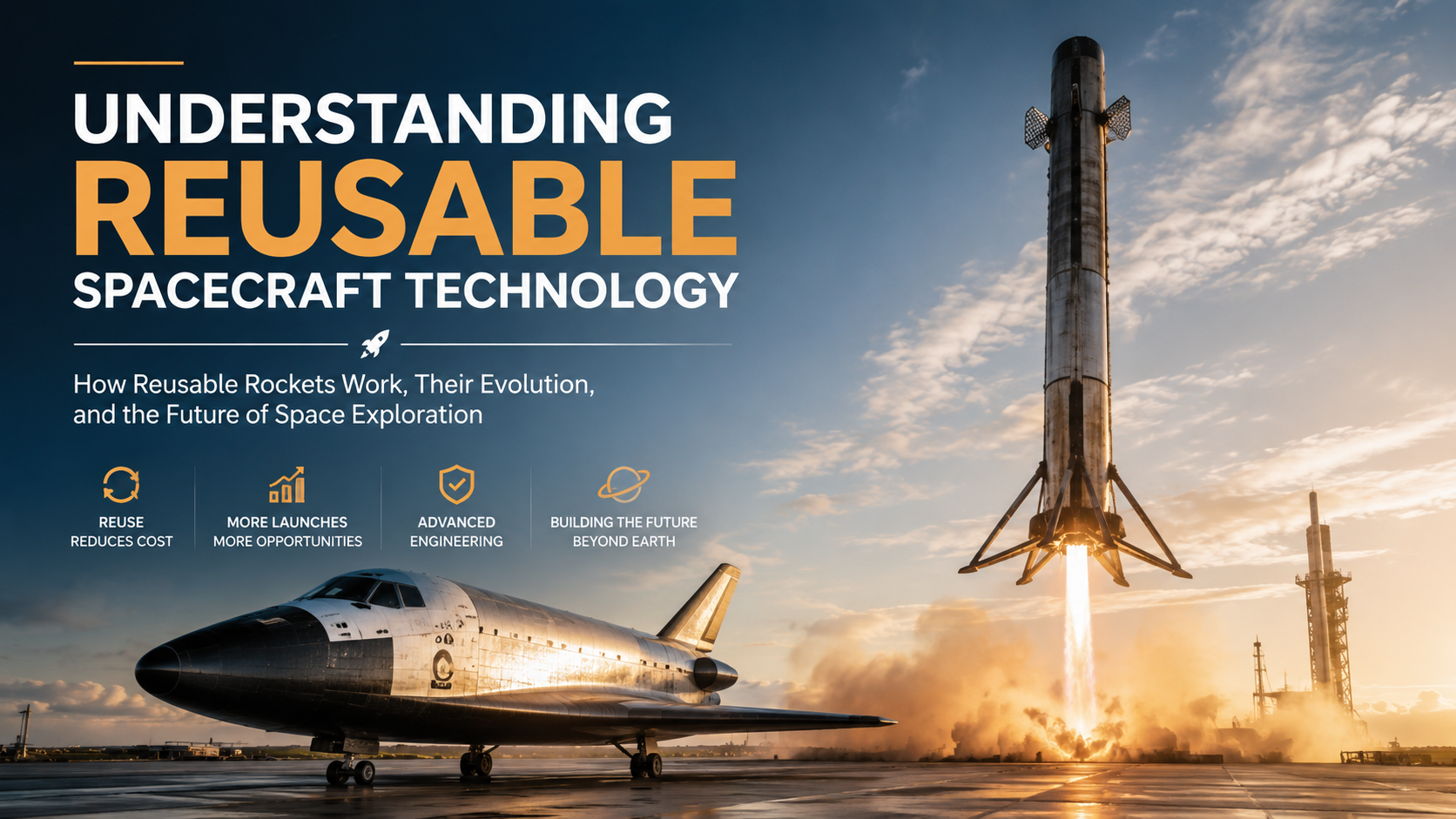
Understanding Reusable Spacecraft Technology and Its Future Impact
Reusable spacecraft technology has changed how the space industry approaches orbital transportation. For decades, space agencies treated rockets and spacecraft as mostly single-use systems. After completing a mission, expensive hardware was discarded, even when many components remained technically valuable. This model made every launch costly and limited how frequently missions could be conducted.
Modern aerospace engineering has introduced vehicles that can return, undergo inspection and refurbishment, and fly again. Reusable systems can preserve expensive engines, avionics, structures, and other critical hardware across multiple missions. This approach can reduce hardware costs and support more frequent launches.
Reusable spacecraft also support growing demand for satellite deployment, scientific research, commercial spaceflight, and human exploration. Companies and space agencies now continue testing different recovery methods and reusable vehicle designs.
This guide explains what reusable spacecraft are, how reusable rocket technology works, and how the concept evolved. It also examines NASA, ISRO, Space Shuttle history, and SpaceX’s role in advancing reusable launch systems.
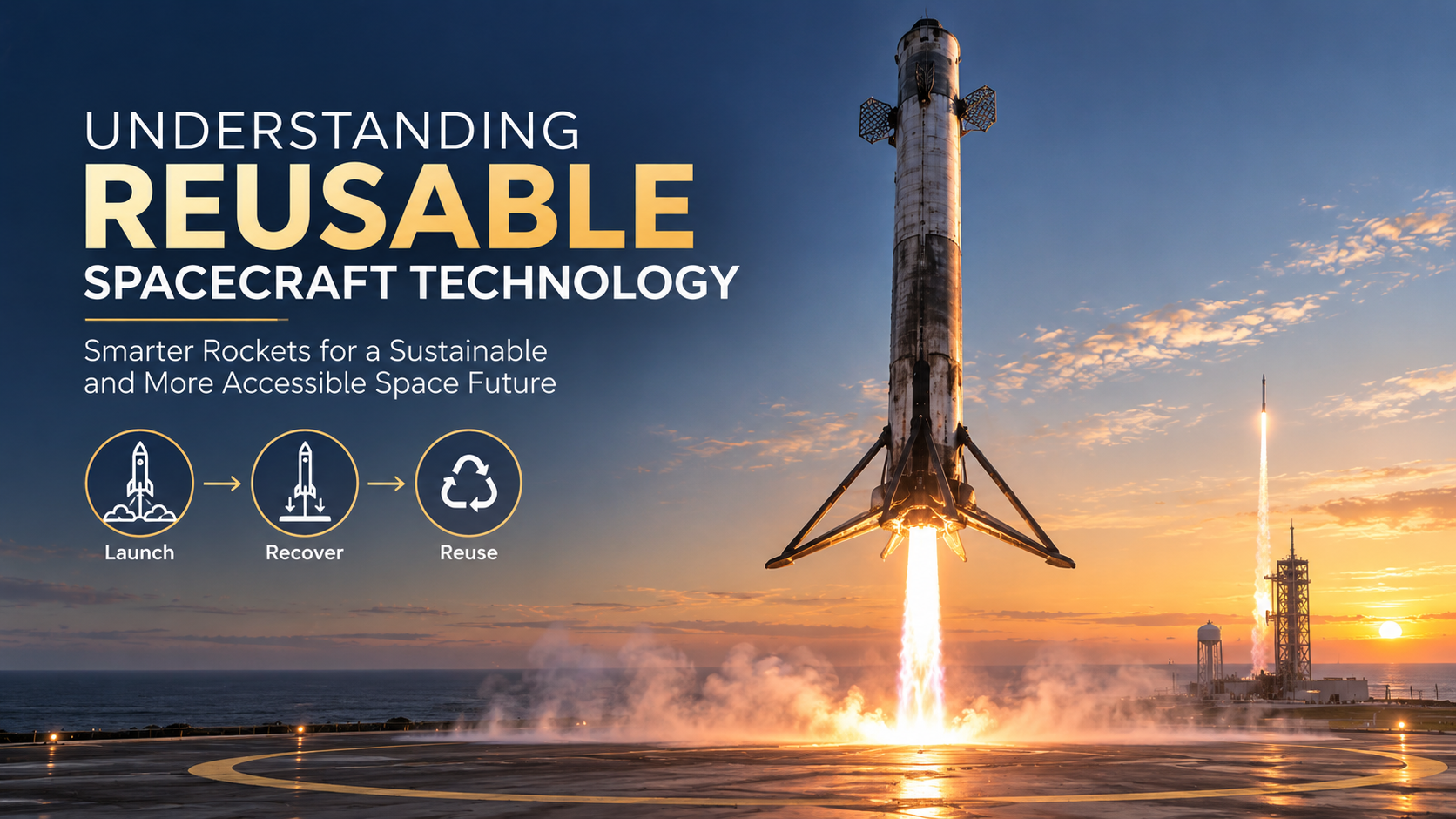
What are reusable spacecraft?
Reusable spacecraft are orbital vehicles designed to return safely after completing a mission and fly again after inspection and refurbishment. Unlike traditional expendable vehicles, reusable spacecraft preserve major hardware instead of discarding it after one flight.
Depending on the design, recovery can involve winged atmospheric flight, parachutes, vertical propulsive landing, or other controlled descent methods. Each approach requires specialized systems that protect the vehicle during re-entry and landing.
During atmospheric re-entry, spacecraft experience extreme heat and aerodynamic forces. Engineers therefore use thermal protection systems, reinforced structures, guidance computers, and carefully designed flight-control systems. These technologies help protect critical components during the return journey.
Reusable spacecraft can reduce the amount of hardware that must be manufactured for every mission. However, reusability does not automatically make launches inexpensive. Vehicles still require inspections, maintenance, testing, and refurbishment between flights.
The main advantage comes from repeatedly using high-value hardware. This can improve launch frequency and potentially reduce long-term operating costs.
Defining Key Structural Components
Modern reusable spacecraft depend on several specialized components that support controlled recovery. Thermal protection systems protect the vehicle from intense heating during atmospheric re-entry. Winged vehicles may use heat-resistant tiles or other protective materials across exposed surfaces.
Reusable launch vehicles can also use grid fins to control aerodynamic movement during descent. These surfaces help guide a returning booster toward its landing location. Landing legs provide structural support during touchdown, while engines can control the final descent.
Avionics and flight computers are equally important. They process information from sensors and guide the vehicle through complex recovery maneuvers. Navigation systems continuously calculate position, speed, altitude, and trajectory.
Engineers must design these components for repeated exposure to vibration, heat, pressure, and mechanical loads. They also need reliable inspection procedures after each flight.
The goal is not simply to make a spacecraft survive one return. The system must support safe, repeatable operations across multiple missions.
What is reusable rocket technology?
Reusable rocket technology refers to the engineering systems that allow parts of a launch vehicle to return and fly again. The technology is most commonly associated with reusable first-stage boosters, although future systems may reuse additional stages and spacecraft components.
During launch, a rocket’s first stage provides much of the initial thrust needed to overcome Earth’s gravity and atmosphere. After stage separation, a recoverable booster can perform a series of controlled maneuvers.
A typical recovery sequence may include a flip maneuver, atmospheric guidance, engine burns, and a final landing burn. Flight computers coordinate these actions while processing sensor and navigation data.
The booster must also account for weather, wind, fuel reserves, landing location, and vehicle performance. Small errors can become dangerous during high-speed descent.
Reusable rocket technology required major advances in propulsion, software, materials, navigation, and autonomous flight control. Modern systems demonstrate that orbital-class boosters can return from space and land under controlled conditions. For students interested in these technical fields, high-paying courses after 12th science can provide relevant educational pathways.
This technology has helped make rocket recovery a practical part of commercial launch operations.
Propulsive Landing and Aerodynamic Control
Successful booster recovery requires precise control throughout the descent. After stage separation, the returning vehicle must adjust its trajectory and manage its speed before reaching the landing area.
Aerodynamic grid fins can help steer the booster as it travels through the atmosphere. They allow the vehicle to make controlled trajectory adjustments while descending toward its target. Their design illustrates how engineers use creative thinking through carefully designed constraints to solve complex flight-control problems.
The vehicle may then perform one or more engine burns to control its speed and position. During the final landing phase, a carefully timed retro-propulsive burn reduces the vehicle’s downward velocity.
The landing sequence requires accurate information about altitude, velocity, orientation, and position. Onboard computers process sensor data and continuously adjust the vehicle’s trajectory.
Fuel management is also critical. The booster must reserve enough propellant for recovery without reducing the launch mission’s required performance.
These systems work together to make autonomous landing possible. The result is a recovery process that can return valuable rocket hardware for inspection, refurbishment, and another launch.
What is the first reusable spacecraft?
The Space Shuttle is widely recognized as the first operational partially reusable spacecraft system to regularly carry people and cargo into orbit. NASA launched Columbia, the first Shuttle orbiter, on April 12, 1981, beginning the Shuttle era.
The system combined a reusable winged orbiter with two reusable solid rocket boosters. Its large external fuel tank was expendable and was discarded during each mission. Therefore, the Space Shuttle was partially reusable, rather than completely reusable.
The orbiter returned to Earth by gliding through the atmosphere and landing on a runway. It could then undergo extensive inspection and refurbishment before another mission.
The Shuttle demonstrated that a spacecraft could survive atmospheric re-entry and return for another flight. However, its complex thermal protection system, engines, and other components required significant maintenance.
The program achieved important scientific and engineering milestones. It deployed satellites, supported space station construction, and carried the Hubble Space Telescope into orbit, contributing to top scientific discoveries of the decade and advances in space-based research.
Its experience also revealed the difficulty of achieving rapid and inexpensive spacecraft reuse.
The Legacy of the Space Shuttle Orbiter
The Space Shuttle orbiter remains one of the most recognizable reusable spacecraft in spaceflight history. Its winged design allowed it to return from orbit and land horizontally on a conventional runway.
During its operational career, Shuttle orbiters supported numerous scientific, engineering, and construction missions. They carried astronauts and cargo into orbit and helped assemble major portions of the International Space Station.
One of the program’s most significant achievements involved the Hubble Space Telescope. Shuttle missions deployed Hubble and later enabled astronauts to service and upgrade the observatory.
The orbiter also demonstrated the practical challenges of spacecraft reusability. Its thermal protection tiles required careful inspection, while its main engines demanded substantial maintenance.
These challenges showed that reusable hardware still carries operational costs. Reuse reduces the need to manufacture completely new vehicles, but it does not eliminate refurbishment.
The Shuttle therefore provided valuable lessons about re-entry, thermal protection, human-rated spacecraft, maintenance, and reusable flight operations. Those lessons continue to influence space industry careers for non-astronauts, particularly in engineering, research, maintenance, and mission operations.
What reusable spacecraft does ISRO have?
The Indian Space Research Organisation (ISRO) is developing reusable launch vehicle technologies through its Reusable Launch Vehicle Technology Demonstrator (RLV-TD) program. The RLV-TD is an experimental vehicle designed to test technologies needed for future reusable launch systems.
Its winged configuration allows engineers to study high-speed atmospheric flight, autonomous navigation, and runway landing. The program has included experimental flights and landing demonstrations that help validate these technologies under realistic conditions.
ISRO’s reusable launch vehicle work focuses on reducing the long-term cost of accessing space. Reusing major vehicle components could reduce manufacturing requirements and support more frequent missions.
However, the RLV-TD itself should not be described as a fully operational reusable spacecraft. It is primarily a technology demonstrator and experimental platform.
The technologies tested through the program could contribute to future reusable launch vehicles. These systems may eventually support satellite launches and other space missions.
ISRO’s work also reflects India’s broader effort to develop advanced, indigenous launch capabilities. Reusable technology remains a long-term engineering objective rather than a fully operational Indian orbital transportation system today.
Advancing Autonomous Landing Capabilities
Autonomous landing is one of the most important technologies being studied through ISRO’s reusable launch vehicle program. A reusable vehicle must navigate and land accurately without relying on continuous manual control from the ground.
During a landing test, onboard computers process information from multiple sensors. These systems help determine the vehicle’s position, altitude, velocity, and orientation.
The flight-control system then makes adjustments to keep the vehicle aligned with its planned trajectory. Accurate navigation becomes especially important during the final approach to the runway.
ISRO’s RLV-TD experiments help engineers validate these capabilities in real flight conditions. Testing provides information that computer simulations alone cannot fully reproduce.
The technology can also improve understanding of hypersonic flight and autonomous flight control. These areas are essential for future reusable vehicles that must survive high-speed atmospheric operations.
Autonomous landing is therefore more than a recovery feature. It is a core capability required for repeatable reusable flight.
Successful testing can help engineers refine guidance algorithms, navigation systems, sensors, and control strategies before applying them to larger future vehicles.
Why does NASA not use reusable rockets?
The statement that NASA does not use reusable rockets is misleading. NASA does use reusable launch systems through commercial partners, including SpaceX, for certain cargo and crew missions. The confusion mainly comes from NASA’s own Space Launch System, or SLS.
SLS was designed as a heavy-lift rocket for deep-space exploration under the Artemis program. Its architecture is expendable, meaning major launch hardware is not recovered for another flight.
NASA’s choice reflects mission requirements, existing program architecture, development history, and payload objectives. Recovering a booster requires additional systems, fuel reserves, structural hardware, guidance technology, and recovery operations.
For some missions, those requirements can reduce available payload performance. NASA’s government-led programs also operate under different procurement and infrastructure constraints than commercial launch providers.
This does not mean reusable technology is unsuitable for NASA. Instead, NASA increasingly relies on a mixed launch strategy.
Commercial rockets can provide reusable transportation for missions where recovery makes economic sense. NASA can then use other architectures when their specific mission requirements demand different performance characteristics.
Balancing Risk, Cost, and Payload Mass
Reusability involves trade-offs rather than automatic savings. A rocket designed for recovery needs additional hardware and propellant margins. Those requirements can affect the vehicle’s overall performance.
Landing legs, control surfaces, recovery systems, and reserved fuel all contribute to the vehicle’s mass or reduce the propellant available for the primary mission. This can lower the payload that reaches a specific destination.
For missions targeting low Earth orbit, the trade-off can be attractive because recovered hardware can support repeated launches. The economics become more complicated for missions traveling beyond Earth orbit.
Deep-space missions also have different requirements. A vehicle sending a payload toward the Moon may prioritize maximum payload performance over recovering every launch component.
Reliability is another consideration. Adding recovery operations introduces additional flight events that must succeed.
The right architecture therefore depends on mission objectives, vehicle design, launch frequency, and operating costs.
Reusable systems can provide major benefits when hardware flies frequently. Expendable systems may remain useful when maximum performance or specialized mission requirements outweigh the benefits of recovery.
Did Elon Musk invent the reusable rocket?
Elon Musk did not invent reusable rocket technology. The idea existed long before SpaceX was founded. Engineers, researchers, and aerospace organizations explored reusable launch concepts throughout the 20th century.
Earlier programs investigated both winged spacecraft and vertical landing vehicles. The McDonnell Douglas DC-X, tested during the 1990s, demonstrated vertical takeoff and landing principles before SpaceX achieved routine orbital booster recovery.
Space Shuttle orbiters also demonstrated operational spacecraft reuse decades before SpaceX’s Falcon 9 landing program. These earlier systems established important knowledge about re-entry, thermal protection, guidance, propulsion, and recovery.
SpaceX’s major contribution was different. The company developed an operational model that made orbital-class booster recovery practical and repeatable. Falcon 9 boosters demonstrated that first stages could launch payloads, return to Earth, and fly again.
SpaceX combined autonomous guidance, powerful engines, reusable structures, and rapid development cycles. Its approach helped shift reusable launch vehicles from an experimental concept toward routine commercial operations.
Therefore, Musk did not create the original idea. SpaceX played a major role in turning reusable rocket technology into a commercially important launch strategy.
The Evolution of Vertical Landing Concepts
Vertical landing concepts have existed for decades. Early researchers recognized that a rocket capable of controlling its descent could potentially return to Earth without using a traditional runway.
The DC-X experimental vehicle provided an important demonstration during the 1990s. It tested vertical takeoff, controlled descent, and landing techniques that influenced later reusable vehicle development.
Earlier studies also explored reusable spacecraft and launch vehicles with different recovery methods. These projects showed that reusability required more than simply adding landing hardware.
Modern systems benefit from advances in computing power, sensors, materials, propulsion, and autonomous control. These technologies allow flight computers to make rapid trajectory adjustments during demanding recovery operations.
SpaceX built on this technological history when developing Falcon 9’s reusable first stage. The company demonstrated that vertical propulsive landing could work at orbital launch speeds and operational scale.
This progression illustrates how aerospace technology develops through multiple generations of experimentation. Modern reusable rockets are not the result of one invention.
Instead, they represent decades of research, testing, failures, engineering improvements, and operational experience. That accumulated knowledge continues to shape the future of reusable space transportation.
FAQ SECTION
How many times can a reusable rocket be flown?
Modern reusable rockets can be flown many times, with some orbital boosters completing more than a dozen missions. The exact lifespan depends on engine durability, structural stress, landing conditions, and refurbishment requirements. Reusable spacecraft technology allows engineers to inspect, repair, and recertify components after each flight, helping extend vehicle life while reducing the need to manufacture an entirely new rocket for every launch.
Are reusable rockets more environmentally friendly?
Reusable spacecraft technology can reduce the environmental impact associated with manufacturing rockets because major components are recovered and flown repeatedly instead of being discarded after one mission. However, reusability does not make launches environmentally harmless. Rockets still consume large quantities of propellant and produce emissions. The overall environmental benefit therefore depends on launch frequency, propellant type, manufacturing efficiency, and how effectively recovered hardware is reused.
How do rockets survive atmospheric re-entry heat?
Reusable spacecraft technology relies on carefully engineered thermal protection to withstand the extreme temperatures generated during atmospheric re-entry. Depending on the vehicle, engineers may use heat-resistant tiles, metallic surfaces, or ablative materials to protect critical structures. Reusable boosters can also perform controlled aerodynamic maneuvers and engine burns to reduce speed before landing. These systems work together to prevent excessive heating and structural damage during repeated flights.
What is the difference between partial and full reusability?
Partial reusability means only certain parts of a launch vehicle, such as the first-stage booster, are recovered and flown again, while other components are discarded. Full reusability aims to recover and reuse every major stage and component. Reusable spacecraft technology currently relies heavily on partial reusability, while full reusability remains considerably more difficult because upper stages must survive demanding orbital operations and atmospheric return conditions.
Conclusion
Reusable spacecraft technology is changing how engineers approach spaceflight by replacing the traditional disposable-launch model with systems designed for recovery, inspection, and repeated use. Its benefits include lower manufacturing demand, potentially reduced launch costs, and faster turnaround between missions. However, reusability does not eliminate fuel consumption, emissions, or the engineering challenges of repeated atmospheric entry. Continued advances in reusable spacecraft technology could eventually support more affordable scientific missions, commercial spaceflight, lunar exploration, and longer-term human activity beyond Earth.