
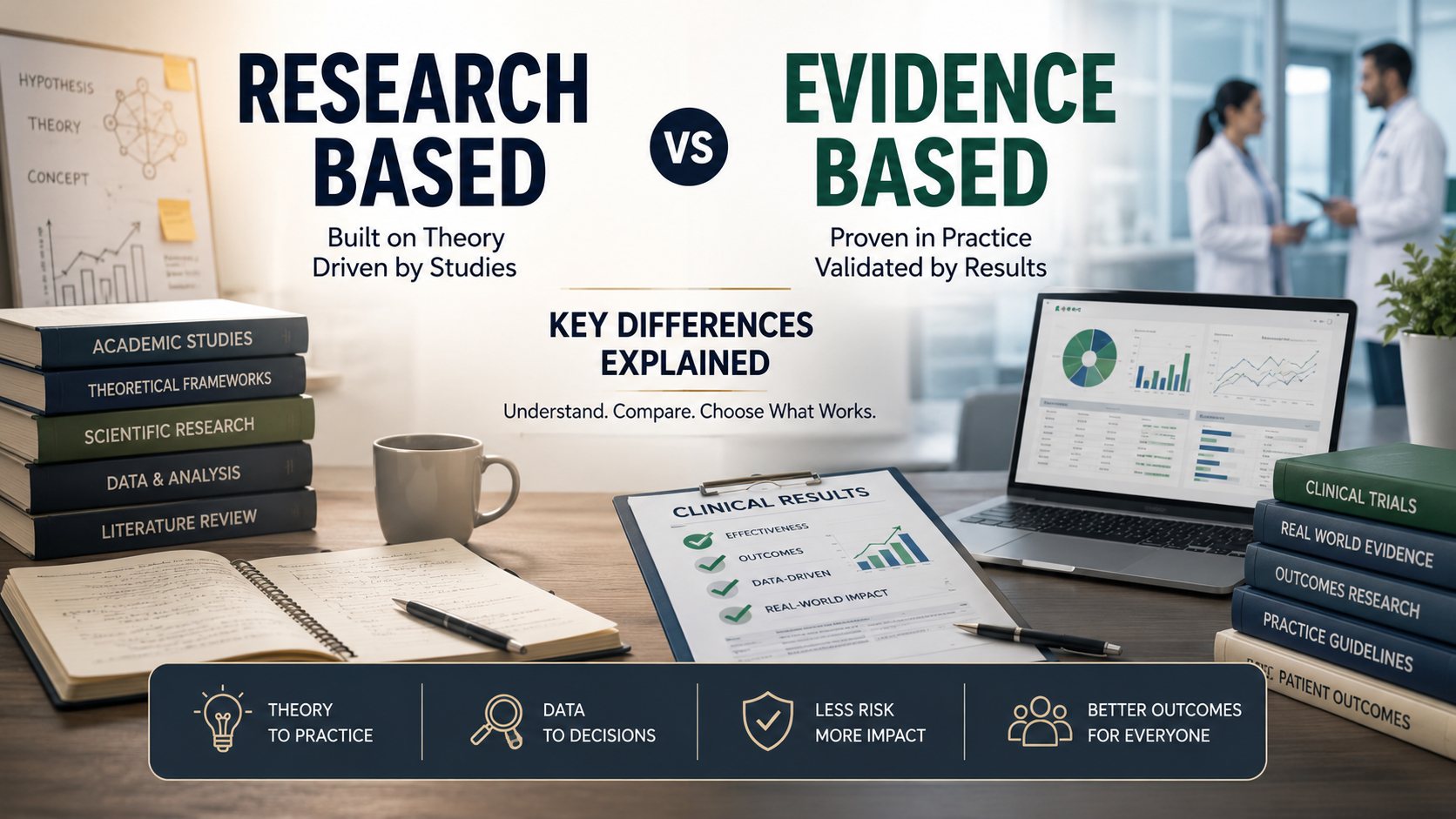
Research Based vs Evidence Based: Key Differences Explained
Professionals frequently encounter two terms: research based vs evidence based. While they sound identical, the distinction between them is vital. Knowing how these approaches differ ensures you implement truly effective methodologies. This knowledge stops you from relying on theoretical concepts alone. Instead, it helps you apply proven, real-world solutions to achieve the best possible outcomes. The dynamic interplay between theoretical data and practical execution dictates how organizations allocate budgets, train staff, and measure success.
To ground these concepts in established standards, organizations like the National Institutes of Health continuously analyze scientific literature. They track how academic studies translate into daily practice. In this article, we break down the structural differences between these two concepts. We also explore practical examples and help you choose the right approach for your specific organizational needs. By exploring the nuances of each framework, you will gain immense clarity. This clarity helps you select methodologies that drive performance improvements while mitigating implementation risks.
Understanding the Core Concepts of Academic Data and Real-World Evidence
To grasp the debate of research based vs evidence based methodologies, we must analyze their definitions. The division between these frameworks dictates how companies market products and how leaders draft policies. Both paths rely heavily on the scientific method. However, they utilize scientific data at completely different points in their development lifecycles. One relies on potential, while the other demands concrete proof before implementation.
What Does a Research-Based Approach Mean?
A research-based practice derives directly from theoretical data, academic studies, and scientific inquiry. When a program is research-based, its core design integrates principles that studies show to be effective. However, researchers may not have tested the specific program itself. Creators look at existing literature and assemble a methodology based on those static findings. They assume the combined elements will work effectively in a real-world setting because the underlying parts are scientifically sound. This assumption can sometimes create gaps between theory and actual practice.
What Does an Evidence-Based Methodology Mean?
An evidence-based practice goes a step further by demanding direct confirmation of success. It requires that the specific intervention, program, or method has undergone direct testing. It also demands that the program yields measurable, consistent, positive results. This approach does not just rely on foundational science. It proves that the specific application of that science works in real-world scenarios. This framework requires rigorous tracking, independent evaluations, and field trials to ensure the exact product delivers on its promises.

Research Based vs Evidence Based: The Defining Operational Differences
While both frameworks value scientific integrity, they operate at completely different stages of validation. The choice between them boils down to your operational goals. Do you want an innovative concept that is scientifically plausible? Or do you require a verified solution that has succeeded in identical environments? Understanding these specific variances allows decision-makers to manage expectations. It also allows leaders to predict outcomes with much greater accuracy.
| Feature | Research-Based Approach | Evidence-Based Approach |
| Primary Focus | Aligns with established theories and data. | Proven outcomes from specific testing. |
| Validation Level | Conceptual validation. | Direct empirical validation. |
| Risk Factor | Higher uncertainty in practice. | Lower risk due to documented success. |
| Core Components | Academic literature and data. | Research, clinical expertise, and client values. |
1. The Scope of Empirical Validation
The primary distinction lies in what investigators actually test. For instance, an educational app might be research-based because it uses spaced repetition. Cognitive science heavily supports this concept. However, the app is not evidence-based until researchers test that specific software on students. They must measure student progress against a control group. The scope of validation shifts from general theory to the specific tool itself. This shift changes how much trust you can place in immediate real-world performance.
2. Integration of Practical Expertise and Clinician Insights
Evidence-based frameworks rarely rely on static data alone. In fields like medicine and psychology, the evidence-based model forms a dynamic triad. It balances the best available scientific evidence, the practical expertise of the professional, and the unique characteristics of the client. Research-based approaches focus more narrowly on the literature itself. They often ignore how human variables, professional intuition, and unique environmental factors influence success or failure when a team deploys the method.
Real-World Applications of Research and Evidence In Key Industries
Looking at how these frameworks operate in specific sectors clarifies their practical implications. It also illustrates why professionals choose one over the other. Every industry experiences constant tension between adopting unproven innovations and sticking to slow, verified strategies. Examining these scenarios highlights how the distinction shapes daily operations and long-term policies. It shows how theory transforms into practical execution across diverse fields.
Healthcare, Proven Interventions, and Clinical Medicine
In medicine, the stakes are exceptionally high, making this distinction critical. A treatment plan built on a research-based vs evidence-based framework changes patient outcomes completely. For example, a pharmaceutical company might develop a drug that targets a specific biomolecule. Lab data suggests it should stop a disease process, making the drug research-based. However, the drug only becomes evidence-based after extensive clinical trials. These trials prove it safely cures human patients, leading to formal clinical guidelines.
Education, Teaching Standards, and Curriculum Development
School districts navigate these terms when purchasing instructional tools for teachers. A reading curriculum is research-based if it utilizes the general phonetic principles of linguistics. Experts agree these principles are effective in theory. Conversely, the curriculum becomes evidence-based when a district implements it across fifty schools. Independent data must prove student reading scores increased by fifteen percent compared to schools using other methods. This data offers concrete proof of utility.
Why the Distinction Between Research and Evidence Matters for Your Strategy
Choosing between these frameworks impacts your budget, your credibility, and your ultimate success rate. Relying solely on research-based tools means you take a calculated gamble on theory. It provides an excellent starting point for innovation, but it lacks a guaranteed track record. If your organization requires absolute certainty before investing capital, relying purely on conceptual alignment can lead to wasted resources when theories fail.
Conversely, prioritizing evidence-based practices minimizes risk across the board. It gives stakeholders, investors, or patients confidence that the chosen path has already succeeded under similar pressures. For organizations aiming to optimize resource allocation, selecting evidence-based methods is the safer, more justifiable choice. It bridges the gap between scientific theory and real-world execution. This approach ensures your strategic initiatives rely on proven performance rather than hopeful academic projections.
FAQs
What is a simple example of research based vs evidence based?
A simple example exists in the fitness industry. A workout routine is research-based if it incorporates high-intensity interval training (HIIT). Decades of sports science show that HIIT burns fat efficiently. However, that specific routine is not evidence-based until researchers track a group of people using that exact sequence of exercises. The researchers must document consistent, measurable fat loss over twelve weeks. The transition from the general concept of interval training to the verified results of a specific routine illustrates the line between these two approaches. Without direct testing on the final product, you only have a research-based theory. Direct testing yields empirical proof.
Is evidence-based always better than research-based?
Not always, though it is usually more reliable for standard operations. Evidence-based practices offer proven security and predictable outcomes, which suits risk-averse environments. However, gathering direct evidence takes years of rigorous testing and heavy funding. Therefore, cutting-edge innovations always start out as purely research-based models. If you want the latest advancements or face a novel crisis, you must rely on research-based frameworks. Evidence-based practices excel at providing predictability. However, research-based practices remain essential for driving innovation. They pioneer new fields and develop creative solutions to complex problems that scientists have not yet studied deeply.
How do you identify if a program is truly evidence-based?
To confirm a program is evidence-based, look for peer-reviewed studies in reputable scientific journals. These studies must specifically evaluate that exact intervention. You should look for randomized controlled trials (RCTs), extensive meta-analyses, or formal endorsements from recognized clearinghouses. Examples include the What Works Clearinghouse in education or the Cochrane Reviews in healthcare. A truly evidence-based program provides public access to its data. This data shows clear comparisons between a treatment group and a control group. If a company points to general science papers rather than independent studies of their specific product, they market a research-based tool instead.
Can a research-based practice become evidence-based?
Yes, this is the standard evolution of successful methodologies across all scientific disciplines. Every evidence-based practice begins its life as a research-based concept. First, developers build a theoretical framework using existing academic literature to create a new program. Once this preliminary framework exists, investigators design specific trials to test the new intervention in real-world environments. If these trials yield positive, repeatable, and statistically significant results over a set period, the practice officially becomes evidence-based. This evolutionary process ensures that field-tested practices remain deeply rooted in foundational science. It also proves their standalone merit through rigorous, practical application.
What are the three pillars of evidence-based practice?
The three pillars of evidence-based practice include scientific research evidence, clinical or professional expertise, and the client’s unique values. This unique triad ensures that professionals do not make choices blindly based on cold data alone. Instead, it tailors decisions to real-world situations and human needs. The research provides the data, while the professional brings practical experience to interpret that data. Finally, the client provides the personal context that determines if the solution is viable. By balancing these three components, professionals deliver high-quality care or strategic direction. This approach respects the individuality of the client while maintaining total scientific integrity.
Conclusion
Navigating the landscape of research based vs evidence based methodologies is essential for making informed decisions. To summarize the core concepts, research-based practices use valid scientific theories as their foundation. Evidence-based practices undergo direct testing and prove their worth in real-world scenarios. Both frameworks hold immense value for modern organizations, but they serve completely different purposes along the spectrum of innovation.
When you need certain, predictable results with minimal risk, always rely on evidence-based solutions. This approach protects your investments and ensures accountability. To stay informed about the latest scientific discoveries and healthcare advancements, explore our guide on the latest medical research. If you pioneer new territory where direct data does not yet exist, a research-based foundation keeps your efforts grounded in scientific truth. By balancing both approaches, you foster a culture of calculated innovation while maintaining the high standards required for sustained professional success.