
Mastering the Water Cycle Process: Essential Stages and Scientific Principles
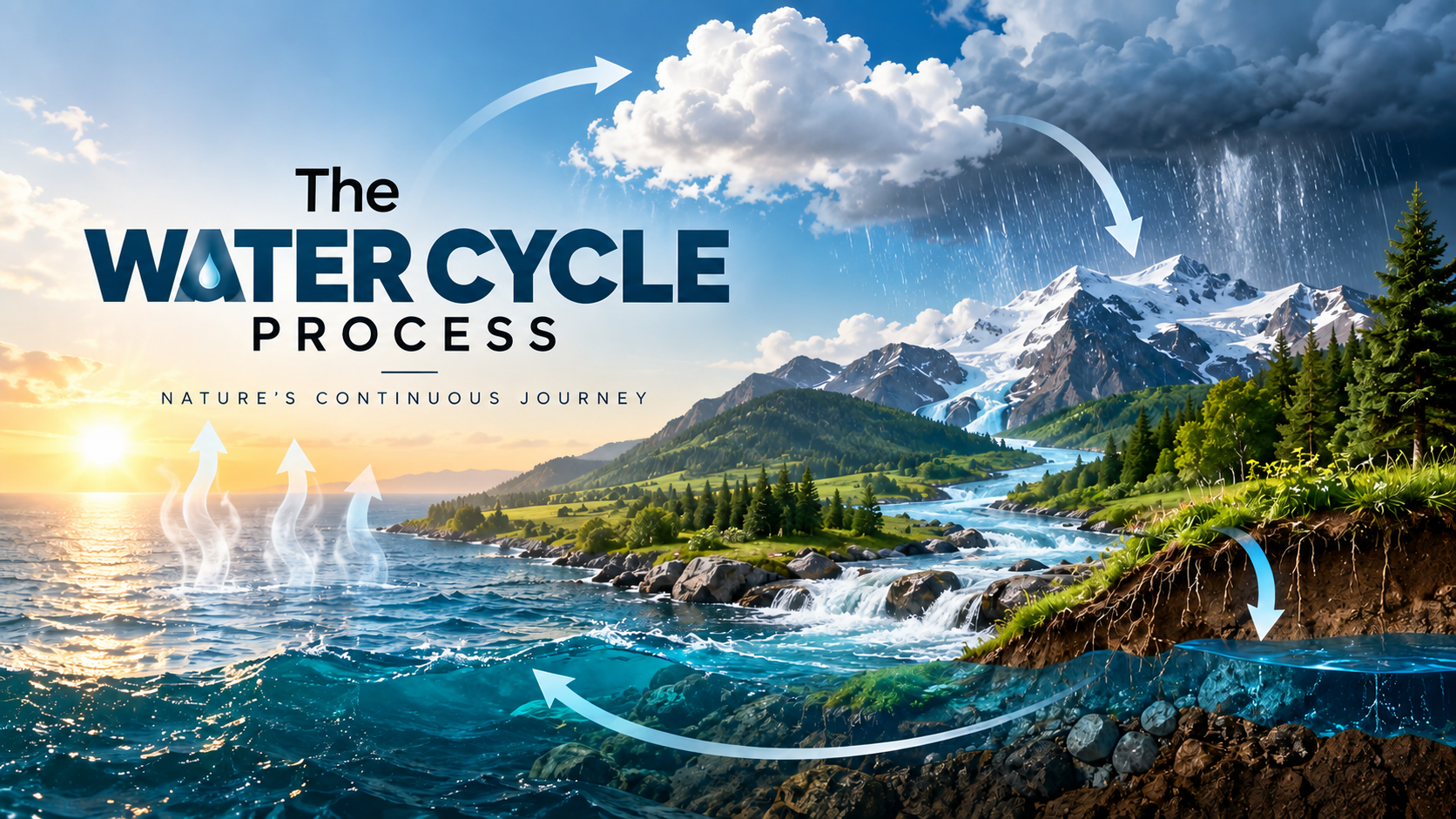
Water sustains all life on Earth and moves continuously through the hydrological system. Understanding the water cycle process shows how evaporation, condensation, precipitation, and runoff redistribute water across the planet. This movement also helps regulate climate and replenish freshwater supplies.
The water cycle has no fixed starting point or endpoint. Water constantly changes between liquid, solid, and gaseous states as it moves through oceans, rivers, soil, ice, plants, and the atmosphere. Solar energy provides most of the energy needed for evaporation, while gravity moves water back toward Earth’s surface.
Whether you are studying basic science or exploring environmental systems, understanding the water cycle process is essential. This guide explains its major stages, common scientific definitions, and educational frameworks. For detailed hydrological information, you can explore resources from the U.S. Geological Survey.
What are the 7 steps of the water cycle?
The 7 steps of the water cycle provide a useful way to understand how water moves between Earth’s surface and atmosphere. Although the hydrological cycle has no true beginning or end, scientists often divide it into separate stages for easier study. The process commonly includes evaporation, condensation, precipitation, collection, runoff, infiltration, and transpiration. You can also explore activities that make geography memorable to make these concepts easier to understand.
Evaporation occurs when solar energy changes liquid water into water vapor. The vapor rises into the atmosphere and cools at higher altitudes. During condensation, water vapor changes into tiny liquid droplets or ice crystals. These particles gather to form clouds.
When droplets or ice crystals become heavy enough, precipitation occurs. Water then reaches Earth’s surface as rain, snow, sleet, or hail. Some water flows across the land as surface runoff, while some enters the soil through infiltration. Plants also absorb groundwater and release moisture through transpiration.
These pathways eventually return water to rivers, lakes, oceans, groundwater systems, or the atmosphere. Together, they create the continuous water cycle process.
The Critical Role of Sublimation and Transpiration
Sublimation and transpiration are important parts of the water cycle process, even though simplified diagrams may leave them out. Sublimation occurs when snow or ice changes directly into water vapor without first becoming liquid. This process commonly occurs in cold, dry environments where sunlight and low atmospheric pressure encourage moisture loss from ice.
Transpiration follows a different pathway. Plants absorb water through their roots and transport it throughout their tissues. Water then escapes through tiny openings called stomata, mainly on plant leaves. This moisture enters the atmosphere as water vapor.
Together, evaporation and transpiration are often considered evapotranspiration. This combined process transfers substantial amounts of water from land surfaces into the atmosphere. Vegetation therefore plays an important role in regional moisture movement. Trees also contribute to local environmental conditions, which is why trees for natural cooling can be relevant when considering vegetation and climate.
Sublimation can also contribute atmospheric moisture in areas covered by snow and ice. However, its contribution varies widely by location and climate. These processes demonstrate that atmospheric moisture does not come only from oceans, lakes, and rivers. Land surfaces, vegetation, snow, and ice also contribute to the constantly changing hydrological system.
What is the process of the water cycle?
The process of the water cycle describes the continuous movement of water between Earth’s surface, underground environments, and the atmosphere. Solar energy drives much of this movement by providing the heat required for evaporation. Oceans, lakes, rivers, soil, and other wet surfaces release water vapor into the atmosphere.
As moist air rises, it generally encounters cooler conditions. Water vapor can then condense around microscopic particles called condensation nuclei. This process produces tiny water droplets or ice crystals that form clouds. Atmospheric winds transport these clouds across different regions.
When atmospheric conditions allow water droplets or ice particles to grow sufficiently, precipitation occurs. Rain, snow, sleet, or hail then returns water to Earth’s surface. Some precipitation enters rivers and lakes, while another portion infiltrates the ground.
Water stored underground can move through soil and rock before reaching springs, rivers, lakes, or oceans. Surface runoff follows the terrain and can also carry water toward larger bodies. Evaporation and plant transpiration then return moisture to the atmosphere, continuing the water cycle process.
Solar Energy as the Primary Engine
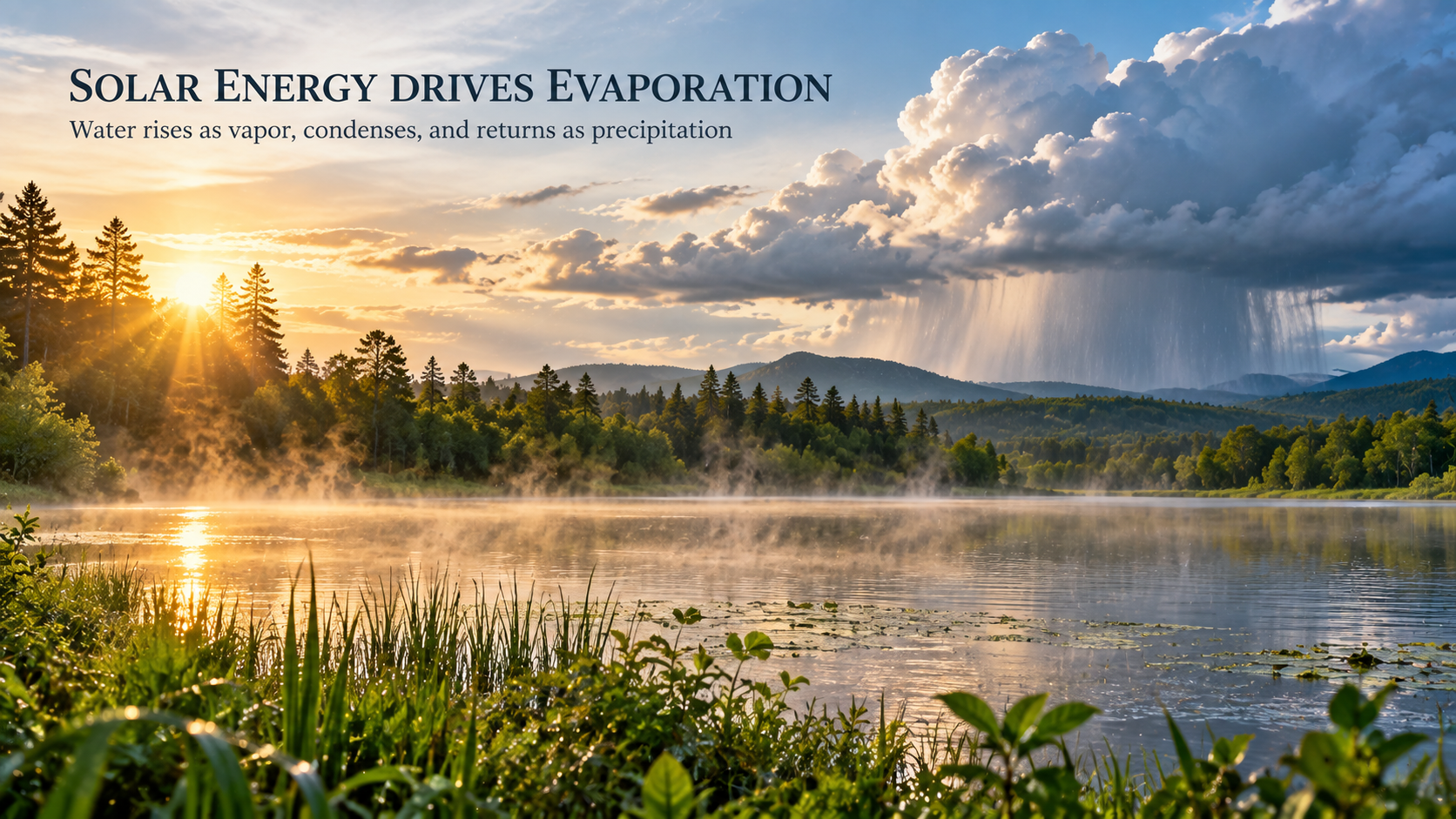
Solar radiation provides the main energy source for many processes within the water cycle. Sunlight warms oceans, lakes, rivers, soil, and other exposed surfaces. This energy allows liquid water to change into water vapor through evaporation. Understanding solar energy more broadly can also help when learning how to calculate your home’s solar energy needs.
Plants also use solar energy during photosynthesis while releasing water through transpiration. Together, these processes transfer moisture from Earth’s surface into the atmosphere. Without solar heating, evaporation and transpiration would be greatly reduced.
However, solar energy is not the only force involved. Gravity plays an equally important role in moving water downward. It pulls precipitation toward Earth’s surface and helps groundwater flow through soil and rock. Gravity also drives water downhill through streams and rivers.
The balance between solar energy and gravity keeps water moving through different parts of the hydrological system. Solar energy generally moves water upward into the atmosphere, while gravity helps return it toward the surface.
Regional differences also affect the speed of the cycle. Warm regions can experience stronger evaporation, while cold environments often store water as snow and ice. Atmospheric circulation then redistributes moisture across the planet.
What are the 5 stages of the water cycle?
The 5 stages of the water cycle commonly used in simplified explanations are evaporation, condensation, precipitation, infiltration, and runoff. Different educational resources may organize the cycle differently, so there is no single universal list of exactly five stages.
Evaporation changes liquid water into water vapor when surfaces receive energy. Condensation then changes water vapor into tiny liquid droplets or ice crystals. These particles can combine to form clouds.
When atmospheric water becomes sufficiently concentrated, precipitation returns it to Earth’s surface. Rain, snow, sleet, and hail are common forms of precipitation. After reaching the ground, water follows several possible pathways.
Some water enters the soil through infiltration. It can eventually contribute to groundwater storage. Other water travels across the land as surface runoff and enters streams, rivers, lakes, or oceans.
These five stages provide a simple framework for understanding water movement. They do not represent every pathway, however. Transpiration, sublimation, groundwater flow, and storage are also important parts of the broader water cycle process.
The Significance of Infiltration Rates
Infiltration determines how quickly water moves from the ground surface into soil. Its rate depends on several factors, including soil texture, moisture levels, vegetation, slope, and land cover. Sandy or highly permeable soils generally allow water to enter more quickly than compacted clay-rich soils.
Vegetation can also improve infiltration. Plant roots create pathways through soil, while organic matter can improve soil structure. These effects allow more rainfall to enter the ground instead of immediately becoming surface runoff.
Urban development creates a different challenge. Roads, rooftops, parking areas, and concrete surfaces are often impermeable surfaces. They prevent much of the rainfall from entering the soil. As a result, more water flows across the surface and can reach drainage systems quickly. This increased runoff also makes the heat island effect an important environmental issue in urban areas.
High runoff volumes can increase the risk of localized flooding, especially when drainage systems cannot handle intense rainfall. Infiltration also supports groundwater recharge, which makes it an important part of freshwater management.
Understanding infiltration helps explain why the same rainfall event can produce very different effects in forests, farmland, deserts, and heavily developed urban areas.
What is water cycle basic 4?
The basic 4 stages of the water cycle provide one of the simplest ways to explain how water continuously moves through Earth’s environment. These four stages are evaporation, condensation, precipitation, and collection. This framework is especially useful for young learners because it focuses on the most recognizable transformations.
Evaporation occurs when heat changes liquid water into water vapor. Solar energy provides most of the energy responsible for this process. Water vapor then rises into the atmosphere and cools.
During condensation, water vapor changes into tiny liquid droplets or ice crystals. These particles can gather and form clouds. When enough moisture accumulates and atmospheric conditions allow it, precipitation occurs.
Precipitation returns water to Earth’s surface as rain, snow, sleet, or hail. The water then collects in oceans, lakes, rivers, glaciers, soil, and groundwater systems.
The four-stage model does not describe every pathway in the hydrological cycle. It leaves out processes such as infiltration, runoff, transpiration, groundwater flow, and sublimation. However, it provides a clear starting point for understanding the broader water cycle process before introducing its more detailed components.
The Role of Collection Reservoirs
Collection refers to water accumulating in natural reservoirs after precipitation reaches Earth’s surface. These reservoirs include oceans, lakes, rivers, glaciers, groundwater, and soil moisture. They temporarily store water before it moves through another part of the water cycle. Keeping these water sources clean is also important, making ways to efficiently clean bodies of water relevant to freshwater protection.
Oceans represent the largest reservoir in the hydrological system. They contain most of Earth’s total water and provide a major source for evaporation. Glaciers and ice sheets store large quantities of freshwater in frozen form.
Groundwater provides another important storage system. Water can remain underground for periods ranging from days to thousands of years, depending on geological conditions. Some groundwater eventually reaches springs, rivers, lakes, or oceans.
Collection therefore does not mean that water simply stops moving. Instead, reservoirs provide temporary storage between different stages. The residence time can vary dramatically between reservoirs.
For example, atmospheric water usually remains there for only a short period. Water stored in deep groundwater or large ice sheets can remain isolated for much longer. These differences help regulate the timing and distribution of water throughout the Earth’s hydrological system.
What are the 10 points of the water cycle?
The 10 points of the water cycle can be used as a detailed checklist of major processes and characteristics within global hydrology. First, the cycle has no permanent beginning or end. Second, solar energy drives much of the evaporation that supplies atmospheric moisture. Third, plant transpiration adds water vapor to the atmosphere.
Fourth, condensation forms clouds when water vapor cools and changes into droplets or ice crystals. Fifth, precipitation returns atmospheric moisture to Earth’s surface. Sixth, infiltration allows some water to enter the soil and contribute to groundwater.
Seventh, surface runoff transports water across land into streams, rivers, lakes, and oceans. Eighth, glaciers and ice sheets store large amounts of freshwater. Ninth, oceans contain more than 96% of Earth’s total water. Tenth, water continuously moves between reservoirs rather than disappearing from the planetary system.
These points highlight the interconnected nature of the water cycle process. They also show why water can move at very different speeds. Atmospheric water may cycle rapidly, while groundwater and ice can remain stored for much longer periods.
The cycle is therefore continuous, but individual water molecules can spend very different amounts of time in each reservoir.
Geological Time and Water Storage
Water does not move through every part of the water cycle at the same speed. Atmospheric moisture has a relatively short average residence time, often measured in days. By contrast, water stored in glaciers, deep groundwater, and other long-term reservoirs can remain there for centuries or much longer.
These differences create a system with both rapid and slow pathways. Evaporation can transfer surface water into the atmosphere quickly. Precipitation can then return that moisture within days or weeks. Groundwater movement is often much slower because water must travel through pores and fractures in soil and rock.
Large ice sheets provide another long-term storage system. Snow can accumulate over many years and gradually become compressed into ice. Some stored water may remain frozen for thousands of years before returning to the active cycle.
Long residence times are important because they influence freshwater availability and environmental stability. However, stored water is not necessarily permanently available for human use. Climate change, groundwater extraction, melting ice, and land-use changes can alter how quickly water moves between reservoirs.
Understanding these timescales provides a clearer picture of how the global hydrological system responds to environmental changes.
What is water cycle NCERT?
The NCERT water cycle explanation presents the hydrological cycle as the continuous movement of water between Earth’s surface and atmosphere. At the school level, the concept focuses on familiar processes such as evaporation, condensation, precipitation, and the collection of water.
Solar heating causes water from oceans, rivers, lakes, and other surfaces to evaporate. The resulting water vapor rises into the atmosphere. As it cools, condensation occurs and tiny water droplets form. These droplets contribute to cloud formation.
When clouds produce precipitation, water returns to Earth’s surface as rain or other forms of precipitation. The water can then collect in rivers, lakes, oceans, soil, and other reservoirs. Some water also enters the ground and contributes to groundwater.
NCERT science education uses these concepts to help students understand how water continuously circulates rather than simply being consumed and disappearing. The water cycle process also helps explain why sunlight, clouds, rainfall, and surface water are interconnected.
The basic school-level model simplifies a much more complex global system. Processes such as groundwater movement, transpiration, sublimation, and surface runoff can be studied in greater detail as students progress through environmental science and hydrology.
Educational Experiments for Students
Simple classroom experiments can make the water cycle process easier for students to understand. One common demonstration uses a transparent container or sealed plastic bag containing a small amount of water. When placed in sunlight, the water warms and some of it evaporates.
The water vapor then reaches cooler surfaces inside the container. As it loses heat, condensation produces visible droplets. These droplets may eventually move downward, providing a simple demonstration of how water can change state and return toward a lower surface.
Students can observe several important concepts through this type of activity:
- Evaporation: Liquid water changes into water vapor.
- Condensation: Water vapor changes back into liquid droplets.
- Precipitation: Collected droplets can fall when they become sufficiently large.
- Collection: Water gathers again at the bottom of the container.
These experiments do not reproduce the entire global hydrological system. They simplify complex atmospheric processes into an observable model. Still, they help students connect abstract scientific terms with physical changes they can see directly.
Frequently Asked Questions
Why is the water cycle important for life on Earth?
The water cycle is essential because it constantly redistributes fresh water across the globe, supplying terrestrial ecosystems, plants, and animals with the moisture they need to survive. Without this continuous recycling mechanism, freshwater supplies would quickly deplete in landlocked regions, causing widespread droughts and collapsing global agricultural systems. Furthermore, the cycle regulates global temperatures by moving heat energy from tropical oceans to colder polar latitudes.
How does human activity impact the natural water cycle?
Human activities significantly alter natural hydrological patterns through urban development, deforestation, and massive groundwater extraction. Paving over land with impermeable concrete prevents normal soil infiltration, drastically increasing surface runoff and intensifying local flood hazards. Additionally, heavy industrial pumping depletes underground aquifers much faster than natural precipitation can replenish them, threatening long-term regional water security and altering local weather patterns.
How do plants contribute to atmospheric moisture?
Plants play a critical role in atmospheric moisture loading through a specialized biological process called transpiration. Roots absorb liquid water from surrounding soils, transporting it upward through vascular tissues to nourish the plant before releasing excess moisture as water vapor through microscopic leaf pores called stomata. This botanical release accounts for a substantial percentage of total atmospheric humidity, particularly in densely vegetated tropical rainforests.
What happens to water after it falls as precipitation?
Once precipitation reaches the ground, it splits into multiple pathways depending on local terrain, temperature, and soil conditions. A large portion soaks directly into the earth via infiltration to nourish vegetation and replenish underground aquifers. Excess water that cannot penetrate the soil becomes surface runoff, flowing downhill into local streams, rivers, and lakes, which eventually carry it back to the ocean.
Conclusion
Understanding the water cycle process highlights the delicate balance that sustains all living organisms across our planet. From solar-driven evaporation and cloud-forming condensation to precipitation, infiltration, and runoff, every stage plays a vital role in distributing freshwater and regulating global climates. Recognizing how human actions and natural factors influence these pathways allows us to protect critical water resources more effectively. By applying these scientific insights to daily conservation efforts, including how to recycle plastic at home, we can help preserve healthy hydrological systems for future generations.