
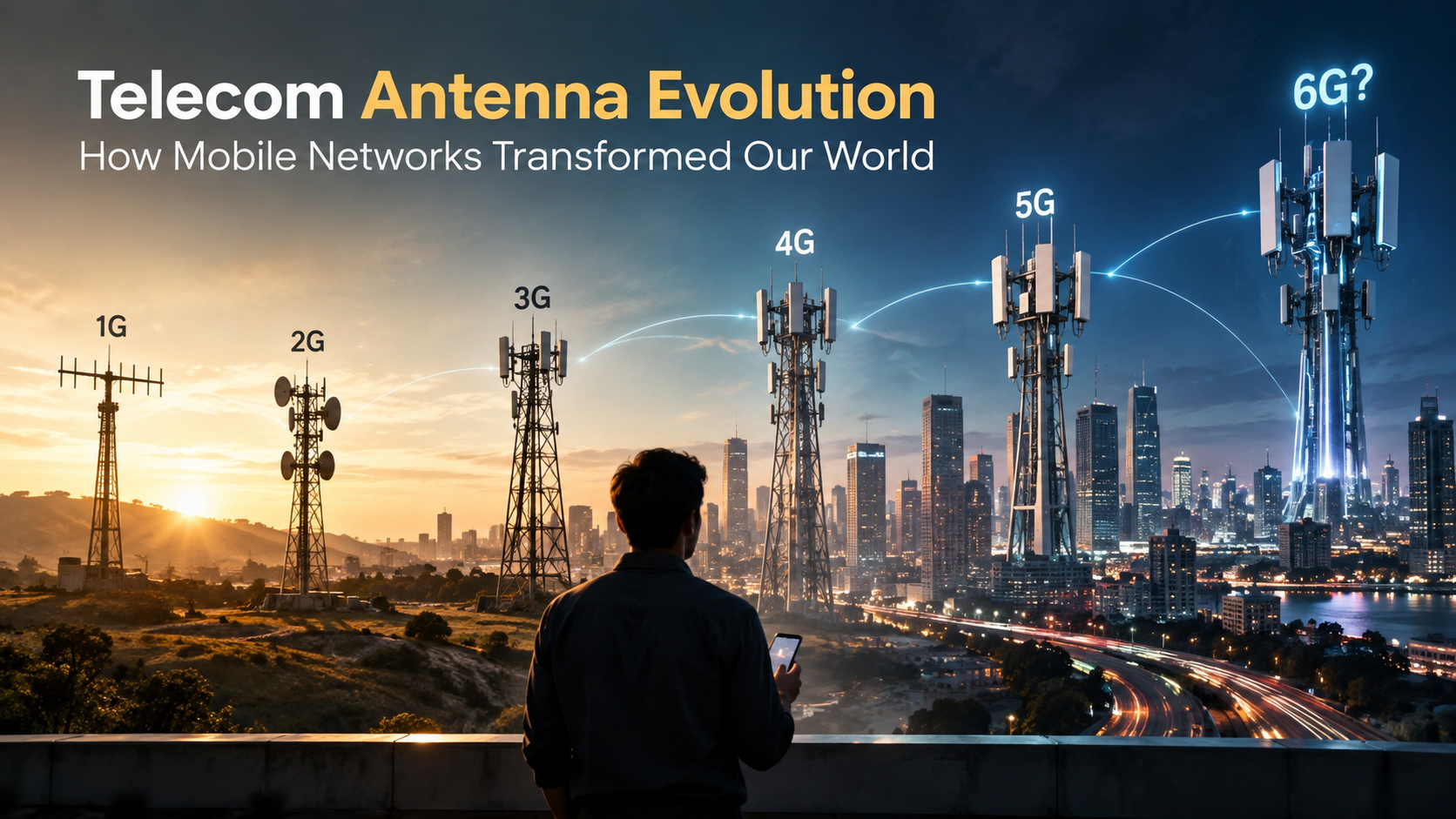
Telecom Antenna Evolution: How Mobile Networks Transformed Our World
The rapid pace of telecom antenna evolution has transformed how people communicate, connect, and share information worldwide. Wireless networks moved from basic analog signals to high-speed digital broadband. Antenna engineering had to evolve alongside this growth.
Each mobile generation introduced higher data demands, greater network density, and more complex frequency requirements. These changes pushed engineers to develop antennas with better coverage, capacity, efficiency, and signal control.
Understanding this progression shows how physical infrastructure supports our increasingly connected society. Early mobile networks depended on relatively simple antennas and broad coverage patterns. Modern systems use advanced arrays, beamforming, and multiple-input multiple-output technology.
The story also explains why antennas remain central to future wireless networks. Emerging 6G research will demand even greater performance from antenna systems and supporting infrastructure. The International Telecommunication Union (ITU) provides global information on telecommunications standards and network development.
What are three types of antenna types?
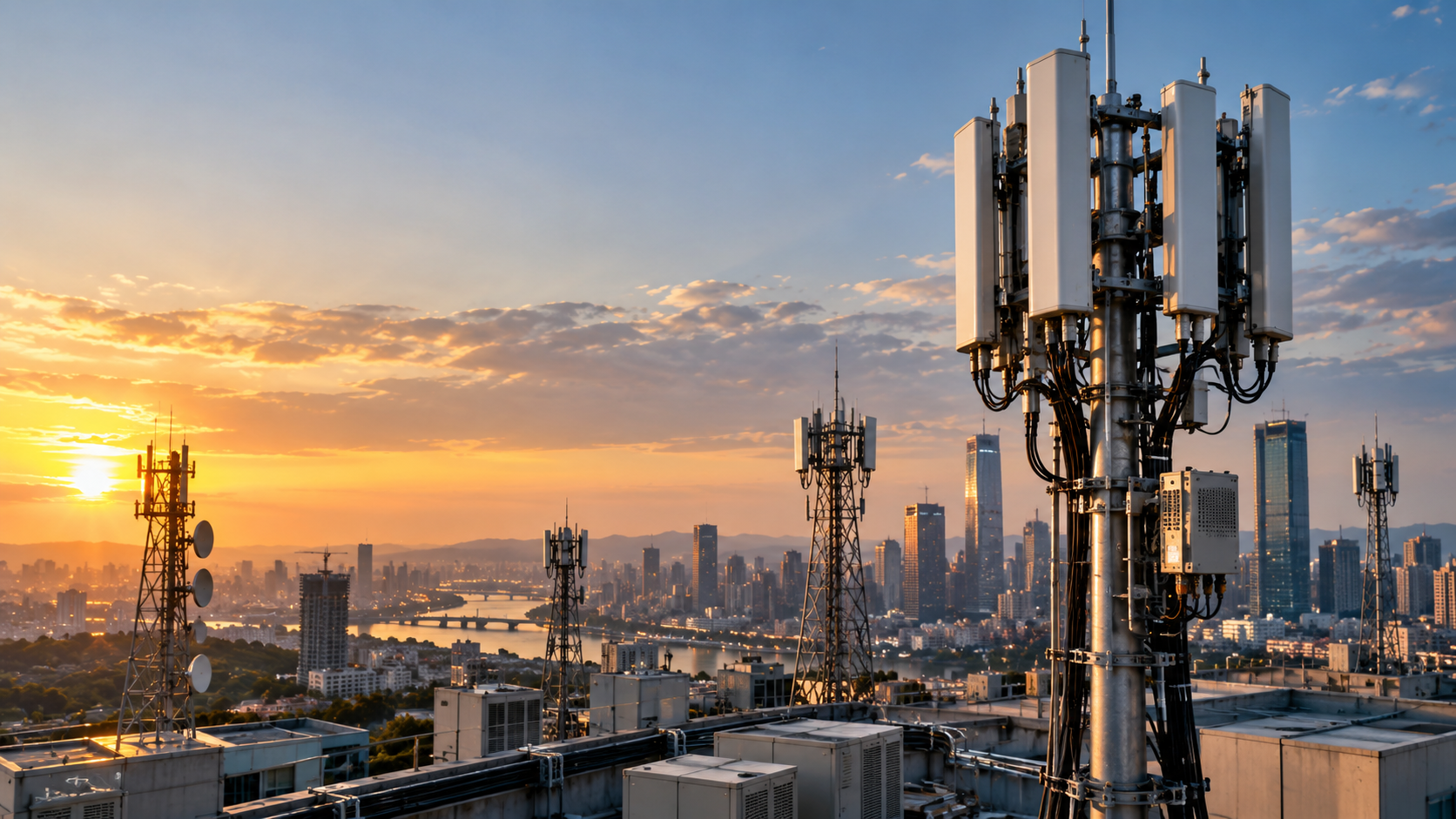
Antennas transmit and receive radio frequency energy for wireless communication. Different applications require different antenna designs. Engineers consider coverage, frequency, gain, directionality, and available installation space when selecting an antenna.
Three broad antenna categories help explain this technology:
- Wire antennas: These include dipoles and monopoles. They are relatively simple and can provide broad or omnidirectional coverage.
- Aperture antennas: Horn antennas are common examples. They guide electromagnetic energy and work effectively at higher frequencies.
- Array antennas: These combine multiple elements into one system. Modern cellular networks use arrays for beamforming and advanced signal management.
The telecom antenna evolution from simple wire designs to intelligent arrays reflects changing network requirements. Earlier systems mainly focused on providing reliable voice coverage. Modern networks must support high data rates, many simultaneous connections, and efficient spectrum use.
Antenna selection therefore plays an important role in network performance, capacity, and coverage.
Directional Array Configurations
Modern cellular networks increasingly depend on directional antenna arrays to improve capacity and spectrum efficiency. These systems combine multiple antenna elements within a single structure. Network equipment can control the elements together to shape and direct radio signals.
This process is known as beamforming. Instead of transmitting energy equally in every direction, the network can concentrate energy toward a specific device or area. This approach can improve signal quality and reduce unnecessary interference.
Advanced arrays also support massive MIMO, where many antenna elements transmit and receive multiple data streams simultaneously. This capability became particularly important during the evolution from 4G to 5G.
The telecom antenna evolution toward directional arrays has therefore changed how base stations manage wireless capacity. These systems help networks serve more users within limited spectrum.
They can also improve coverage in challenging environments. However, sophisticated arrays require more complex hardware, calibration, processing, and network planning than traditional antennas.
How did communication evolve from 1G to 5G?
Communication evolved through several major technological shifts, with each mobile generation introducing new capabilities. 1G networks primarily supported analog voice calls. Their antennas focused on basic coverage rather than high-capacity data transmission.
With 2G, digital communication improved voice quality and introduced services such as SMS. The arrival of 3G brought mobile internet, enabling users to access websites and other data services from phones.
4G expanded mobile broadband dramatically. Smartphones could support video streaming, cloud services, social media, and other data-intensive applications. Networks also began using advanced MIMO systems to increase capacity.
5G continued this progression with higher data rates, lower latency, and support for large numbers of connected devices. These requirements accelerated telecom antenna evolution, particularly through massive MIMO and beamforming.
The transition was not simply about faster phones. Each generation required changes across radio equipment, spectrum, network architecture, and antenna design. Engineers increasingly moved from broad coverage approaches toward intelligent systems that manage signals more precisely.
The Shift Toward Digital Data
The move from analog to digital communication was a major turning point in mobile network development. Analog systems represented voice signals directly as continuously varying radio signals. Digital networks instead converted information into data that could be processed and transmitted more efficiently.
This change created several important advantages. Digital systems could improve voice quality, support encryption, use spectrum more efficiently, and introduce new communication services.
2G networks demonstrated these benefits on a large scale. Digital cellular standards supported services such as SMS while improving network capacity. Later generations expanded digital communication into packet-based mobile data.
This transition also influenced telecom antenna evolution. As networks carried increasingly complex digital traffic, antenna systems needed greater capacity and better interference management.
Modern antennas work alongside sophisticated signal-processing systems. Multiple antennas can transmit and receive separate data streams simultaneously. Beamforming can further direct those signals toward users.
The shift to digital communication therefore affected more than mobile phones. It changed the design of the entire wireless network, including radio equipment, antennas, spectrum management, and core infrastructure.
How has telecommunication evolved over time?
Telecommunications evolved from basic wired systems into highly integrated networks connecting billions of devices. Early telegraph systems transmitted coded messages through physical cables. Telephone networks later enabled real-time voice communication over copper infrastructure.
For much of the twentieth century, fixed-line systems dominated telecommunications. The development of cellular technology changed that model by allowing communication through radio waves. Users could communicate without remaining connected to a physical telephone line.
Digital technology then increased network capacity and enabled services beyond traditional voice calls. Mobile networks began carrying internet traffic, multimedia content, and data from connected devices.
Today, telecom antenna evolution supports increasingly dense wireless environments. Cellular base stations use advanced antennas to provide coverage and manage large volumes of traffic. Satellite systems can also extend connectivity beyond conventional terrestrial networks.
Modern telecommunications therefore combines several technologies. These include fiber-optic backhaul, cellular networks, wireless access points, and satellite communication. Together, they create flexible networks capable of supporting smartphones, industrial equipment, vehicles, sensors, and other connected devices, while AI technologies increasingly help manage connected systems.
From Copper Wires to Wireless Airwaves
The gradual expansion of wireless communication reduced dependence on physical connections for many forms of communication. Copper cables remained important for fixed networks, but radio technology allowed users to connect while moving.
Early wireless systems used relatively simple radio transmitters and receivers. Cellular networks introduced a more organized approach by dividing geographic areas into cells. Each cell could reuse frequencies while serving local users.
This architecture created the foundation for modern mobile communication. As demand increased, engineers developed smaller cells, improved spectrum management, and more capable antennas.
The telecom antenna evolution associated with this transition was significant. Antennas moved beyond basic broadcasting functions and became important tools for controlling coverage, capacity, and interference.
Wireless infrastructure also helped extend communication into areas where extensive wired networks were difficult or expensive to build. However, wireless systems did not eliminate physical infrastructure. Modern networks still rely heavily on fiber-optic connections, power systems, towers, and data centers.
The result is a hybrid telecommunications environment where wireless access and wired infrastructure work together.
When was 1G, 2G, 3G, 4G, and 5G?
Mobile generations emerged at different times and introduced major changes in network capabilities. 1G services began appearing commercially in the late 1970s and early 1980s. NTT launched one of the first commercial cellular services in Tokyo in 1979.
2G followed in the early 1990s. GSM became one of the most influential standards and helped establish digital voice and SMS as major mobile services.
3G networks emerged commercially around 2001, with Japan among the first markets to launch. These networks expanded mobile data and supported services such as video calling.
4G LTE deployments began around 2009. They significantly increased mobile broadband performance and supported modern smartphone applications.
5G deployments began commercially around 2019 in several markets. The technology introduced higher capacity, lower latency, and improved support for connected devices.
These milestones also accelerated telecom antenna evolution. Each generation required antennas and radio systems capable of handling changing frequencies, bandwidths, coverage needs, and traffic levels.
The Decade-Long Generational Cycle
Mobile technology has often followed a broad cycle of roughly one decade between major generations. However, these timelines are not exact. New standards usually develop over several years before commercial networks become widely available.
Organizations such as the 3GPP play a central role in defining technical specifications for cellular technologies. Their work gives equipment manufacturers a framework for developing compatible network components.
A new generation affects much more than software. Base stations, radio units, antennas, chipsets, and network infrastructure may all require substantial changes.
This pattern has driven telecom antenna evolution for decades. Engineers must anticipate future requirements while maintaining compatibility with existing networks. Operators also need to balance performance improvements against installation costs and infrastructure limitations.
The transition from one generation to another is therefore gradual. Older technologies may continue operating while newer systems expand. Many networks use multiple generations simultaneously to provide coverage and support different devices.
This layered approach helps operators manage upgrades without replacing entire networks at once. It also explains why antenna sites often contain equipment supporting several generations.
Who is the father of 5G technology?
There is no single inventor who can accurately be called the father of 5G. Modern cellular technology resulted from contributions from researchers, universities, standards organizations, semiconductor companies, network manufacturers, and mobile operators.
One important contributor is Dr. Theodore Rappaport, whose research helped establish the feasibility of millimeter-wave frequencies for mobile communication. His work included extensive studies of radio propagation at high frequencies.
These studies challenged earlier assumptions about the practicality of millimeter-wave communication. They also helped researchers understand how signals behave around buildings, streets, and other urban obstacles.
Rappaport’s research became relevant to the development of technologies that use directional transmission and advanced antenna arrays. However, 5G itself was not created by one researcher or organization.
The telecom antenna evolution behind 5G reflects decades of research in radio propagation, MIMO, beamforming, semiconductor design, and network architecture. Standards organizations also played a critical role in turning research concepts into interoperable technologies.
It is therefore more accurate to describe 5G as a global engineering achievement. Many researchers contributed important pieces to the technology that eventually became modern 5G networks.
Pioneering Millimeter-Wave Research
Millimeter-wave research became an important part of the development of advanced 5G systems. These frequencies can provide large amounts of available spectrum, but they also present significant propagation challenges.
High-frequency signals generally experience greater path loss and can be affected by physical obstacles. Engineers therefore developed techniques that use highly directional antenna arrays to focus radio energy.
Research led by Theodore Rappaport and other wireless researchers helped demonstrate that millimeter-wave communication could support mobile applications under realistic conditions.
These findings influenced later work on beamforming, channel modeling, and antenna-array design. Modern 5G systems can use many antenna elements to steer signals toward individual users.
This represents an important stage in telecom antenna evolution. Instead of treating an antenna as a passive component that simply radiates energy, modern systems use antenna arrays as active parts of the communication process.
The approach also supports spatial multiplexing, allowing networks to serve multiple users through different signal paths. However, millimeter-wave networks can require denser infrastructure because their coverage is generally more limited.
These characteristics make high-frequency antenna design a key consideration for 5G deployment strategies.
Is there a 6G or 7G?
6G is being actively researched, but it has not yet become a globally standardized commercial mobile generation. Research programs are exploring technologies that could support future applications around the 2030 timeframe.
Potential 6G capabilities include higher data rates, extremely low latency, integrated sensing, artificial intelligence, and stronger support for immersive applications such as spatial audio. Researchers are also investigating higher-frequency spectrum, including sub-terahertz and terahertz bands.
These frequencies could provide wider bandwidth, but they also create major engineering challenges. Signal propagation, energy efficiency, hardware limitations, and coverage must all be addressed.
The next stage of telecom antenna evolution will therefore require more than simply increasing antenna count. Researchers are exploring advanced materials, intelligent surfaces, distributed antennas, and AI agents for increasingly autonomous network systems.
By contrast, 7G remains speculative. There is currently no established global technical standard comparable to 3G, 4G, or 5G.
Future generations will depend on research outcomes, industry requirements, spectrum policy, and international standardization. Claims about exact 6G or 7G capabilities should therefore be treated carefully until formal standards emerge.
The Promise of Terahertz Frequencies
Terahertz frequencies are among the areas being investigated for future wireless communication. These frequencies offer potentially enormous bandwidth, which could support extremely high data rates under suitable conditions.
However, using terahertz signals for practical mobile communication presents difficult challenges. High-frequency signals can experience substantial propagation loss and may be strongly affected by obstacles and atmospheric conditions.
These limitations make antenna technology especially important. Future systems may require highly directional antennas, advanced beamforming, compact arrays, and new semiconductor or antenna materials.
Researchers are also investigating reconfigurable intelligent surfaces. These surfaces could potentially manipulate radio propagation and help redirect signals around difficult environments, supporting the broader development of AI-enabled wireless systems.
The continuing telecom antenna evolution toward higher frequencies will likely involve closer integration between antennas, radio circuits, signal processing, and multimodal AI systems.
Terahertz communication is still primarily a research topic rather than a mature commercial cellular technology. Its eventual role in 6G will depend on technical progress and practical deployment costs.
Rather than assuming terahertz will replace existing frequencies, researchers are exploring how it could complement lower-frequency bands within future heterogeneous networks.
Frequently Asked Questions
What role do active antenna units play in modern cellular networks?
Active antenna units combine radio transceivers directly with antenna elements to deliver advanced beamforming capabilities. This integration reduces signal loss between components, improving overall energy efficiency and transmission range. They allow operators to adjust coverage patterns dynamically based on real-time user traffic demands across urban environments.
How do millimeter-wave antennas differ from sub-6 GHz antennas?
Millimeter-wave antennas operate at much higher frequencies, allowing them to transmit massive amounts of data over short distances. However, these high-frequency waves struggle to penetrate solid objects like walls and foliage easily. Sub-6 GHz antennas provide broader geographic coverage and better building penetration, serving as the reliable baseline for wide-area cellular connectivity.
Why is beamforming essential for modern telecom infrastructure?
Beamforming technology focuses wireless signals into concentrated beams aimed directly at specific user devices instead of broadcasting blindly. This targeted approach minimizes radio interference between neighboring cell towers and significantly increases data transmission speeds. It maximizes the efficiency of limited radio spectrum allocations in densely populated metropolitan areas.
What are intelligent reflecting surfaces in wireless design?
Intelligent reflecting surfaces are programmable metasurfaces designed to manipulate radio wave propagation in smart environments. By dynamically altering the reflection angle of incoming signals, these surfaces bypass physical obstacles without requiring active power amplification. They represent a promising hardware frontier in the ongoing progression of advanced wireless network architectures.
Conclusion
The remarkable journey of telecom antenna evolution underscores humanity’s relentless drive toward seamless, instantaneous global communication. From analog voice transmission in the 1G era to the lightning-fast, AI-driven horizons of 6G, hardware engineering continually adapts to meet rising demands. Understanding these generational shifts highlights the complex engineering triumphs hidden inside every modern smartphone and cellular base station. As researchers look beyond current boundaries, advanced antenna designs will remain the invisible foundation powering our interconnected future. Readers are encouraged to explore how upcoming network upgrades will impact their local digital infrastructure and daily connectivity.