The Science Behind Color Changing Animals
The natural world is full of remarkable adaptations, but few are as fascinating as those found in color changing animals. From deep-sea cephalopods to reptiles living in hot, dry environments, these creatures can alter their appearance in response to different conditions. This ability helps them survive, communicate, regulate body temperature, and avoid predators.
According to research featured by National Geographic, animal coloration plays an important role in survival and behavior. However, not every species changes color in the same way. Some rely on specialized pigment cells, while others manipulate light using microscopic structures beneath their skin.
Understanding these mechanisms reveals the connection between physics, chemistry, and evolutionary biology. In this guide, we will explore how color changing animals work, why chameleons are famous for their changing colors, and what scientific experiments reveal about this ability. We will also examine how many animals can change color and why some poisonous species display bright warning patterns.
How do color changing animals work?
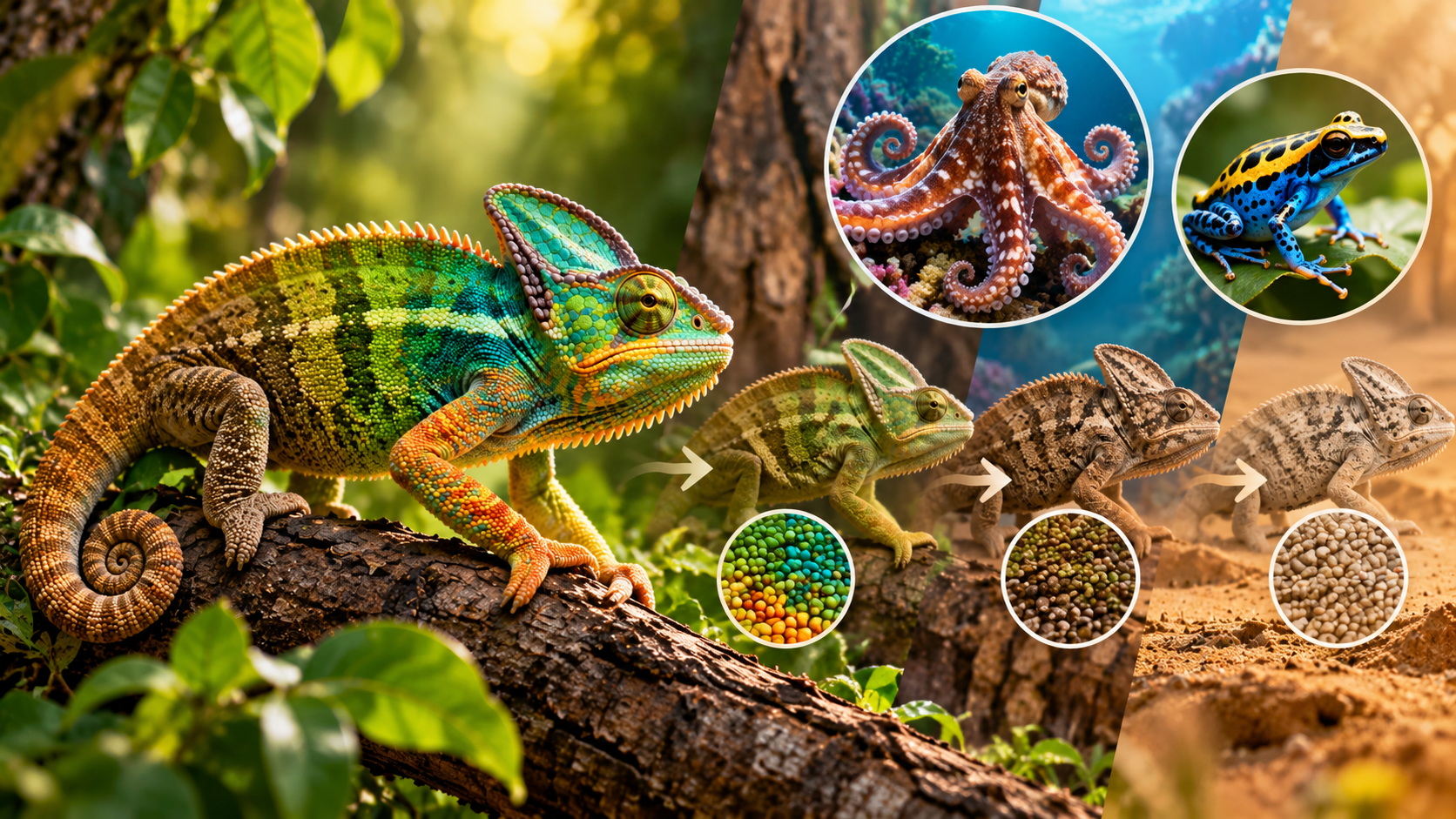
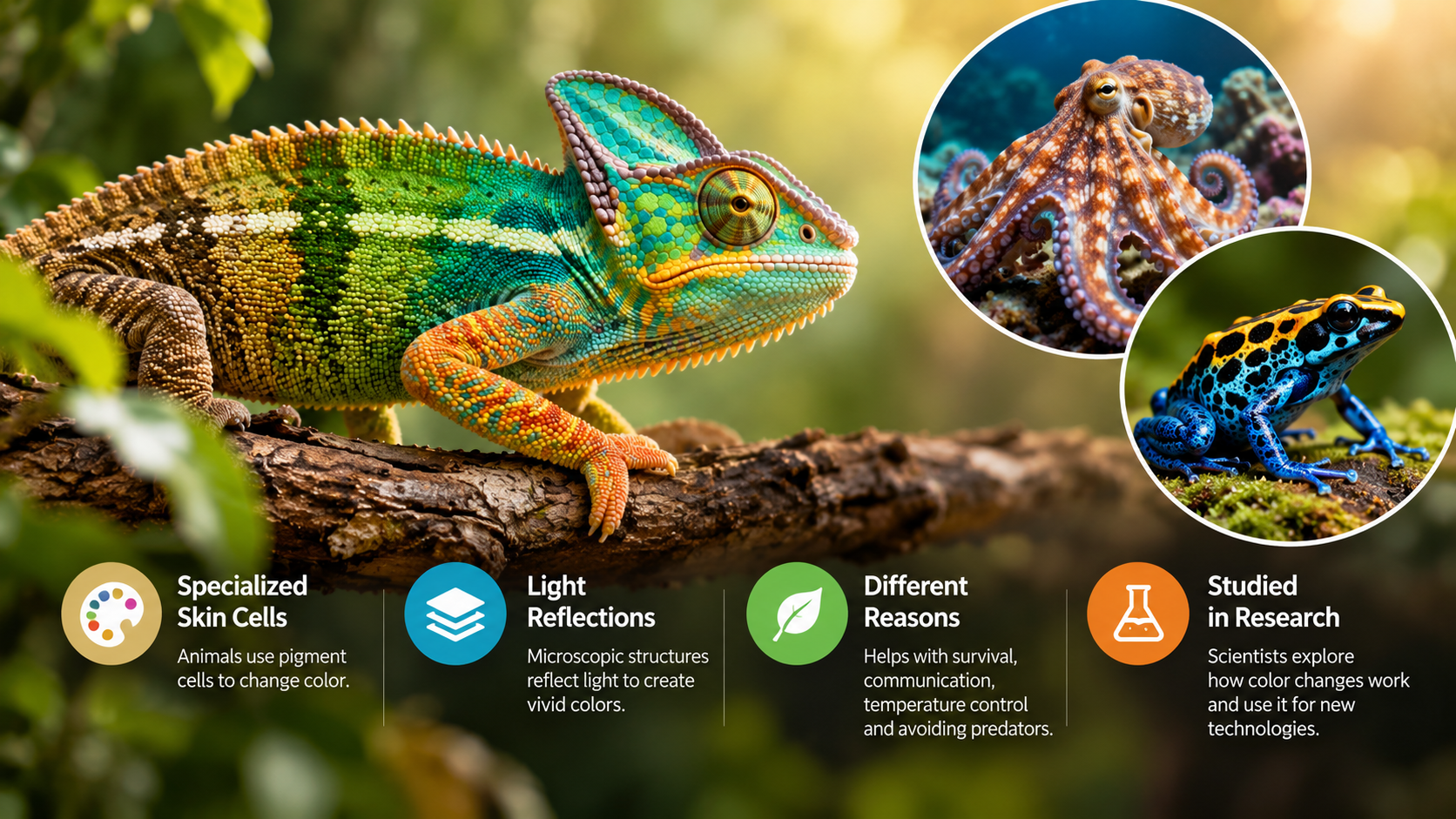
Color changing animals use specialized skin cells and microscopic structures to alter their appearance. One important type of cell is called a chromatophore. These cells contain pigments that produce colors such as red, yellow, brown, and black. In many species, signals from the nervous system or hormones control how these pigments are distributed, allowing the animal to change its appearance.
Some animals use a different method called structural coloration. Instead of relying entirely on pigments, they have microscopic structures that reflect and scatter specific wavelengths of light. Changes in these structures can produce shifting colors, including blue, green, and iridescent shades.
Different species combine these mechanisms in different ways. Octopuses and cuttlefish can change their skin patterns rapidly, helping them blend into their surroundings or communicate with other animals. Chameleons use specialized skin structures to change color, particularly during social interactions and temperature regulation. Understanding these adaptations is an important part of animal behaviour essentials.
The speed and range of these changes depend on the species. Some animals transform their appearance within seconds, while others change gradually over minutes or hours. These adaptations help animals respond to environmental conditions and improve their chances of survival.
The Role of Pigments and Crystals
Pigments and microscopic structures both contribute to the remarkable colors seen in nature. Pigments absorb certain wavelengths of light while reflecting others. This selective absorption creates many familiar colors, including red, yellow, brown, and black.
Structural coloration works differently. Microscopic structures interact with incoming light, reflecting or scattering particular wavelengths. In some species, specialized cells called iridophores contain reflective structures that produce bright blue, green, or iridescent colors.
These mechanisms can work together to create complex patterns. For example, some animals combine pigment cells with reflective layers to produce colors that change with viewing angle or environmental conditions. Chameleons use nanocrystals within their iridophores to adjust reflected light, while cephalopods rely heavily on pigment-filled chromatophores and other specialized skin structures.
Scientists study these biological systems to understand how animals produce such vivid displays. Their findings also inspire research into adaptive materials, flexible camouflage, and color-changing technologies. However, artificial systems still face challenges when attempting to reproduce the speed, flexibility, and complexity of living skin. These discoveries also highlight the value of science books you must read for readers interested in scientific research and innovation.
What are some scientific experiments that change colors?
Scientists conduct experiments to understand how environmental conditions and biological signals influence color changes. Researchers often study cephalopods, such as squid and cuttlefish, because their skin can produce rapid, complex patterns. By presenting different backgrounds or visual stimuli, scientists can observe how these animals adjust their appearance.
Researchers also investigate the nervous system’s role in controlling chromatophores. Electrical recordings, imaging techniques, and controlled stimulation can help reveal how neural signals trigger changes in skin patterns. These studies explain how certain animals coordinate complex displays in response to their surroundings.
Other experiments examine structural coloration in species such as chameleons. Scientists use specialized microscopes and optical measurements to investigate how changes in microscopic crystal arrangements affect reflected light. These findings help explain how some animals produce vivid colors without relying solely on pigments.
Not all color-changing experiments involve living animals. Researchers also test pH-sensitive solutions and develop artificial materials that change color when exposed to heat, light, or chemical changes. Such research may support future technologies, including adaptive camouflage, environmental sensors, and responsive display materials. Studying natural color change therefore contributes to both biology and materials science, connecting with broader discussions about how science and Buddhism can coexist.
What animal is famous for changing color?
The chameleon is one of the most famous color changing animals. These reptiles are native mainly to Africa and Madagascar, although different species also live in parts of Europe, the Middle East, and Asia. Their distinctive eyes, independently moving gaze, and long tongues make them especially recognizable.
Many people believe chameleons change color primarily to camouflage themselves against leaves or branches. Camouflage can play a role, but color changes also help them communicate and regulate body temperature. For example, some chameleons display brighter colors during courtship or confrontations with rivals. Others become darker under certain conditions, helping them absorb more solar energy.
Their skin contains specialized cells, including pigment-bearing chromatophores and reflective iridophores. In several species, microscopic nanocrystals within the iridophores influence the wavelengths of light reflected by the skin. Changes in the arrangement of these crystals can produce noticeable shifts in color.
However, chameleons cannot match every background perfectly. Their color range depends on the species, its physiological state, and environmental conditions. Their changing appearance is a sophisticated biological response rather than a simple ability to imitate any surrounding surface.
What is the scientific explanation for chameleons changing color?
The scientific explanation for chameleon color change involves specialized skin cells, microscopic structures, and the physics of light. Unlike animals that rely mainly on pigment movement, many chameleons change certain colors through structural coloration. Their skin contains layers of iridophore cells with microscopic nanocrystals that reflect specific wavelengths of light.
In species such as the panther chameleon, changes in the spacing between these crystals alter which wavelengths are reflected most strongly. When the spacing changes, the reflected color can shift from shorter wavelengths toward longer ones. This process helps produce visible changes across shades such as blue, green, yellow, and orange.
Chameleons also have pigment cells that contribute to their overall appearance. The interaction between these cells and reflective structures helps create a broader range of colors and patterns.
Color changes can occur in response to social signals, temperature, and other environmental conditions. A male may display more vivid colors during a confrontation with another male. A chameleon may also become darker to absorb more heat in cooler conditions. These responses vary among species, so no single explanation accounts for every color change.
The Physics of Nanocrystal Lattices
Nanocrystal lattices help explain how certain chameleons change color by controlling the way their skin reflects light. These microscopic crystals are arranged within specialized iridophore cells. Their spacing influences which wavelengths of light are reflected and which are absorbed or transmitted.
When the distance between the crystals changes, the reflected wavelengths can change as well. A different arrangement may reflect longer wavelengths, producing colors closer to yellow, orange, or red. Other arrangements can favor shorter wavelengths, including blue.
This process is an example of structural coloration. It differs from changing color solely by moving pigments around within cells. Both mechanisms can contribute to the final appearance of the animal.
The ability to modify reflected light gives chameleons a flexible way to communicate and respond to environmental conditions. Researchers investigate these structures to understand how living organisms control optical effects at microscopic scales. Similar principles may inspire new materials that change their appearance without relying on conventional dyes. However, biological skin remains more complex than most artificial color-changing systems.
How many animals change colors?
Thousands of animal species can change their coloration to some degree, although an exact global count is difficult to establish. Color-changing abilities occur across several groups, including reptiles, amphibians, fish, cephalopods, and certain insects and crustaceans. The mechanisms and purposes differ considerably between species. Exploring the rarest creatures found on Earth can reveal even more about the diversity of animal life.
In marine environments, octopuses, cuttlefish, and squid are especially well known for their rapid color changes. Many use specialized pigment cells to create patterns that help them hide, hunt, or communicate. Some species can also alter skin texture, making their camouflage more convincing.
On land, chameleons and other lizards can change color in response to temperature, stress, or social interactions. Certain frogs adjust their coloration under changing environmental conditions. Some insects and crustaceans also display color changes during development or in response to their surroundings.
It is important to distinguish rapid color changes from gradual changes caused by growth, seasonal conditions, or molting. Not every animal that changes color can do so instantly or produce a wide range of hues.
Scientists continue to discover new species and investigate how coloration evolved. Because these adaptations developed independently in different evolutionary lineages, researchers cannot rely on a single mechanism or species count to describe all color changing animals.
Why did poisonous animals evolved to be colorful?
Poisonous and venomous animals have evolved bright colors in many cases because these patterns warn potential predators of danger. This strategy is known as aposematism. Instead of relying entirely on camouflage, an animal advertises that attacking or eating it may have unpleasant consequences.
Poison dart frogs are a familiar example. Depending on the species, they may display vivid yellow, orange, red, or blue patterns. These colors can signal chemical defenses that make the frogs dangerous or unpleasant to consume. Predators that learn to recognize these signals may avoid attacking similar-looking animals in the future.
Bright warning colors can therefore reduce the risk of predation. However, not every poisonous or venomous animal is brightly colored, and not every colorful animal is dangerous. Some harmless species also resemble toxic animals, benefiting from predators’ learned avoidance of warning patterns.
It is also important to distinguish poison from venom. Poisonous animals generally cause harm when their toxins are swallowed or absorbed, while venomous animals deliver toxins through structures such as fangs or stingers. Both groups may use warning coloration, but their defensive strategies vary.
Aposematism illustrates how animal appearance can influence survival. Through natural selection, warning patterns may become more common when predators learn to associate them with danger. This adaptation helps shape interactions between predators and prey across many ecosystems.
FAQ SECTION
Do mammals have the ability to change their body colors?
No mammals possess the physiological ability to dynamically change their body colors like chameleons or cephalopods. Mammalian skin relies primarily on stable pigments like melanin in hair and skin cells for protection against ultraviolet radiation. While some mammals experience seasonal coat color changes—such as the arctic fox turning white in winter—this process happens gradually over several weeks through hormone-driven hair shedding rather than rapid cellular or neural adjustments.
How fast can cephalopods like octopuses change their skin color?
Cephalopods like octopuses and squids can change their skin color in a fraction of a second, often taking less than three-tenths of a second. This lightning-fast transformation is controlled directly by their central nervous system through specialized motor neurons attached to elastic chromatophore sacs. When these neurons fire, muscles contract instantly to expand pigment sacs across the skin. This unmatched speed allows them to disappear into complex backgrounds or flash warning signals instantly.
Do color-changing creatures use their ability to hunt prey?
Yes, numerous color-changing predators rely heavily on dynamic coloration to successfully hunt and capture prey. Octopuses and cuttlefish expertly shift their skin patterns to mimic surrounding coral reefs or sandy ocean floors, allowing them to ambush unsuspecting fish and crustaceans. By blending seamlessly into their environment, these skilled hunters achieve stealth until they launch a sudden strike with their tentacles, securing their next meal with remarkable efficiency.
Conclusion
The intricate biological mechanisms behind color changing animals showcase the extraordinary power of natural selection. From microscopic chromatophores to structural nanocrystals, animals have evolved remarkable ways to survive in challenging environments.
Throughout this article, we explored how these fascinating organisms change color, examined scientific experiments, and highlighted iconic species like chameleons. We also explored the diversity of color-changing species and the protective role of aposematism in poisonous wildlife.
Understanding these adaptations deepens our appreciation for Earth’s biodiversity and the evolutionary pressures shaping life. When observing wildlife or exploring biomimetic technologies inspired by nature, consider the hidden physics and chemistry behind these transformations. Learning about the world’s top environmental risks also helps explain the challenges facing wildlife and natural habitats.
Supporting wildlife conservation and scientific research helps protect these remarkable species for future generations. Preserving their natural habitats also allows scientists to continue uncovering nature’s fascinating optical mysteries.