
Can You Run House on Solar Power Completely?
Yes, you can run house on solar power completely, but the system must be designed around your home’s actual energy needs. Modern solar panels can generate electricity for many household appliances, while battery storage can provide power when solar generation drops. The U.S. Department of Energy’s Homeowner’s Guide to Solar explains how residential solar systems can supply some or all of a home’s electricity needs.
However, solar independence requires more than installing a few panels. You need to consider your daily electricity consumption, peak loads, available sunlight, roof space, and battery capacity. Appliances such as air conditioners, water heaters, pumps, and refrigerators can significantly increase the required system size.
A properly designed system can reduce or even eliminate your dependence on grid electricity. An off-grid system needs enough solar generation and battery storage for normal days and periods of poor sunlight. A hybrid system can keep the grid available as backup.
This guide explains how to run house on solar power reliably. It covers solar panel requirements, air-conditioning loads, battery storage, and inverter sizing. Understanding these factors can help you avoid an undersized or unnecessarily expensive system.

Can I run my whole house on solar?
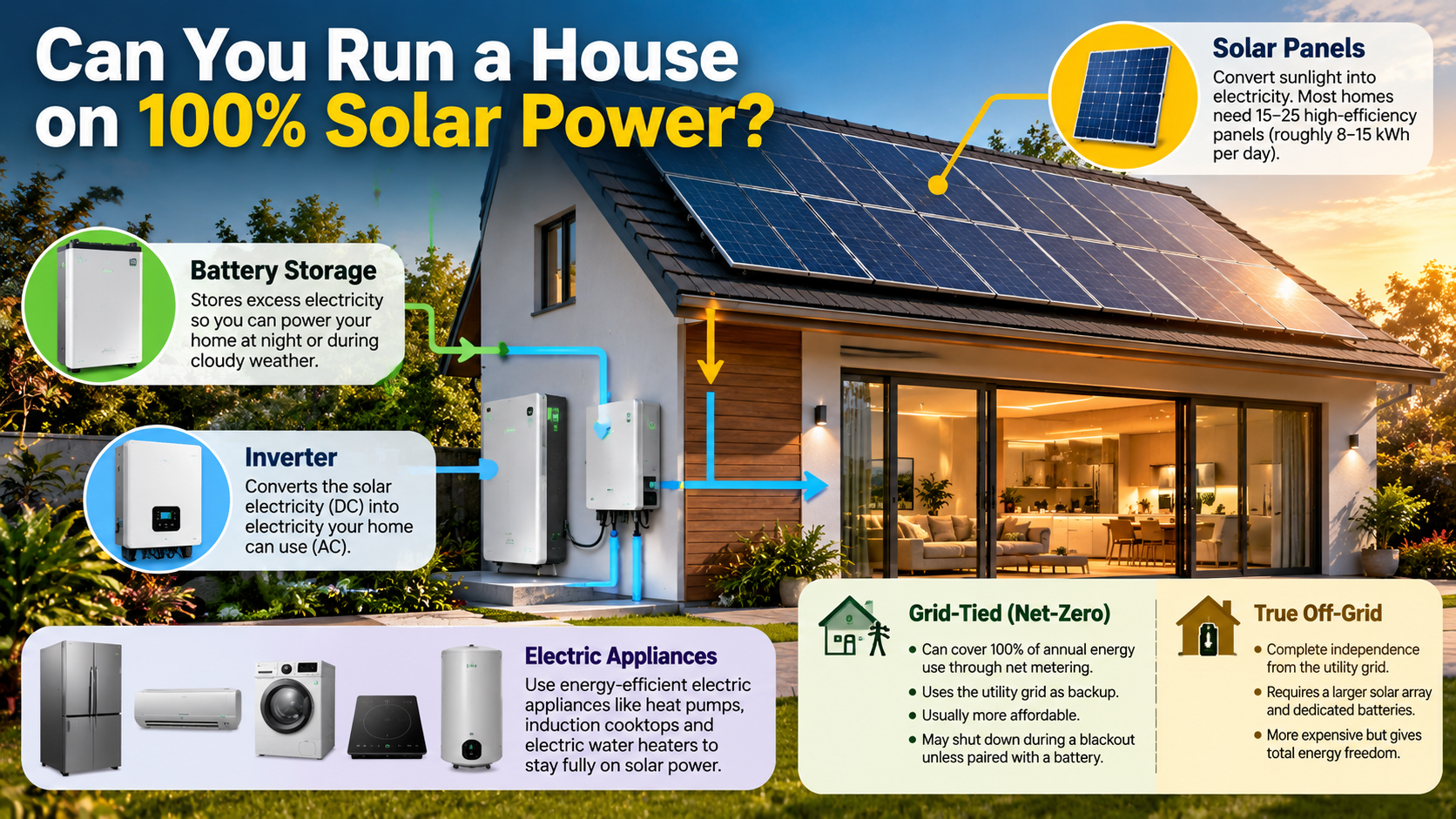
Yes, you can run your whole house on solar power, but the system must match your home’s electricity consumption. Solar panels generate most of their electricity during daylight hours. An off-grid home therefore needs batteries to provide power at night and during periods of low solar production.
Start by calculating your home’s average daily electricity consumption in kilowatt-hours (kWh). Then identify the appliances that create the highest demand. Calculating your home’s solar energy needs can help estimate the system size more accurately. Air conditioners, water heaters, pumps, and other high-power appliances can affect both solar array and inverter sizing.
A complete solar setup usually includes:
- Solar panels to generate electricity.
- An inverter to convert DC electricity into household AC power.
- Batteries to store excess solar energy.
- A charge controller, depending on the system design.
- Protection and distribution equipment for safe operation.
A hybrid system can use the grid as backup when solar generation or battery capacity is insufficient. A fully off-grid system needs additional capacity for cloudy periods.
Battery Storage and Peak Load Management
Battery storage becomes important when you want to run house on solar power beyond daylight hours. The battery should provide enough usable energy for your expected nighttime consumption. It should also have enough reserve for periods when solar generation is lower than normal.
Battery sizing should consider usable capacity rather than only the advertised battery capacity. Depth of discharge, conversion losses, and system efficiency can reduce the energy available for household use.
Peak demand is another important consideration. Several appliances may operate at the same time and push the system beyond its normal load. Air conditioners, pumps, and refrigerators can also create short-term starting demands.
Your inverter therefore needs sufficient continuous output and suitable surge capacity. A load-management system can help prevent overloads by temporarily switching off non-essential appliances.
For an off-grid home, battery capacity should also account for cloudy weather. This can make batteries one of the largest components of the overall solar investment.
How many solar panels are required for a 2bhk house?
There is no universal number of panels for every 2BHK house. The required number depends on daily electricity consumption, panel wattage, local sunlight, roof conditions, and system losses.
For example, a home using around 8–12 kWh of electricity per day could require roughly 2.5–4 kW of solar capacity in a location with good solar resources. Eight 450-watt panels would provide a nominal capacity of 3.6 kW.
However, panels do not produce their maximum rated output throughout the entire day. Heat, clouds, shading, dust, wiring losses, inverter losses, and panel orientation can reduce actual generation.
To estimate your requirements, start with your monthly electricity bills. Convert your average monthly usage into a daily figure. Then compare that figure with the expected solar production in your location.
Your system may need additional capacity if you regularly use:
- Air conditioners
- Electric water heaters
- Water pumps
- Induction cookers
- Large refrigerators or freezers
- Multiple computers and other electronics
Therefore, 6–10 panels may suit some 2BHK homes, but that range should not be treated as a fixed rule.
Accounting for Regional Sunlight and Roof Orientation
Solar generation varies significantly between locations and seasons. Two homes with identical electricity consumption can require different solar capacities because they receive different amounts of usable sunlight.
When planning a system to run house on solar power, consider your area’s peak sun hours, seasonal weather, temperature, shading, and roof characteristics. A roof with strong sunlight throughout the day will generally produce more energy than a heavily shaded roof.
Roof orientation also affects solar production. In many regions, positioning panels toward the equator provides strong exposure. However, the ideal orientation depends on your location and roof design.
Tilt angle matters too. Proper positioning helps panels receive useful sunlight throughout the year. Poor positioning can reduce production even when the panels themselves are efficient.
Before installation, evaluate:
- Daily and seasonal electricity consumption
- Available roof space
- Roof direction and tilt
- Nearby trees and buildings
- Local solar irradiation
- Expected system losses
These factors provide a more reliable estimate than simply counting the number of bedrooms.
How many AC can run in a 3kW solar system?
A 3 kW solar system can potentially run one efficient air conditioner, but the exact result depends on the AC’s electrical consumption and the other appliances operating at the same time.
A 3 kW system has a maximum panel rating of 3 kW under standard test conditions. Actual production varies throughout the day. Heat, clouds, shading, dust, and system losses can reduce the available output.
A modern inverter AC can reduce its power consumption after reaching the desired temperature. However, consumption can rise during extremely hot weather or when the compressor works harder to cool the room.
If you use an AC with a 3 kW solar system, you must also account for other household loads. Refrigerators, fans, lights, televisions, routers, and pumps all consume part of the available electricity.
Running two AC units may exceed the practical capacity of a 3 kW system. The inverter rating is also important because it must handle the home’s total simultaneous demand.
For reliable solar-powered cooling, check the rated input power of the AC, rather than relying only on its tonnage. Higher cooling demand may require a larger solar array, inverter, or battery system.
The Role of Variable Inverter Technology
Inverter air conditioners can make it easier to run house on solar power because their compressors can adjust their speed according to cooling demand. They do not always operate at maximum power.
After the room reaches the selected temperature, an inverter AC can reduce compressor speed. This can lower electricity consumption compared with continuously operating at full power.
However, inverter technology does not remove the need for proper solar system sizing. The AC can still consume significant electricity during very hot weather or when the room needs rapid cooling.
The solar inverter must also support the AC’s electrical characteristics. Modern inverter ACs generally have smoother power demand than older fixed-speed models. However, the home’s total simultaneous load must still remain within the inverter’s continuous output rating.
When planning solar-powered AC operation, consider:
- AC rated input power
- Minimum and maximum compressor consumption
- Outdoor temperature
- Room size and insulation
- Solar generation during operating hours
- Other appliances running simultaneously
- Battery capacity for evening cooling
This approach is more reliable than assuming every 1.5-ton AC uses the same amount of electricity. Actual consumption varies between models and operating conditions.
Can I run AC on a solar panel?
Yes, you can run an AC using solar power, but a conventional household AC should not be connected directly to a solar panel. Solar panels produce variable DC electricity, while typical household air conditioners require regulated AC electricity.
A standard solar-powered AC setup therefore uses solar panels, an inverter, and the required electrical protection equipment. Residential solar panel installation also requires proper planning of these components. Battery storage can also be included when cooling is needed after sunset or during periods of low solar generation.
The inverter converts DC electricity from the panels into suitable AC power. It also manages changes in solar generation. If batteries are included, the system needs appropriate battery charging and management equipment.
The exact setup depends on the AC and solar system. Some specialized DC solar air conditioners can use solar DC power through compatible equipment. These systems differ from conventional AC units.
Before installing an AC with solar power, check its electrical specifications. Pay attention to rated input power, operating range, inverter compatibility, and expected daily energy consumption.
For homeowners planning to run house on solar power, these details help determine whether the solar system can support cooling reliably.
Dedicated Solar Air Conditioning Alternatives
Dedicated solar air conditioners are another option for homes that want to use solar energy specifically for cooling. Some models can use DC electricity from solar panels and may combine solar generation with grid electricity when necessary.
These systems can reduce conversion losses in certain configurations. Their control systems can also adjust operation when solar production changes. However, performance depends on the specific equipment and installation.
A dedicated solar AC is not automatically suitable for every home. You should consider your climate, cooling requirements, solar availability, installation cost, expected operating hours, and backup requirements. Comparing solar and wind energy costs can also provide broader context when evaluating renewable-energy options for a home.
A conventional inverter AC connected to a properly sized household solar system can also provide effective solar-powered cooling. This option may be practical when the solar system already supplies electricity to the rest of the home.
When comparing the two approaches, consider:
- Solar capacity required
- Battery requirements
- AC efficiency
- Installation complexity
- Grid-backup availability
- Expected daily cooling hours
- Maintenance requirements
The best system depends on the home’s complete energy profile. Solar cooling works most reliably when the panels, inverter, battery, and AC are designed to work together.
How many solar panels for 1.5 ton AC?
The number of solar panels needed for a 1.5-ton AC depends on its actual electrical input rather than its cooling capacity alone. A 1.5-ton inverter AC may have a rated input around 1–2 kW, but its actual consumption changes with temperature, settings, efficiency, and compressor speed.
For example, four 500-watt panels provide a nominal solar capacity of 2 kW. Five panels provide 2.5 kW. However, the panels will not continuously produce their full rated output.
Real-world conditions can reduce solar production. Heat, clouds, shading, dust, orientation, and electrical losses all affect generation. Adding some solar capacity can therefore provide a useful operating margin.
Battery storage may also be necessary if you want the AC to operate after sunset. For daytime cooling, additional solar capacity can reduce the amount of energy that needs to come from the battery.
Before choosing the panel count, check:
- AC rated power consumption
- Average operating consumption
- Local peak sun hours
- Solar system losses
- Desired cooling hours
- Other household loads
- Battery requirements
Rather than assuming every 1.5-ton AC requires four, five, or six panels, use the manufacturer’s electrical specifications. This provides a more accurate basis for system sizing.
Sizing Inverter Surge Capacity for Compressor Starts
The inverter must be sized for the home’s complete electrical load, not simply the total wattage of the solar panels. It must provide enough continuous output for appliances operating together.
Older fixed-speed compressors can create significant starting currents. Modern inverter ACs usually manage compressor speed differently and may have lower starting demands. However, the exact electrical requirement varies by model.
For this reason, do not automatically assume that a 3,000-watt inverter will support every 1.5-ton AC. Check the AC manufacturer’s specifications and the inverter’s continuous and surge ratings before installation.
Other appliances also contribute to the total demand. Refrigerators, pumps, fans, lights, computers, and kitchen appliances can all operate at the same time.
A suitable inverter should provide:
- Sufficient continuous output
- Appropriate surge capacity
- Compatibility with the AC
- Adequate battery support when required
- Proper electrical protection
Correct inverter sizing can reduce overloads and unexpected shutdowns. The final specification should therefore consider the complete household load.
If your goal is to run house on solar power, sizing the solar panels, battery, and inverter together is more reliable than sizing each component separately.
Conclusion
Transitioning your property to run house on solar power is a proven, highly achievable milestone for modern homeowners. By matching your daily kilowatt-hour demand with an appropriately sized photovoltaic array and dedicated battery backup, you can eliminate grid dependence. As we have explored, running heavy cooling equipment like a 1.5-ton air conditioner is entirely practical when you design your array with sufficient wattage margins and modern inverter equipment.
A standard 2BHK home can achieve complete daytime energy freedom with a compact setup of 6 to 10 panels. When you supplement that capacity with lithium storage, you secure reliable power day and night. Evaluate your recent utility statements to calculate your true daily electricity needs. Invest in tier-one panels, choose an inverter that accommodates motor surge currents, and consult a certified solar professional to design a dependable system tailored to your property.