

How to Calculate Solar Energy for a Home
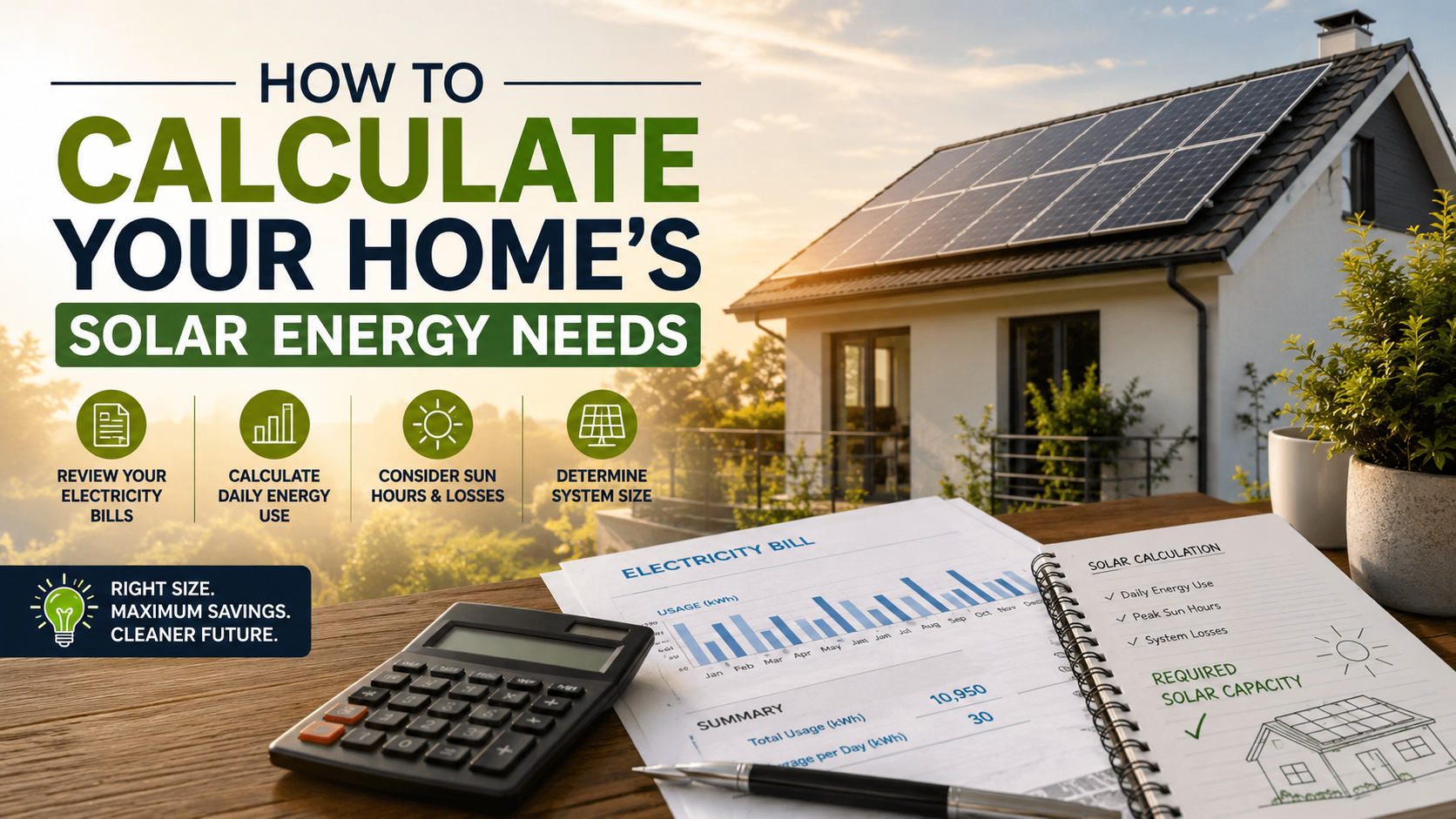
Calculating solar energy for a home begins with your electricity consumption. Start by collecting your utility bills from the previous 12 months. Record the kWh used each month and add those values to determine your annual electricity consumption.
Next, divide your annual consumption by 365. This gives you an approximate daily energy requirement. For example, a home using 10,950 kWh annually consumes about 30 kWh per day. Before moving forward with system sizing, homeowners can review a residential solar panel installation guide to understand the broader installation process.
You then need to estimate how much energy a solar system can produce at your location. A basic planning formula is:
Required solar capacity ≈ Daily energy use ÷ Equivalent peak-sun hours
However, this calculation is only an initial estimate. Solar systems experience losses from shading, soiling, wiring, inverter conversion, temperature, and other factors. NREL’s PVWatts model accounts for these losses when estimating photovoltaic production.
Also consider future electricity demand. An electric vehicle, heat pump, larger air conditioner, or home addition could significantly increase consumption.
Analyzing Utility Bill Data Effectively
Reviewing utility bills helps reveal seasonal energy-use patterns. Compare your highest-use months with your annual average. This can show whether cooling, heating, or another major load drives your electricity demand.
Focus on the kWh figure rather than the dollar amount. Electricity prices can change, while kWh provides a clearer measure of actual energy consumption.
Look for unusual increases as well. A sudden rise could result from a new appliance, increased occupancy, or seasonal weather.
When planning solar, use enough historical data to avoid basing your system size on one unusually low month. A 12-month record provides a much stronger starting point.
You should also estimate future loads before finalizing your system. Adding an EV charger or electric heating system can change your required solar capacity considerably.
What Is the 33% Rule for Solar Panels?
The 33% rule for solar panels is not a universal industry standard. Some solar-sizing discussions use a roughly one-third increase as a simple planning allowance for losses or future demand. However, treating 33% as a fixed requirement can produce inaccurate system estimates.
Solar panels do not deliver their rated output continuously. Actual production depends on sunlight, temperature, shading, panel orientation, soiling, inverter efficiency, wiring, and other system characteristics. NREL’s PVWatts model uses individual loss factors rather than assuming one universal percentage. Comparing solar with other renewable technologies can also provide useful context when evaluating wind vs. solar efficiency.
For example, PVWatts includes factors for soiling, shading, mismatch, wiring, availability, and other losses. Its default assumptions produce a modeled total loss rather than simply adding 33% to the system size.
Therefore, use the 33% figure only as a rough planning shortcut when appropriate. A location-specific production estimate provides a more reliable result.
Factoring Environmental Losses In
Environmental conditions can reduce solar production throughout the year. Shading from trees and buildings can limit sunlight reaching the panels. Dust and dirt can also reduce the radiation reaching the photovoltaic cells. Thoughtful landscaping can help homeowners manage outdoor conditions, as explained in this guide to landscape for energy efficiency.
Temperature affects panel performance as well. Solar modules generally produce less power as cell temperatures rise. Weather conditions can also create substantial daily and seasonal differences in generation.
NREL’s PVWatts model considers several of these factors when estimating system production. Its loss model includes categories such as soiling, shading, mismatch, wiring, availability, and inverter performance.
Rather than automatically adding 33%, homeowners should estimate these losses based on their property and location. A professional site assessment can identify shading and roof-related limitations.
This approach produces a more realistic solar panel system size than relying on a single percentage rule.
What Is the 20% Rule for Solar?
The 20% rule for solar does not have one universally accepted meaning. It may refer to a battery reserve, a planning margin, or a proposed allowance for future electricity demand. These are different concepts and should not be treated as the same rule.
For battery systems, maintaining a reserve can help ensure backup power remains available during an outage. The appropriate reserve depends on the battery manufacturer, system controls, expected loads, and backup objectives. It should not automatically be set to exactly 20%.
Some solar planning approaches also use a percentage increase to allow for future electricity consumption. For example, a homeowner expecting to buy an electric vehicle may intentionally size the system above current consumption.
However, future-proofing should reflect the actual equipment you expect to add. A fixed 20% increase may be too small for major new electrical loads or unnecessary for a home with stable consumption.
Therefore, treat the 20% solar rule as a general planning concept, not a mandatory sizing formula. Use your expected energy needs and equipment specifications instead.
Protecting Battery Health and Longevity
Battery health depends on several factors, including depth of discharge, temperature, charging behavior, cycle frequency, and battery chemistry. Keeping a battery above a specific 20% state of charge is not a universal requirement for every modern solar battery.
Different manufacturers establish different operating ranges. Some systems automatically manage charging and discharge limits to protect battery life.
If you are installing battery storage, follow the manufacturer’s recommended operating limits. Those specifications are more useful than applying a generic percentage rule.
You should also distinguish battery capacity from usable capacity. A battery may have a larger total capacity than the amount available for normal household use.
For backup planning, determine which appliances you need during an outage. Refrigeration, lighting, internet equipment, medical equipment, and selected HVAC loads may have different priorities.
This approach helps you determine both solar battery capacity and solar generation requirements without relying on an arbitrary reserve percentage.
Is 10 kW Enough to Run a House?
A 10 kW solar system can meet the annual electricity needs of many homes, but it is not automatically enough for every household. The answer depends on annual energy consumption, location, solar resource, roof conditions, system losses, and household loads.
A 10 kW rating describes the system’s nominal power capacity. It does not mean the system continuously produces 10 kW throughout the day. Solar output changes with sunlight, weather, temperature, and time of day.
For example, a home with moderate electricity consumption in a strong solar resource may generate enough annual energy from a 10 kW system. A larger home with electric heating, multiple EVs, or other heavy loads may need more capacity.
You should also distinguish between energy production and instantaneous power demand. A home can consume more than 10 kW at a particular moment even when a 10 kW system produces enough energy over an entire year.
Use your 12-month electricity history and a location-specific production estimate before deciding whether 10 kW is appropriate.
Assessing Appliance Power Demands
Large electrical appliances can significantly affect your solar system requirements. Heating and cooling equipment, electric water heaters, EV chargers, and pool equipment can consume substantial amounts of electricity.
Start by identifying the appliances that operate most frequently. Check their wattage or annual energy-use information where available.
Also consider when each appliance operates. An appliance that runs during daylight hours may use solar electricity directly. Nighttime loads may require grid electricity or battery storage.
For backup systems, power demand becomes especially important. Several high-wattage appliances operating simultaneously can exceed the inverter’s rated output even when the solar array is large enough for annual energy needs.
Create a simple appliance inventory that includes:
- Appliance power rating
- Estimated hours of daily use
- Approximate daily energy consumption
- Typical operating time
- Whether the appliance must operate during outages
This information helps distinguish solar energy needs from peak power requirements.
How to Calculate Solar Panel Requirements for a Home
To calculate your solar panel requirement for a home, first determine your average daily electricity consumption. Divide annual kWh usage by 365 to get an approximate daily requirement. Once you have an initial estimate, you can compare it with practical considerations covered in a residential solar panel installation guide.
Next, estimate the solar energy available at your location. A basic planning calculation divides daily electricity demand by equivalent peak-sun hours. The result provides an initial estimate of the required solar capacity.
For example, a home using 30 kWh per day in an area with five equivalent peak-sun hours would require about 6 kW before accounting for system losses.
You then need to account for real-world performance. Instead of automatically adding a fixed percentage, use a location-specific production model or installer estimate. NREL’s PVWatts calculator is designed to estimate photovoltaic energy production using location and system characteristics.
Finally, divide the required system capacity by your chosen panel’s wattage. A 6 kW array using 400-watt panels would require about 15 panels before final design adjustments.
Matching Roof Space and Panel Wattage
Roof space is another important part of solar panel sizing. The number of panels you need depends on each panel’s wattage and the final system capacity. Roof design also matters when evaluating how to select a sustainable roof system for a property.
Higher-wattage panels can reduce the number of modules required for the same total system capacity. However, panel dimensions, roof layout, setbacks, vents, skylights, and shading can limit how many modules fit.
Do not calculate roof capacity using panel count alone. Measure usable, unshaded roof areas and consider the orientation of each roof section.
For example, a roof may have enough total area for the required panels but still lack enough suitable space because of chimneys, dormers, vents, or nearby trees.
Your installer should also evaluate structural conditions and local installation requirements. These factors can change the final layout.
Before purchasing equipment, compare your calculated system size with the available roof area. This confirms whether the proposed home solar system is practical for your property.
FAQ SECTION
How many solar panels do I need for a 2,000-square-foot house?
A 2,000-square-foot home may require around 15 to 25 solar panels, but square footage alone cannot determine the correct number. Your electricity consumption, location, roof orientation, shading, panel wattage, and system efficiency all affect the calculation. To learn how to calculate your home’s solar energy needs, review your annual electricity usage first. For example, a 6 to 10 kW system using 400-watt panels would require approximately 15 to 25 panels. Homes with higher electricity consumption may need additional capacity. A professional solar assessment can provide a more accurate estimate based on your property and energy usage.
Do solar panels still generate power on cloudy days?
Yes, solar panels still generate electricity on cloudy days, although their output is usually lower than during clear, sunny conditions. Photovoltaic panels can capture diffuse sunlight that passes through or scatters around clouds. However, the amount of electricity produced depends on cloud thickness, weather conditions, panel technology, and the available sunlight.
When learning how to calculate your home’s solar energy needs, you should account for changes in solar production throughout the year. A system designed only around ideal sunny conditions may not meet expected energy production during periods of poor weather. Location-specific solar production estimates provide a more realistic picture of annual generation.
What happens to my solar panels at night?
Solar panels do not generate electricity at night because photovoltaic cells require sunlight to produce power. Your home can still operate normally after sunset by using electricity from the utility grid or stored energy from a solar battery.
If your system includes battery storage, excess daytime solar production can charge the battery for evening use. Some homeowners may also benefit from net metering or other utility programs, depending on local regulations and eligibility.
Understanding nighttime consumption is an important part of how to calculate your home’s solar energy needs. Your system should account for both daytime production and the electricity your household requires after sunset.
How long do residential solar panel systems last?
Most quality residential solar panels are designed to operate for 25 to 30 years or longer. Their electricity production gradually declines over time rather than stopping suddenly. Many manufacturers provide long-term performance warranties that specify minimum production levels after several decades.
However, the panels are only one part of a complete solar energy system. Inverters, batteries, wiring, and other components can have different lifespans and replacement requirements. Battery systems may require replacement sooner than the solar modules themselves.
When considering how to calculate your home’s solar energy needs, think beyond the initial installation. Long-term performance, maintenance, equipment warranties, and future electricity consumption can all affect the value and suitability of your solar investment.
Conclusion
Understanding how to calculate your home’s solar energy needs starts with accurate electricity-use data. Review at least 12 months of utility bills and determine your average daily consumption. Then consider your location, available sunlight, roof conditions, panel wattage, and expected system losses.
Avoid relying on household size or square footage alone. A smaller home with high electricity consumption may require more solar capacity than a larger, energy-efficient property.
The same principle applies to system rules and capacity estimates. A 10 kW system may work well for one household but fall short for another. Future purchases, such as an electric vehicle or heat pump, can also increase your energy requirements.
Learning how to calculate your home’s solar energy needs helps you make better decisions before requesting installation quotes. Use your energy data as the starting point, compare it with realistic solar production estimates, and have a qualified professional verify the final system design.