

Remote Software Deployment: How to Manage Teams Smoothly
Coordinating continuous delivery across distributed engineers requires structured processes, strong communication, and clear accountability. A successful remote software deployment depends on real-time alignment across distributed development environments. Engineering leaders must balance delivery speed with release stability while reducing unnecessary developer fatigue.
According to the DORA (DevOps Research and Assessment) research program, high-performing teams benefit from practices such as automated testing, trunk-based development, and transparent documentation. These practices become especially important when developers work across different locations and time zones.
Distributed architectures also create collaboration challenges that centralized offices may handle more easily. When engineers deploy code across multiple time zones, asynchronous communication becomes essential. Without clear operational playbooks, small pipeline failures can become production incidents.
This guide explains how to manage remote teams, improve deployment workflows, and maintain accountability. It also covers practical management tips, useful collaboration tools, and examples of fully remote technology companies.
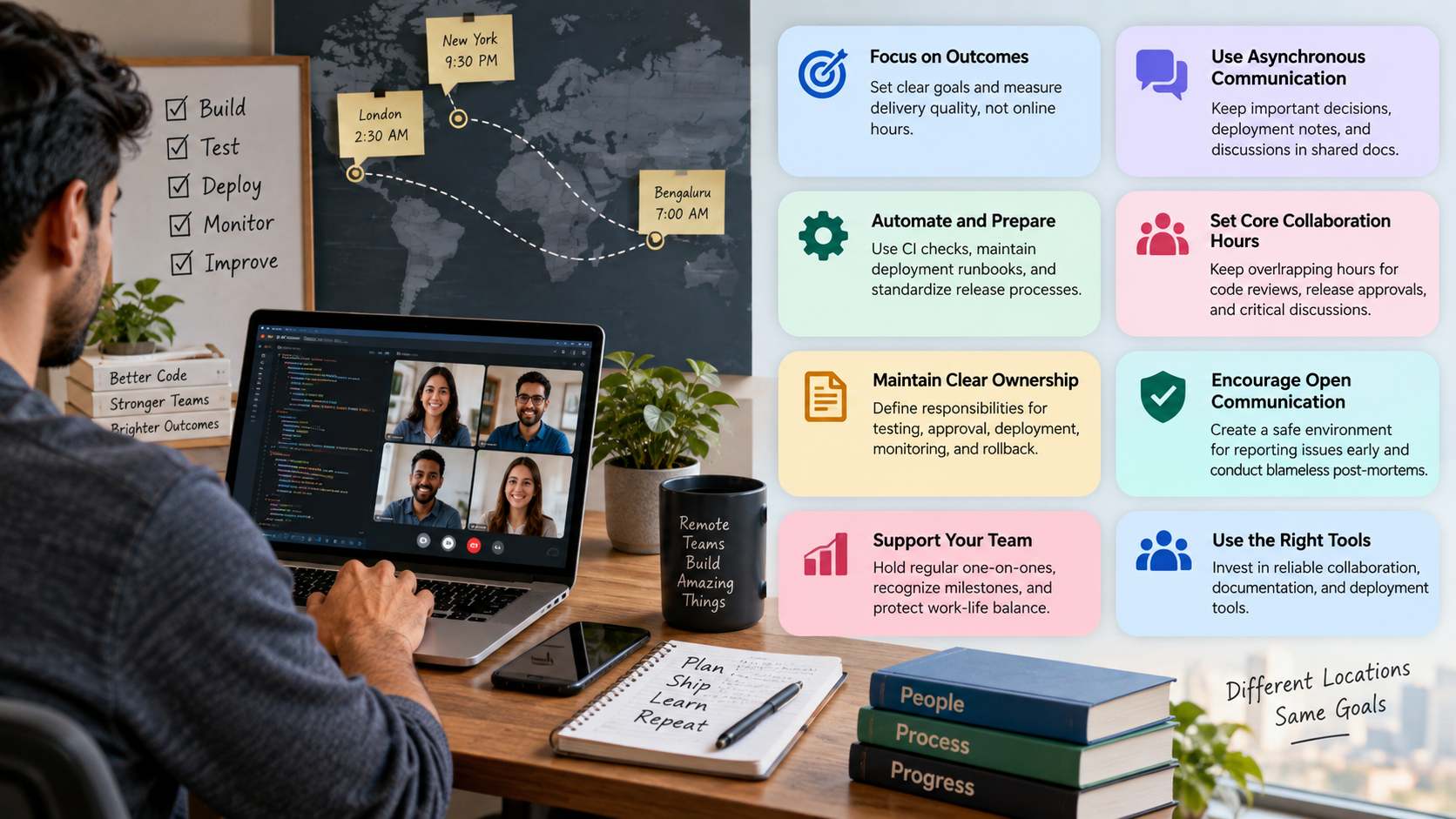
How to manage teams effectively remotely?
Managing teams effectively remotely requires a shift from monitoring activity toward measuring meaningful outcomes. Instead of tracking online status or working hours, managers should define clear delivery milestones and quality expectations. This approach gives developers autonomy while maintaining accountability. For teams improving their workflows, best project management tools for teams can also provide structured ways to organize tasks, milestones, and responsibilities.
For remote software deployment, asynchronous communication should become the default for routine updates. Important decisions, deployment notes, and technical discussions should remain in shared repositories or documentation platforms. This prevents information from becoming trapped inside private conversations.
Teams should also establish core overlap hours for activities that benefit from real-time communication. These may include peer code reviews, release approvals, architecture discussions, and incident response.
Regular sprint retrospectives can reveal problems within distributed deployment workflows. Managers should also create psychological safety so engineers can report failed builds, staging problems, or deployment risks early.
Clear ownership is equally important. Every release should have defined responsibilities for testing, approval, deployment, monitoring, and rollback. This structure reduces confusion when issues occur outside normal working hours.
What are 12 tips for managing remote teams effectively?
Executing smooth remote software deployment cycles requires practical disciplines across engineering, communication, and management. Teams should establish clear delivery metrics that emphasize software quality instead of online activity. Automated continuous integration checks can catch errors before releases reach production.
Detailed deployment runbooks should explain common release and rollback procedures. Centralized sprint documentation and project management tools keep project information available to everyone. Defined collaboration hours make important deployment discussions easier across time zones.
Teams should also standardize incident response procedures and encourage asynchronous status updates. Regular one-on-one meetings can uncover workload issues, technical blockers, and development needs before they become larger problems.
A practical framework includes these 12 priorities:
- Measure delivery quality and outcomes.
- Automate continuous integration checks.
- Maintain detailed deployment runbooks.
- Centralize project documentation.
- Define overlapping collaboration hours.
- Standardize incident response.
- Encourage asynchronous updates.
- Hold consistent one-on-one meetings.
- Invest in reliable delivery tools.
- Recognize meaningful shipping milestones.
- Protect work-life balance.
- Conduct blameless post-mortems after failures.
Together, these practices create a more consistent environment for distributed development and remote software deployment.
Which of the following should be done to effectively manage remote teams?
Effective remote management should prioritize structured workflows, automation, and measurable expectations. Leaders should avoid confusing employee visibility with productivity. A developer can be highly productive without remaining continuously available in chat applications.
For remote software deployment, teams should maintain asynchronous documentation, structured code reviews, and transparent sprint roadmaps. These practices help engineers understand priorities without requiring constant meetings.
Managers should also avoid intrusive tools such as keyboard trackers or excessive status requests. Such systems can create unnecessary pressure without measuring actual software quality. Instead, leaders should focus on delivery outcomes and remove infrastructure blockers quickly.
Reliable staging environments are another important priority. Engineers need realistic environments where they can test changes before production deployment. Cross-functional alignment also matters when releases involve product, security, operations, or support teams.
A healthy remote workflow gives contributors ownership over their work while keeping responsibilities visible. Managers should define who owns each release stage and how teams escalate problems.
These practices make remote software deployment more predictable. They also help distributed engineers focus on building stable software rather than proving that they are online.
How should remote employees be managed?
Managing remote employees requires clear expectations, regular communication, and respect for individual working conditions. Managers should define measurable contribution goals that connect individual responsibilities with broader project objectives.
Weekly one-on-one meetings can provide space to discuss professional development, technical blockers, workload, and team collaboration. These meetings should not become repetitive status reports when project tools already provide that information.
For remote software deployment, managers must also respect time-zone differences. A release that requires late-night responses from the same engineers repeatedly can create unsustainable working patterns. Teams should establish escalation procedures that distribute urgent responsibilities appropriately.
Employees also need access to suitable hardware, development environments, communication platforms, and continuous delivery tools. Poor infrastructure can create delays that managers may incorrectly interpret as performance problems.
Clear ownership is equally important. Each employee should understand their responsibilities during development, testing, deployment, monitoring, and incident response.
Remote management works best when autonomy exists alongside accountability. Engineers should have freedom to organize their work while meeting agreed deadlines and quality standards.
By combining clear goals with consistent support, managers can create a stable environment for distributed development and more dependable software releases.
What tools are best for managing remote employees?
The right software tools can keep distributed engineering teams connected and organized. For project tracking and sprint planning, Jira and Linear provide structured issue management and workflow visibility. These tools help teams track development work without relying on private conversations.
GitHub and GitLab support distributed version control, pull requests, code review, and automated development workflows. Their integration capabilities can also connect source-code activity with deployment pipelines.
For communication, Slack and Discord provide channel-based collaboration and can support automated notifications. Deployment systems can send alerts when builds fail, releases complete, or incidents require attention.
Documentation platforms such as Notion and Confluence can store architecture decisions, deployment procedures, troubleshooting guides, and retrospective notes. A centralized knowledge base is particularly useful for remote software deployment, especially when teams need to understand how cloud storage and external hard drives differ for storing and accessing important files outside another teammate’s working hours.
Teams should avoid adopting tools simply because they are popular. Each platform should have a defined purpose and ownership model. Too many overlapping systems can create information silos.
A practical toolset should make work visible without creating unnecessary administrative effort. When project tracking, communication, source control, documentation, and deployment alerts work together, distributed teams can coordinate releases more consistently.
Which company is 100% remote?
GitLab is a prominent example of a technology company built around an all-remote operating model. The company has described itself as an all-remote organization, with team members working across many countries and regions.
Rather than depending on a traditional central office, GitLab emphasizes documentation, asynchronous communication, and digital collaboration. Its public handbook documents many aspects of how teams operate, including communication and signs of a good company culture in remote-work practices.
The model is particularly relevant to remote software deployment because distributed engineers need reliable systems for sharing information. Documentation can reduce dependence on informal office conversations and make operational knowledge easier to access across time zones.
GitLab’s engineering workflows also use modern software development practices, including version control, code review, continuous integration, and continuous delivery. These practices support collaboration when engineers are not working from the same physical location.
However, a remote operating model does not automatically solve management challenges. Organizations still need clear ownership, effective communication, reliable infrastructure, and strong documentation.
GitLab provides a useful case study for understanding how a large technology organization can structure distributed work. Its approach demonstrates the importance of systems and processes when teams develop, review, deploy, and maintain software across geographic boundaries.
Frequently Asked Questions
How do time zones affect remote deployment schedules?
Dispersed time zones require teams to select deployment windows that do not isolate individual on-call engineers. Rather than forcing late-night releases, modern teams schedule deployments during overlapping working hours. This window ensures that staging support, quality assurance, and site reliability engineering teams are available simultaneously. Asynchronous handoff protocols handle maintenance when schedules diverge.
What is the biggest challenge in remote deployments?
Communication breakdowns during pipeline failures remain the single greatest challenge for distributed teams. Without shared physical war rooms, teams risk fragmented incident response across disorganized private chat threads. Organizations solve this operational hurdle by designating primary incident commanders, automating incident alerts, and standardizing runbooks inside centralized knowledge bases before deployment day arrives.
How often should distributed engineering teams ship code?
Distributed engineering teams should deploy code frequently in small, manageable batches. Elite development teams ship updates multiple times daily by relying on automated testing suites and continuous delivery pipelines. Frequent micro-deployments drastically reduce release risk, simplify immediate troubleshooting, and prevent massive code merge conflicts across distributed repositories.
Can automated testing completely replace staging oversight?
Automated testing catches functional bugs and regression issues rapidly, but human verification remains essential for complex database migrations and user experience validations. Automated pipelines must handle routine unit tests and integration suites, freeing senior software engineers to review critical architecture changes, verify environmental dependencies, and approve final production releases.
Conclusion
Executing a dependable remote software deployment requires clear engineering playbooks, deliberate operational frameworks, and intentional communication. Managing dispersed engineering teams effectively means leaving outdated micromanagement behind and embracing objective output metrics, continuous integration, and transparent documentation. By implementing automated testing suites, unifying tool ecosystems, and drawing inspiration from all-remote innovators like GitLab, engineering leaders can remove friction from distributed release pipelines.
Success relies on establishing psychological safety, protecting deep work intervals, and ensuring every engineer understands staging and deployment rollback procedures. When distributed teams operate with shared autonomy and proven tooling, geographical separation transforms from a management hurdle into a competitive advantage. Apply these proven deployment strategies today to empower your remote engineers, accelerate continuous delivery, and release resilient production software with complete confidence.