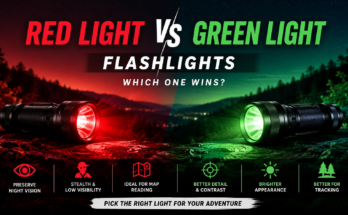
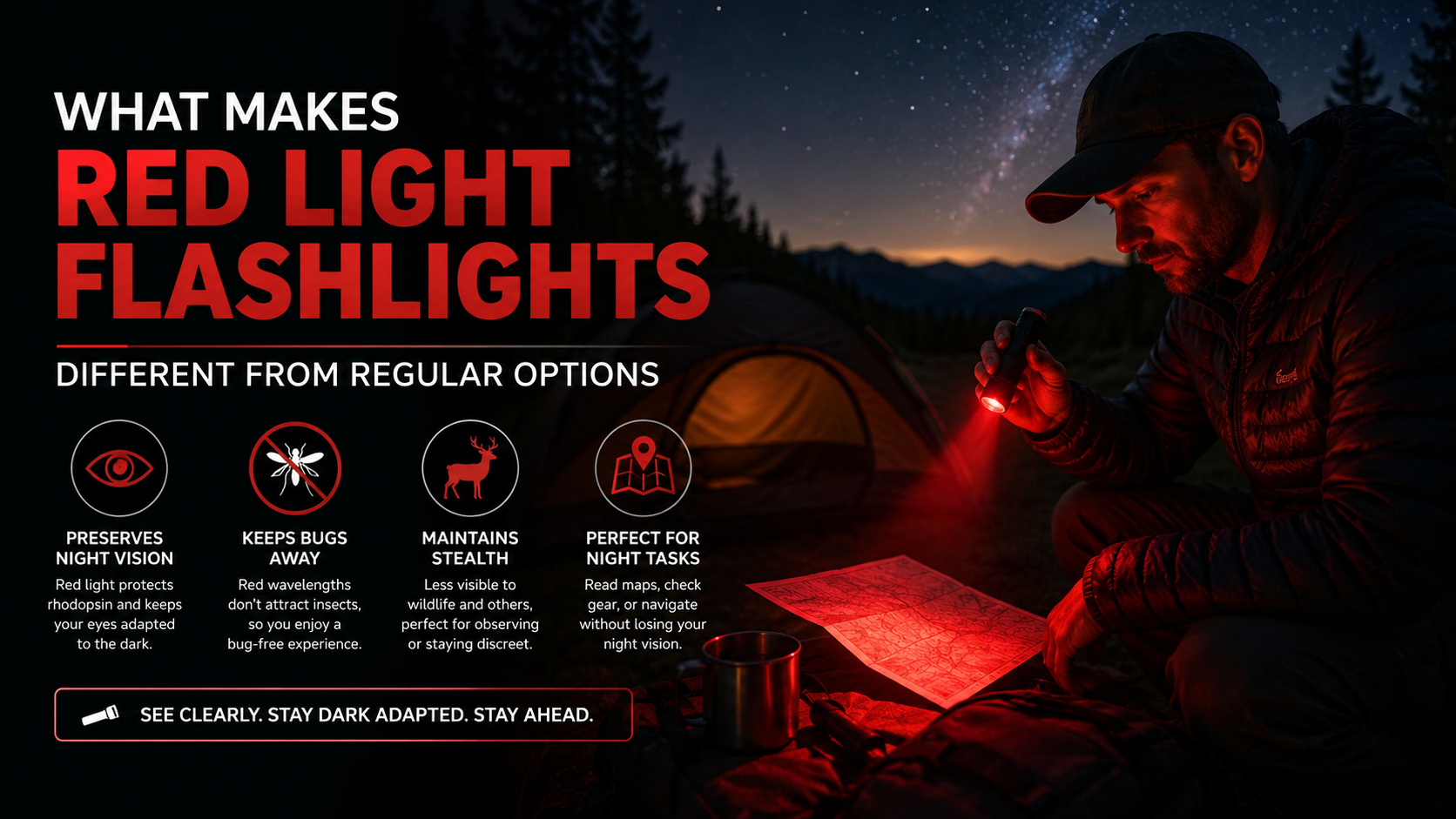
What Makes Red Light Flashlights Different From Regular Options
If you spend any time outdoors after dark, you already know how blinding a standard white LED can be. Whether you are setting up a campsite, checking a trail map, or looking through a telescope, bright white beams completely ruin your natural ability to see in the dark. This is exactly why outdoor enthusiasts, astronomers, and tactical professionals rely on red light flashlights instead.
But what exactly sets them apart from the standard flashlights you keep in a kitchen drawer? The difference fundamentally comes down to biology and physics. When you use a standard white flashlight, your pupils constrict immediately. This biological reaction forces your eyes to constantly readjust to the darkness every time you turn the beam off.
Red light, however, operates on a much longer wavelength. According to experts at Sky & Telescope, red wavelengths do not bleach the light-sensitive pigment in your eyes. This scientific fact allows you to navigate effectively without destroying your hard-earned dark adaptation.
In this guide, we will explore exactly what makes these specific tools different from regular options. We will cover the science behind human vision, the practical benefits of using red illumination, and the best real-world applications for your outdoor gear kit. By the end, you will understand exactly why a red beam is mandatory for nighttime exploration.
Are red light flashlights better?
Red light flashlights are not universally better than regular torches, but they excel in specific night tasks. They outperform white light whenever you need to preserve your natural night vision in pitch-black settings. Regular white beams cause immediate pupil constriction, blinding you temporarily when you turn the device off. Red beams bypass this harsh reaction, letting your eyes stay adjusted to the dark environment effortlessly. However, white light remains far superior for general tasks, color differentiation, and maximum illumination distance. Therefore, choosing the right tool depends entirely on your specific activity and immediate lighting needs.
Wavelength Physics and Human Eye Sensitivity
The superiority of red beams stems directly from human biological optics and light physics. Rod cells in our eyes handle low-light vision and remain largely insensitive to long-wavelength red light. When you switch on a red beam, your rods do not bleach their rhodopsin pigments entirely. This clever biological quirk lets you see map details without triggering a reset in your dark adaptation timeline.
Why do astronomers use red flashlights?
Astronomers rely heavily on red light flashlights because deep space observation demands absolute dark adaptation for hours. Stargazers spend considerable time letting their eyes adjust to faint starlight and distant nebulae through telescope eyepieces. Turning on a bright white flashlight instantly ruins this hard-earned night vision, requiring another thirty minutes of dark adaptation. Red illumination provides just enough localized light to read star charts or adjust camera settings without interfering with sensitive eye receptors. This practical habit ensures astronomers can read equipment dials while maintaining optimal vision for observing faint celestial objects across the night sky.
Protecting Faint Starlight Viewing Capabilities
Stargazing requires maximum sensitivity from human eye photoreceptors to detect faint photons traveling across the universe. White light overwhelms these delicate cells and forces pupils to close rapidly, obscuring dim stars entirely. Red illumination avoids this disruption, allowing scientists and hobbyists to maintain peak visual acuity while working efficiently under dark rural skies.
Why use a red flashlight at night?
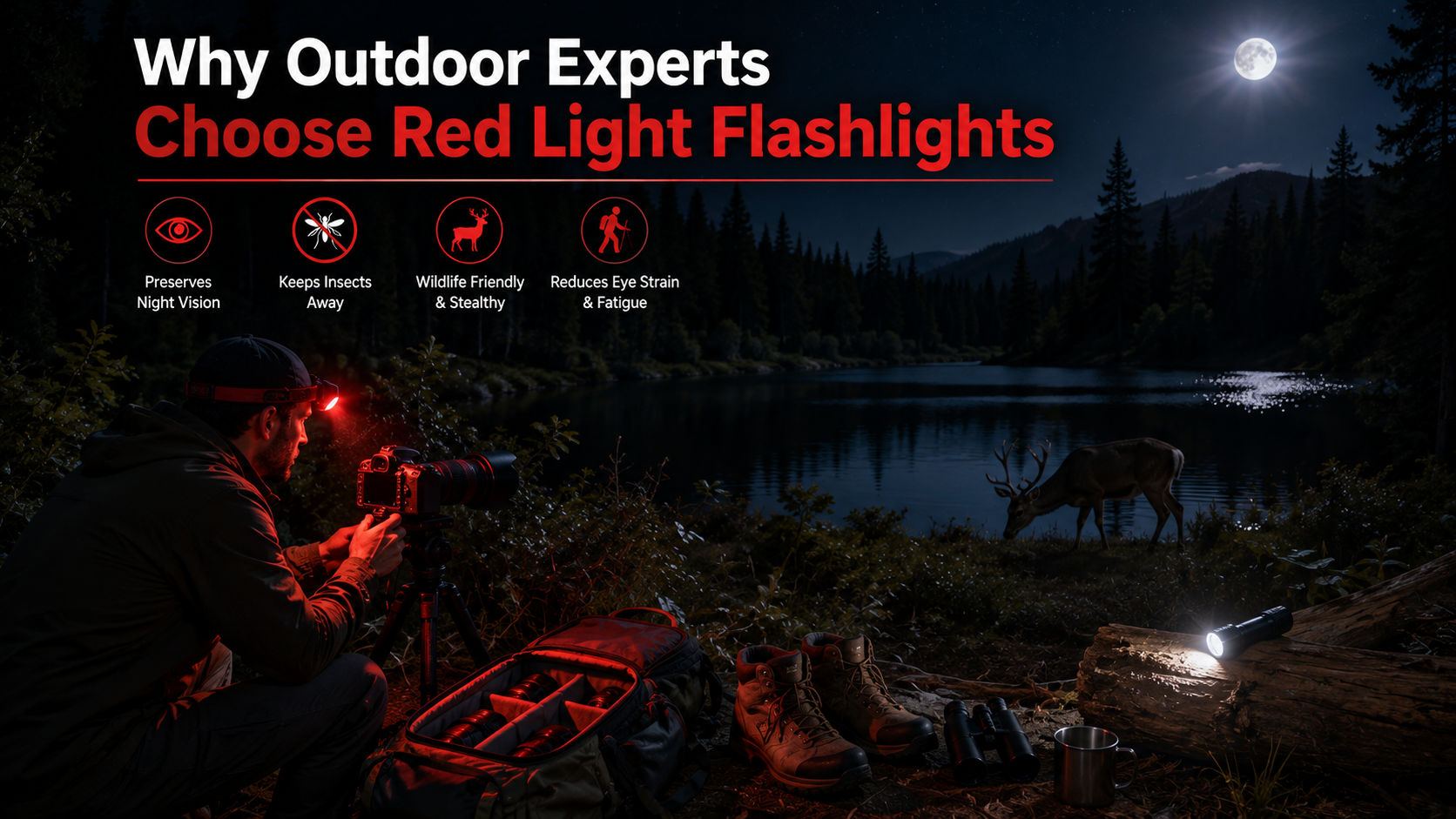
Using a red flashlight at night prevents temporary blindness and keeps your pupils dilated in dark environments. Whether you walk down a dark campsite trail or navigate a tent, white light creates harsh glare and disturbs sleeping companions. Red beams emit a soft, localized glow that illuminates your immediate path without casting blinding reflections. This discreet nature also prevents you from attracting unwanted attention or ruining the night vision of fellow campers. Furthermore, insects are notoriously less attracted to red light wavelengths compared to harsh white LED bulbs.
Preserving Night Vision and Camp Comfort
Navigating a dark campsite requires careful balance between personal safety and minimizing disruptions to others nearby. Blasting a high-lumen white beam wakes up fellow campers and destroys everyone’s night vision instantly. A gentle red glow provides adequate visibility for finding gear or walking paths while maintaining a peaceful, dark environment for the entire group.
What Are Red Light Flashlights Good For?
Red light flashlights prove exceptionally useful across a wide variety of specialized outdoor, tactical, and industrial applications. Hunters frequently use red beams because many game animals cannot perceive red wavelengths clearly, allowing hunters to track targets without startling them. Military personnel and tactical operators rely on red settings to read maps discreetly during night operations without giving away their position. Photographers working in darkrooms or night landscapes use red illumination to adjust camera settings safely. Additionally, automotive mechanics and emergency responders utilize red filters or bulbs to preserve night vision during roadside repairs.
Tactical Stealth and Wildlife Observation
The unique properties of red illumination make it invaluable for discreet nighttime operations and wildlife tracking. Because many animals lack sensitivity to long red wavelengths, observers can watch wildlife without causing behavioral distress or flight responses. Similarly, tactical professionals use low-intensity red beams to maintain operational security and preserve situational awareness during high-stakes nighttime deployments.
Is a 200,000 Lumen Flashlight Real?
A flashlight advertised as producing 200,000 lumens in a handheld consumer device is generally unrealistic. While extremely powerful lighting systems do exist, they require large power sources, advanced cooling systems, and much larger housings than a typical flashlight.
Lumens measure the total amount of visible light emitted by a source. Producing 200,000 lumens generates enormous heat and consumes significant electrical power. A pocket-sized flashlight cannot safely sustain that output using standard rechargeable batteries.
Many online listings exaggerate brightness figures to attract buyers. Some confuse lumens with beam distance or peak beam intensity, while others simply use inflated marketing claims. Before buying a high-output flashlight, look for products tested under the ANSI FL1 standard or supported by trusted independent reviews. Reputable manufacturers usually publish realistic performance data, including runtime and regulated output, making it easier to compare different models accurately.
Understanding Marketing Hype and Thermal Limits
Many budget flashlight brands advertise extremely high lumen ratings that cannot be verified through independent testing. These claims often exceed the physical limits of compact handheld electronics.
High-powered LEDs generate substantial heat. Without efficient heat sinks and thermal regulation, excessive temperatures can reduce brightness, damage components, or shorten the LED’s lifespan. Quality flashlights automatically reduce output when temperatures become too high.
When comparing flashlights, focus on verified specifications rather than headline lumen numbers. Look for regulated output charts, ANSI FL1 certification, realistic runtime data, and reviews from trusted testers. These details provide a much more accurate picture of real-world performance than exaggerated marketing claims.
How Do I Make My Flashlight a Red Light?
Converting a standard white flashlight into a red light flashlight is simple and affordable. In most cases, you can make the change without replacing the flashlight itself.
The easiest solution is to install a red filter over the flashlight lens. Slip-on silicone filters and dedicated red lens caps block most other wavelengths while allowing red light to pass through. Another option is applying a transparent red lighting gel or vinyl film that fits securely over the lens.
If your flashlight uses a modular design, you may be able to replace the white LED with a dedicated red LED emitter. Some premium tactical flashlights also include built-in red LEDs alongside white and green modes, allowing you to switch colors with a single button. The best option depends on your flashlight design and how often you plan to use red illumination.
Using Slip-On Filters for Easy Conversion
Slip-on red filters are one of the most convenient ways to convert a flashlight temporarily. They install in seconds and can be removed just as quickly when white light is needed.
This flexibility makes them popular with campers, hunters, astronomers, and outdoor enthusiasts. Instead of carrying separate flashlights, you can switch between white and red illumination whenever conditions change. It’s an inexpensive upgrade that adds versatility while helping preserve your night vision during nighttime activities.
Why Do Military Use Red Flashlights?
Military personnel use red flashlights because they help maintain night vision while reducing visibility during nighttime operations. Bright white light can reveal a person’s position from long distances and temporarily reduce the user’s ability to see in darkness.
Red light produces a lower visual signature and is generally less disruptive to dark-adapted eyes. Soldiers use it to read maps, inspect equipment, review checklists, and move inside vehicles or command posts without flooding the area with bright illumination.
This allows units to remain more prepared when transitioning between lit and dark environments. While red light can still be detected, it is often preferred for close-range tasks that require discretion and minimal light output. These characteristics make red tactical flashlights valuable tools in military, law enforcement, and other professional nighttime operations.
Tactical Concealment and Operational Readiness
Maintaining operational security often requires limiting unnecessary light. Red illumination provides enough visibility for close-range activities without producing the intense glare associated with white LEDs.
Military personnel commonly use red light for equipment checks, weapon maintenance, reading maps, and communicating inside vehicles or temporary shelters. Because their eyes remain better adapted to darkness, they can respond more quickly when lights are switched off.
Many tactical flashlights include dedicated red LEDs or compatible red filters for this reason. While no light source is completely invisible, controlled red illumination offers a practical balance between visibility and reduced visual disturbance during nighttime missions.
Frequently Asked Questions
Can Red Light Attract Bugs?
Red light generally attracts far fewer insects than white, blue, or ultraviolet light. Most flying insects are much more responsive to shorter wavelengths, especially UV and blue light, which they use for navigation.
Because red light has a longer wavelength, many insects show little interest in it. This makes a red light flashlight an excellent choice for camping, fishing, hiking, and other outdoor activities where insects are common. Although it won’t eliminate bugs completely, it can significantly reduce the number drawn to your light source.
Does Red Light Help You Sleep Better?
Red light has a much smaller effect on melatonin production than blue or bright white light. Melatonin helps regulate your body’s natural sleep-wake cycle, and exposure to blue-rich light before bed can suppress its production.
Using a dim red flashlight at night allows you to move around without exposing yourself to intense white light. While a red flashlight is not a sleep treatment, it is generally less disruptive to your circadian rhythm and may make it easier to return to sleep after nighttime interruptions.
Is Red Light Better for Hunting?
Many hunters prefer red hunting lights because several game animals have limited sensitivity to red wavelengths. Deer, feral hogs, coyotes, and other species often perceive red light less distinctly than humans do.
This can help reduce the chance of startling animals while scanning fields or tracking movement. However, animal vision varies by species, and red light does not make a hunter invisible. Always follow local hunting regulations and use lighting responsibly during nighttime hunting activities.
Can Red Light Pass Through Fog Better?
Red light generally experiences less scattering than shorter wavelengths such as blue light. Because of its longer wavelength, it can reduce glare in fog, smoke, and dusty conditions compared to bright white or blue-rich light.
However, the improvement is often modest rather than dramatic. Vehicle fog lights are commonly yellow or amber because those colors also reduce scattering effectively while providing good visibility. Even so, a red flashlight can perform well in misty environments and may offer a clearer view than a standard white beam in certain conditions.
Conclusion
Understanding what makes red light flashlights different from regular options ultimately comes down to basic biology and practical purpose. Regular white flashlights certainly dominate when you need extreme brightness, long-distance visibility, and highly accurate color rendering.
However, standard beams are actively detrimental when you need to maintain your natural night vision in the wilderness. By utilizing extremely long red wavelengths, these specialized flashlights allow you to see your immediate surroundings without destroying the rhodopsin in your eyes.
This simple shift in color provides undeniable advantages. You can navigate your campsite comfortably without attracting swarms of insects, observe wildlife without startling animals, and read maps without painful glare. If you’re planning a family camping trip, pairing the right lighting with engaging outdoor activities can make the experience even better. Check out our guide on fun games that both parents and children will enjoy for ideas to keep everyone entertained after sunset.
If you spend considerable time outdoors after dark, relying solely on a standard white flashlight is a mistake. Instead, choose a high-quality dual-mode headlamp or durable handheld flashlight with independent white and red light modes. Investing in a reliable red light flashlight will enhance your nighttime adventures while preserving your vision, improving wildlife observation, and making every outdoor experience more enjoyable.