
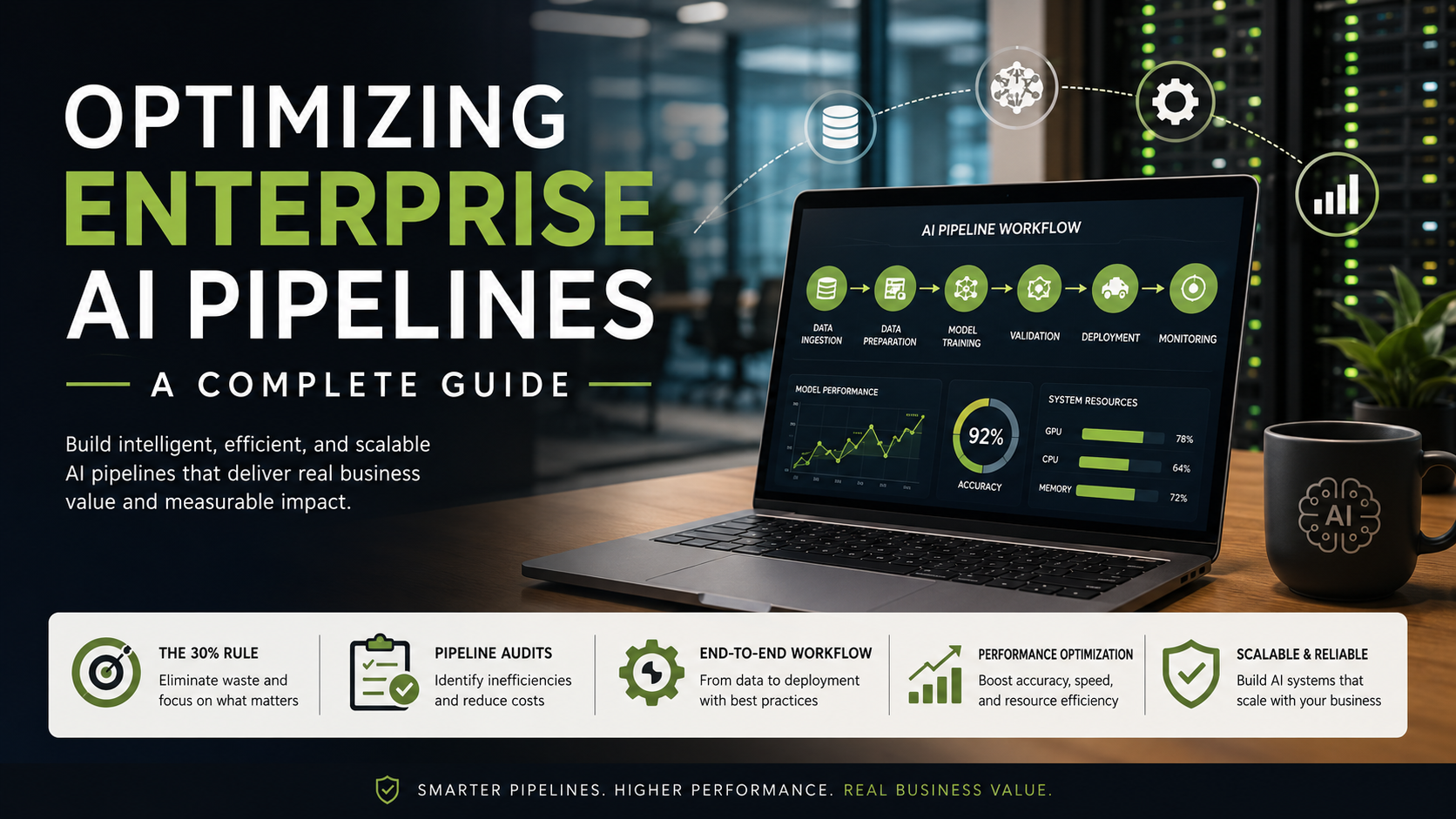
Optimizing Enterprise AI Pipelines: A Complete Guide
Optimizing enterprise AI pipelines is essential for organizations that need to manage large data volumes, training workloads, and real-time inference. As machine learning models scale, infrastructure bottlenecks can slow deployment and increase cloud costs.
Addressing these challenges starts with understanding AI pipeline architecture, model workflows, and performance optimization. Modern engineering teams rely on NVIDIA Developer resources to streamline hardware acceleration and maximize computational throughput.
This guide explains optimizing enterprise AI pipelines through practical concepts and proven engineering strategies. It covers the 30% rule, AI pipeline mechanics, workflow stages, and generative architectures such as ChatGPT.
What Is the 30% Rule in AI?
The 30% rule in AI can serve as a useful financial and operational benchmark. It highlights the need to review whether deployed machine learning models deliver measurable business value. In practice, organizations may find that a meaningful share of models underperform after entering production.
Several factors can cause this inefficiency. Common issues include data drift, high inference latency, unnecessary compute usage, and weak alignment with business needs. Teams should therefore monitor production systems instead of treating deployment as the final step.
Regular audits can reveal models or processes that consume resources without producing sufficient value. Engineers can then redirect compute capacity toward higher-impact workloads.
Effective optimization typically involves:
- Tracking model accuracy and latency.
- Monitoring GPU and CPU utilization.
- Identifying redundant workloads.
- Reviewing production costs.
- Retiring outdated models when appropriate.
The 30% figure should not be treated as a universal law. It works better as a practical review threshold for evaluating model performance and resource efficiency. Organizations should define their own targets based on workload, risk, and business objectives.
Mitigating Resource Waste Through Rigorous Auditing
Regular AI pipeline audits help engineering teams identify unnecessary computational work before it increases infrastructure costs. Teams can review resource utilization, model performance, and inference patterns at regular intervals.
Weekly monitoring can expose inefficient workloads early. Engineers can then adjust batch sizes, remove redundant processes, or retire models that no longer provide meaningful value.
Auditing should cover both technical and business metrics. A model may perform well technically but still fail to justify its operating cost. Conversely, a costly model may support a critical business process and remain valuable.
Useful audit metrics include:
- GPU and CPU utilization.
- Training and inference latency.
- Model accuracy and error rates.
- Data freshness and drift.
- Cost per prediction or training run.
- Model usage across applications.
This approach helps teams reduce resource waste without sacrificing important production capabilities. It also creates a repeatable process for improving enterprise AI operations.
What Is an AI Pipeline?
An AI pipeline is a structured sequence of automated steps that transforms raw data into useful machine learning outputs. It typically covers data ingestion, cleaning, feature engineering, model training, validation, deployment, and monitoring.
Without a standardized pipeline, data scientists may spend substantial time moving files manually. They may also maintain inconsistent preprocessing scripts across different projects. These issues make experiments harder to reproduce and production systems harder to maintain.
Automated AI pipelines create a consistent path from raw data to deployed models. They reduce manual errors and make retraining easier when new data becomes available.
A typical pipeline includes:
- Data ingestion: Collect data from approved sources.
- Data preparation: Clean and standardize incoming information.
- Feature engineering: Create useful model inputs.
- Model training: Train algorithms using prepared datasets.
- Validation: Measure accuracy and robustness.
- Deployment: Move approved models into production.
- Monitoring: Track performance and operational health.
This structure improves machine learning lifecycle management. It also gives enterprise teams greater visibility into delays, errors, and resource bottlenecks.
Automating Data Flow for Seamless Scalability
Automating data ingestion and preprocessing removes manual bottlenecks from machine learning workflows. When data moves automatically between storage, processing systems, and training environments, teams can retrain models faster.
Automation also improves consistency. Every training run can use the same validation rules, transformations, and preprocessing logic. This reduces the risk of differences between experimental and production environments.
Scalable data flows become especially important when organizations process continuously changing information. Real-time data streaming can support scheduled or event-driven workflows without requiring engineers to move files manually.
Effective automation can include:
- Automated data validation.
- Scheduled ingestion jobs.
- Feature transformation services.
- Reproducible preprocessing steps.
- Automated training triggers.
- Pipeline failure alerts.
- Versioned datasets and models.
These capabilities create a more reliable enterprise AI workflow. They also help engineering teams respond quickly when market conditions or customer behavior change.
The goal is not simply faster processing. A well-automated pipeline should also improve reliability, traceability, and operational control across the entire machine learning lifecycle.
How to Optimize a Pipeline?
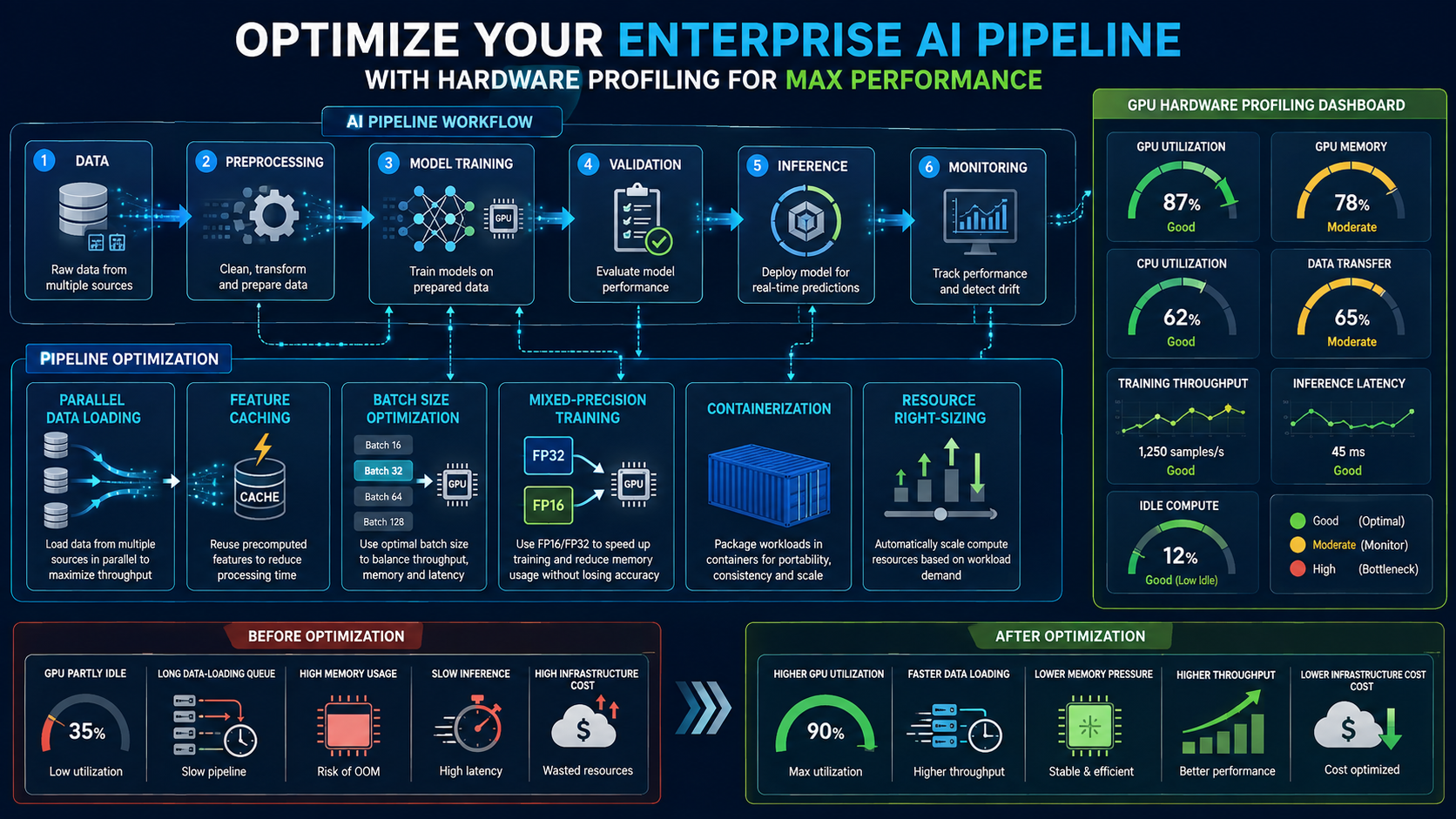
Optimizing enterprise AI pipelines requires teams to identify bottlenecks across data processing, training, and inference. Engineers should begin by profiling each pipeline stage. This reveals where latency, memory pressure, or unnecessary computation occurs.
Several optimization techniques can improve overall performance. Parallel data loading can reduce waiting time during training. Caching can prevent repeated processing of identical features. Mixed-precision training can also reduce memory usage and accelerate compatible workloads.
Containerization improves consistency across cloud and on-premises environments. Orchestration platforms can then help teams manage workloads and allocate resources more efficiently.
Key optimization techniques include:
- Profile every pipeline stage.
- Parallelize independent workloads.
- Cache frequently used features.
- Optimize batch sizes.
- Use mixed-precision training where appropriate.
- Containerize production workloads.
- Monitor infrastructure continuously.
- Right-size compute resources.
Optimization should remain an ongoing process. Workloads change as datasets grow and models evolve. Continuous monitoring helps teams adjust infrastructure before performance problems become expensive.
A strong optimization strategy balances speed, accuracy, reliability, and cost rather than focusing on performance alone.

Accelerating Workflows With Advanced Hardware Profiling
Hardware profiling helps engineers identify hidden performance limitations inside AI workloads. Profiling can reveal GPU memory pressure, inefficient kernels, poor batch sizes, and periods of low hardware utilization.
These insights allow teams to tune workloads based on actual behavior. Instead of increasing infrastructure blindly, engineers can address the specific causes of slow execution.
For example, adjusting batch sizes may improve GPU utilization. Optimizing data transfer can reduce time spent waiting for input. Mixed-precision computation can also improve throughput on compatible hardware.
Teams should monitor metrics such as:
- GPU utilization.
- GPU memory consumption.
- CPU utilization.
- Data transfer rates.
- Training throughput.
- Inference latency.
- Idle compute time.
Profiling is particularly useful when workloads scale across multiple accelerators. Small inefficiencies can become significant when multiplied across large clusters.
By combining hardware profiling with pipeline monitoring, engineering teams can make better infrastructure decisions. This approach can reduce training time, improve throughput, and lower operating costs without compromising model quality, especially when optimizing data engineering workloads.
What Are the 7 Stages of AI?
The seven stages of AI describe the major steps in a machine learning project lifecycle. They help teams move from an initial business problem toward reliable production operation.
The stages generally include:
- Problem identification: Define the business problem and desired outcome.
- Data collection: Gather relevant and authorized data.
- Data preparation: Clean, transform, and validate the data.
- Model building: Select and train suitable machine learning models.
- Model evaluation: Test accuracy, robustness, fairness, and other requirements.
- Deployment: Release the approved model into a production environment.
- Ongoing monitoring: Track performance, drift, security, and operational health.
Each stage supports the next. Weak data preparation can undermine training. Poor evaluation can allow unreliable models into production. Insufficient monitoring can allow performance degradation to continue unnoticed.
Enterprise teams should therefore establish quality gates between stages. These gates create consistent approval criteria and improve governance.
A lifecycle approach also makes AI systems easier to maintain. Teams can identify failures earlier and respond before they affect customers or business operations.
Ensuring Model Stability Through Rigorous Evaluation
Thorough model evaluation helps prevent unreliable or biased systems from reaching production. Testing should go beyond a single accuracy score. Enterprise models often require evaluation across multiple datasets and operating conditions.
Teams should assess whether models remain reliable for different user groups and realistic production scenarios. They should also examine latency, resource consumption, robustness, and error patterns.
Important evaluation areas can include:
- Accuracy and relevant task metrics.
- Fairness across appropriate groups.
- Robustness against unusual inputs.
- Inference latency.
- Resource requirements.
- Security and privacy considerations.
- Performance on representative validation data.
Validation should continue after deployment. Production data can differ from training data, causing performance to change over time.
A strong evaluation process therefore combines pre-deployment testing with continuous monitoring. This approach helps organizations identify model degradation earlier.
It also supports better governance. Clear evaluation criteria provide evidence that a model meets technical and business requirements before teams expand its use.
What Type of AI Is ChatGPT?
ChatGPT is a generative AI system built around large language model technology. Its underlying models use transformer-based neural network architectures designed to process and generate natural language.
Large language models learn statistical patterns from extensive training data. They generate responses by predicting tokens based on the context provided during interaction. This enables them to perform many language-related tasks rather than focusing on one narrow classification problem.
Enterprise applications can use generative AI for tasks such as:
- Customer support assistance.
- Document summarization.
- Content generation.
- Code assistance.
- Information extraction.
- Conversational interfaces.
However, enterprises should evaluate security, privacy, accuracy, and governance before integrating these systems into production workflows.
Understanding transformer architecture and large language models helps engineering teams make better integration decisions. It also clarifies why these systems require substantial computing resources during training and inference.
For enterprise deployments, the model itself is only one component. Data pipelines, access controls, monitoring, evaluation, and application infrastructure all influence the final system.
Harnessing Transformer Architectures for Advanced Text Generation
Transformer architectures use attention mechanisms to model relationships between tokens in a sequence. This design helps language models process contextual information efficiently and generate coherent text.
Earlier sequence-processing approaches often handled tokens sequentially. Transformers introduced mechanisms that allow models to consider relationships across many tokens more effectively. This architecture became foundational to modern large language models.
In enterprise environments, transformer-based models can support diverse language workflows. Examples include summarization, document analysis, conversational assistants, and code generation.
Their flexibility comes with infrastructure considerations. Large models can require substantial memory and computational capacity. Inference costs can also increase as usage grows.
Engineering teams can manage these demands through:
- Efficient model serving.
- Appropriate batching strategies.
- Quantization where suitable.
- Hardware acceleration.
- Caching repeated requests.
- Continuous latency monitoring.
The goal is to balance model quality, response speed, scalability, and cost. These factors should be considered together when integrating generative AI into enterprise applications.
FAQ
How Often Should Enterprise AI Pipelines Be Retrained?
Enterprise AI pipelines should be retrained when meaningful data drift occurs or performance falls below defined thresholds. However, the ideal schedule depends on the application and the rate of change in its data.
For example, fast-changing systems may need frequent retraining. Fraud detection, recommendations, and demand forecasting can require more frequent updates. In contrast, stable use cases may only need periodic retraining.
Therefore, teams should use monitoring data to guide retraining decisions instead of relying only on a fixed calendar. In addition, automated alerts can trigger reviews when accuracy, drift, or other metrics change significantly.
What Role Does Data Quality Play in Pipeline Optimization?
Data quality is fundamental to pipeline performance. Poor-quality data can create incorrect patterns and force teams to repeat training runs. As a result, weak data quality can increase both development time and infrastructure costs.
Clean, consistent, and validated data helps models learn from useful information. Moreover, it reduces unnecessary processing and makes model evaluation more reliable.
For this reason, data validation should occur before training and throughout production workflows. Automated checks can identify missing values, unexpected formats, duplicates, and other anomalies. Ultimately, strong data quality gives teams a more reliable foundation for optimizing enterprise AI pipelines.
How Can Companies Reduce Cloud Costs Associated With AI Pipelines?
Companies can reduce AI infrastructure costs by right-sizing compute resources and removing unnecessary workloads. Additionally, teams can use lower-cost infrastructure for suitable non-critical tasks.
For example, spot or preemptible instances may reduce costs for workloads that can tolerate interruptions. Similarly, model quantization and efficient serving can lower inference expenses when appropriate.
Meanwhile, daily or continuous cost monitoring can reveal idle resources and inefficient workloads. As a result, engineering teams can redirect unused capacity and improve overall infrastructure efficiency.
However, cost optimization should always consider reliability and business requirements. The cheapest infrastructure is not always the most appropriate choice for critical production workloads.
Why Is Model Monitoring Crucial After Deployment?
Post-deployment monitoring helps detect data drift, concept drift, latency changes, and unexpected model degradation. Although a model may perform well during validation, its behavior can change with real-world data.
Therefore, monitoring should cover both model and infrastructure metrics. Teams can track prediction quality, input distributions, response times, errors, and resource usage.
In addition, monitoring creates an early warning system for production issues. Engineers can investigate changes before they affect large numbers of users. As a result, continuous oversight supports better reliability, security, compliance, and long-term model governance.
Conclusion
Optimizing enterprise AI pipelines is essential for organizations seeking scalable machine learning operations and controlled infrastructure costs. To begin with, effective optimization requires a clear understanding of AI data center and cloud storage infrastructure to support data flow, model lifecycle stages, and production requirements.
Next, teams should profile workloads, automate repetitive processes, and monitor model performance. At the same time, careful resource management can improve efficiency without sacrificing reliability or model quality.
The 30% rule can provide a useful prompt for reviewing model value and resource consumption. However, organizations should define performance thresholds that reflect their workloads, risks, and business objectives.
Furthermore, generative AI adds another layer of opportunity and complexity. Transformer-based systems can support many enterprise applications, but they also require careful infrastructure planning.
Ultimately, combining automation, rigorous evaluation, hardware profiling, and continuous monitoring can create more efficient AI systems. As a result, enterprises can scale AI initiatives more securely, reliably, and cost-effectively.