
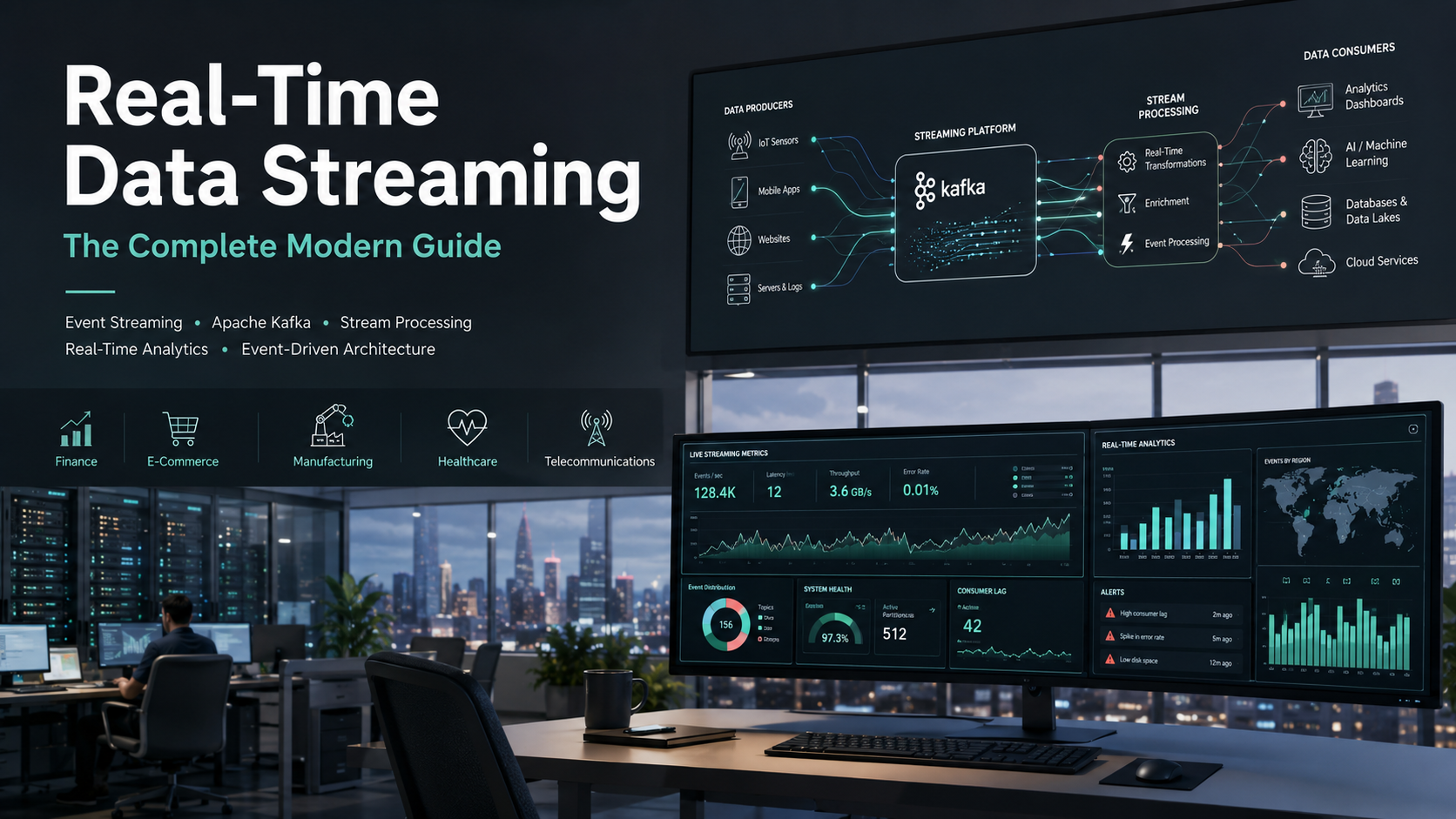
Real-Time Data Streaming: The Complete Modern Guide
Modern businesses cannot rely only on delayed reports and historical data. Decisions now depend on information that is available instantly. Real-time data streaming allows organizations to capture, process, and analyze events as they happen.
From financial transactions and IoT devices to customer interactions and application logs, streaming technology helps businesses respond faster. Instead of waiting hours or days for batch processing, companies can act on fresh data within seconds.
Traditional systems were designed around scheduled data processing. They collected information first and analyzed it later. Real-time streaming changes this approach by creating continuous data pipelines that process events immediately.
Technologies such as Apache Kafka have helped engineering teams build reliable event-driven architectures. These platforms can handle massive data volumes while maintaining speed, durability, and scalability.
Understanding real-time data streaming requires more than knowing how data moves. It involves understanding how modern systems collect, process, store, and analyze continuous streams of information.
In this guide, we will explore how streaming systems work, compare stream processing with batch processing, explain core architecture components, and review popular tools used for real-time analytics.
What Is Real-Time Data Streaming and How Does It Work?
Real-time data streaming is the process of continuously collecting, processing, and analyzing data as events occur. Instead of storing large amounts of information before processing it, streaming systems handle records immediately.
This approach allows applications to respond to changes within milliseconds or seconds. It is commonly used in systems that require instant decisions, such as fraud detection, recommendation engines, monitoring platforms, and automated alerts.
A streaming architecture usually contains three main components:
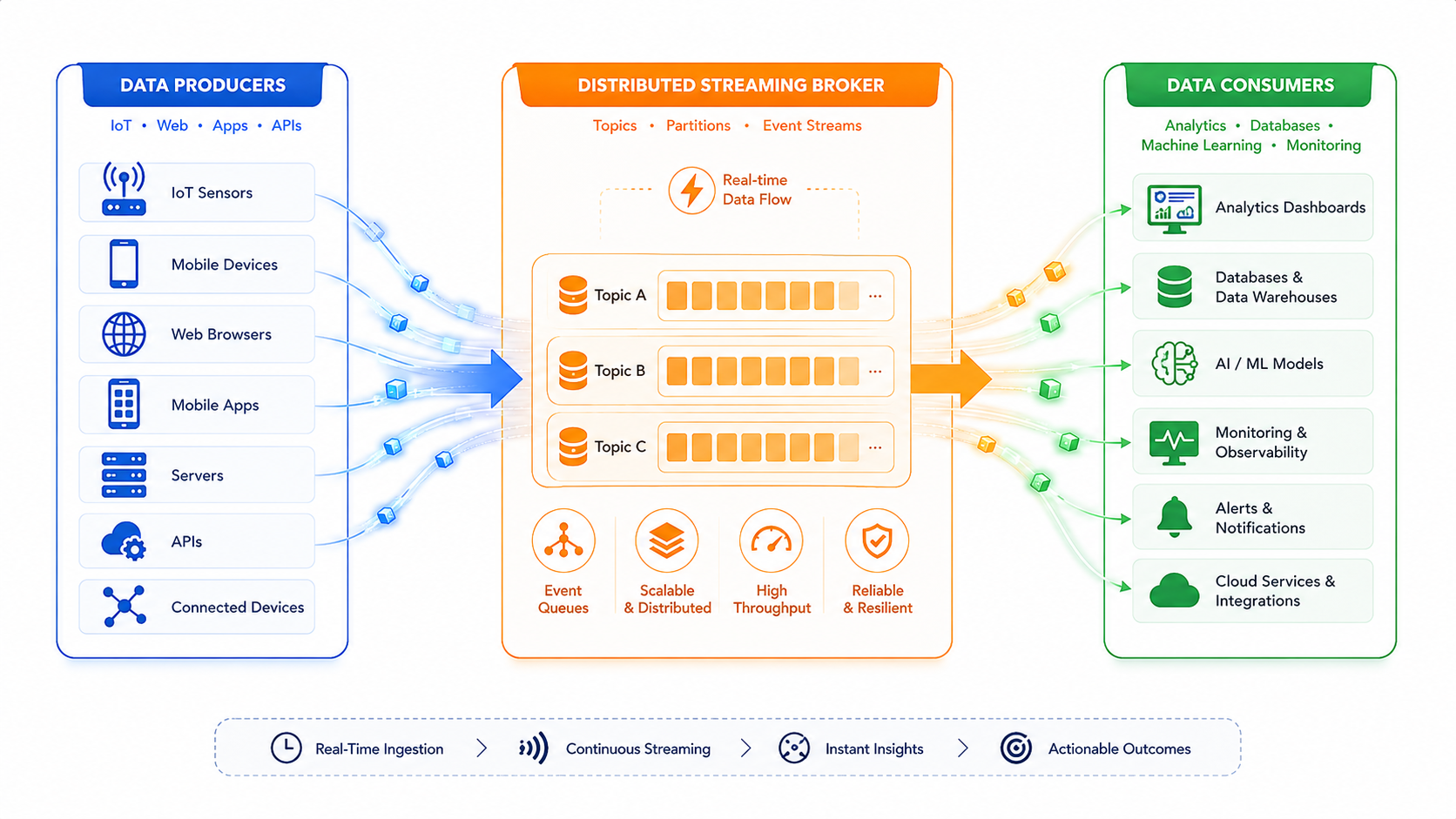

The process follows an event-driven publish-subscribe model:
- Producers: Applications, websites, mobile devices, and sensors generate events when something changes.
- Stream Brokers: Messaging platforms store and organize events into ordered streams called topics.
- Consumers: Analytics tools, databases, machine learning systems, and monitoring applications subscribe to these streams.
Unlike traditional systems, streaming platforms continuously process incoming information. This allows businesses to react quickly to new conditions.
For example, an online payment system can detect suspicious behavior while a transaction is still happening. A manufacturing system can identify equipment issues before a machine fails.
The main goal of real-time streaming is not only faster data movement. It is creating systems that can understand and respond to events immediately.
Real-Time Data Streaming vs. Batch Processing
Real-time data streaming and batch processing represent two different approaches to handling information. The main difference is how quickly data is processed after it is created.
Batch processing collects data over a specific period. The system then processes the entire group at scheduled intervals. This method works well for large historical reports, backups, and offline analysis.
Real-time streaming processes data continuously. It handles events as they arrive instead of waiting for a collection period to finish.
| Feature | Stream Processing | Batch Processing |
|---|---|---|
| Data Scope | Continuous, unlimited data flow | Fixed groups of collected data |
| Latency | Milliseconds to seconds | Hours to days |
| Execution | Always running | Scheduled intervals |
| Best For | Fraud detection, live analytics, alerts | Reports, backups, historical analysis |
Batch systems remain useful for many business operations. They are efficient when immediate results are not required.
However, they create delays because information must wait before processing begins. These delays can prevent businesses from responding quickly.
Stream processing removes this waiting period. It enables real-time decision-making by turning incoming events into immediate insights.
For modern applications, many organizations use both approaches together. Streaming handles fast-changing information, while batch systems support deeper historical analysis.
Core Components of a Real-Time Streaming Architecture
A reliable real-time streaming architecture requires multiple layers working together. Each layer has a specific role in collecting, storing, processing, and delivering data.
A typical streaming pipeline looks like this:
[ Ingestion Layer ]
        ↓
[ Storage Broker Layer ]
        ↓
[ Processing Engine ]
        ↓
[ Analytics Sink ]
The architecture must support high speed, fault tolerance, and scalability. As data volumes increase, each component must continue operating without interruption.
The major layers include:
1. The Ingestion Layer
The ingestion layer is the entry point of a streaming system. It collects raw events from different sources, including applications, sensors, websites, and databases.
This layer prepares incoming information for processing. It may handle tasks such as data validation, formatting, and protocol conversion.
A strong ingestion system allows organizations to collect millions of events without slowing down the overall pipeline.
2. The Streaming Storage Layer
The storage layer manages incoming event streams. Unlike traditional databases, streaming brokers store data as append-only logs.
These logs maintain event order and allow multiple applications to access the same information. Systems can also divide streams across servers through partitioning.
This design improves performance, reliability, and scalability.
3. The Stream Processing Engine
The processing engine contains the business logic of the streaming system. It analyzes incoming events and transforms raw data into useful information.
Processing engines can filter events, calculate metrics, combine multiple streams, and run analytics in memory.
This layer enables applications to make immediate decisions based on current data.
Key Benefits of Adopting Real-Time Data Streaming
Real-time data streaming provides organizations with faster insights, improved automation, and more responsive digital experiences. As businesses generate increasing amounts of data, traditional processing methods often create delays. Streaming systems solve this challenge by continuously analyzing information as it arrives.
A well-designed real-time data streaming platform helps companies make better decisions using current information instead of outdated reports. It also allows applications to react automatically when important events occur.
The biggest advantages of adopting event streaming include:
- Immediate Business Insights: Teams can monitor live metrics and make decisions using fresh data. Executives can track performance changes instantly instead of waiting for scheduled reports.
- Proactive Anomaly Detection: Streaming systems can identify unusual activity in real time. Financial institutions can detect suspicious transactions, while IT teams can identify system failures before they become major problems.
- Improved Customer Experiences: Companies can personalize services based on real-time user behavior. Streaming data supports recommendations, targeted notifications, and dynamic content delivery.
- Decoupled System Architecture: Event-driven systems separate data producers from consumers. This allows developers to create new applications without changing existing services.
- Better Operational Efficiency: Automated responses reduce manual monitoring and improve workflows. Businesses can react faster to changing conditions.
Real-time streaming is especially valuable in industries where timing directly affects outcomes. A few seconds can determine whether a company prevents fraud, avoids downtime, or delivers a better customer experience.
By adopting streaming technologies, organizations create flexible systems that can handle modern data demands. These architectures support scalability while improving speed, reliability, and business agility.
Popular Real-Time Data Streaming Tools and Technologies
Choosing the right real-time data streaming tools depends on several important factors. For example, organizations must evaluate data volume, processing requirements, latency expectations, and their existing technology environment.
Furthermore, different streaming platforms provide different capabilities. While some solutions focus on high-speed event delivery, others specialize in advanced stream processing, complex analytics, or cloud-based management.
Therefore, businesses should select a platform based on their specific workload, scalability needs, and future growth plans.
The most widely used streaming technologies include:
Apache Kafka
Apache Kafka is one of the most popular event streaming platforms available today. It is designed for high-throughput data pipelines and large-scale distributed systems.
In addition, Kafka works as a distributed commit log that stores events reliably. As a result, multiple applications can read and process the same stream independently without affecting other consumers.
Its key features include:
- High message throughput
- Fault-tolerant architecture
- Scalable event storage
- Real-time data integration
Because of its reliability and scalability, many companies use Kafka as the foundation for event-driven architectures. For instance, it supports applications such as monitoring systems, analytics platforms, data integration solutions, and machine learning pipelines.
Apache Flink
Apache Flink is a powerful framework designed for complex stream processing workloads. Unlike simple data transfer systems, Flink focuses on low-latency computation and accurate event-time processing.
Moreover, it provides advanced capabilities for applications that require continuous calculations and real-time decision-making.
Flink supports:
- Stateful stream processing
- Real-time analytics
- Event-time calculations
- Fault recovery mechanisms
As a result, Flink is commonly used when businesses need advanced processing logic, accurate analytics, and reliable results from continuous data streams.
AWS Kinesis
Amazon Web Services provides AWS Kinesis, a managed service for collecting, processing, and analyzing real-time data streams.
With Kinesis, teams can build streaming applications without managing complex infrastructure. Additionally, the service supports various use cases, including application logs, video streams, IoT data, and real-time analytics workloads.
Cloud-based streaming services are becoming increasingly popular because they simplify deployment and reduce operational challenges. Moreover, they provide flexible scaling options, allowing organizations to handle changing data volumes more efficiently.
Ultimately, selecting the right streaming technology depends on business goals, technical requirements, and the level of control an organization needs over its data infrastructure.
Common Real-Time Data Streaming Use Cases Across Industries
Real-time data streaming powers many applications that people use every day. From financial security systems to personalized online experiences, continuous data processing has become an essential technology.
Organizations across different industries use streaming platforms to improve speed, automation, and decision-making.
Financial Services
Banks and payment companies use streaming systems to monitor transactions instantly. Fraud detection models analyze payment activity and identify suspicious patterns within seconds.
Streaming also supports algorithmic trading systems that require rapid access to market information.
E-Commerce
Online retailers use real-time data streaming to improve customer experiences. Streaming platforms help manage inventory updates, personalized recommendations, and dynamic pricing.
For example, an e-commerce website can adjust product suggestions based on a customer’s current browsing behavior.
Internet of Things (IoT) and Manufacturing
Manufacturing companies use streaming technology to monitor connected machines and sensors. These systems collect equipment data continuously and detect early warning signs.
Predictive maintenance helps organizations repair machines before unexpected failures occur.
Healthcare
Healthcare providers use real-time streaming to monitor patient information continuously. Connected devices can track vital signs and send alerts when unusual conditions appear.
This enables faster responses and improves patient monitoring processes.
Telecommunications
Telecom companies process network data streams to monitor service quality. They can detect outages, analyze traffic patterns, and optimize network performance.
Across all these industries, the common goal remains the same: transform continuous data into immediate action.
Frequently Asked Questions About Real-Time Data Streaming
What is the difference between real-time data streaming and message queuing?
Real-time data streaming and message queuing both move data between systems, but they work differently. Traditional message queues usually deliver a message to one consumer and remove it after processing.
In contrast, real-time data streaming platforms store events in persistent, ordered logs. Multiple applications can access the same stream at different times without affecting other consumers.
This makes streaming systems more suitable for modern event-driven architectures. A single event can support several applications, such as analytics tools, monitoring systems, and machine learning models.
Message queues are still useful for task distribution and simple communication workflows. However, streaming platforms provide better support for continuous data processing and large-scale analytics.
Is real-time data streaming expensive to implement?
The cost of implementing real-time data streaming depends on system requirements, data volume, and infrastructure choices.
Initial development can require investment in:
- Streaming platforms
- Cloud resources or servers
- Data engineering expertise
- Monitoring and maintenance tools
However, managed cloud services have made streaming technology easier to adopt. Companies can use scalable solutions without maintaining complex infrastructure themselves.
Over time, streaming can reduce operational costs by improving automation and preventing costly issues. For example, real-time monitoring can detect failures before they cause major downtime.
For organizations handling large amounts of constantly changing data, the benefits often outweigh the initial setup costs.
What is event time versus processing time in streaming?
Event time and processing time represent two different timestamps in a streaming system.
Event time refers to when an action actually happened at the source. For example, it may represent the exact moment a customer completed a purchase.
Processing time refers to when the streaming application receives and handles that event.
These timestamps may differ because of network delays, system performance issues, or temporary connection problems.
Modern stream processing frameworks use event-time processing to produce more accurate results. This is especially important for analytics, reporting, and applications where timing affects business decisions.
Can real-time streaming replace traditional databases?
No. Real-time streaming and databases serve different purposes.
Streaming systems are designed for continuous data movement and event processing. They help applications react quickly to new information.
Traditional databases are better suited for storing structured data, performing complex queries, and supporting application transactions.
Most modern architectures use both technologies together. A streaming platform processes incoming events, while databases store important information for long-term access.
For example, an online store may use streaming to analyze customer activity instantly and a database to maintain customer profiles and order history.
Together, these systems create a complete data management strategy.
How do you handle failures in a real-time stream?
Reliable streaming systems use several techniques to prevent data loss during failures.
Common approaches include:
- Replication: Data is copied across multiple servers to improve availability.
- Checkpoints: Processing states are saved regularly so systems can recover quickly.
- Write-ahead logs: Events are stored before processing to maintain consistency.
Modern streaming frameworks can automatically recover from hardware failures or application errors. When a component stops working, another system can continue processing from the latest saved state.
These reliability features make real-time streaming suitable for critical applications where downtime or lost data can create serious problems.
Conclusion: The Future of Real-Time Data Streaming
Real-time data streaming has become a core requirement for modern digital businesses. Organizations can no longer depend only on delayed reports when decisions must happen instantly.
By processing events as they occur, streaming systems provide faster insights, better automation, and improved customer experiences. Businesses can detect problems earlier, personalize services, and respond quickly to changing conditions.
Building a successful streaming strategy requires careful planning. Companies must choose the right tools, design scalable architectures, and create reliable data pipelines.
Technologies such as Kafka, Flink, and cloud streaming services continue to improve how organizations manage growing data volumes. As connected devices, applications, and digital interactions continue expanding, the demand for instant information will only increase.
The future of data architecture is moving toward event-driven systems. Organizations that adopt real-time data streaming can build more flexible, responsive, and competitive technology environments.
By investing in continuous data processing today, businesses prepare themselves for a faster and more data-driven future.
Strong security practices, continuous monitoring, and awareness of cyber threats are essential for maintaining reliable data systems. Understanding how attackers attempt to access confidential information can help businesses strengthen their defenses and reduce security risks. Learn more about common data theft methods and how hackers steal sensitive information in our detailed guide: How Hackers Steal Data.