
Do Mini LED TVs Last Longer Than OLED TVs?
Choosing a modern television is a major investment, so long-term durability matters. Many buyers ask whether Mini LED TVs last longer than OLED TVs. The answer depends on panel design, usage habits, brightness settings, and how each technology ages over time.
Mini LED TVs use an LCD panel with a dense array of small LED backlights. OLED TVs use self-emissive organic pixels that create their own light. These different designs affect brightness, burn-in risk, aging, and expected service life.
According to the Society for Information Display, understanding display technology helps explain how different panels perform over time. This guide compares Mini LED and OLED longevity, burn-in risks, LED and OLED lifespan, QLED durability, and the main disadvantages of Mini LED TVs.

Is a Mini LED TV Better Than an OLED?
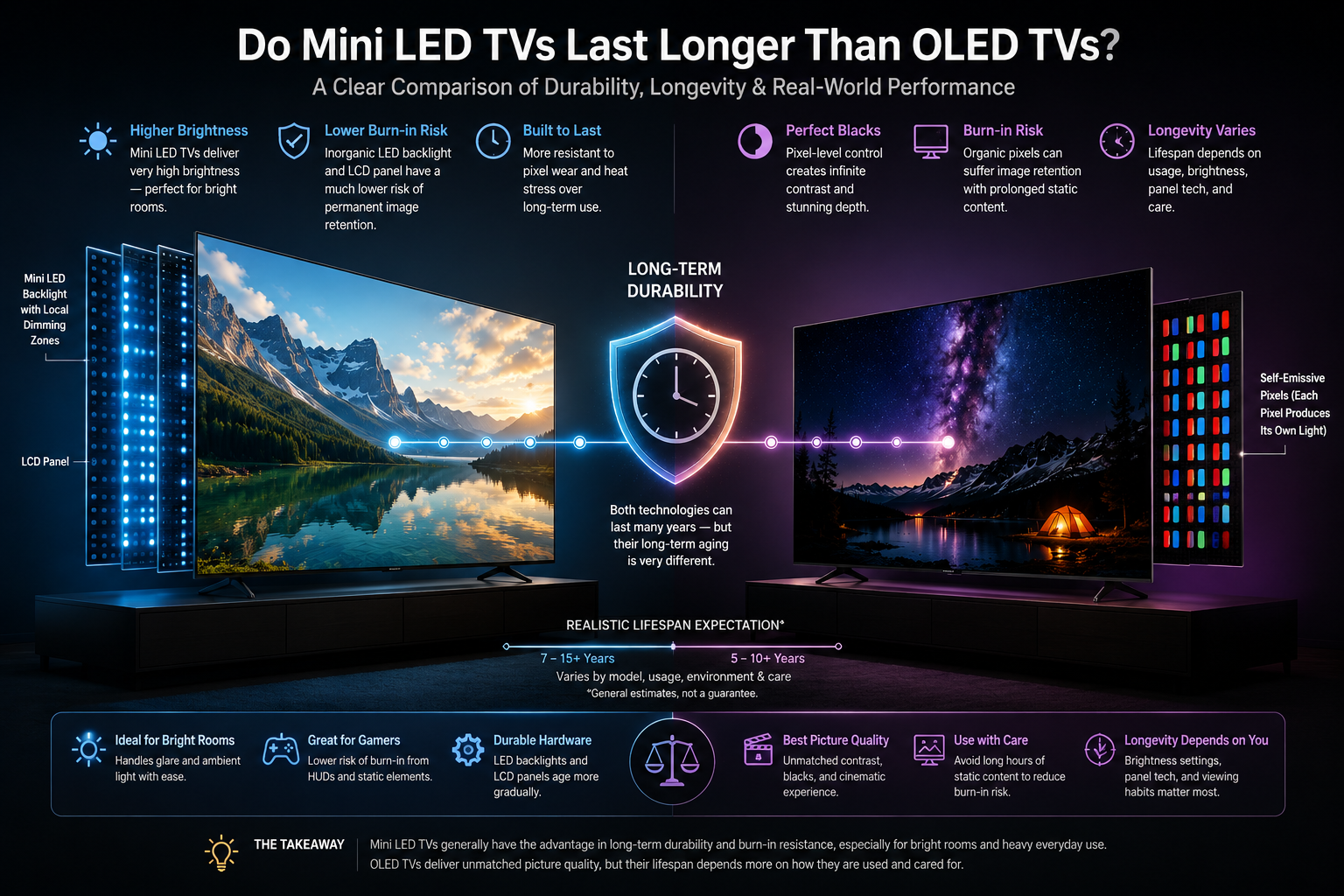
Whether a Mini LED TV is better than an OLED TV depends on your room and viewing habits. Neither technology is the clear winner for every viewer. Mini LED usually has an advantage in bright rooms because its powerful backlight can reach very high brightness levels. That makes daytime viewing easier, especially when sunlight enters the room.
OLED has a different strength. Each pixel produces its own light and can switch off completely. This creates perfect blacks and extremely precise contrast. OLED can therefore look exceptional in dark rooms and home theaters.
Mini LED also has an important durability advantage. Its LCD panel and inorganic LED backlight do not have the same organic pixel wear found in OLED displays. It also has a much lower risk of permanent image retention.
Your priorities should guide the decision:
- Choose Mini LED for high brightness, bright rooms, and heavy static-content use.
- Choose OLED for perfect blacks, pixel-level contrast, and dark-room viewing.
- Consider Mini LED if long-term burn-in concerns are a major factor.
Peak Brightness and Room Lighting Advantages
Mini LED technology is particularly strong in rooms with substantial ambient light. Its backlight uses many small LEDs and local dimming zones. These zones can produce very high brightness while controlling darker parts of the image. As a result, bright scenes remain easier to see during daytime viewing.
High brightness can also improve the experience when watching sports, movies, or TV shows in rooms with windows. Reflections and ambient light can reduce perceived contrast on any television. A brighter Mini LED screen can help overcome some of that effect.
OLED TVs can also become very bright, especially newer models. However, sustained full-screen brightness can be more limited than on many Mini LED models. OLED technology also manages brightness differently to protect the panel from excessive heat and power use.
Mini LED has another practical benefit for long-term ownership. Its inorganic backlight does not face the same organic emitter degradation found in OLED panels. However, that does not mean every Mini LED TV will outlast every OLED TV. Build quality, heat, electronics, and usage patterns also affect reliability.
For bright rooms and demanding everyday use, Mini LED often offers the more practical combination of brightness and durability.
Can OLED Last 20 Years?
An OLED TV can potentially remain functional for many years, but a 20-year lifespan should not be treated as a realistic guarantee. Television lifespan depends on usage, panel design, brightness levels, operating temperature, and other components. A screen may continue working while its picture quality gradually changes.
OLED panels use organic light-emitting materials. These materials gradually age as they produce light. Different colors can age at different rates, which may eventually affect brightness and color uniformity. Manufacturers use compensation systems to reduce these effects during normal use. For a broader look at display technologies, see AMOLED vs OLED vs LCD.
Burn-in is another consideration. Permanent image retention can occur when certain elements remain on the screen for long periods. Modern OLED TVs include protective features that reduce this risk. These features can include pixel shifting, screen refresh cycles, and brightness management.
Daily usage also matters. Five hours of viewing per day adds roughly 1,825 operating hours each year. Heavy use therefore accelerates cumulative panel aging compared with occasional viewing.
An OLED TV can still provide excellent picture quality for many years. However, buyers should not assume that every OLED panel will maintain its original brightness and uniformity for two decades. Long-term OLED performance varies considerably by model and usage pattern.
The Role of Pixel Wear and Blue Degradation
OLED pixels contain organic light-emitting materials that gradually lose efficiency with use. The aging process is not always uniform across the red, green, and blue components. Blue emitters have historically presented greater durability challenges than other colors.
Manufacturers have developed newer materials and compensation technologies to reduce these differences. Modern OLED panels can therefore manage aging much better than earlier generations. Still, organic materials remain subject to gradual wear.
When different subpixels age at different rates, color balance can change. Brightness can also decline over time. These changes are usually gradual rather than sudden. Heavy use at high brightness can increase the stress placed on the panel.
OLED televisions also perform compensation cycles. These processes help correct small differences in pixel performance and maintain image uniformity. Users should allow the TV to complete its automatic maintenance routines rather than repeatedly disconnecting it from power.
This does not mean OLED panels are inherently short-lived. Many owners use OLED TVs for years without serious problems. However, organic pixel aging is an important factor when comparing OLED longevity with Mini LED.
For buyers focused primarily on long-term durability, the inorganic backlight used by Mini LED provides a simpler aging profile.
Which TV Lasts Longer, LED or OLED?
In general, LED and Mini LED TVs can have a longevity advantage over OLED TVs. Standard LED TVs use inorganic LEDs as their primary light source. Mini LED models use the same basic principle but employ much smaller LEDs and more advanced local dimming. For another energy-efficient lighting option, explore energy-efficient LED bulbs.
Inorganic LEDs can operate for many thousands of hours. However, manufacturers may rate individual products differently, and the backlight is only one part of a television. Power supplies, processors, capacitors, LCD layers, and other components can fail before the LEDs reach their theoretical limit.
OLED TVs face a different aging process because their pixels generate light directly. Organic materials gradually lose efficiency, and static images can increase the risk of permanent image retention. Modern OLED models include protections, but the underlying technology still has this characteristic.
That makes Mini LED attractive for buyers who prioritize long-term reliability. It is especially useful for households that display static logos, news tickers, game interfaces, or computer content for extended periods.
Still, lifespan should not be judged by panel technology alone. Manufacturing quality, heat management, operating hours, and brightness settings all influence how long a television remains usable.
Inorganic Backlights Versus Organic Emissive Pixels
The key longevity difference comes from how these displays create light. Mini LED TVs use an LCD layer and an inorganic LED backlight. OLED TVs use organic materials within individual pixels to generate light directly.
Inorganic LED components generally resist the type of organic material degradation associated with OLED pixels. They can operate for very long periods before significant light-output decline occurs. However, this does not make Mini LED televisions immune to failure.
The television’s electronics can fail independently of the backlight. A power supply, mainboard, driver circuit, or display connection can become defective. Repairs can also become difficult when replacement parts are unavailable.
OLED has fewer separate backlight components because each pixel produces its own light. This helps OLED achieve perfect blacks and extremely precise contrast. However, the organic emitters gradually age with use.
The distinction is therefore important. Mini LED does not necessarily guarantee a longer overall television lifespan, but its backlight architecture generally creates fewer concerns about organic pixel degradation and burn-in.
For consumers who plan to keep a television for many years, that difference can make Mini LED a compelling choice. Actual durability still depends on the specific TV model and how it is used.
Does QLED or Mini LED Last Longer?
QLED and Mini LED televisions can have similar longevity because both commonly use inorganic LED backlights. However, QLED and Mini LED describe different parts of display technology.
A traditional QLED TV typically combines an LCD panel, LED backlight, and quantum-dot layer. Quantum dots improve color performance by converting portions of the backlight spectrum. Mini LED refers primarily to the size and arrangement of the LEDs used in the backlight.
A television can therefore combine both technologies. Many modern Mini LED QLED TVs use quantum dots alongside a Mini LED backlight. This combination can provide strong brightness, wide color volume, and improved local dimming.
Neither technology should be assigned a universal lifespan such as 60,000 or 100,000 hours. Manufacturers use different components and testing methods, and the useful life of a television depends on more than its backlight.
For longevity, QLED and Mini LED are generally closer to each other than either is to OLED. Both avoid the organic pixel structure that creates OLED’s unique aging characteristics.
If durability is your main concern, focus on the TV’s overall build quality, warranty, thermal management, and manufacturer reputation. The QLED or Mini LED label alone cannot guarantee a specific lifespan.
Quantum Dot Stability in Modern Displays
Quantum dots are semiconductor nanocrystals that help convert light into more precise colors. In modern QLED and Mini LED QLED televisions, they are typically integrated into a dedicated layer within the display system.
These materials are designed for long-term stability under normal operating conditions. Manufacturers also protect the quantum-dot layer from environmental factors that could reduce performance. As a result, quantum dots are not generally considered the main durability concern in modern QLED televisions.
The backlight and other television components remain more relevant when considering long-term reliability. LED performance can decline gradually, while electronic components can fail unexpectedly. Heat and prolonged operation can also influence component life.
Mini LED can combine quantum dots with a highly sophisticated backlight. This gives manufacturers more control over brightness and local dimming. It can also produce strong color performance without relying on OLED’s self-emissive pixel structure.
However, quantum dots do not make a television permanently immune to aging. Every display technology experiences some form of performance change over time. The goal is to minimize those changes and maintain consistent picture quality.
For buyers comparing QLED and Mini LED, longevity is unlikely to be the deciding factor. Both can offer strong long-term durability when built with quality components and used under normal conditions.
What Are the Disadvantages of a Mini LED TV?
Mini LED TVs offer impressive brightness and strong durability, but they also have drawbacks. The most noticeable is blooming, sometimes called the halo effect. This happens when a bright object appears against a dark background. If you are considering a new streaming-focused television, you may also want to see whether the Apple TV 4K is still worth buying.
Mini LED screens use local dimming zones rather than controlling each pixel individually. A zone may need to illuminate several pixels around a bright object. Some light can therefore reach nearby dark areas.
Premium Mini LED TVs use more dimming zones and advanced processing to reduce blooming. Even so, OLED can control each pixel independently. OLED therefore has an advantage when displaying small bright objects against nearly black backgrounds.
Mini LED TVs can also be thicker than OLED models. Their backlight requires additional layers and physical space. Viewing angles may also vary by LCD panel type, with some models losing contrast or color accuracy when viewed from the side.
Other potential disadvantages include:
- Blooming around bright objects.
- Greater thickness than many OLED televisions.
- Potentially weaker off-axis performance.
- More complex backlight systems.
- Picture quality that depends heavily on local-dimming processing.
Despite these drawbacks, Mini LED remains an excellent choice for many households. Its high brightness and low burn-in risk make it particularly appealing for bright rooms, sports, gaming, and general everyday viewing.
Understanding the Blooming Effect
Blooming occurs when a local dimming zone becomes bright while nearby zones remain dark. Because each zone controls multiple LCD pixels, light can spread beyond the intended bright object.
The effect is easiest to notice in dark scenes. White subtitles, stars, streetlights, or bright logos can sometimes appear surrounded by a faint glow. The size and visibility of this effect vary greatly between Mini LED televisions.
Several factors influence blooming:
- The number of local dimming zones.
- The size of individual zones.
- The LCD panel’s native contrast.
- The TV’s image-processing algorithms.
- Your viewing angle and room lighting.
More advanced Mini LED models usually manage blooming better. However, increasing the number of LEDs does not automatically eliminate the problem. Software and LCD performance remain important.
OLED has an inherent advantage because each pixel can turn completely off. There is no conventional backlight to illuminate neighboring pixels. This allows OLED to produce cleaner dark scenes and more precise highlights.
For most viewers, blooming is a minor compromise rather than a deal-breaker. Mini LED remains a strong option when brightness and long-term durability matter more than perfect pixel-level contrast.
Frequently Asked Questions
Is burn-in a real concern for Mini-LED televisions?
No, burn-in is not a concern for Mini-LED televisions. Because Mini-LED displays use inorganic LED backlights shining through an LCD panel, they do not suffer from the permanent image retention that affects organic pixels. You can safely watch news channels with static banners or play video games for hours without worrying about damaging the display hardware.
How many hours of use can a Mini-LED TV handle?
A typical Mini-LED television is rated to last between 60,000 and 100,000 hours of use. If you watch television for five hours every day, this translates to roughly thirty to fifty years of theoretical panel operation. Most users will choose to upgrade long before the backlight components fail or burn out.
Do Mini-LED TVs consume more electricity than OLEDs?
Mini-LED TVs often consume slightly more power than OLED models when displaying very bright, white scenes because the entire backlight must illuminate. However, power consumption varies depending on picture settings and content. OLEDs can be more efficient during dark scenes, but draw more power when displaying full-screen bright images due to current limiters. You can also explore ways to use your TV’s USB ports to get more functionality from your television.
Can you replace the backlight on a Mini-LED television?
Technically, component-level repairs are possible, but replacing a Mini-LED backlight is rarely practical or cost-effective for consumers. Modern televisions are engineered as sealed, integrated units. If a major hardware failure occurs outside of the standard warranty period, purchasing a brand-new television is usually cheaper than paying for professional component repair labor.
Conclusion
So, do Mini LED TVs last longer than OLED TVs? In many cases, Mini LED has a durability advantage. Its inorganic LED backlight avoids the organic pixel aging associated with OLED technology. It also has a much lower risk of permanent image retention.
OLED remains an excellent choice for viewers who value perfect blacks, pixel-level contrast, and a cinematic viewing experience. Modern OLED televisions also include technologies designed to reduce image retention and manage panel aging.
Mini LED is often the better fit for bright rooms and heavy everyday use. It is also attractive for gamers, sports fans, and users who display static content frequently. However, overall television lifespan depends on more than the display panel.
Build quality, heat management, electronics, usage patterns, and manufacturer support all matter. A high-quality OLED can last many years, just as a poorly built Mini LED TV can fail prematurely.
For buyers focused on long-term durability, high brightness, and low burn-in risk, Mini LED is a strong choice. For viewers who prioritize perfect blacks and cinematic contrast, OLED may still be worth the trade-offs.