
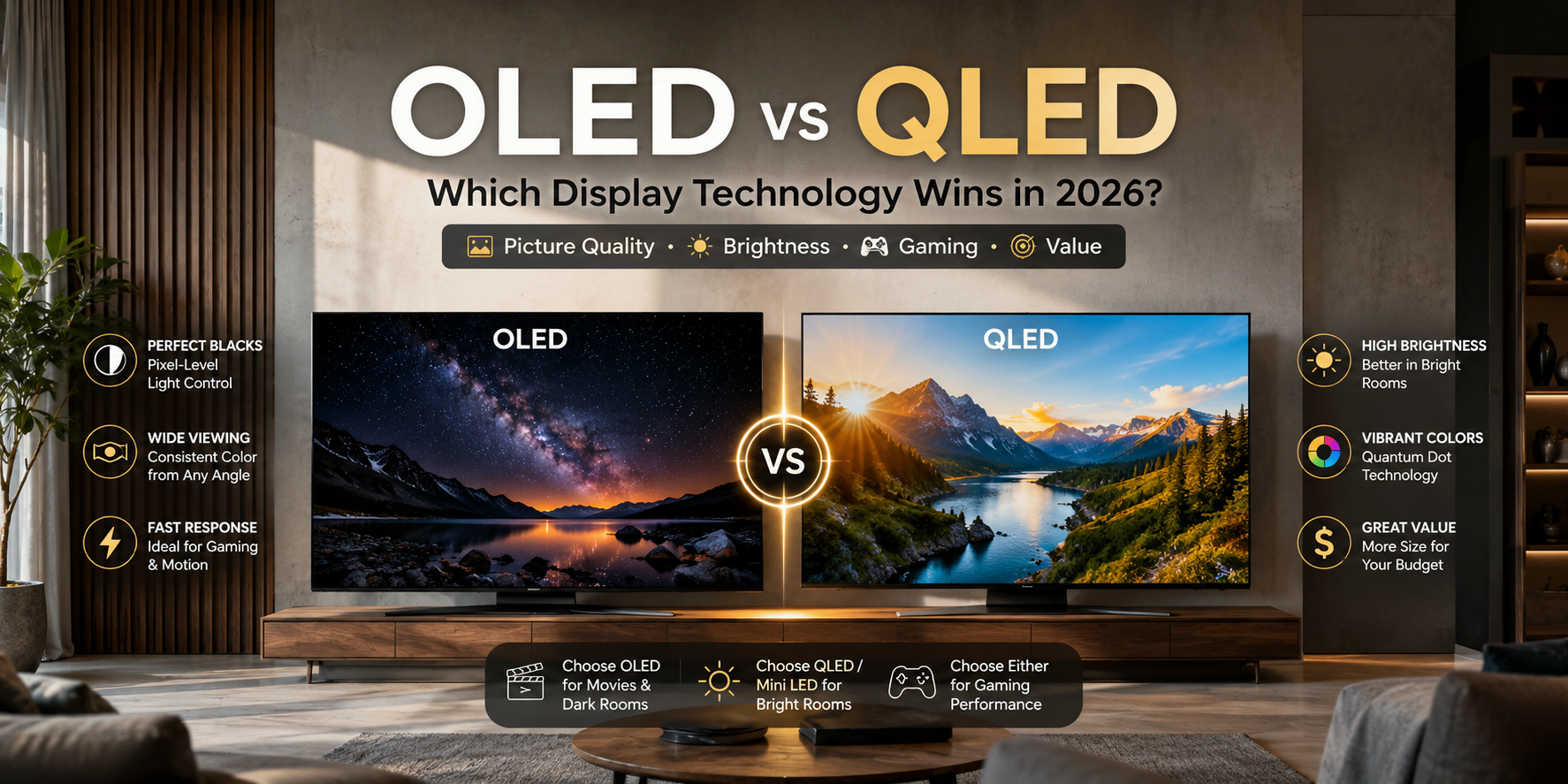
OLED vs QLED: Which Display Technology Wins in 2026?
Choosing a new TV can feel overwhelming with so many display technologies available. The OLED vs QLED debate remains especially important for movie fans, gamers, and everyday viewers.
OLED uses self-lit pixels that can switch off completely. QLED uses an LCD panel with a backlight and a quantum-dot layer. This fundamental difference affects contrast, brightness, viewing comfort, and price. For a broader look at panel technologies, see the AMOLED vs OLED vs LCD comparison.
Industry research from the Society for Information Display reflects the rapid development of modern display technology. Manufacturers continue improving brightness, color accuracy, efficiency, and image processing.
This guide compares OLED vs QLED for picture quality, brightness, eye comfort, gaming, durability, and value. It also explains whether OLED is still worth buying in 2026 and when QLED makes more sense.
Which TV Technology Is Best in 2026?
There is no single winner for every viewer. The best TV depends on your room, viewing habits, content, and budget. In the OLED vs QLED comparison, OLED has a major advantage for contrast and dark-room viewing. Its self-emissive pixels can switch off individually, creating extremely deep blacks and precise highlights.
QLED takes a different approach. It combines an LCD panel, LED backlight, and quantum-dot technology. Many premium QLED TVs also use Mini LED backlighting. This can improve local dimming, brightness, and contrast.
For bright rooms, a high-end QLED or Mini LED TV can have a practical advantage. Strong brightness helps HDR highlights remain visible despite sunlight and reflections. OLED TVs have also become brighter, but room conditions still matter.
Consider these priorities:
- Choose OLED for movies, deep blacks, and dark-room viewing.
- Choose QLED or Mini LED for bright rooms and high sustained brightness.
- Choose either when gaming features are your main concern.
The best choice depends on which strengths matter most to you.
Balancing Peak Brightness and Ambient Light Control
Peak brightness matters most when watching HDR content in a bright room. Stronger brightness helps highlights remain visible when sunlight or room lighting reaches the screen. QLED and Mini LED TVs often perform particularly well in these conditions.
OLED TVs have improved significantly in brightness. Premium models can produce impressive HDR highlights while maintaining excellent contrast. However, brightness varies between models, panel generations, and picture modes.
Room lighting should therefore influence your decision. A TV opposite large windows has different requirements from one in a dark media room. Reflection handling is also important because a bright panel cannot fully solve distracting reflections.
For bright living rooms, look for strong measured brightness, effective local dimming, and good reflection handling. For dark rooms, OLED’s pixel-level control becomes more valuable.
It is also important to understand the difference between QLED and Mini LED. QLED describes quantum-dot technology, while Mini LED describes the backlight. A TV can use both technologies together.
Before buying, consider:
- How much natural light reaches the screen.
- Whether you watch mostly during the day or night.
- How important HDR brightness is.
- Whether reflections are a major issue.

Is OLED Still Worth It in 2026?
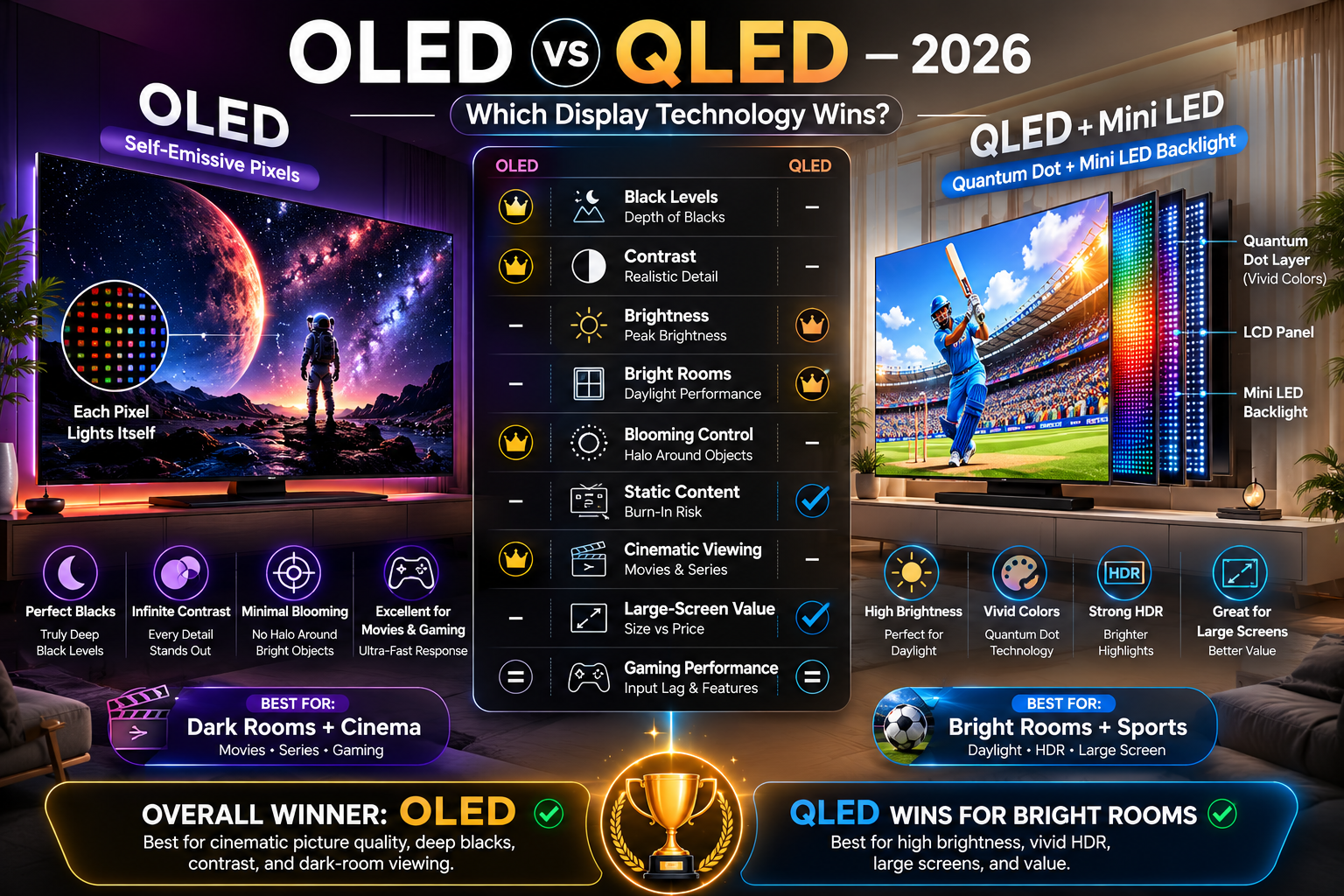
Yes, OLED remains an excellent choice in 2026. It is particularly appealing to movie lovers and gamers who value contrast and motion clarity. Its biggest advantage is pixel-level light control. Each pixel produces its own light and can switch off completely.
This creates exceptional contrast and minimizes blooming around bright objects. Dark movie scenes can therefore look clean and immersive. OLED also offers extremely fast pixel response, which benefits gaming and fast-moving content.
OLED prices have become more competitive across several screen sizes. Premium models can now combine excellent contrast with impressive brightness and advanced gaming features. Newer panels also include technologies designed to manage heat and pixel wear.
However, OLED is not completely immune to burn-in. Persistent static images can still cause permanent image retention under demanding conditions. This is an important consideration when comparing OLED vs QLED for specialized uses.
For typical mixed-content viewing, the risk is considerably lower. Buyers who regularly display static logos, news tickers, or desktop interfaces should still consider the potential risk.
Overall, OLED remains worth considering if picture quality is your top priority.
Long-Term Panel Reliability and Burn-In Protection
Modern OLED TVs include several features designed to reduce uneven pixel wear. These can include pixel shifting, panel maintenance cycles, brightness management, and thermal controls.
These technologies can reduce burn-in risk, but they cannot guarantee that permanent image retention will never occur. Usage patterns remain important.
The key distinction is between normal mixed viewing and prolonged static display. Watching different movies, shows, sports events, and games generally places less stress on the same pixels.
If your TV will display the same news channel for many hours each day, consider an LCD-based QLED or Mini LED model. It does not use OLED’s organic self-emissive pixels. For another practical way to use a TV beyond standard viewing, see these ways to use TV USB ports.
For most households, OLED can provide many years of excellent performance. Still, burn-in should be viewed as a managed risk, rather than a completely solved issue.
Before purchasing, check the manufacturer’s warranty terms. Coverage for burn-in can vary by brand, model, region, and warranty plan.
When comparing OLED vs QLED for long-term ownership, also consider your daily content. A mixed viewing routine favors OLED, while heavy static content may favor QLED.
Is QLED Good in 2026?
QLED remains a strong TV choice in 2026. It offers bright images, vivid colors, and options across many price ranges. Unlike OLED, conventional QLED TVs use an LCD panel with an LED backlight and quantum-dot layer.
Quantum dots can improve color performance while maintaining strong brightness. Premium models can also combine QLED with Mini LED backlighting. This provides more precise local dimming and can improve contrast.
This combination makes premium QLED TVs especially attractive for bright living rooms. Sports, daytime television, and HDR content can benefit from their strong brightness.
QLED also avoids the specific OLED burn-in mechanism because it does not use organic self-emissive pixels. However, LCD TVs can still experience other forms of panel or backlight degradation over time.
Price is another advantage. QLED TVs are available in many screen sizes and price categories. Large models can offer strong value for family rooms, sports viewing, and gaming.
For shoppers comparing OLED vs QLED, QLED is especially appealing when brightness and value matter most. It may also suit households that display static content regularly.
If you want vivid color, strong brightness, large screens, and flexible pricing, QLED remains highly competitive.
The Impact of Mini LED Backlighting Advancements
Mini LED has significantly improved the performance of premium LCD televisions. It uses much smaller LEDs than traditional backlights. This allows manufacturers to place more LEDs behind the display.
More LEDs can support more precise local-dimming control. Darker areas can receive less backlight, while bright areas receive more. This improves contrast and HDR performance compared with basic LED-backlit LCD designs.
Mini LED does not make an LCD panel identical to OLED. OLED controls individual pixels, while Mini LED controls groups of backlight zones. Bright objects can therefore still produce some blooming against very dark backgrounds.
The quality of implementation also matters. The number of dimming zones, processing algorithms, panel characteristics, and viewing angle can affect real-world performance.
For many buyers, premium Mini LED QLED TVs offer an excellent middle ground. They can deliver very high brightness while providing much stronger contrast than conventional LCD televisions.
When comparing OLED vs QLED, do not judge a TV by its label alone. Check whether it uses Mini LED, how well its local dimming performs, and how it handles HDR.
Mini LED has narrowed the performance gap, but OLED still has the advantage in pixel-level black control.
Which TV Is Better for Eyes, OLED or QLED?
Neither OLED nor QLED is automatically better for everyone’s eyes. Viewing comfort depends on brightness, room lighting, viewing distance, flicker behavior, and individual sensitivity.
OLED can feel comfortable in dark rooms because its pixels produce only the light required by the image. It also provides excellent contrast without a full-screen backlight.
QLED can work well in brighter rooms because its higher brightness can better overcome ambient light. However, excessive brightness can also cause discomfort. The best approach is to adjust the TV to match your environment.
There is no universal rule that one panel type prevents eye strain. Features such as reduced-blue-light modes and flicker-control options also vary by manufacturer and model.
For comfortable viewing, avoid setting brightness higher than necessary. Watching a very bright screen in a completely dark room can make the image feel more intense.
A small amount of ambient or bias lighting can also reduce the perceived contrast between the screen and surrounding wall.
When considering OLED vs QLED for eye comfort, focus on your actual viewing environment. Proper brightness and room lighting usually matter more than the panel label itself.
Managing Blue Light and Room Lighting for Eye Comfort
Blue light is one factor that can affect nighttime viewing comfort and sleep patterns. Modern TVs often include picture modes that create a warmer image or reduce blue-heavy output.
These settings can be useful during late-night viewing. However, they should not be treated as a guarantee against eye strain. Comfort depends on brightness, contrast, room lighting, viewing distance, and viewing duration.
Room lighting is particularly important. Watching a bright TV in complete darkness can make the screen feel more intense. Adding soft ambient lighting behind or around the TV can create a more comfortable viewing environment.
You should also avoid using maximum brightness simply because the TV can produce it. Set brightness according to the room and content.
For longer viewing sessions, consider these habits:
- Match screen brightness to the room.
- Reduce brightness during nighttime viewing.
- Use a warmer picture mode when preferred.
- Maintain a comfortable viewing distance.
- Take regular breaks during long gaming sessions.
- Reduce distracting reflections from windows and lamps.
These adjustments can improve comfort with either technology. In the OLED vs QLED discussion, there is no universal eye-comfort winner.
Your viewing habits and display settings remain the most important factors.
Is It Better to Buy QLED or OLED?
The better purchase depends on how and where you watch TV. OLED is usually the better choice for cinematic picture quality. Its self-lit pixels provide exceptional black levels, precise contrast, and minimal blooming. If you’re also considering a streaming device for your TV setup, see whether the Apple TV 4K is still worth buying.
QLED becomes more attractive when brightness, room lighting, and value are bigger priorities. A premium Mini LED QLED can produce powerful HDR highlights and strong contrast while offering large screen sizes.
Your content also matters. Movie enthusiasts who watch mostly at night may appreciate OLED’s pixel-level control. Sports fans watching during the day may prefer the brightness of a QLED or Mini LED model.
Gaming is more balanced. Both technologies can offer high refresh rates, low input lag, variable refresh rate support, and HDMI 2.1. The specific TV model matters more than the panel label.
Use this simple guide:
- OLED: Best for dark rooms and cinematic viewing.
- QLED: Best for bright rooms and strong value.
- Mini LED QLED: Best for high brightness and improved LCD contrast.
- Either: Excellent for modern gaming when the model has the right features.
Ultimately, the best choice in the OLED vs QLED comparison is the TV that matches your room, viewing habits, and budget.
Matching Display Choice to Your Daily Viewing Habits
Your daily routine is one of the easiest ways to choose between OLED and QLED. Start by considering when and where you watch television.
If you mostly watch movies at night, OLED offers a major advantage. Its self-emissive pixels create deep blacks and precise highlights. This makes dark scenes look more natural and immersive.
If your TV sits in a bright living room, QLED can make more sense. High-brightness models can maintain a punchy image despite strong ambient light. Mini LED models can also provide better local dimming than conventional QLED TVs.
Think about static content too. Heavy use of news channels, sports scoreboards, or fixed game interfaces can make QLED a safer choice if you want to avoid OLED burn-in concerns.
Budget should be your final consideration. Compare complete TVs rather than judging only by panel type. Processing, brightness, local dimming, reflection handling, gaming features, and warranty terms can vary significantly.
When making an OLED vs QLED decision, also consider your screen size. QLED often offers attractive pricing for very large displays.
The right choice is the TV that fits your actual viewing habits.
Frequently Asked Questions About OLED vs QLED
Does OLED burn in easily with modern models?
Burn-in is rarely an issue with modern organic panels due to advanced preventive software, pixel-shifting, and thermal management. Manufacturers have successfully mitigated the risks of static image retention for normal daily use. You can safely watch news broadcasts or play video games without worrying about permanent damage during standard viewing intervals.
Can QLED match the black levels of OLED?
Quantum dot displays with mini-LED backlighting achieve impressive black levels that come remarkably close to self-emissive panels. However, they cannot completely eliminate minor blooming around bright objects on pitch-black backgrounds. Organic screens still hold the crown for absolute darkness because individual pixels turn completely off.
Which display type lasts longer over time?
Quantum dot televisions generally offer a longer lifespan because their inorganic LED backlights degrade much slower than organic compounds. That said, modern organic panels easily last for a decade or more under normal household usage conditions. Both technologies will likely outlive your desire to upgrade to newer screen resolutions.
Are QLED TVs better for competitive gaming?
Quantum dot screens excel at competitive gaming due to exceptionally high peak brightness and zero risk of temporary image retention. They also feature lightning-fast response times, variable refresh rates, and HDMI 2.1 support for modern consoles. Many models also offer lower price points for ultra-large screen sizes, maximizing your immersive gaming field of view.
Conclusion
The OLED vs QLED debate has no universal winner. Both technologies deliver excellent picture quality, but they excel in different situations.
OLED remains the standout choice for cinematic viewing. Its self-lit pixels provide exceptional black levels, precise contrast, and minimal blooming. These qualities make it particularly impressive in dark rooms.
QLED remains a strong alternative for bright living spaces. It can deliver high brightness, vivid colors, and excellent value. When combined with Mini LED backlighting, it can also provide much stronger contrast than traditional LCD televisions.
Your viewing habits should guide the final decision. Choose OLED if deep blacks and movie performance are your top priorities. Choose QLED or Mini LED if brightness, large screen sizes, and static-content durability matter more.
Before buying, compare the complete TV rather than the panel technology alone. Brightness, local dimming, processing, gaming features, reflections, warranty coverage, and price can all change the value of a model. If gaming is a major priority, consider these tips on how to choose the perfect gaming monitor.
In 2026, both OLED and QLED are excellent choices. The best TV is the one that fits your room, content, and budget.