Is Building Your Own PC Still the Cheaper Option in 2026?
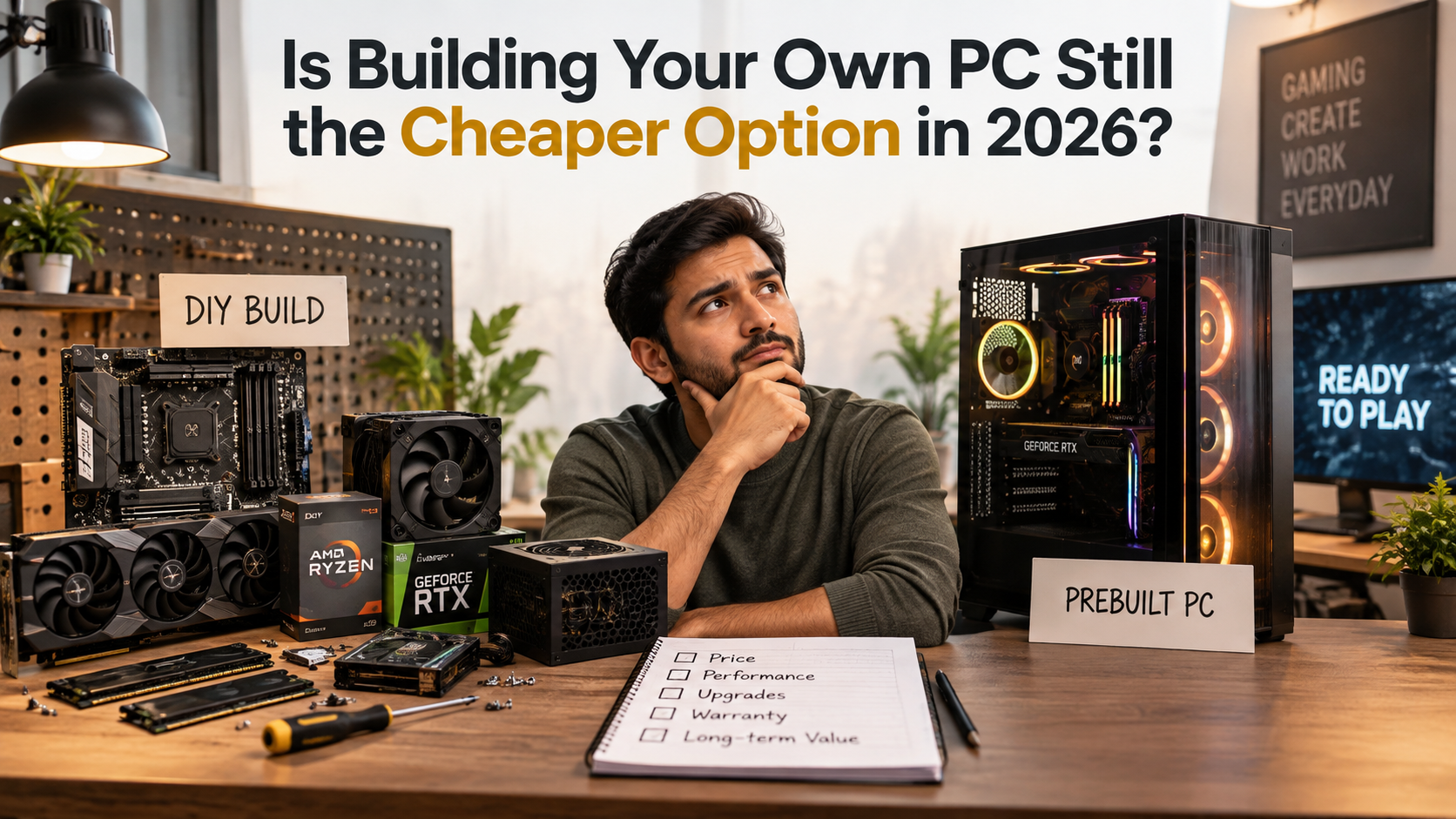
Is building your own PC still the cheaper option in 2026? For years, building a custom desktop was a popular way to get better hardware for less money. Gamers, developers, and creative professionals often chose individual components instead of buying a prebuilt system. Tools like PCPartPicker also make it easier to compare components, check compatibility, and estimate the total cost of a custom build.
Today, the answer is less straightforward. Component prices, memory shortages, AI infrastructure demand, and aggressive prebuilt pricing have changed the market. As a result, many buyers now question whether building your own PC is still cheaper than purchasing a ready-made system.
That does not mean DIY building has lost its value. A custom system still gives you greater control over components, upgrades, cooling, and long-term repairability.
This guide examines is building your own PC still the cheaper option in 2026. It also looks at component pricing, prebuilt value, and the factors that can make a DIY computer worthwhile.
Is it cheaper to build a PC in 2026?
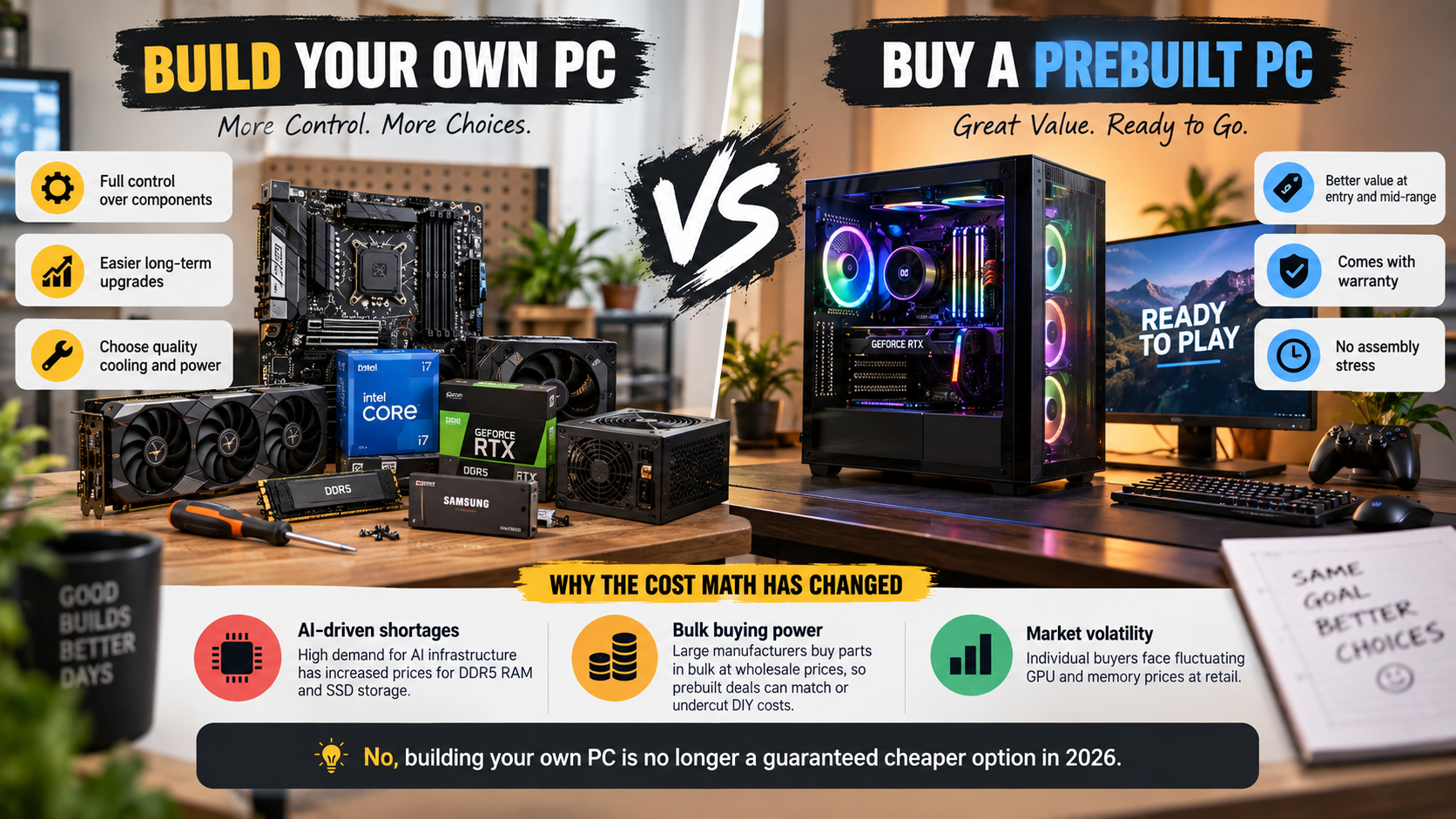
So, is building your own PC still the cheaper option in 2026? The answer is not always. The final price depends on the parts you choose, current sales, and the performance level you target. Prebuilt manufacturers can spread assembly, logistics, software, and purchasing costs across large production volumes.
That can make some entry-level and mid-range systems surprisingly competitive with DIY builds. However, the comparison changes when you move toward higher-end hardware or specialized configurations.
A custom build can make more sense when you want specific components. You can also avoid compromises that sometimes appear in lower-cost prebuilts, such as limited storage or weaker cooling.
The biggest advantage is flexibility. You can spend more of your budget on the GPU or CPU and less on features you do not need.
If you are asking is building your own PC still the cheaper option, compare the total price and exact components in both options before buying.
Prebuilt Mass Discounts Outweigh Retail Parts
Large PC manufacturers purchase components in substantial quantities. That purchasing power can help them negotiate better prices than individual consumers receive at retail. It can also reduce costs for assembly, shipping, testing, and software licensing.
This advantage can make a prebuilt computer competitive with a similarly equipped DIY system. Retail buyers must purchase every component separately, and those prices can change quickly during shortages or sales.
Memory is a particularly important consideration in 2026. Tight supply and continued demand from AI infrastructure can put pressure on consumer memory availability.
However, prebuilt pricing should never be judged by the headline specification alone. Check the Motherboard VRMs: Understanding PC Power Delivery, power supply, memory configuration, storage, cooling, and upgrade options.
A discounted prebuilt can offer excellent value. A carefully selected DIY build can still provide better component control.
For anyone wondering is building your own PC still the cheaper option, the complete hardware configuration matters more than the advertised CPU and GPU alone.
Will PC prices increase in 2026?
Some PC components are experiencing significant price pressure in 2026. Memory is one of the clearest examples. AI infrastructure continues to increase demand for high-capacity memory and storage hardware.
Suppliers are also allocating more production toward server applications. This can put additional pressure on consumer memory supply and pricing.
That does not mean every PC component will become more expensive throughout the year. CPU, GPU, motherboard, case, and power-supply pricing can follow different market cycles.
Retail pricing also depends on promotions, inventory, currency movements, tariffs, and regional availability. Therefore, broad claims about every PC component becoming more expensive are difficult to justify.
For buyers asking is building your own PC still the cheaper option, tracking individual component prices is more useful than waiting for a universal market drop.
High-Bandwidth Memory Demands Drive Component Costs
The rapid expansion of AI infrastructure is affecting the wider memory market. High-bandwidth memory, or HBM, is designed for demanding accelerator and data-center workloads. Its production uses manufacturing capacity that overlaps with conventional DRAM supply.
Strong AI server demand has contributed to tighter conventional DRAM supply. Suppliers have also shifted capacity toward server-focused products, putting additional pressure on consumer memory availability.
However, it would be misleading to say that HBM directly determines the retail price of every DDR5 kit. PC memory pricing depends on several factors, including supply, demand, inventories, production capacity, and procurement contracts.
The effect is still relevant for PC builders. When memory supply tightens, retailers can face higher costs for consumer modules.
That makes RAM and SSD pricing worth monitoring before starting a new build. If prices are unusually high, knowing How to spot fake SSDs? can also help you avoid poor-quality storage. If prices are unusually high, delaying a purchase or choosing a different capacity may protect your budget.
These factors can influence whether building your own PC is still the cheaper option for your particular hardware requirements.
Will building a PC ever be affordable again?
Yes. Affordable PC building is still possible in 2026, although the best approach has changed. You do not need flagship hardware to build a capable gaming or productivity desktop.
Mid-range processors and graphics cards can deliver strong performance without requiring an extreme budget. You can also reduce costs by choosing practical cases, sensible cooling, and storage capacity that matches your actual needs.
The second-hand and refurbished markets can provide additional savings. However, used components require more caution. Check the seller, warranty status, condition, and return policy before buying.
A cost-conscious build should also avoid spending heavily on cosmetic features. RGB lighting, premium cases, and elaborate cooling can increase the total without improving core performance. Choosing the Best PC Case for Air and Liquid Cooling: Complete Guide can also help balance cooling performance and cost.
Platform longevity matters too. A motherboard with useful upgrade options can reduce future replacement costs. Value comes from balancing performance, reliability, and upgrade potential, rather than buying the cheapest component in every category.
For buyers asking is building your own PC still the cheaper option, the answer can change depending on your budget, workload, and component choices.
Value-Focused Component Sockets Maximize Long-Term Budgets
Choosing a platform with a useful upgrade path can improve the long-term value of a custom PC. Instead of replacing the entire system after a few years, you may be able to upgrade individual components.
The motherboard plays an important role in that strategy. Processor compatibility, memory support, expansion slots, storage interfaces, and firmware support can all affect future upgrade options.
However, platform longevity should not be the only buying criterion. A newer socket may offer better features, while an older platform can sometimes provide stronger value at a lower entry price.
The same principle applies to other components. A reliable power supply can support future upgrades, while a case with good airflow can accommodate larger graphics cards and additional storage. You should also consider Should You Add USB-C Ports To Your Desktop PC? when planning future connectivity.
You can also save money by avoiding unnecessary premium features. Spend your budget where performance actually matters for your workload.
A thoughtful component selection can make a DIY PC more economical over several years, even when the initial purchase price matches a prebuilt system.
Is building a PC actually cheaper?
Sometimes, but the answer depends heavily on the specific parts and current retail prices. A DIY build can be cheaper when you find component discounts or avoid paying for hardware you do not need.
It can also provide better control over component quality. You choose the motherboard, power supply, memory, storage, cooling, and case instead of accepting whatever combination a manufacturer selected.
However, the claim that DIY builds always save five to ten percent is too broad. Pricing changes constantly, and some prebuilts can sell at aggressive promotional prices.
A fair comparison should match the systems component by component. Look beyond the CPU and GPU, because cheaper prebuilts may use lower-capacity storage, basic cooling, or less flexible power supplies.
Consider the total configuration rather than the advertised headline specifications. Warranty coverage, assembly, operating system costs, and upgradeability can also affect overall value.
Ultimately, is building your own PC still the cheaper option depends on the exact systems you compare and the prices available when you buy.
Component Quality Delivers Superior Financial Value
One major benefit of a custom PC is control over component quality. You can choose a power supply from a reputable manufacturer, select suitable cooling, and install the storage capacity you actually need.
Some inexpensive prebuilts may use basic components to meet a target price. However, it is not accurate to assume that every prebuilt uses poor-quality hardware. Many established system builders provide detailed specifications and reliable components.
The key is to check the full parts list before comparing prices. A system with the same processor and graphics card can still differ significantly in motherboard features, memory configuration, storage, cooling, and power delivery. It is also useful to understand Why Some USB Ports Are Color-Coded & USB-C Isn’t when comparing connectivity options.
DIY also lets you prioritize reliability based on your needs. You can choose a higher-quality power supply or better airflow instead of spending money on cosmetic extras.
That flexibility can improve value over the life of the computer. It may also make future repairs easier because standard components are generally simpler to replace.
For many buyers, component transparency is just as important as the initial purchase price when deciding is building your own PC still the cheaper option.
Is building a PC even worth it anymore?
Yes, building a desktop can still be worthwhile in 2026. The financial advantage is only one part of the decision. DIY also gives you greater control over hardware selection, upgrades, repairs, and software setup.
A custom system can use standard components such as ATX-compatible cases, modular power supplies, and PCIe expansion hardware. This makes individual upgrades easier than replacing an entire computer.
However, not every prebuilt system uses proprietary hardware. Many mainstream desktops also use standard components. Buyers should therefore inspect the exact model rather than assuming a prebuilt will be difficult to upgrade.
DIY also provides an educational benefit. Building a PC teaches you how components work together and makes future troubleshooting easier.
The process does require time and responsibility. You must research compatibility, assemble the hardware, install software, and diagnose problems if something goes wrong.
For users who value ownership, repairability, customization, and upgrade flexibility, building a PC can still make strong financial sense. These benefits also matter when considering whether building your own PC is still the cheaper option.
Universal Hardware Standards Prevent Premature Obsolescence
Standardized hardware can make a custom desktop easier to maintain over time. A compatible ATX case, standard power supply, and PCIe expansion slots can allow individual components to be replaced as technology advances.
This does not guarantee unlimited upgrade potential. Motherboard sockets eventually become obsolete, power requirements can change, and newer interfaces may require newer hardware.
Still, a standard DIY system can offer considerable flexibility. You might replace the graphics card while keeping the case, storage, power supply, and other components. You can also add memory or storage when your needs increase.
This modular approach can reduce the need to replace an entire computer at once. It can also spread upgrade costs across several years. Regular maintenance can further extend that lifespan, including understanding Sleep Mode vs Shutdown: Which Is Better for Your PC? when deciding how to manage your system.
Before buying, check socket compatibility, power requirements, physical clearance, storage interfaces, and expansion support. These details determine whether future upgrades will be practical.
In 2026, deciding whether is building your own PC still the cheaper option involves more than comparing today’s checkout price. Long-term upgrade flexibility can also affect the total cost of ownership.
Conclusion
Determining whether is building your own PC still the cheaper option comes down to how you measure long-term value against immediate checkout costs. Prebuilt desktops have closed the upfront price gap at the budget and mid-tier levels through immense corporate supply chains. However, measuring a computer solely by its initial purchase price ignores the true cost of ownership.
Custom-built desktops eliminate unbranded power supplies, locked proprietary motherboards, and pre-installed operating system bloatware. By picking every module yourself, you invest directly in durable silicon, superior thermal efficiency, and standardized modular components that accept seamless upgrades for years to come.
If your objective is simply scoring the absolute cheapest office desktop today, a factory build on sale makes practical sense. But if you want a reliable, high-performance machine tailored precisely to your workflow, rolling up your sleeves remains the most rewarding path. Take inventory of your software demands, establish a sensible hardware budget, and start designing a balanced setup that you can maintain and enjoy for years.