
Is a 3D Printer Still Worth Buying in 2026?
If you are asking “is a 3D printer still worth buying” in 2026, the answer depends on what you plan to make. Modern 3D printers are much easier to use than many early consumer models. Automatic bed leveling, improved sensors, faster motion systems, and better slicer software have reduced much of the frustration.
3D printing, also called additive manufacturing, creates objects layer by layer from digital designs. The National Institute of Standards and Technology’s explanation of additive manufacturing shows how the technology is used across areas such as aerospace, engineering, and customized manufacturing. NIST also maintains additive manufacturing standards and benchmarks to support more consistent and reliable manufacturing processes.
So, is a 3D printer still worth buying for the average person? It can be, especially for people who enjoy making, repairing, customizing, or prototyping objects.
This guide explains why a 3D printer is still worth buying, what it costs to own one, how long printers can last, and what safety issues you should consider before purchasing.

Which 3D Printer Should I Buy in 2026?
If you are wondering whether a 3D printer is still worth buying, start by choosing the type of printer that matches your projects. You do not need an expensive machine if you only want to print simple household objects.
For beginners, models such as the Bambu Lab A1 and some Creality Ender-3 V3 models offer features designed to reduce manual setup. They can be suitable for users who want to spend more time printing and less time calibrating.
If you want faster printing or an enclosed design, the Bambu Lab P1S is another option to consider. An enclosure can also be useful when working with materials that benefit from better temperature control.
For highly detailed miniatures, resin printers such as the Elegoo Saturn series can produce fine details.
Before deciding if a 3D printer is still worth buying for you, consider:
- Build volume: Choose a size that fits your projects.
- Material support: Check which filaments or resins the printer handles.
- Automation: Features such as automatic bed leveling can simplify setup.
- Enclosure: Useful for certain materials and controlled printing conditions.
- Replacement parts: Make sure parts are readily available.
- Software: Choose a slicer that matches your experience.
The right printer depends more on your intended use than its specification sheet.
Core Considerations for Every Buyer
The most important question is simple: What will you actually print? Your answer should determine whether a 3D printer is still worth buying and which model makes sense.
If you want replacement brackets, organizers, phone stands, or simple prototypes, a basic FDM printer may be enough. You may not need a high-end machine with advanced features.
Build volume is another important consideration. A compact printer takes less space, but its smaller print area can limit larger projects.
Material compatibility matters too. PLA is generally easy to print and works well for many beginner projects. If you are comparing materials, understanding the strongest 3D printer filament can help you choose a filament based on strength and your intended use. Materials such as ABS, ASA, nylon, and carbon-fiber-filled filaments can require different temperatures, hardware, or printing conditions.
Think about maintenance as well. Nozzles, build surfaces, belts, fans, and other components can eventually require attention or replacement.
You should also calculate the ongoing cost of materials. A printer may look affordable initially, but frequent printing increases filament expenses.
Finally, consider your workspace. Noise, ventilation, heat, storage, and electrical safety all matter.
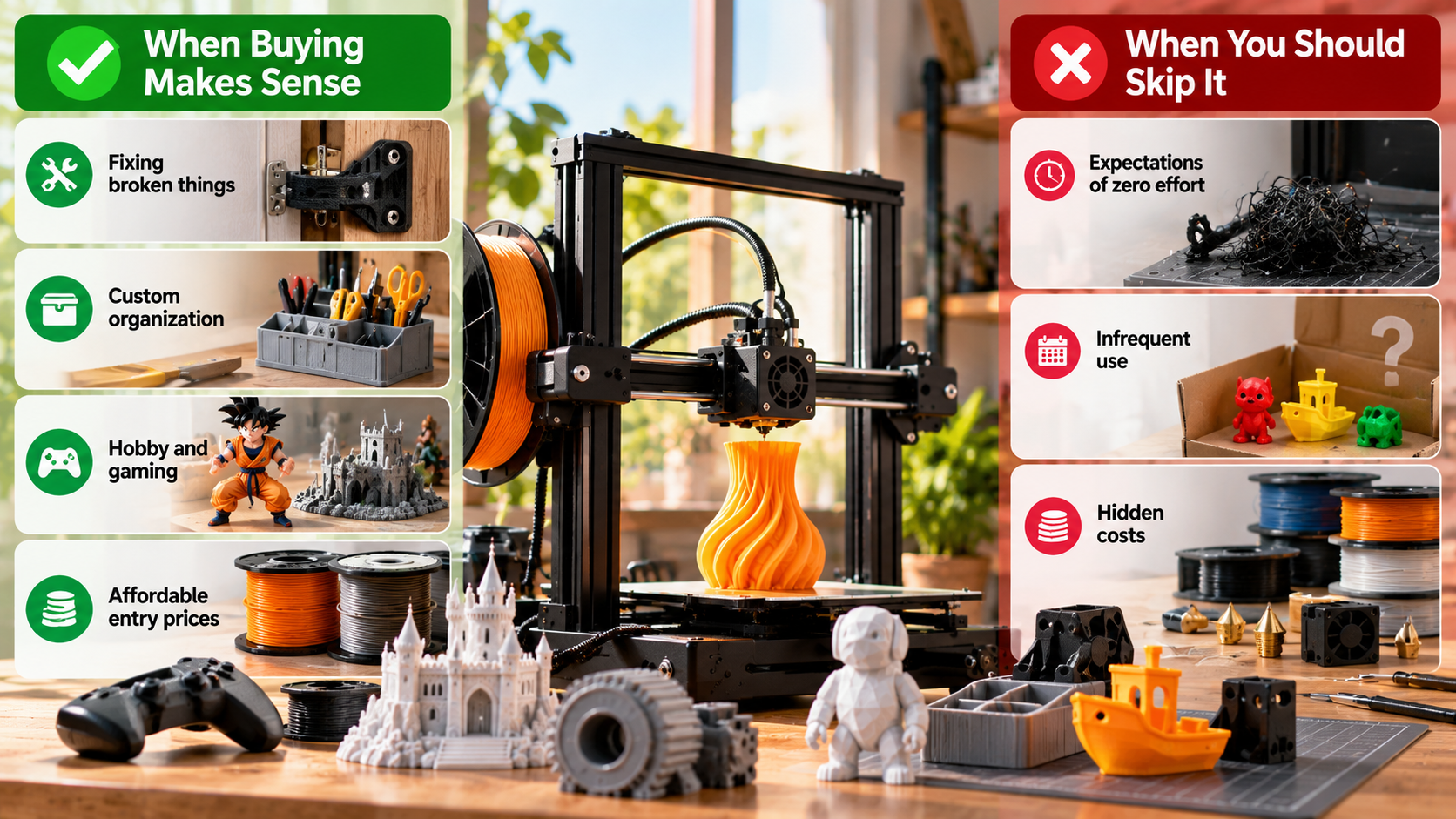
If you only expect to print a few objects each year, buying may not make financial sense. Frequent users are more likely to get meaningful value from owning a printer.
Does 3D Printing Have a Future?
If you are asking is a 3D printer still worth buying because the technology may become outdated, current developments suggest that additive manufacturing will remain useful. However, its future is more likely to involve specialized applications than replacing conventional manufacturing.
3D printing already has important applications in aerospace, automotive manufacturing, healthcare, engineering, education, and product development. Businesses use it for prototypes, customized components, tooling, and some production parts.
Consumer 3D printing is also becoming easier. Better slicers, automated calibration, improved hardware, and AI-assisted design tools can reduce the technical knowledge needed to create useful objects.
Another important development is digital manufacturing. Companies can maintain digital designs for selected replacement parts instead of keeping every physical component in stock.
That does not mean traditional manufacturing will disappear. Injection molding and other processes remain more efficient for many high-volume products.
For consumers, the future is likely to focus on customization, repair, rapid prototyping, education, and small-batch production.
This is another reason a 3D printer can still be worth buying in 2026. The technology is becoming more accessible while remaining useful for tasks that traditional manufacturing handles poorly.
Distributed Digital Inventory and On-Demand Production
One potential future application is digital inventory. Instead of physically storing every replacement component, a company could maintain digital files for selected parts.
When a compatible component is needed, the design could be manufactured locally. This could reduce the need to store large quantities of rarely requested parts.
The approach may be particularly useful for products with long lifespans. Manufacturers could potentially provide replacement designs years after a product was originally released.
However, this concept has important limitations. A consumer 3D printer cannot safely reproduce every type of component.
Critical automotive, electrical, medical, structural, and safety-related parts may require certified materials and controlled manufacturing processes. A visually identical printed part may not have the same strength or heat resistance as the original.
For everyday consumers, the most realistic benefit is access to custom and replacement parts. You could potentially create a bracket, clip, holder, or adapter instead of searching for an exact replacement.
For businesses, digital manufacturing may complement traditional inventory systems.
This does not mean physical warehouses will disappear. Instead, digital files may become another way to manage selected low-volume components.
If you are considering whether a 3D printer is still worth buying, this flexibility can be valuable. The printer becomes a small manufacturing tool rather than simply a hobby machine.
What Is the Lifespan of a 3D Printer?
If you are wondering is a 3D printer still worth buying because you are concerned about durability, there is no single guaranteed lifespan. A printer can remain useful for many years, depending on its construction, workload, maintenance, and availability of replacement parts.
Some components can operate for years under normal use. Other parts are consumables and eventually need replacement.
Common wear components include:
- Nozzles, particularly when printing abrasive materials.
- Build plates, which can eventually lose surface performance.
- Belts, which may require adjustment or replacement.
- Fans, which wear through continuous operation.
- PTFE components, where the printer uses them.
- Motion components, depending on the machine’s design.
Electronic components can also fail. Power supplies, control boards, heaters, and sensors may eventually need replacement.
The advantage of many consumer 3D printers is their repairability. A worn nozzle or failed fan does not necessarily mean replacing the entire machine.
This makes repairability and replacement-part availability important buying factors.
Rather than assuming every printer will last five or eight years, check the manufacturer’s support history and the availability of replacement components.
A well-maintained printer can remain useful well beyond its initial warranty period. However, heavy use can accelerate wear.
Therefore, a 3D printer can still be worth buying when you expect to use it regularly and choose a model that can be maintained over time.
Essential Preventative Maintenance Best Practices
Maintenance is one of the biggest differences between owning a 3D printer and buying a finished product. Fortunately, most routine maintenance is manageable for home users.
Start by keeping the build surface clean. A dirty or damaged surface can contribute to poor adhesion and failed prints.
Inspect belts, screws, fans, and moving components periodically. If your printer requires lubrication, follow the manufacturer’s instructions for the correct lubricant and maintenance interval.
The nozzle also deserves attention. Abrasive materials such as carbon-fiber-filled filaments can wear standard brass nozzles more quickly. A hardened nozzle may be more suitable for frequent abrasive-material printing.
Filament storage is another important consideration. Some materials absorb moisture from the surrounding air. Moisture can cause inconsistent extrusion, surface defects, popping, and other printing problems.
Store moisture-sensitive filament in a sealed container with desiccant. Some materials may also require drying before use.
Do not apply the same maintenance routine to every printer. Different hotends, motion systems, extruders, and printer designs have different requirements.
Instead, follow the manufacturer’s maintenance instructions.
Regular inspection is more useful than replacing components according to an arbitrary schedule. Unusual sounds, inconsistent extrusion, poor first layers, or repeated failures can indicate that maintenance is needed.
Good maintenance can improve reliability and help your printer remain useful for longer.
Why Did 3D Printing Fail to Become Ubiquitous Earlier?
If you are asking is a 3D printer still worth buying, it helps to understand why earlier consumer 3D printing did not become an everyday household technology.
During the early 2010s, 3D printing attracted significant attention. Some expectations suggested that consumers would soon manufacture many everyday products at home.
The technology was not ready for that level of convenience.
Early desktop printers often required substantial manual calibration. Understanding how a 3D printer works also helps explain why these machines required careful control of bed adhesion, leveling, warping, extrusion, temperature settings, and software configuration.
Creating models also required learning CAD software or finding suitable designs online. Printing could take hours, and failed prints wasted both material and time.
For many households, buying an inexpensive manufactured product was simply easier.
The technology continued developing instead of disappearing. Manufacturers improved sensors, calibration systems, slicers, motion systems, print speeds, and overall reliability.
Modern machines have therefore changed the experience considerably. Many users can start a print with fewer manual adjustments than earlier machines required.
That does not mean modern printers are completely automatic. Users still need to select appropriate materials, prepare files, maintain hardware, and troubleshoot occasional problems.
The important change is that the barrier to useful 3D printing has become lower.
For people who regularly make custom objects, this improvement is one reason a 3D printer can still be worth buying in 2026.
Shifting From Consumer Toys to Practical Utilities
The role of consumer 3D printers has gradually changed. Earlier machines were often associated with experimentation and technical tinkering.
Modern printers increasingly focus on making the printing process easier. Automatic bed leveling, improved sensors, better motion control, and more reliable software can reduce routine setup work.
Slicer software has also become more accessible. Many programs offer ready-made profiles for common printers and materials.
This allows beginners to start printing without understanding every technical setting.
However, 3D printers are still mechanical devices. They use heated components, moving parts, electrical systems, and consumable materials.
A printer can still produce failed prints or develop problems. Users need to understand basic maintenance and safe operation.
The practical value comes from the ability to make objects when needed. You can produce custom organizers, replacement pieces, prototypes, brackets, decorations, educational models, and hobby components.
This is different from buying a printer simply because the technology is interesting.
If you regularly have projects that require custom parts, the convenience can justify the purchase.
If you rarely make anything, the printer may spend most of its time unused.
That distinction is important when deciding whether a 3D printer is still worth buying.
The technology has become easier to use, but its value still depends on what you do with it.
Are 3D Printers Unhealthy to Run Indoors?
If you are researching is a 3D printer still worth buying, indoor safety should be part of the decision. 3D printing can release ultrafine particles and volatile organic compounds. Emissions vary according to the printer, material, temperature, additives, and operating conditions.
PLA is generally considered easier to work with than some higher-emission materials, but it should not automatically be considered emission-free.
Materials such as ABS and ASA can produce higher levels of certain emissions under some conditions. Nylon and other engineering materials can also require careful handling and appropriate printing conditions.
Resin printing presents different concerns. Liquid photopolymer resin can irritate the skin and may cause sensitization with repeated exposure. Uncured resin therefore requires careful handling.
If you operate a printer indoors:
- Use adequate ventilation.
- Keep printers away from bedrooms and heavily occupied areas.
- Consider an enclosure and appropriate filtration.
- Follow the manufacturer’s material safety instructions.
- Use suitable protective equipment when handling liquid resin.
- Keep children and pets away from operating equipment and uncured resin.
Filtration can help reduce exposure, but it should not automatically replace ventilation.
Your workspace should influence your purchase decision. A printer may be less suitable if you have no practical way to manage heat, noise, emissions, or resin handling.
Essential Ventilation Protocols for Home Workspaces
The right ventilation strategy depends on your printer and the material you use. A small PLA printer has different considerations from a resin printer or an enclosed machine printing ABS.
For filament printing, place the printer in an area with adequate airflow. Avoid putting it directly beside your bed or in a small room where you spend many hours.
An enclosure can help contain particles and control printing temperatures. However, the enclosure should be appropriate for the printer and material.
For materials with higher emissions, exhausting air outdoors can provide an additional exposure-control measure. Filtration may also help when properly designed and maintained.
Resin printing requires additional precautions. Wear appropriate nitrile gloves and eye protection when handling uncured resin. Follow the resin manufacturer’s instructions for ventilation, washing, curing, and disposal.
Do not treat liquid resin and fully cured resin as the same material. Uncured resin requires more careful handling.
Before deciding if a 3D printer is still worth buying, consider where you will operate it.
A large printer may not be practical in a small bedroom or poorly ventilated workspace. A resin printer may require even more planning.
Safe operation is therefore part of the total ownership cost.
The best printer is not simply the one with the fastest print speed. It is one that fits your projects, budget, workspace, materials, and ability to operate it safely.
Is a 3D Printer Still Worth Buying in 2026?
So, is a 3D printer still worth buying in 2026? For the right user, it can be a practical tool rather than a novelty.
Modern printers are easier to operate than many early consumer models. Faster printing, automated features, better slicers, and improved hardware have reduced several common frustrations.
The strongest reason to buy one is regular use. If you frequently need custom parts, prototypes, organizers, replacement pieces, miniatures, or hobby components, owning a printer can provide useful flexibility.
The purchase makes less sense if you have no specific projects in mind. A printer can become expensive unused equipment when filament, maintenance, and workspace requirements are added to the purchase price.
Before buying, compare the total cost of ownership rather than looking only at the printer’s price.
Consider:
- Printer cost
- Filament or resin
- Replacement parts
- Maintenance
- Electricity
- Ventilation or filtration
- Workspace requirements
- Your expected printing frequency
The answer to “is a 3D printer still worth buying?” is therefore personal. The technology is more accessible than before, but the value comes from how often you will use it.
If you already have several projects in mind, buying may be easier to justify. If you are only curious about the technology, consider trying a local 3D-printing service first.