
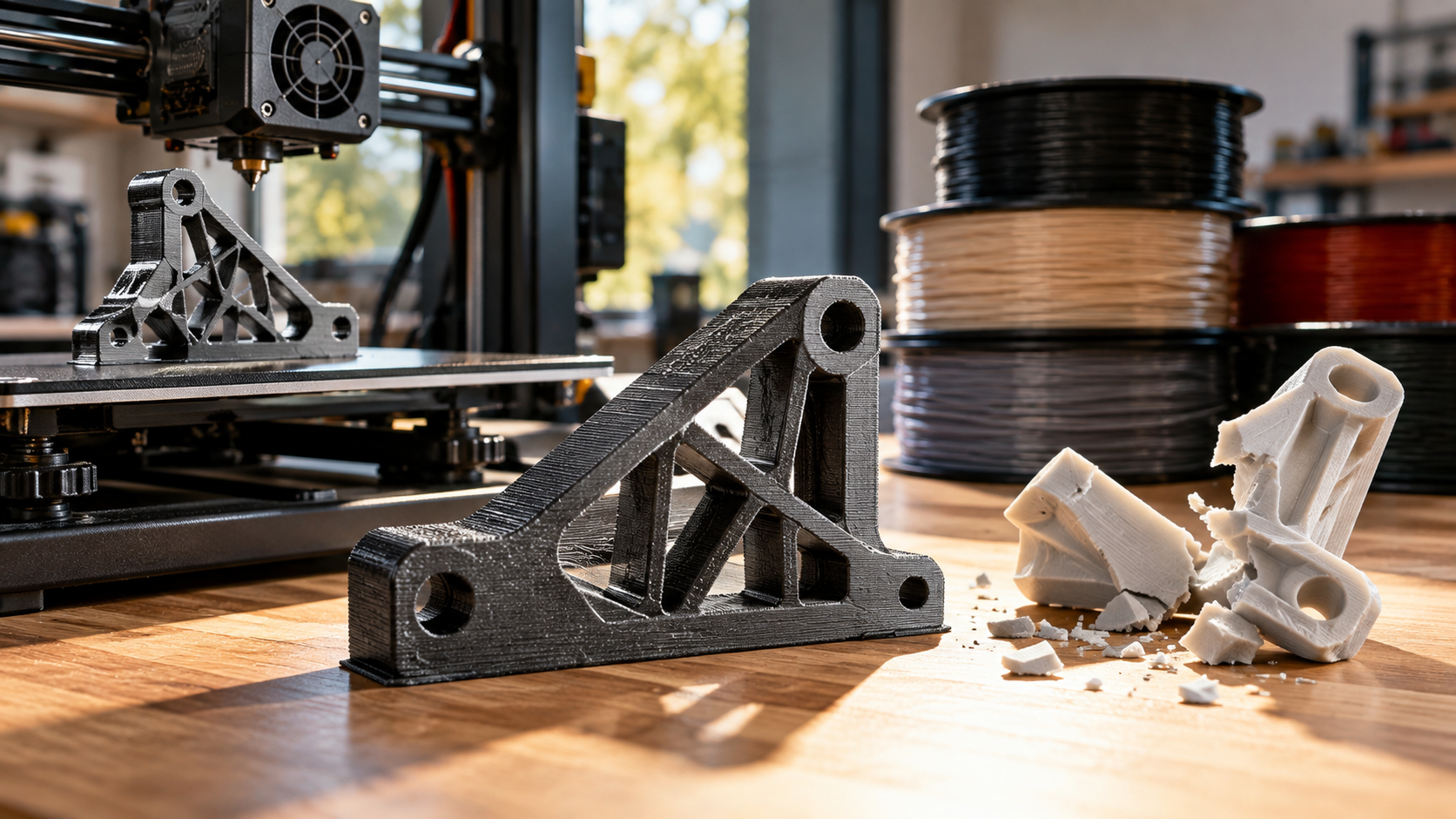
What’s the Strongest 3D Printer Filament?
Choosing the strongest 3D printer filament is not as simple as finding the highest tensile-strength number. Different materials behave differently when exposed to weight, impact, heat, bending, and repeated stress.
A rigid material may support a heavy static load but crack when dropped. A tougher material may bend under pressure and absorb the impact without breaking. This difference matters when choosing filament for functional 3D-printed parts.
Before comparing materials, it helps to understand the basic printing process. If you’re new to the technology, our guide on how a 3D printer works explains how a digital model becomes a physical object through slicing, G-code, and layer-by-layer printing.
For FDM printing, engineers and makers usually consider several mechanical properties, including tensile strength, impact resistance, flexural strength, and interlayer adhesion. You can also compare these characteristics across common materials using Prusa’s Filament Material Guide.
- Tensile strength: How much pulling force a material can withstand before stretching or breaking.
- Impact resistance: How well a printed part handles sudden shocks, collisions, or drops.
- Flexural strength: How well the material resists bending when a load is applied.
- Interlayer adhesion: How strongly individual printed layers bond together along the Z-axis.
Interlayer adhesion is especially important because the connection between layers can become the weakest part of an FDM print.
Therefore, the strongest 3D printer filament for one project may not be the strongest choice for another. The right material depends on how the finished part will be used.

What Is the Strongest Filament for 3D Printing?
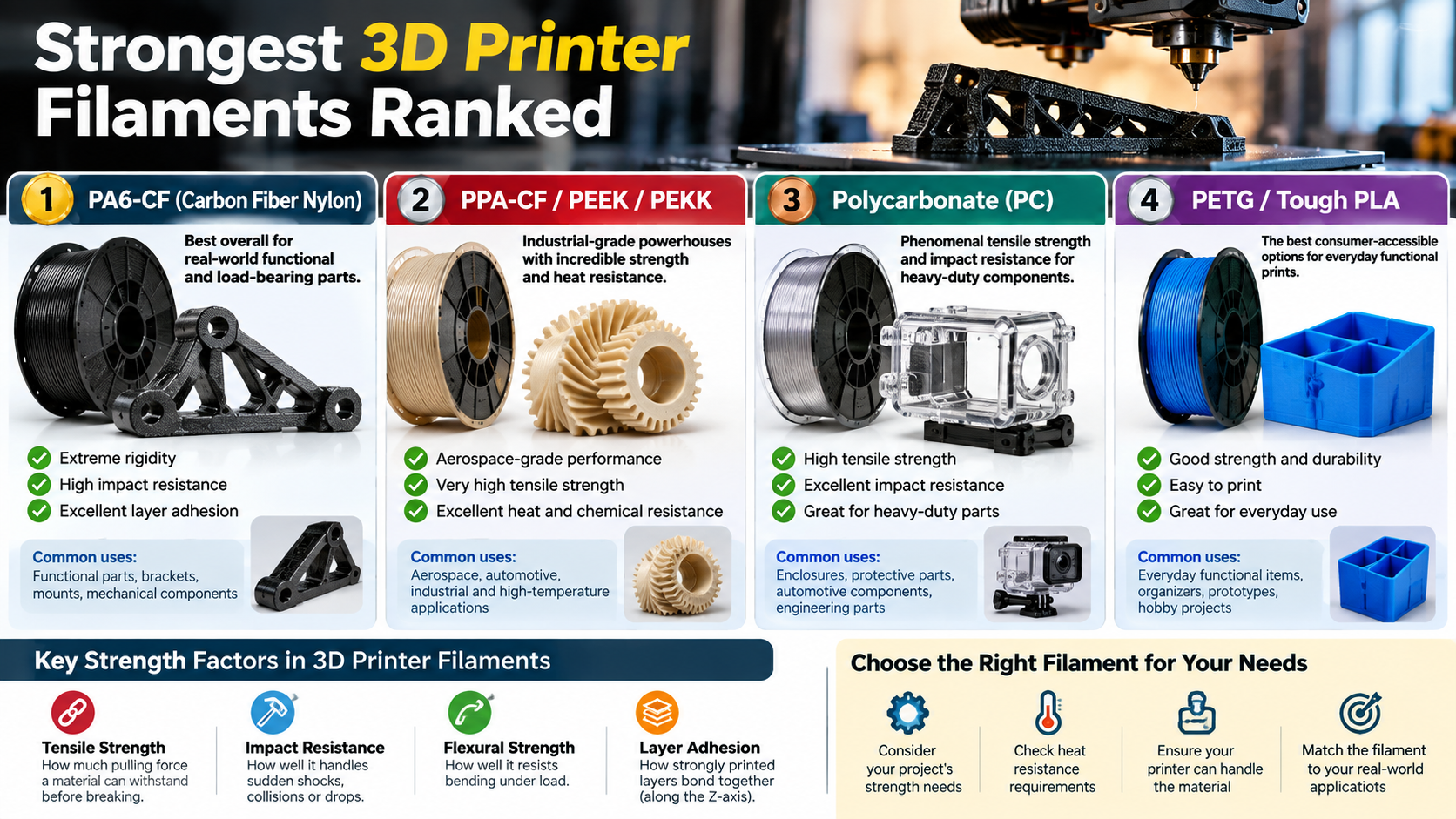
The strongest 3D printer filament options generally come from the PAEK family of high-performance polymers. PEEK and PEKK are two well-known examples, while ULTEM, or PEI, is another engineering-grade material used for demanding applications.
These materials can provide excellent mechanical strength, heat resistance, and chemical resistance. However, their impressive specifications come with significant printing requirements.
PEEK, for example, can offer tensile strength around 90–100 MPa. It can also withstand continuous operating temperatures above 250°C in suitable applications. Reinforced versions can provide even greater stiffness and dimensional stability.
The problem is accessibility. Printing these materials typically requires specialized hardware, high nozzle temperatures, heated build plates, and actively heated chambers.
For most desktop users, the strongest 3D printer filament is therefore more likely to be carbon-fiber-reinforced nylon or polycarbonate. These materials provide high mechanical performance without requiring the same industrial equipment as PEEK.
Your printer’s capabilities should always be considered before selecting an engineering filament.
Industrial High-Performance Polymers: PEEK and PEKK
PEEK and PEKK are among the strongest materials used in high-performance additive manufacturing. Their mechanical properties make them suitable for applications that require high strength, chemical resistance, and heat resistance.
PEEK can provide tensile strength of roughly 90–100 MPa. It can also maintain performance at temperatures far beyond common consumer materials such as PLA and PETG.
Carbon-fiber reinforcement can further increase stiffness and dimensional stability. This makes reinforced PEEK attractive for demanding engineering applications.
However, these materials require specialized equipment. Typical printing requirements can include:
- Nozzle temperatures between 380°C and 450°C.
- Heated build plates reaching approximately 120°C to 150°C.
- Actively heated chambers reaching approximately 90°C to 140°C.
Without adequate temperature control, parts can experience severe warping or layer delamination.
For most consumer and prosumer printers, PEEK and PEKK are therefore impractical. They are better suited to industrial systems designed specifically for high-temperature engineering materials.
The strongest 3D printer filament on a technical data sheet is not automatically the most practical material for your printer.
The Strongest Practical Filaments for Desktop 3D Printers
For desktop machines, polycarbonate and carbon-fiber-reinforced nylon are among the strongest practical engineering materials.
Polycarbonate is one of the strongest unreinforced polymers commonly used on capable desktop printers. It can provide tensile strength around 65–75 MPa, high rigidity, and heat-deflection temperatures around 110–130°C.
However, polycarbonate generally requires an all-metal hotend and an enclosure. Controlling temperature is important because the material can warp during printing.
Carbon-fiber nylon combines nylon’s toughness with the stiffness provided by chopped carbon fibers. This reinforcement can improve rigidity and dimensional stability while reducing some of nylon’s tendency to deform.
| Material | Tensile Strength (MPa) | Impact Resistance | Heat Deflection Temp. | Desktop Printer Feasibility |
|---|---|---|---|---|
| PEEK / PEKK | 90–100+ | Very High | 250°C+ | Industrial |
| Polycarbonate (PC) | 65–75 | High | 110–135°C | Prosumer |
| PA-CF | 70–85 | Very High | 140–175°C | Intermediate |
| PETG | 45–55 | Moderate | 65–75°C | Easy |
| Standard PLA | 50–65 | Low | 50–55°C | Entry-Level |
This makes PC and PA-CF strong candidates when you need the strongest 3D printer filament that remains realistic for desktop manufacturing.
Is PETG or PLA+ Stronger?
When comparing PETG and PLA+, there is no single answer because strength depends on the type of load. A rigid component may benefit from PLA+, while a part exposed to impact may perform better with PETG.
PLA+ is usually formulated from PLA with additional modifiers. These formulations can improve toughness while maintaining much of PLA’s rigidity. For slow, steady loads, PLA+ can perform well.
PETG has greater ductility and elongation at break. Instead of failing suddenly, it can flex and deform before breaking. This behavior can be useful for parts exposed to vibration, impact, or repeated handling.
Heat resistance is another important difference. PLA+ can soften at relatively low temperatures. PETG generally provides better resistance to heat and outdoor conditions.
Therefore, neither material should automatically be called the strongest 3D printer filament in every situation.
For rigid indoor parts, PLA+ may be more suitable. For parts that experience impact or environmental exposure, PETG may provide better practical durability.
Key Performance Differences
PETG and PLA+ differ most when you look beyond basic tensile strength. Real-world performance depends on impact, layer bonding, heat, moisture, and the environment where the printed part will operate.
1. Impact resistance: PETG generally handles drops, vibration, and sudden shocks better than PLA+. PLA+ is tougher than standard PLA, but it can still behave as a relatively rigid material.
2. Layer adhesion: PETG can form strong bonds between printed layers when the material is printed at suitable temperatures. Good layer adhesion can reduce splitting along the Z-axis.
3. Thermal durability: PLA and PLA+ can soften at approximately 55°C–60°C. A PLA+ part left inside a hot vehicle may deform. PETG generally offers better heat resistance.
4. Environmental durability: PETG typically performs better in applications involving moisture and outdoor exposure.
The practical choice depends on your project. PLA+ can work well for rigid indoor brackets and fixtures. PETG can be better when the part must handle impact, vibration, sunlight, or higher temperatures.
So, if you are searching for the strongest 3D printer filament between these two materials, first define what “strong” means for your application.
Is PETG OK to Drink Out Of?
PETG should not automatically be considered safe for drinking just because PET is widely used for beverage containers. 3D-printed PETG introduces additional factors that do not exist in the same way with commercially manufactured bottles.
The FDM process creates microscopic ridges and gaps between extrusion lines. These areas can be difficult to clean completely and may retain moisture or organic material.
The filament itself can also contain additives. Pigments, processing aids, stabilizers, and other ingredients may vary between manufacturers.
The printer nozzle is another consideration. Many standard nozzles use brass, and some brass alloys contain trace amounts of lead.
If you plan to use a printed PETG object for food or beverages, evaluate the complete printing process rather than the polymer alone.
Use material with appropriate food-contact documentation when available. A suitable stainless-steel nozzle can also reduce concerns associated with brass.
A certified food-contact coating may help seal the printed surface. However, the coating must itself be appropriate for the intended application.
The strongest 3D printer filament is not necessarily the safest material for food contact. Strength and food-contact suitability are separate considerations.
1. The Microscopic Ridges Between Layers
FDM printing creates a part by depositing plastic in individual lines. These lines form visible ridges and microscopic surface imperfections. The effect can become important when the printed object is intended to hold food or liquids.
Even when a print looks smooth, the layer structure can create small areas that are difficult to clean. Moisture and organic residue may remain inside surface imperfections.
This is one reason a 3D-printed PETG container should not automatically be treated like a commercially manufactured beverage bottle.
Surface treatment can reduce these concerns. A properly selected food-contact-safe coating can cover the layer lines and create a smoother surface.
Print quality also matters. Under-extrusion, poor layer bonding, and printing defects can create larger gaps.
For repeated food or beverage contact, evaluate the entire finished object. Consider the filament, additives, nozzle, print settings, surface finish, and cleaning requirements.
A food-contact-compatible coating may provide an additional barrier, but it must be selected for the intended use.
Therefore, choosing the strongest 3D printer filament should never be confused with choosing the most suitable filament for food contact. Mechanical performance and hygiene are separate requirements.
2. Additives, Dyes, and Chemical Residues
The polymer is only one component of commercial 3D printing filament. Manufacturers may add pigments, processing aids, stabilizers, and other ingredients to change the material’s properties.
This matters when evaluating food-contact applications. A polymer that is commonly used in food packaging does not automatically make every filament product suitable for food contact.
Natural or uncolored filament may avoid certain pigment-related concerns. However, it does not automatically make the finished print food-safe.
The specific manufacturer’s documentation is more important. Look for information about food-contact certification, intended use, and recommended processing conditions.
This principle applies beyond PETG. Different filaments can contain different additives, and their suitability depends on the exact product.
If a manufacturer does not provide appropriate food-contact information, avoid assuming that the filament is suitable for repeated contact with food or beverages.
The strongest 3D printer filament may contain additives that are completely appropriate for engineering applications but unsuitable for food contact.
For that reason, select filament according to the intended application rather than relying on the base polymer’s reputation.
3. Nozzle Contamination: Lead and Heavy Metals
The printer nozzle is another factor to consider when producing objects intended for food or beverage contact.
Many FDM printers use brass nozzles because brass is inexpensive, easy to machine, and suitable for many common filaments. However, some brass alloys can contain small amounts of lead.
Using a suitable stainless-steel nozzle can reduce this particular contamination concern. Keeping the nozzle clean is also important.
However, replacing a brass nozzle does not automatically make a printed object food-safe. The filament, additives, printer cleanliness, print quality, and surface treatment still matter.
This is an important distinction when choosing the strongest 3D printer filament for a functional project. Mechanical strength tells you how a material performs under load. It does not tell you whether the finished object is appropriate for food contact.
For general mechanical parts, brass nozzles remain common and practical. The issue becomes more significant when the printed object will directly contact food or beverages.
If food safety is important, evaluate the entire production process. Use materials with appropriate documentation and follow the manufacturer’s recommendations for the specific application.
How to Make a PETG Print Food-Safe
If you intend to use a PETG print around food or liquids, several precautions can reduce potential contamination risks. However, these steps should not be treated as a universal guarantee of food safety.
Start with a filament specifically documented for food-contact applications. Do not assume ordinary PETG is suitable simply because PET is used in commercial beverage containers.
A suitable stainless-steel nozzle can reduce concerns related to potential metal contamination. The printer and nozzle should also be kept clean.
A certified food-contact coating may help seal the microscopic grooves created by FDM printing. This can make the surface easier to clean.
Important precautions include:
- Use documented food-contact-compatible filament.
- Use an appropriate stainless-steel nozzle.
- Keep the printer and nozzle clean.
- Maintain consistent extrusion and layer bonding.
- Use a suitable certified coating when necessary.
- Follow the coating and filament manufacturer’s instructions.
The intended use also matters. A decorative container has different requirements from a cup used every day.
Therefore, the strongest 3D printer filament should be selected based on mechanical requirements, while food-contact applications should be evaluated separately.
Is Nylon or PETG Stronger?
Nylon generally provides better performance than PETG for demanding mechanical applications. It is particularly useful when a part needs impact toughness, fatigue resistance, wear resistance, or flexibility.
PETG remains attractive because it is easier to print. It generally does not require the same level of moisture control as nylon and can often be printed without an enclosure.
Nylon behaves differently under stress. It can absorb energy and deform before breaking. This makes it useful for functional components that experience repeated movement or sudden loads.
Nylon also performs well in applications involving abrasion. Its properties make it useful for gears, bushings, sliding components, and snap-fit parts.
Chemical resistance is another potential advantage. Certain nylon formulations can provide strong resistance to oils, fuels, grease, and solvents.
However, nylon requires more careful preparation. It absorbs moisture quickly and can warp during printing.
Therefore, if you are looking for the strongest 3D printer filament between nylon and PETG, nylon generally has the advantage for demanding mechanical applications. PETG remains easier to print and may be sufficient for less demanding parts.
Why Nylon Outperforms PETG
Nylon’s main advantage is its combination of toughness, flexibility, wear resistance, and mechanical durability. These properties make it useful for functional parts that experience repeated movement.
Toughness and impact absorption: Nylon can stretch considerably before breaking. Under sudden torque or impact, it can absorb energy instead of immediately fracturing.
Wear and abrasion resistance: Nylon has a relatively low coefficient of friction. This makes it useful for gears, bushings, sliding tracks, and snap-fit mechanisms.
Chemical resistance: Depending on the formulation, nylon can resist various oils, fuels, greases, and solvents.
PETG remains useful because it is easier to print and handle. It requires less demanding material storage and printer preparation.
This creates a practical trade-off. Nylon is often the better option for demanding mechanical components, while PETG can be a more convenient choice for general functional parts.
Tensile Toughness & Shock Absorption:

PETG   █████████▒▒▒▒▒▒▒▒▒▒▒  Moderate
Nylon  ███████████████████▒  Exceptional
Abrasion Resistance:
PETG ██████▒▒▒▒▒▒▒▒▒▒▒▒▒▒ Prone to surface wear
Nylon ████████████████████ Excellent for moving partsIf mechanical durability is the main priority, nylon deserves consideration before PETG.
The Trade-Off: Printing Difficulty
Nylon’s mechanical advantages come with more demanding printing requirements. A printer that handles PLA and PETG easily may require additional preparation for nylon.
1. Moisture absorption: Nylon is highly hygroscopic. It absorbs moisture from surrounding air relatively quickly. Wet nylon can cause bubbling, foaming, stringing, inconsistent extrusion, and poor layer adhesion.
Nylon should be dried before printing and stored in a dry environment. A sealed container or dry box can help maintain low moisture levels.
2. Thermal warping: Nylon can contract as it cools. This can cause corners to lift from the build plate or produce dimensional inaccuracies.
A heated bed and enclosed build environment can help control temperature changes. Exact requirements depend on the specific nylon formulation.
3. Printer requirements: Some nylon and carbon-fiber nylon materials require high nozzle temperatures. Carbon-fiber-filled filaments can also wear standard brass nozzles quickly.
These requirements make nylon more demanding than PETG. Its mechanical advantages come with additional preparation.
So, while nylon can be a strong candidate for the strongest 3D printer filament, your printer must be capable of handling the material correctly.
What’s Illegal to 3D Print?
A 3D printer is a general-purpose manufacturing tool, but the law can still regulate the objects you produce. What you can legally 3D print depends on the object, purpose, location, and applicable regulations.
Many jurisdictions heavily regulate firearms and certain weapon components. Intellectual property laws can also restrict how you reproduce or commercially sell protected designs.
Other regulated categories include counterfeit currency and certain medical devices. 3D printing does not create an exception to existing manufacturing laws.
If a law restricts an object made through conventional manufacturing, that same law may apply when you produce the object with a 3D printer.
Rules also vary between countries, states, provinces, and municipalities. A restriction in one jurisdiction may not apply in another.
Before you manufacture or sell a potentially regulated object, check the laws that apply to your location and intended use.
The strongest 3D printer filament may work well for engineering applications, but the material itself does not determine whether the law permits the finished object.
1. Undetectable and Unlicensed Firearms
Firearms represent one of the most legally sensitive categories in additive manufacturing. In the United States, federal law sets specific requirements for undetectable firearms.
The Undetectable Firearms Act establishes detection requirements for firearms. Other federal and state laws may also regulate firearm manufacturing and specific components.
Some firearm components require licenses or additional legal compliance. Producing a component at home does not automatically exempt you from those requirements.
Firearm laws also differ internationally. The UK, Australia, Canada, and EU member states each have their own rules for firearms and firearm components.
The exact requirements depend on the object and jurisdiction. For that reason, do not treat general 3D-printing information as legal advice.
If you plan to manufacture a firearm or regulated firearm component, verify the laws that apply before proceeding.
The strongest 3D printer filament does not determine whether an object complies with firearm laws. Legal requirements generally depend on what you manufacture, where you manufacture it, and how you use or transfer it.
Commercial manufacturing can also create additional licensing and regulatory requirements.
2. Weapons Prohibited by State or Federal Statutes
Firearms are not the only objects that can face legal restrictions. Depending on your jurisdiction, laws may regulate the manufacture, possession, sale, or transfer of specific weapons.
Examples can include:
- Switchblades and gravity knives.
- Brass knuckles.
- Throwing stars.
- Certain concealed weapons.
- Other objects that local law classifies as prohibited weapons.
The exact rules vary widely. One jurisdiction may prohibit an item while another may allow or regulate it differently.
The intended use can also affect how authorities classify an object. Some jurisdictions distinguish between ordinary tools, sporting equipment, replicas, and objects designed or intended as weapons.
3D printing does not create a special legal exception. If the law prohibits an object made through conventional manufacturing, the same restriction may apply when you produce it through additive manufacturing.
Check the laws in your specific jurisdiction before producing an object that could fall into a regulated category.
If you plan to sell or distribute such objects, additional requirements may apply.
The strongest 3D printer filament remains a material consideration. Whether the finished object complies with the law remains a separate question.
3. Intellectual Property, Counterfeiting, and Trademarks
3D printing can also create intellectual property issues. Owning a printer does not automatically give you permission to reproduce someone else’s protected design.
For example, making a replacement part for personal use can raise different legal questions from manufacturing and selling unauthorized copies.
Potential issues include:
- Trademark counterfeiting: Producing branded products or logos with the intent to deceive buyers or sell unauthorized copies.
- Patent infringement: Manufacturing a patented invention or mechanism without appropriate authorization.
- Copyright infringement: Reproducing protected digital models, artwork, characters, or designs without permission.
The law may treat personal use, repair, modification, and commercial distribution differently.
Licensing also matters. A creator may allow you to download a 3D model while restricting commercial use. Always check the model’s license before selling a printed object based on someone else’s work.
Commercial manufacturers should review ownership rights and licensing terms before they produce or distribute a design.
Choosing the strongest 3D printer filament does not give you ownership of the design you print. Material selection and intellectual property rights remain separate issues.
For commercial projects, verify the model license and applicable intellectual property rules before production.
4. Controlled Medical Devices and Currency
Some 3D-printed objects fall into highly regulated categories because they can affect health, safety, or financial systems. Medical devices and currency-related objects require particular caution.
Currency and security items: Producing objects that you intend to pass as genuine currency or protected financial instruments can constitute counterfeiting or forgery. Laws vary by jurisdiction, but authorities treat intentional deception seriously.
Medical devices: Manufacturing a medical component for personal experimentation differs from manufacturing and distributing a device for patient use.
Products such as dental prosthetics, orthopedic implants, and respiratory components may fall under specific regulatory requirements.
In the United States, agencies such as the FDA regulate many medical devices. Commercial manufacturers may need to meet requirements for manufacturing, testing, labeling, quality, and approval.
A 3D printer does not remove these obligations. Successfully printing an object does not prove that regulators approve the finished product or consider it medically suitable.
The same principle applies when you select the strongest 3D printer filament. Mechanical strength alone cannot establish whether a finished product is safe, approved, or legal.
For regulated applications, verify the applicable requirements before you manufacture or sell the product.