
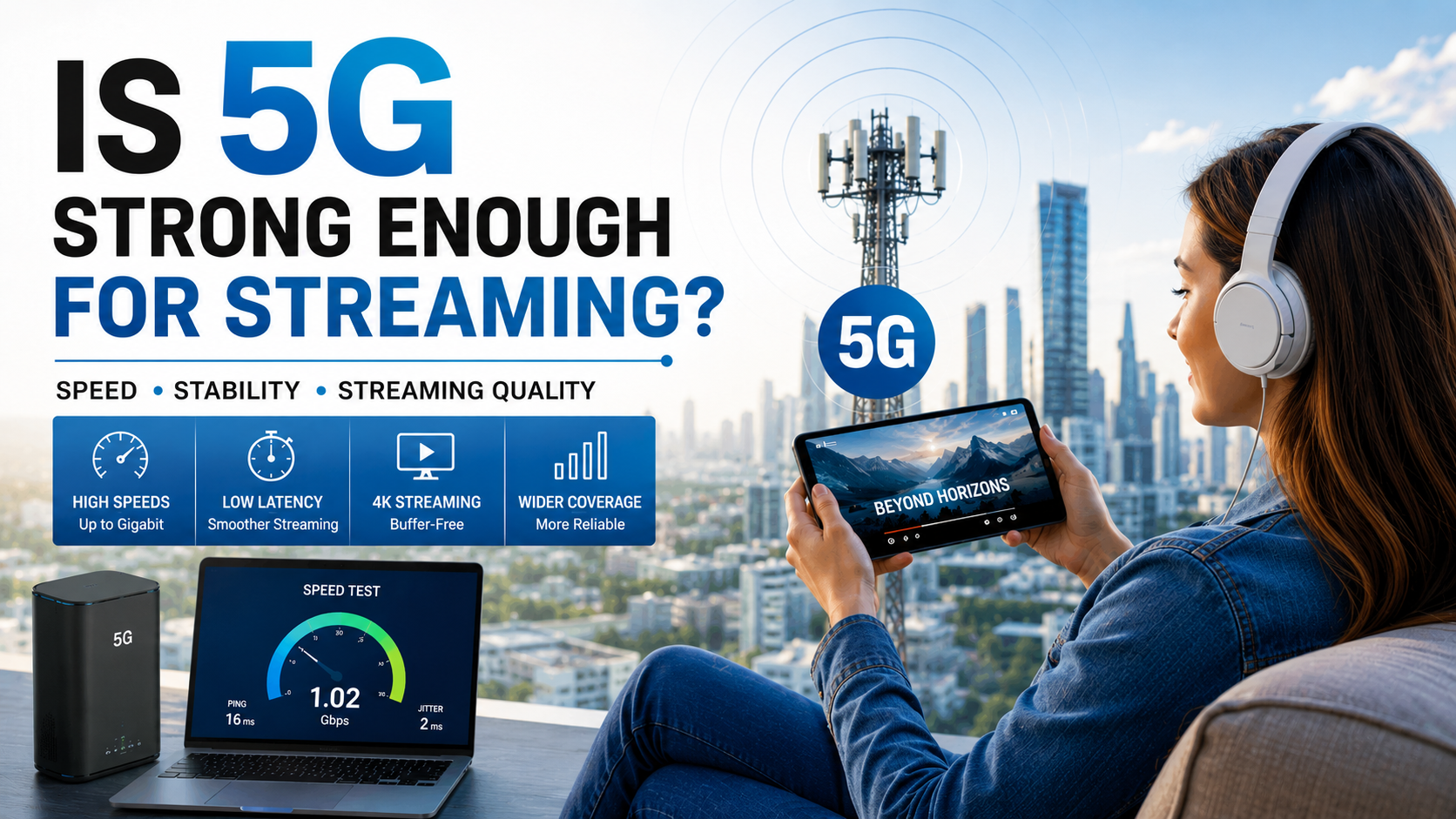
Is 5G Strong Enough For Streaming?
Streaming your favorite movies and shows requires a fast, dependable connection. A weak connection can cause buffering, lag, and pixelated playback. So, is 5G strong enough for streaming without interruptions? In most cases, yes. 5G networks offer higher bandwidth, lower latency, and greater capacity than older mobile technologies.
Your actual experience still depends on signal strength, network congestion, spectrum type, and your location. A strong 5G signal can easily support HD and 4K video streaming. A weak or congested connection may struggle, even when the network is labeled 5G.
According to technical specifications outlined by the Federal Communications Commission (FCC), modern mobile broadband networks deliver real-world performance that easily handles intensive data demands.
Whether you stream on a smartphone or use a 5G home router, connection stability matters. We will compare 5G with home Wi-Fi, examine Netflix requirements, and explain whether 5 Mbps is enough. We will also look at 6G and what future wireless networks could bring.
Is 5G faster than WiFi?
In many situations, 5G can deliver faster download speeds than older home Wi-Fi connections. Mid-band 5G can provide strong real-world performance, while high-band 5G can reach gigabit-class speeds in suitable locations. However, results vary by carrier, spectrum, coverage, and network congestion.
Modern fiber broadband paired with Wi-Fi 6 or Wi-Fi 7 can outperform many cellular connections. For readers considering newer Wi-Fi standards, Wi-Fi 6 vs Wi-Fi 7 provides a useful comparison. Fiber also provides a stable connection that does not depend on nearby cell towers or changing radio conditions. This makes it particularly useful for busy households.
Home Wi-Fi can also offer better indoor consistency. Walls, windows, and building materials can weaken cellular signals. For additional guidance on keeping a home connection protected, Secure Home Network Guide for Remote Engineers covers important home-network security considerations. High-frequency 5G signals can be especially sensitive to physical obstructions.
Therefore, 5G is not automatically faster than Wi-Fi. It can beat older broadband setups, but modern fiber remains highly competitive. Your actual speed test results matter more than the network label.
Real-World Consistency and Latency
Peak 5G speeds can exceed many residential broadband connections. However, peak performance does not always reflect everyday performance. Mobile networks share capacity among nearby users, so speeds can change throughout the day. Signal strength also affects throughput and connection stability.
Latency is another important factor. A strong 5G connection can provide low latency, which benefits live video, cloud gaming, and video calls. Still, a wired fiber connection usually offers more predictable performance.
Indoor coverage can create additional problems. High-frequency 5G signals may weaken when passing through walls or other dense materials. Your phone may also switch between spectrum bands as conditions change.
For streaming, consistency often matters more than maximum speed. A stable connection above the platform’s recommended threshold should provide smooth playback. If your 5G speed frequently drops, buffering may occur despite impressive peak speeds.
For demanding home use, fiber with modern Wi-Fi remains one of the most consistent options. However, strong 5G can provide excellent performance without a fixed broadband connection.

Can I watch Netflix with 5G?
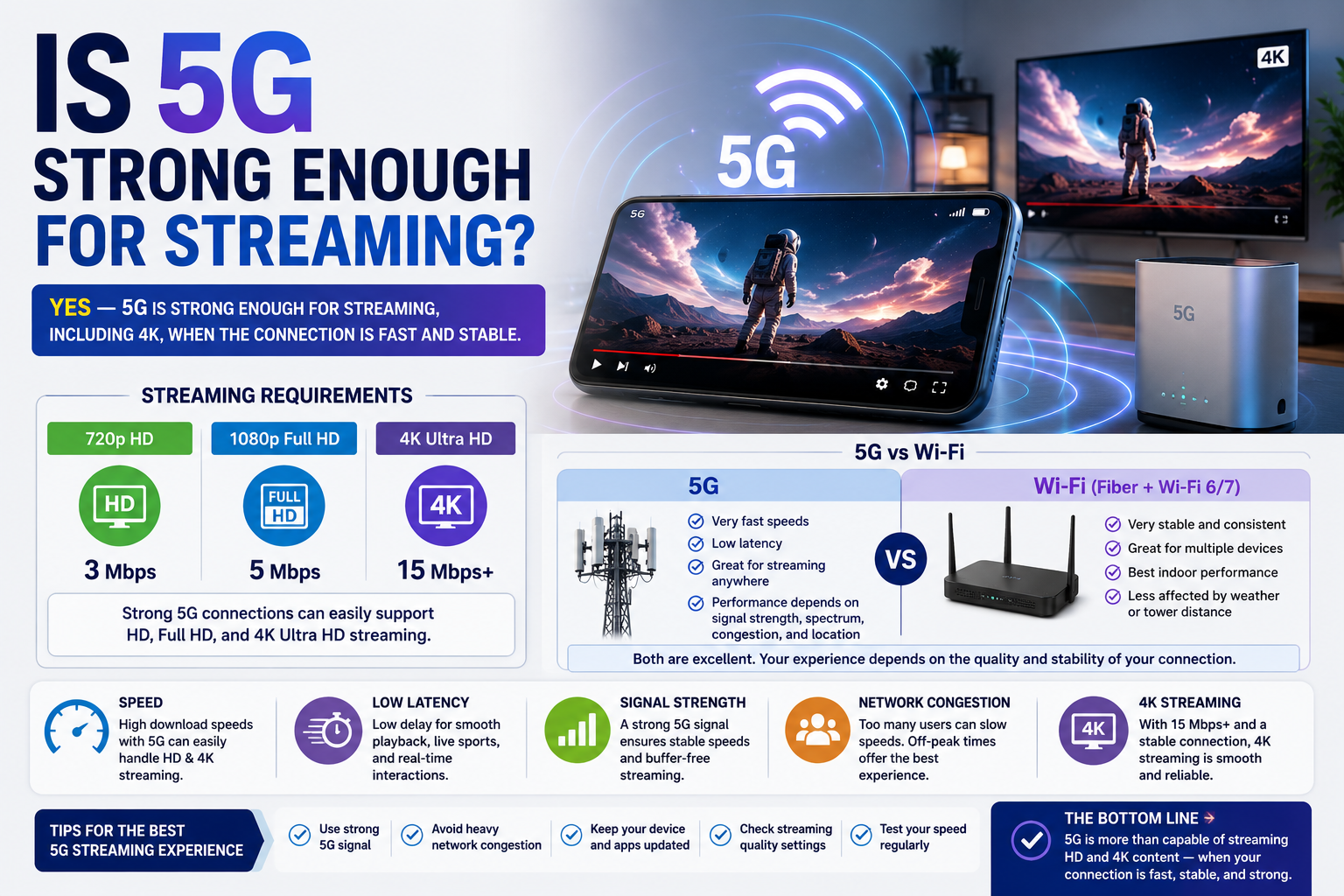
Yes, you can watch Netflix using a 5G connection. Netflix recommends at least 3 Mbps for 720p HD, 5 Mbps for 1080p Full HD, and 15 Mbps for 4K Ultra HD.
That means most capable 5G connections can handle regular HD and 4K streaming. However, speed alone does not guarantee smooth playback. An unstable connection can reduce video quality or cause buffering.
Your signal strength, network congestion, and device also matter. A weak indoor signal may produce inconsistent speeds, even when your phone shows a 5G icon.
Your streaming plan and device capabilities can also limit video quality. Compatible devices and supported plans may be required for certain formats, including 4K and HDR.
Overall, 5G is more than capable of streaming Netflix. If your connection consistently exceeds the required speed, you should enjoy smooth playback. For the best results, test your connection where you normally watch.
Optimizing Netflix Playback on Mobile Networks
You can improve Netflix playback by checking both your connection and video settings. Netflix automatically adapts streaming quality to available network performance. A slow or unstable connection can cause the service to lower resolution temporarily.
On mobile devices, also check whether your app or device limits video quality over cellular data. Some settings prioritize lower data usage rather than maximum resolution. If your plan supports high-quality streaming, adjust the relevant settings when appropriate.
Before troubleshooting the app, test your actual connection speed. Netflix provides an internet speed test through its app on supported mobile devices. You can also use Fast.com in a browser to measure performance.
For the most reliable experience:
- Use a strong 5G signal when possible.
- Avoid heavily congested locations.
- Keep your device software updated.
- Check your Netflix video quality settings.
- Monitor mobile data usage if your plan has limits.
Remember that a 5G label does not guarantee a fixed speed. Testing your connection during normal viewing hours gives you a better idea of real-world performance. When using public networks instead, Public Wi-Fi Risks: How to Stay Safe on Open Networks explains the security concerns to keep in mind.
Is 5 Mbps fast enough for Netflix?
Yes, 5 Mbps is enough for Netflix in Full HD at 1080p. Netflix recommends 3 Mbps or higher for 720p HD and 5 Mbps or higher for 1080p Full HD. It recommends 15 Mbps or higher for 4K Ultra HD.
However, 5 Mbps provides very little extra bandwidth. If you are the only person using the connection, it can support a suitable Netflix stream. Other activities may quickly consume the remaining capacity.
Background downloads, cloud backups, app updates, and video calls can compete with your stream. When available bandwidth falls, Netflix may reduce quality or buffering may occur.
For a single 1080p stream, 5 Mbps is a practical minimum. A faster connection provides more breathing room and better supports other devices.
If several people share the connection, consider a higher-speed plan. 15 Mbps or more is particularly important when 4K streaming is involved. Multiple simultaneous streams require additional bandwidth.
Limitations with Multiple Household Devices
A 5 Mbps connection can handle one Full HD Netflix stream under suitable conditions. It becomes restrictive when multiple devices compete for the same bandwidth. Phones, laptops, smart TVs, game consoles, and connected appliances can all consume network capacity.
For example, a household may stream Netflix while another device downloads a large update. Cloud backups may also run in the background. These activities can leave too little bandwidth for consistent video playback.
The problem becomes more obvious with 4K content. A single 4K Ultra HD stream generally requires around 15 Mbps. Multiple 4K streams therefore require substantially more available capacity.
A faster connection also provides useful headroom. You do not want your streaming service using nearly all available bandwidth.
For households with several users, consider your total usage rather than one stream’s requirement. Connection stability and available bandwidth both matter.
A 5 Mbps connection works for basic individual streaming. It is not a good choice for busy households. A higher-speed broadband or 5G home internet plan offers greater flexibility.
Is 5G the same as 300 Mbps?
No. 5G and 300 Mbps describe different things. 5G is a generation of wireless network technology. Mbps describes the speed at which data transfers over a connection.
A 5G connection can operate at many different speeds. Performance depends on spectrum, signal strength, network design, device capability, and congestion. Your location and network conditions can also affect performance.
Therefore, 300 Mbps is not a universal 5G speed. It is simply one possible result from a 5G connection. Some users may receive much less, while others may see considerably higher speeds.
This distinction matters when deciding whether 5G is strong enough for streaming. You should not judge streaming performance by the 5G label alone. Instead, test your connection where you plan to stream.
A consistent connection above your streaming platform’s recommended speed is usually more important than reaching a specific headline number. For 4K Netflix, 15 Mbps is a useful benchmark.
Understanding Diverse Cellular Spectrum Tiers
5G networks use different spectrum ranges to balance coverage, capacity, and speed. Low-band spectrum generally travels farther and penetrates buildings better. However, it typically offers less capacity than higher-frequency spectrum.
Mid-band spectrum provides a useful balance between coverage and performance. It is important for delivering strong everyday 5G speeds across populated areas. High-band millimeter-wave spectrum can deliver extremely high speeds under favorable conditions.
However, higher frequencies generally have shorter ranges and can be more affected by physical obstructions. This makes network design important for real-world performance.
Your phone may also move between spectrum layers as signal conditions change. A connection that performs well outdoors may behave differently inside a building.
For streaming, the exact spectrum band is less important than the speed and stability available at your location. If your connection remains comfortably above the platform’s requirements, you can stream without worrying about the specific band.
In short, 5G performance is not one fixed number. Coverage, spectrum, congestion, and signal quality all influence your actual experience.
How fast is 6G speed?
6G is expected to deliver significantly higher performance than current 5G networks. Proposed systems could eventually support extremely high peak data rates, potentially reaching hundreds of gigabits per second or more in specialized scenarios. However, 1 Tbps should not be treated as a guaranteed consumer speed.
6G remains a developing technology. Researchers are exploring sub-terahertz frequencies, advanced antennas, artificial intelligence, and new network architectures. For readers interested in the infrastructure behind modern connectivity, What Does a Data Center Do? provides broader context on the systems that support digital services. Commercial specifications and real-world performance are still being established.
The goal extends beyond faster downloads. Future networks are expected to reduce latency and connect large numbers of devices with greater precision. These capabilities could support immersive communications, advanced robotics, spatial computing, and real-time digital systems.
Some industry projections place early commercial 6G deployments around 2030. The exact timeline will depend on standards, infrastructure, spectrum policy, and device development.
For streaming, however, 5G already provides more than enough bandwidth for mainstream HD and 4K video. 6G is unlikely to be necessary for ordinary streaming. Its value will come from applications that require extreme bandwidth, responsiveness, and connectivity.
Advancements in Sub-Terahertz Communication
Sub-terahertz communication is one area researchers are studying for future 6G networks. These frequencies could provide access to much wider channels than those commonly used by today’s cellular systems. That could support extremely high data rates in suitable environments.
Higher frequencies also introduce challenges. Signals can have shorter ranges and may be more sensitive to obstacles. Future networks will therefore need advanced antennas, beamforming, intelligent routing, and dense infrastructure.
6G development also focuses heavily on latency and network intelligence. Edge computing could process data closer to users and connected devices. Artificial intelligence could help networks manage traffic and allocate resources dynamically.
These capabilities could support applications such as spatial computing, autonomous systems, immersive communication, and real-time industrial monitoring.
For everyday video streaming, the benefits are less dramatic. 5G already handles the bandwidth required for modern streaming services. 6G would mainly improve the broader network ecosystem rather than solve a problem most viewers currently have.
As standards mature, researchers will determine how these technologies perform outside controlled environments. Until then, projected 6G speeds should be viewed as targets rather than guaranteed consumer performance.
Frequently Asked Questions
Does 5G use more data than 4G when streaming video?
5G does not consume more data simply by being a newer network. However, because 5G easily handles higher bandwidth, streaming platforms automatically serve the highest video quality available. Streaming a video in 4K resolution uses significantly more gigabytes per hour than an automated 720p stream on a slower connection.
Can 5G replace home broadband for multiple 4K video streams?
Yes, 5G home internet can replace traditional fixed-line broadband for multiple simultaneous 4K video streams. With average mid-band speeds ranging between 100 Mbps and 300 Mbps, a dedicated 5G home gateway provides more than enough sustained bandwidth to support three or four simultaneous 4K streams without buffering.
Why does my 5G connection buffer when watching live video?
Even when 5G is strong enough for streaming, live video can still buffer. Buffering usually happens because of weak indoor coverage, physical obstacles, or heavy network congestion during peak hours. A strong 5G label does not always mean you have a stable connection.
How much bandwidth do major streaming platforms require?
Most major streaming services require roughly 3 Mbps for standard definition, 5 Mbps for full HD (1080p), and 15 to 25 Mbps for 4K Ultra HD. Audio-only streaming platforms require less than 1 Mbps. A standard 5G connection comfortably exceeds all of these baseline bandwidth recommendations.
Conclusion
Understanding modern cellular network performance can help you choose the right streaming setup. 5G is strong enough for streaming in most everyday situations. A reliable 5G connection can easily support HD video and often provides enough bandwidth for 4K playback.
Netflix recommends 3 Mbps for 720p, 5 Mbps for 1080p, and 15 Mbps for 4K. These requirements are modest compared with the speeds available from many 5G networks.
Still, speed is only part of the equation. Signal strength, congestion, spectrum, device capability, and network stability can all affect playback. A strong and consistent connection usually delivers a better experience than a connection with impressive peak speeds.
If you want better streaming performance, test your connection where you normally watch. Check your carrier’s coverage, review your streaming quality settings, and position a 5G home router where it receives a strong signal.
As wireless networks evolve, 5G home internet will continue to compete with traditional broadband. For most viewers, today’s 5G technology already provides more than enough performance for smooth, high-quality streaming.