

iPad mini OLED vs. iPad mini: What’s New?
Compact tablet enthusiasts have waited years for Apple to introduce modern display technology to its smallest tablet. That wait ended with the official announcement of the iPad mini OLED. Apple unveiled the redesigned device on October 26, 2026, through its official Newsroom announcement.
Previous iPad mini generations relied on Liquid Retina LCD technology. These displays offered accurate colors and reliable everyday performance. However, they lacked the pixel-level lighting control available with OLED technology.
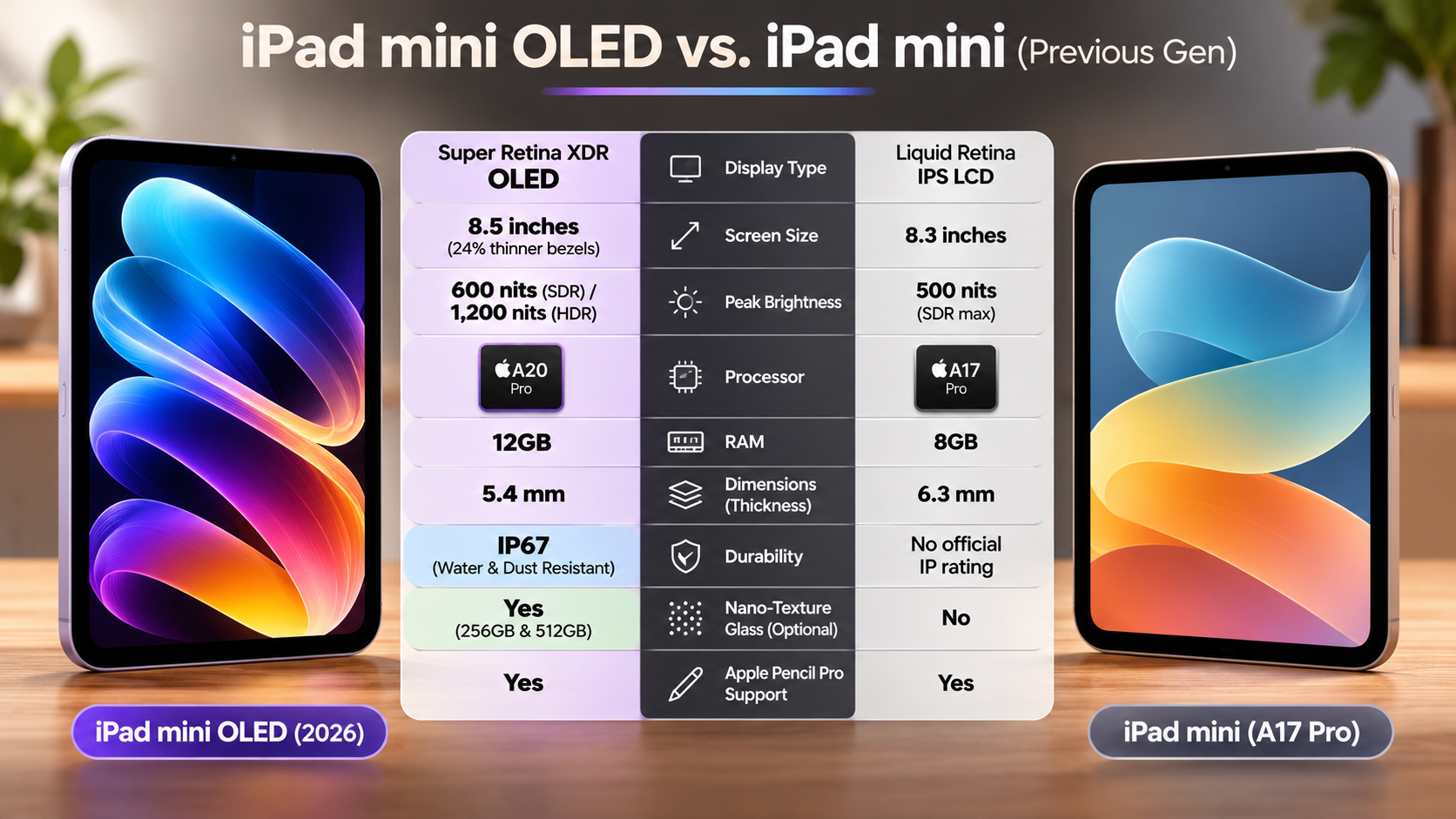
The latest generation changes that experience considerably. It introduces an 8.5-inch OLED display, thinner bezels, higher brightness, and improved contrast. Apple also introduces the A20 Pro processor and IP67 water and dust resistance.
These improvements affect multimedia consumption, mobile gaming, digital illustration, and everyday productivity. Meanwhile, the older iPad mini 6 and iPad mini (A17 Pro) remain relevant alternatives.
Does the new display justify upgrading? How does OLED compare with mini-LED technology? Which iPad mini generation actually includes an OLED panel?
This comprehensive comparison explores the differences, specifications, and practical benefits. It also helps you decide whether the latest compact tablet deserves your money.

Will the New iPad mini Have OLED?
Yes, Apple officially introduced an OLED display with its 2026 iPad mini. The device features an 8.5-inch Super Retina XDR OLED panel with pixel-level lighting control. This technology allows individual pixels to produce their own light. Consequently, black pixels can switch off completely, producing deeper blacks and exceptional contrast.
The display supports a 2,000,000:1 contrast ratio and up to 1,200 nits of peak HDR brightness. It also supports 600 nits of full-screen brightness and a minimum brightness of one nit. These improvements make content more comfortable to view across different lighting conditions.
Apple also reduced the display bezels by 24 percent. This creates additional screen space without increasing the previous model’s overall footprint.
The new display supports P3 wide color and True Tone technology. Together, these features deliver accurate colors and more immersive visuals. However, Apple does not advertise ProMotion support for this model.
Screen Engineering and Nano-Texture Glass
The new iPad mini introduces an optional nano-texture display glass finish. This technology reduces distracting reflections in bright environments. It works particularly well for people using tablets outdoors or under strong indoor lighting.
Unlike a conventional glossy surface, nano-texture glass uses microscopic surface structures. These structures help scatter reflected light without significantly compromising image clarity. This makes the display useful for digital artists, photographers, and field professionals.
Apple offers this option on the 256GB and 512GB configurations. Buyers should consider their actual working environments before paying extra. Most indoor users may find the standard glass perfectly adequate.
The display also supports a minimum brightness of one nit. This makes nighttime reading more comfortable in darker surroundings. Combined with OLED’s pixel-level lighting, it offers improved control over the viewing experience.
For artists, Apple Pencil Pro compatibility adds further flexibility. Users can sketch, annotate documents, and create digital illustrations directly on the screen. Buyers can also explore iPad accessories that cost less than Apple’s official options to build a more affordable creative setup.
Which Is Better for iPads, Mini-LED or OLED?
OLED generally offers better contrast and black levels than mini-LED technology. However, both technologies have different strengths. OLED uses individually illuminated pixels instead of relying on a separate backlight. This allows completely black pixels to switch off, eliminating backlight blooming.
Mini-LED uses thousands of tiny LEDs arranged behind an LCD panel. These LEDs operate through local dimming zones rather than individual pixels. Consequently, bright objects against dark backgrounds can sometimes produce visible halos.
OLED also provides excellent viewing angles and fast pixel response times. These characteristics benefit gaming, video playback, and everyday tablet use.
Mini-LED can deliver stronger sustained brightness across large areas. This advantage makes it useful for certain professional displays and demanding HDR environments.
For compact tablets, OLED offers an attractive combination of contrast, viewing quality, and responsiveness. The 2026 iPad mini benefits from these characteristics. However, remember that previous iPad mini generations used LCD technology, not mini-LED.
Dimming Precision Versus Sustained Brightness
The biggest difference between OLED and mini-LED involves how each technology controls light. OLED manages brightness at the individual pixel level. Mini-LED controls brightness through separate backlight zones.
This distinction becomes particularly noticeable during dark scenes. For example, movie subtitles appear against genuinely black backgrounds on OLED displays. Mini-LED panels can sometimes produce surrounding halos because their dimming zones cover multiple pixels.
OLED also provides consistent contrast when viewed from different angles. This benefits people sharing content or working with illustrations.
However, mini-LED maintains an advantage in certain high-brightness situations. Its backlighting system can illuminate large portions of the screen simultaneously. OLED brightness depends on the content displayed and the panel’s operating limits.
For everyday reading, gaming, and streaming, OLED offers excellent visual performance. Its pixel-level control creates a particularly immersive experience.
Should I Buy an iPad mini in 2026?
The 2026 iPad mini makes sense for buyers who prioritize portability and premium display quality. Its 8.5-inch OLED screen delivers deeper blacks and significantly improved contrast. Meanwhile, the A20 Pro processor provides additional performance for demanding applications.
The device also introduces IP67 water and dust resistance. This provides additional protection during everyday use, although it does not make the tablet waterproof.
Its 5.4mm thickness and lighter construction improve portability. The tablet also supports Apple Pencil Pro and offers an optional nano-texture display.
These features make it suitable for students, digital artists, travelers, and mobile professionals. Students considering the iPad mini for studying should also compare digital and handwritten note-taking methods before choosing a tablet-based workflow. However, the starting price of ₹82,900 in India is considerably higher than many mainstream tablets.
Buyers should also consider their existing devices. Someone upgrading from an older LCD model may notice substantial display improvements. However, an existing iPad mini (A17 Pro) owner may not need every new feature.
Your purchasing decision should depend on actual usage rather than specifications alone.
Balancing High Price Against Form Factor
The latest iPad mini carries a premium price compared with older generations. Its starting price in India is ₹82,900 for the Wi-Fi configuration. The Wi-Fi + Cellular version starts at ₹1,00,900.
That difference matters when choosing between compact tablets and larger alternatives. The iPad Air, for example, provides more screen space for multitasking and productivity. If price is your main consideration, understanding why standard iPads cost less than the iPad mini can help you make a more informed purchasing decision.
Consider these factors before purchasing:
- Choose the new iPad mini: If portability, OLED contrast, and improved performance matter most.
- Choose an older iPad mini: If reading, browsing, and basic productivity are your primary activities.
- Consider the iPad Air: If you prefer a larger screen for documents, creative applications, and multitasking.
Existing iPad mini (A17 Pro) owners should evaluate their actual requirements. Its LCD display remains suitable for everyday entertainment and productivity.
Ultimately, the additional investment makes sense when you regularly use the new hardware capabilities. Otherwise, an older model may provide better value.
Which iPad mini Has an OLED Display?
Only the 2026 iPad mini with the A20 Pro chip features Apple’s new OLED display. Apple introduced this panel alongside its redesigned hardware on October 26, 2026. Earlier generations continue using traditional Liquid Retina LCD technology.
The iPad mini 6 features an 8.3-inch LCD panel. Its successor, the iPad mini (A17 Pro), also retains an 8.3-inch Liquid Retina display. Neither model uses OLED or mini-LED technology.
The latest generation increases the screen size to 8.5 inches. It also introduces thinner bezels, higher brightness, and a substantially improved contrast ratio.
You can identify the OLED model through its display specifications and processor. Look for the Super Retina XDR OLED specification and A20 Pro chip.
The new model also measures just 5.4mm thick. These differences make identification easier when comparing devices in stores or online marketplaces.
Identifying Display Hardware Across Generations
Checking the model specifications is the easiest way to identify an OLED iPad mini. The 2026 generation introduces several hardware changes that distinguish it from previous models. This becomes particularly important when considering the pros and cons of buying a used iPad, where checking the model and specifications can help avoid purchasing the wrong device.
Here are the main display and design differences:
| Feature | iPad mini 6 | iPad mini (A17 Pro) | iPad mini (A20 Pro) |
|---|---|---|---|
| Display size | 8.3 inches | 8.3 inches | 8.5 inches |
| Display technology | Liquid Retina LCD | Liquid Retina LCD | Super Retina XDR OLED |
| Processor | A15 Bionic | A17 Pro | A20 Pro |
| Peak brightness | 500 nits | 500 nits | 1,200 nits HDR |
| Thickness | 6.3mm | 6.3mm | 5.4mm |
| Water resistance | Not rated | Not rated | IP67 |
The older generations remain capable tablets for everyday activities. However, the latest model provides a noticeably different display experience.
Before purchasing a used device, check its model information and official specifications. Do not rely entirely on the seller’s product title or photographs.
For accurate identification, consult Apple’s official iPad mini technical specifications.
Final Verdict: Is the iPad mini OLED Worth Buying?
The 2026 iPad mini represents a substantial upgrade for Apple’s compact tablet lineup. Its OLED display brings deeper blacks, stronger contrast, and improved HDR brightness. The A20 Pro processor and thinner design add further improvements.
However, not everyone needs to upgrade immediately. Older generations remain capable of handling everyday browsing, reading, and entertainment.
If display quality and portability are your priorities, the latest model deserves consideration. If you already own the previous generation, compare the improvements against the purchase price.
The best choice ultimately depends on your budget, existing device, and everyday requirements.