
Why Are Standard iPads Cheaper Than the iPad Mini?
The question why are standard iPads cheaper than the iPad mini becomes clearer when you compare their hardware. The standard iPad costs less because Apple builds it around everyday tablet needs and a lower entry price. The current model has an A16 chip, an 11-inch Liquid Retina display, and 128GB of starting storage. It also works with a range of iPad accessories that can expand its usefulness for work, study, and entertainment.
However, size is only one factor in a tablet’s price. Apple also considers the processor, display technology, connectivity, cameras, internal design, and product positioning. The current standard iPad uses an A16 chip and an 11-inch Liquid Retina display. The iPad mini uses the A17 Pro chip and a fully laminated 8.3-inch Liquid Retina display. You can compare the models and their features on Apple’s official iPad comparison page.
So, why are standard iPads cheaper than the iPad mini? The main reason is that Apple positions the standard iPad as its everyday tablet. The mini combines premium hardware with an unusually compact design.
This guide explains the key differences. You will also learn which iPad is cheaper, whether the mini is worth its premium, and how long each model can remain useful.
Why Is the iPad Cheaper Than the iPad Mini?
The question why are standard iPads cheaper than the iPad mini becomes clearer when you compare their hardware. The standard iPad costs less because Apple builds it around everyday tablet needs and a lower entry price. The current model has an A16 chip, an 11-inch Liquid Retina display, and 128GB of starting storage. It offers sRGB color support and True Tone.
The iPad mini takes a different approach. Its 8.3-inch Liquid Retina display has 326 pixels per inch, P3 wide color, True Tone, full lamination, and an anti-reflective coating. It also uses an A17 Pro chip, which supports Apple Intelligence and delivers stronger graphics performance.
That means the mini is not simply a smaller version of the standard iPad. It is a premium compact tablet with different priorities.
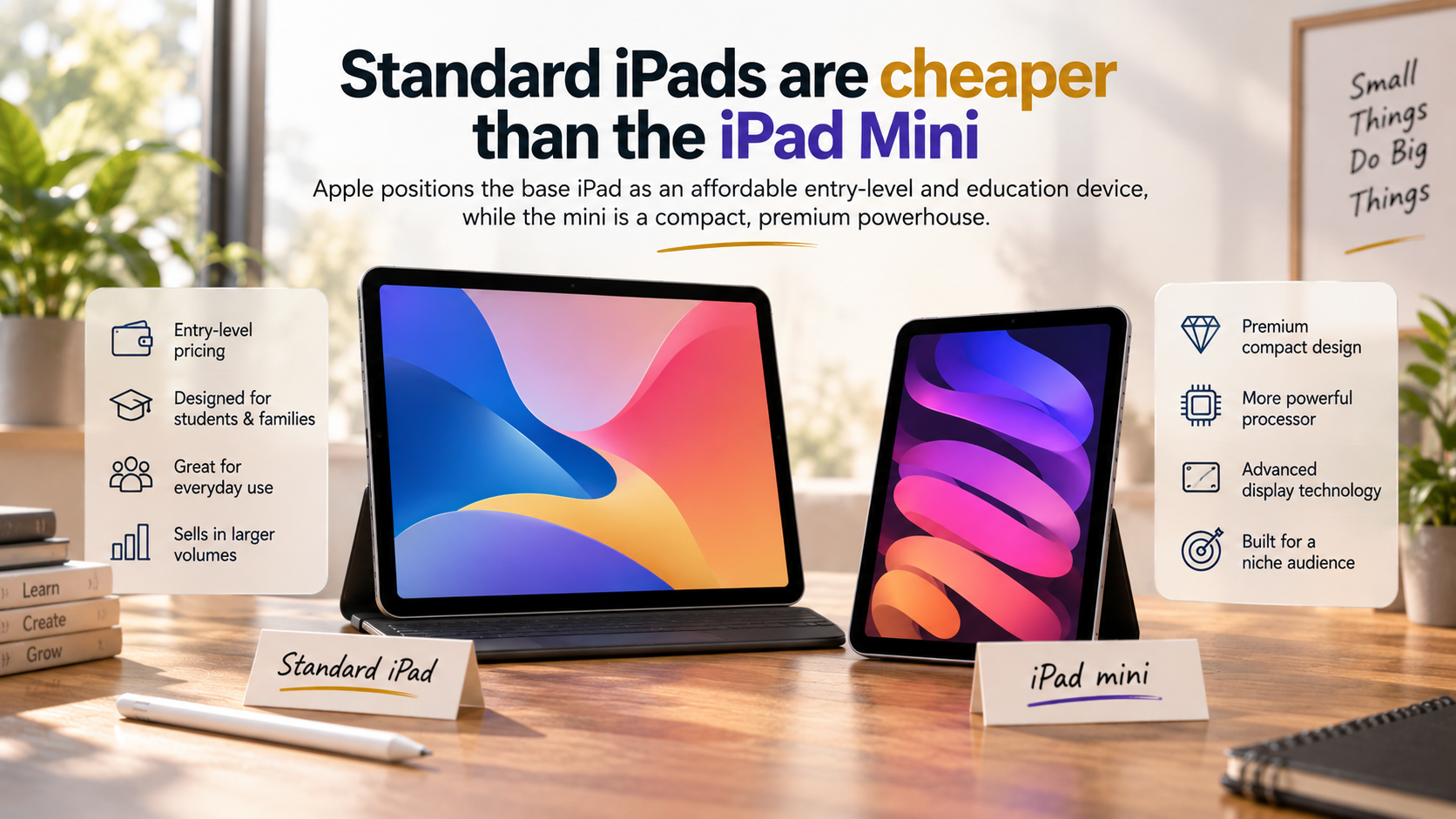
Apple also prices products according to their market position. The standard iPad targets everyday users, students, families, and general productivity. The mini targets buyers who value portability, premium display features, and high performance.

Advanced Engineering in Compact Spaces
Miniaturizing powerful hardware can increase engineering complexity. Apple must fit the processor, battery, cameras, speakers, display, and other components into a much smaller enclosure.
The iPad mini measures just 195.4 by 134.8 millimeters and weighs 293 grams in its Wi-Fi configuration. Despite its compact dimensions, it includes an A17 Pro chip, stereo speakers, USB-C connectivity, and support for Apple Pencil Pro. Its USB-C port also makes it useful with compatible accessories, including options designed to use wired headphones without losing the charging port.
Compact products also leave less internal space for component placement. Engineers must carefully manage the arrangement of batteries, logic boards, antennas, cameras, and thermal components.
The standard iPad has a larger 11-inch chassis. That gives Apple more room for internal components and makes the design less constrained.
This does not mean the mini is expensive simply because it is difficult to manufacture. Its higher price reflects a combination of premium specifications, compact engineering, and product positioning.
In other words, fewer physical materials do not automatically mean lower production costs. A smaller premium device can require more specialized design work than a larger mainstream product.
Is the iPad Mini Better Than Regular iPads?
The iPad mini offers stronger hardware in several important areas, but that does not make it better for every user. Its A17 Pro chip is more advanced than the A16 chip in the current standard iPad. The mini also supports Apple Intelligence, Apple Pencil Pro, and a P3 wide-color display.
Its 8.3-inch display provides 326 pixels per inch. The standard iPad’s larger 11-inch display is less dense at 264 pixels per inch. However, the standard model gives users significantly more screen space for documents, video, multitasking, and typing.
The mini is also much easier to hold for long periods. Its smaller footprint works well for reading, handwritten notes, travel, navigation, and gaming.
The standard iPad has a different advantage. Its larger display is more comfortable for productivity and shared entertainment.
Therefore, the better choice depends on how you use a tablet. Performance and portability favor the mini, while screen size and a lower purchase price favor the standard iPad.
Display Quality and Creative Precision
Display technology is one of the clearest differences between the two models. The iPad mini has a fully laminated Liquid Retina display. It also offers P3 wide color, True Tone, an anti-reflective coating, and Apple Pencil hover support.
Full lamination places the display components closer together. This creates a more direct visual connection between the image and the glass surface. It can also make writing with a stylus feel more natural.
The standard iPad uses a Liquid Retina display with sRGB color and True Tone. It does not have the same fully laminated display specification or anti-reflective coating as the mini.
These differences can matter to artists, designers, photographers, and frequent note-takers. The mini’s higher pixel density also makes text and graphics appear particularly sharp at close viewing distances.
However, the larger standard iPad remains useful for creative work. Its bigger canvas provides more room for documents, illustrations, presentations, and split-screen workflows.
So, display quality favors the mini in several technical areas, while usable screen area favors the standard iPad.
Which Version of iPad Is the Cheapest?
The standard iPad is Apple’s lower-priced mainstream iPad line. The current model uses the A16 chip, starts with 128GB of storage, and has an 11-inch Liquid Retina display. Apple positions it for everyday activities such as studying, browsing, note-taking, streaming, and general productivity.
By comparison, the current iPad mini starts at ₹69,900 in India. It begins with 128GB of storage and uses the A17 Pro chip. Buyers should also keep broader pricing changes in mind, especially when Apple increases Mac and iPad prices in India.
Older standard iPad generations can sometimes cost less through retailers or the refurbished market. However, prices and availability vary, so buyers should compare the exact generation, storage capacity, warranty, and condition.
The standard iPad also supports Apple Pencil USB-C and the first-generation Apple Pencil, although compatibility differs from the mini’s Apple Pencil Pro support.
For budget-conscious buyers, the standard iPad therefore provides a straightforward entry point into Apple’s tablet ecosystem.
It is especially practical for students, families, casual users, and anyone who values a larger display without paying for premium compact hardware.
Is the iPad Mini Still Worth Buying?
The iPad mini can make sense for users who value portability above screen size. Its 8.3-inch display and 293-gram Wi-Fi weight make it considerably easier to carry than a full-size tablet.
The current mini also combines its compact design with an A17 Pro chip. It supports Apple Intelligence, Apple Pencil Pro, Apple Pencil USB-C, and USB-C connectivity.
That combination makes it useful for reading, handwritten notes, mobile gaming, travel, navigation, and quick productivity tasks. It can also serve as a portable second screen for some workflows.
However, the compact size creates trade-offs. The smaller display gives you less room for side-by-side apps, long documents, spreadsheets, and extended typing.
The standard iPad is therefore more practical for people who prioritize screen space and lower cost.
The mini is more specialized. Its premium makes sense when small size, high performance, and portability are central to your daily routine.
For someone who regularly carries a tablet between meetings, classrooms, flights, or appointments, those advantages can matter more than having a larger screen.
What Is the Lifespan of an iPad Mini?
An iPad mini can remain useful for many years, but Apple does not guarantee a fixed software-support period. Actual longevity depends on the model, battery condition, software support, storage, and how heavily you use the device.
The current iPad mini uses the A17 Pro chip and supports Apple Intelligence. That gives it a strong hardware foundation for demanding apps and future iPadOS features.
Battery capacity naturally declines over time. Heavy daily use and repeated charging cycles can reduce battery performance after several years. Understanding the 80-20 rule for rechargeable batteries can also help explain why battery capacity changes with repeated use. Battery service can extend the device’s practical life when battery health becomes the main limitation.
The physical hardware can also remain useful after major software updates end. Older iPads may still work well for reading, streaming, note-taking, children’s apps, or smart-home controls.
However, buyers should not assume that every iPad will receive updates for exactly five, six, or seven years. Apple determines software compatibility by model and operating-system requirements.
For that reason, a better expectation is to view the mini as a long-term tablet investment, while recognizing that its exact useful lifespan depends on future software support and battery condition.
Extended Value Through Hardware Longevity
Understanding why are standard iPads cheaper than the iPad mini also requires looking at long-term hardware value. A premium tablet can retain practical value for years when its hardware remains capable. The iPad mini’s A17 Pro chip gives the current model substantial performance headroom for demanding applications.
Its compact design can also give the device a longer role in a household. Even after it stops being someone’s primary tablet, it can still serve as a reading device, media screen, travel companion, or dedicated note-taking tool.
Battery condition becomes increasingly important as a device ages. If the battery becomes the main weakness, professional battery service may restore much of the tablet’s usefulness.
Resale value is harder to predict. It depends on storage capacity, physical condition, battery health, software support, and demand for that particular generation.
For buyers focused on long-term value, the processor matters. A stronger chip can help a device remain capable as apps become more demanding.
The current iPad mini combines A17 Pro performance with a compact premium design, giving it a strong technical foundation. Still, buyers should treat resale value as variable rather than guaranteed.
Frequently Asked Questions
Does the iPad mini have better battery life than the standard iPad?
No, both devices deliver roughly the same battery performance. Apple officially rates both the standard iPad and the iPad mini for up to 10 hours of web surfing on Wi-Fi or video playback. The iPad mini utilizes a physically smaller battery cell to fit its frame, but its power-efficient silicon balances consumption against the larger battery found inside the baseline iPad.
Can the iPad mini replace an everyday laptop for work?
The iPad mini can handle light email, document review, and task management, but it rarely replaces a laptop entirely. Its compact 8.3-inch display makes side-by-side multitasking and extensive typing cramped. This is one reason to consider the disadvantages of using a tablet as a laptop replacement before making the switch. While it supports external Bluetooth keyboards, users wanting a true laptop alternative should consider larger options like the iPad Air, iPad Pro, or standard iPad with keyboard folios.
Why do smaller tech gadgets sometimes cost more than larger ones?
Miniaturization requires advanced engineering, tighter manufacturing tolerances, and specialized components that carry higher production expenses. Fitting premium displays, intricate heat dissipation systems, and robust processors into dense enclosures requires custom fabrication. Large devices have ample internal space, allowing manufacturers to use standard, cheaper components without experiencing heat issues or structural integrity concerns.
Does the standard iPad support the newest Apple Pencil models?
The standard iPad has limited stylus integration depending on the generation. The 10th-generation iPad supports the USB-C Apple Pencil and the older 1st-generation model via an adapter, lacking magnetic wireless pairing. In contrast, modern iPad mini units support advanced magnetic stylus pairing and charging along the edge, offering a far cleaner and more integrated workflow.
Conclusion
Understanding the differences between the two models explains why are standard iPads cheaper than the iPad mini. The price gap is not simply about screen size or the amount of material used.
The current standard iPad uses an A16 chip and an 11-inch Liquid Retina display. It focuses on everyday productivity, entertainment, education, and general tablet use.
The iPad mini uses an A17 Pro chip and an 8.3-inch fully laminated Liquid Retina display. It adds P3 wide color, an anti-reflective coating, Apple Pencil Pro support, and Apple Intelligence.
That combination explains why a smaller tablet can carry a higher price.
If you want a larger display and a lower entry price, the standard iPad is designed around those priorities. If you value portability, premium display technology, and higher performance in a compact body, the iPad mini offers a different experience.
The right choice depends on your daily workflow, budget, and preferred tablet size. Comparing those factors will help you choose the model that fits your needs rather than judging value by dimensions alone.