

The Importance of Quality Education in Modern Society
Education shapes how people handle daily challenges, build careers, and contribute to society. Understanding the importance of quality education helps explain how learning can reduce inequality, improve economic opportunities, and strengthen communities. Global evidence from UNESCO shows that many learners still lack basic literacy and numeracy skills, making education quality an urgent worldwide concern.
Quality education does more than deliver textbook knowledge. It develops critical thinking, communication, problem-solving, and practical skills that people can use throughout life. UNICEF’s education resources also highlights the importance of providing children with equitable opportunities to learn and develop.
Inclusive and equitable learning helps students participate more fully in society and adapt to changing workplaces. It can also support better employment opportunities, social mobility, and lifelong learning.
This guide explores the importance of quality education from several perspectives. It covers five key benefits, ten major advantages, UN Sustainable Development Goal 4, practical improvement strategies, teacher development, and UNICEF’s framework for educational quality. Together, these areas show why effective learning matters to individuals, communities, and modern economies.
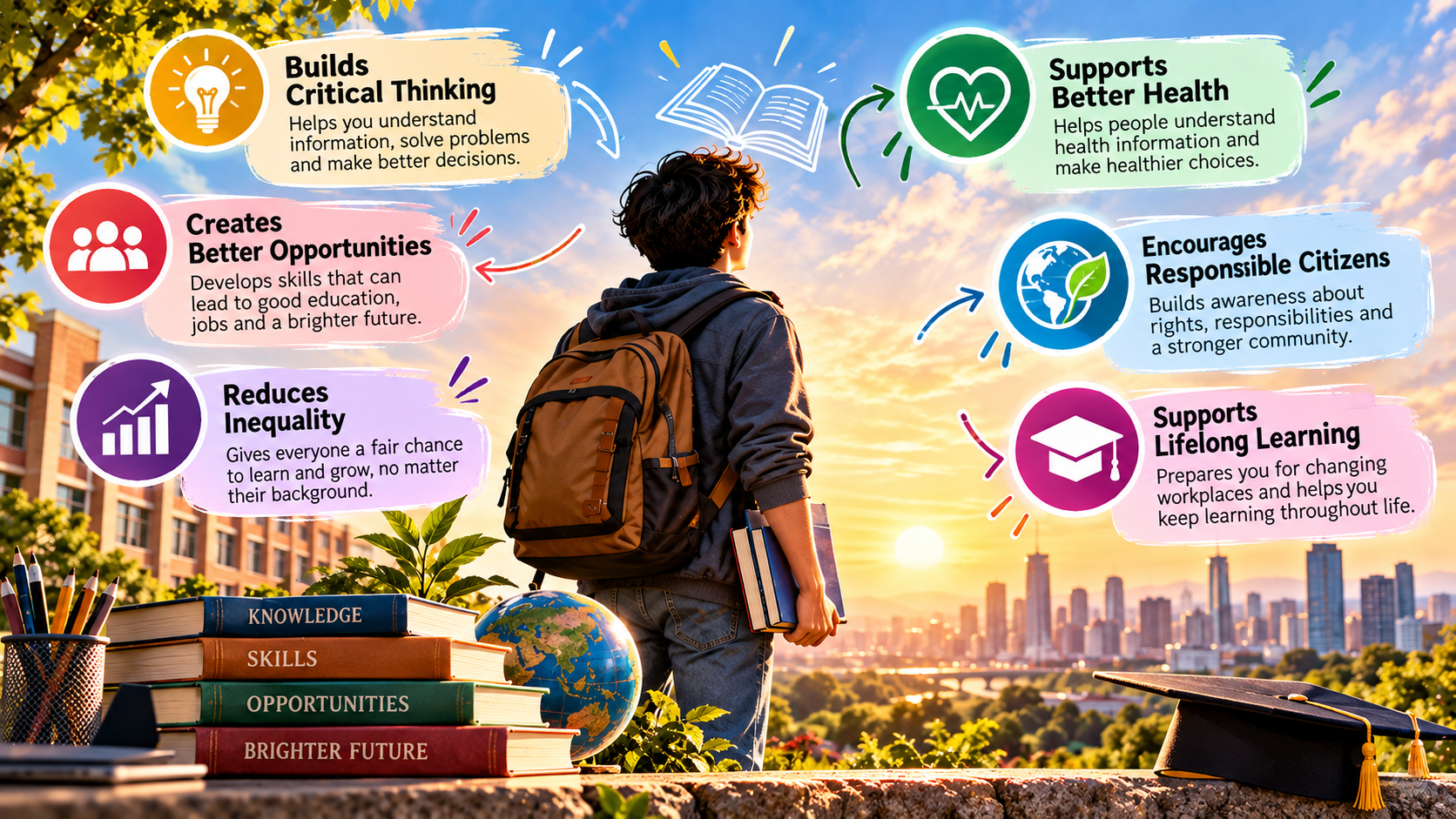

What is the importance of education 5 points?
The importance of education can be understood through five foundational benefits. First, structured learning develops critical thinking and decision-making skills. Students learn to evaluate information, solve problems, and make more informed choices. These abilities become useful in both personal and professional life.
Second, Education improves economic opportunities. Relevant knowledge and skills can help people qualify for employment, pursue careers, and improve their earning potential. Third, education can help reduce inequality by giving disadvantaged groups better access to knowledge and opportunities, as discussed in the connection between education and career success.
Fourth, education supports better health awareness. Literacy helps people understand health information, make informed choices, and use public services more effectively. Finally, education encourages civic participation and social responsibility. It helps people understand their rights, responsibilities, and role in their communities.
Together, these five areas demonstrate the importance of quality education for personal development, economic participation, social inclusion, and responsible citizenship.
Why is education important 10 lines?
Education is important because it influences almost every part of personal and social development. It helps people understand information, communicate clearly, and make better decisions. It also creates opportunities for employment and continued learning for career success.
The following ten points summarize why education matters:
- It develops critical thinking and reasoning skills.
- It can improve employment and earning opportunities.
- It helps reduce cycles of poverty and inequality.
- It supports health and nutritional awareness.
- It improves communication and social skills.
- It builds digital and workplace literacy.
- It can promote gender equality and inclusion.
- It encourages environmental awareness and responsible behavior.
- It supports creativity, innovation, and problem-solving.
- It encourages informed participation in community and public life.
These benefits extend beyond classrooms. Education can influence families, workplaces, and communities by giving people knowledge and skills they can apply throughout their lives. This makes education an important foundation for individual opportunity and broader social development.
What is goal 4 quality education?
Sustainable Development Goal 4 (SDG 4) is one of the United Nations Sustainable Development Goals adopted in 2015. Its central aim is to ensure inclusive and equitable quality education and promote lifelong learning opportunities for everyone.
SDG 4 goes beyond simply increasing school enrollment. It focuses on whether learners actually receive meaningful education and develop relevant learning outcomes. Its targets cover areas such as primary and secondary education, early childhood development, technical and vocational training, higher education, literacy, and skills for employment. These priorities can be viewed alongside education systems around the world and how different countries approach learning.
The goal also recognizes the importance of qualified teachers and safe, inclusive learning environments. Education facilities should support learners regardless of their background, abilities, or circumstances.
SDG 4 therefore provides a global framework for improving both access to education and the quality of learning. Its broader purpose is to make effective learning available throughout life while reducing educational inequalities.
What are the advantages of quality education?
Quality education provides benefits that extend well beyond academic achievement. Students develop problem-solving, communication, collaboration, and critical-thinking skills that can remain valuable as technology and workplaces change. Effective education also encourages learners to understand different perspectives and make informed decisions. These outcomes are closely connected to why education is important in our life.
Another major advantage is improved economic opportunity. Relevant education can help people develop skills required for employment, entrepreneurship, and further study. At the community level, stronger education systems can contribute to greater social participation and improved awareness of health, rights, and civic responsibilities.
Quality education also depends on more than what happens inside a classroom. UNESCO notes that educational quality involves factors such as trained teachers, suitable infrastructure, safe learning environments, and meaningful learning outcomes.
When these elements work together, students are better prepared for real-world challenges. Quality learning can therefore support personal growth, economic mobility, social inclusion, and lifelong learning while helping communities become more resilient.
What are the 10 advantages of education?
Education provides numerous advantages that can influence both individual lives and wider communities. Ten important benefits include:
- Higher earning potential: Education can improve access to skilled employment and career opportunities.
- Better health awareness: Literacy helps people understand health information and make informed choices.
- Stronger problem-solving: Learning develops reasoning and decision-making abilities.
- Reduced poverty: Education can improve opportunities across generations.
- Professional networking: Schools and institutions can connect learners with peers and professionals.
- Digital literacy: Education helps people use modern technologies more effectively.
- Gender equality: Equal educational opportunities can strengthen participation and independence.
- Environmental awareness: Learning can encourage responsible use of natural resources.
- Better communication: Education develops interpersonal and communication skills.
- Civic participation: Knowledge helps people understand responsibilities and participate in society.
These advantages show why investment in education matters. However, outcomes depend on the quality, relevance, accessibility, and inclusiveness of learning. Simply increasing enrollment does not guarantee meaningful learning or equal opportunity, especially when systemic barriers in education remain unaddressed.
How can we improve the quality of education?
Improving education requires coordinated action from governments, schools, teachers, families, and communities. The first priority should be supporting qualified teachers through effective training, professional development, and appropriate working conditions. Teachers need practical resources and modern teaching approaches to respond to different learning needs.
Curricula should also remain relevant to current and future challenges. Schools can strengthen areas such as digital literacy, financial knowledge, communication, critical thinking, and practical problem-solving. These skills complement foundational subjects rather than replacing them.
Infrastructure is another important factor. Schools need safe classrooms, clean water, sanitation, electricity, suitable learning materials, and reliable technology. UNESCO identifies trained teachers, infrastructure, and safe learning environments as important elements of education quality.
Finally, education systems should promote inclusion. Students with different abilities and backgrounds need appropriate support. Regular assessment can identify learning gaps and guide improvements. Combining teacher support, relevant curricula, adequate resources, inclusion, and effective evaluation creates stronger conditions for meaningful learning.
Continuous Professional Teacher Development
Teachers are central to improving educational quality because their daily decisions directly affect classroom learning. Professional development should therefore continue throughout a teacher’s career rather than ending with initial qualification.
Schools can provide regular training on teaching methods, assessment, classroom management, digital tools, and inclusive education. Training should be practical and connected to the challenges teachers actually face. Teachers also benefit from sharing strategies with colleagues and receiving constructive feedback.
Support should extend beyond workshops. Education systems need adequate resources, manageable workloads, professional recognition, and opportunities for career development. These conditions can help teachers apply new approaches more effectively.
UNESCO identifies teachers as a key part of education systems and emphasizes the importance of properly trained and supported educators.
Continuous professional development also helps teachers respond to changing student needs and new technologies. When educators have the right knowledge, resources, and institutional support, they are better positioned to create engaging, inclusive, and effective learning environments for their students.
What is UNICEF’s definition of quality education?
UNICEF’s framework describes educational quality through five interconnected dimensions: learners, environments, content, processes, and outcomes. These dimensions show that quality education depends on more than classroom instruction alone.
The first dimension focuses on learners who are healthy, supported, and ready to participate in learning. The second covers learning environments that are safe, healthy, protective, gender-sensitive, and adequately resourced. This emphasis on inclusive environments also relates to equality and equity in education.
The third dimension concerns relevant content. Curricula and learning materials should support foundational literacy, numeracy, life skills, and other knowledge appropriate to learners’ needs. The fourth focuses on educational processes, including trained teachers, child-centered teaching approaches, effective classroom management, and appropriate assessment.
The fifth dimension covers outcomes. These include knowledge, skills, and attitudes connected to educational goals and meaningful participation in society.
Together, these five dimensions provide a broader way to understand the quality of education. They emphasize that successful learning requires capable learners, supportive environments, relevant content, effective teaching processes, and meaningful outcomes.
Frequently Asked Questions
How does early childhood education influence long-term adult success?
Early childhood education builds crucial cognitive, emotional, and social foundations during critical brain development stages. Children who attend structured early learning programs develop better language abilities, emotional regulation, and social cooperation. Long-term studies show these students achieve higher graduation rates, earn higher adult wages, and experience fewer criminal justice interactions compared to peers without early schooling.
Why is digital literacy essential in modern educational curricula?
Digital literacy teaches students to locate, evaluate, create, and communicate information using modern technology tools safely and ethically. In an increasingly automated global economy, workers must use digital platforms to solve complex workplace challenges. Without foundational digital instruction, students face systemic exclusion from well-paying jobs, public services, and online learning environments.
What role do local communities play in maintaining educational standards?
Local communities provide vital cultural context, volunteer support, and external accountability for neighborhood schools. When parents, civic leaders, and local businesses actively engage with school boards, institutions allocate public funds more transparently. Furthermore, strong community partnerships provide students with practical mentorships, safe transport options, and after-school programs that reinforce daily academic achievement.
Conclusion
Understanding the true value of structured learning helps society build fairer and more productive communities. Far from being a luxury, the importance of quality education lies in its power to reduce poverty, improve public health, and protect human dignity across generations. Global initiatives such as Sustainable Development Goal 4 show why equitable, accessible, and high-quality schooling requires collective commitment and effective resource distribution.
When schools focus on holistic child-centered development, relevant curricula, and continuous teacher training, students gain stronger opportunities to succeed. The benefits of the importance of quality education can be seen in areas such as employment, household income, social inclusion, and civic participation. These outcomes demonstrate why educational investment can create lasting benefits for individuals and communities.
Governments, local leaders, educators, and parents must work together to remove barriers to learning and improve classroom instruction. Supporting qualified teachers, providing updated learning resources, and welcoming diverse learners can turn educational goals into practical opportunities. Prioritizing the importance of quality education today can help create a more equitable, skilled, and sustainable future for the next generation.