
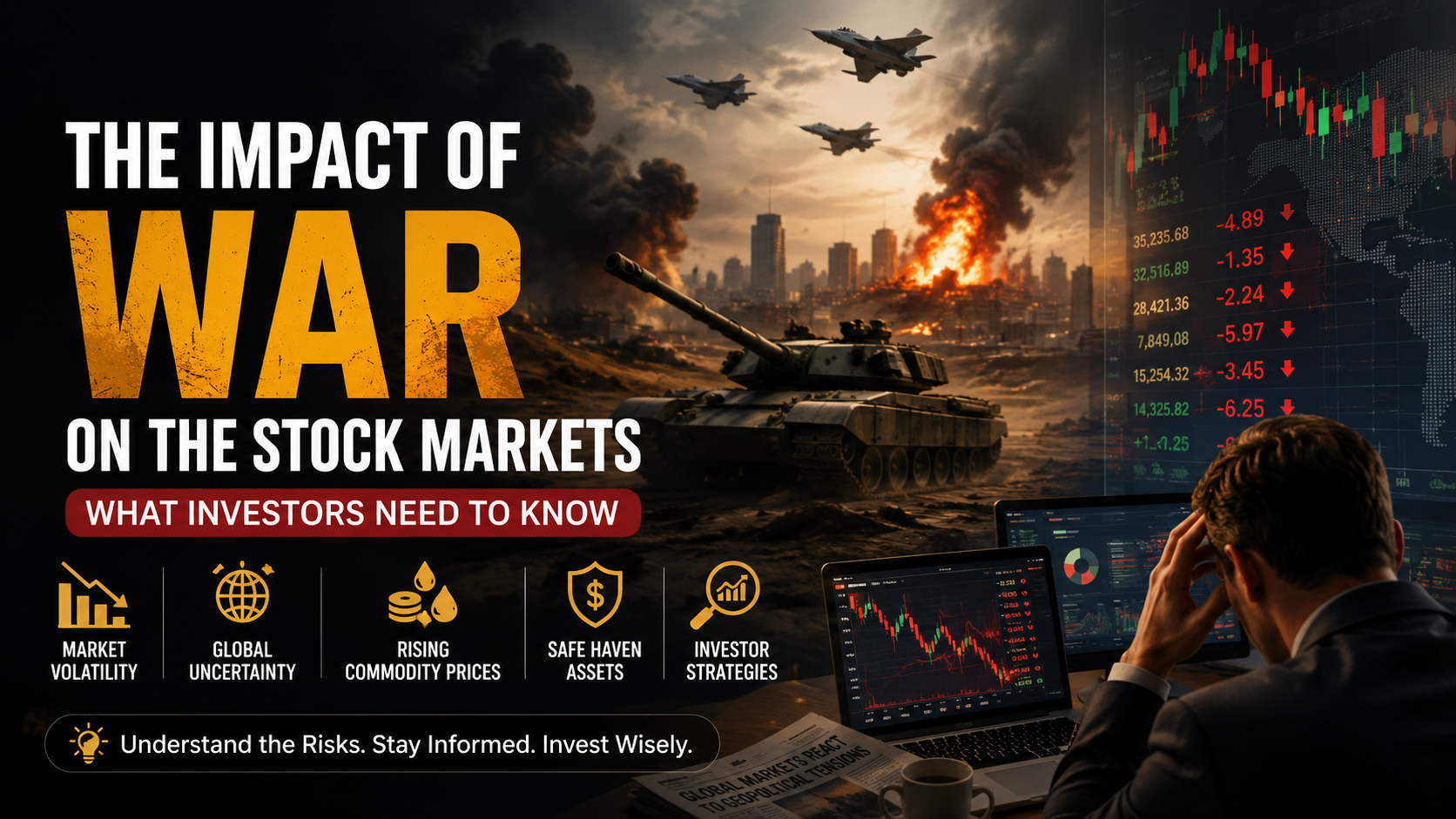
The Impact of War on the Stock Markets—What Investors Need To Know
Geopolitical conflicts can send shockwaves through the global financial system. Understanding the impact of war on the stock markets helps investors prepare for sudden volatility and changing economic conditions. Markets often react quickly to military escalations because investors must reassess risk, growth prospects, inflation, and corporate earnings.
During periods of conflict, investors may move capital toward perceived safe-haven assets. These can include gold, the U.S. dollar, and government bonds. Equity prices can therefore move sharply within hours of major developments. For historical information about market stability and investor protection during crises, investors can review resources from the U.S. Securities and Exchange Commission.
This article explains what happens to the stock market during war, which sectors may be most vulnerable, and why some stocks can rise. It also examines whether markets always fall and how investors can understand these movements without reacting emotionally.


What will happen to the stock market if a war happens?
When a war begins, stock markets often experience an immediate rise in volatility. Investors face uncertainty about economic growth, inflation, interest rates, trade, and corporate profits. That uncertainty can trigger rapid selling, particularly when the conflict is unexpected.
Investors may also shift money toward assets they consider safer. Gold, government bonds, and major currencies can attract additional demand. At the same time, major stock indexes may fall as investors reduce exposure to riskier assets.
The initial reaction does not always predict the market’s longer-term direction. Once investors understand the scale and economic consequences of a conflict, attention often returns to earnings and economic data.
Several factors can influence the market response:
- Conflict duration: Longer wars can create deeper economic disruption.
- Geographic exposure: Markets react differently when conflict affects major economies.
- Commodity supplies: Disruptions can push energy and food prices higher.
- Government policy: Fiscal and monetary responses can influence recovery.
- Corporate exposure: Companies dependent on affected regions may face greater risks.
Initial Market Reactions and Panic Selling
Initial market declines are often driven by fear and uncertainty rather than confirmed changes in corporate fundamentals. Portfolio managers may reduce risk quickly when military developments create an unpredictable environment. This can produce sharp movements in major indexes and individual stocks.
Consumer discretionary and technology companies can face selling pressure because investors often become more cautious about future spending and economic growth. Companies with high valuations may also become vulnerable when investors suddenly prioritize stability over growth.
However, panic selling does not necessarily continue indefinitely. After the first shock, markets often begin evaluating the conflict through economic data rather than headlines alone. Investors may assess corporate earnings, inflation, interest rates, commodity prices, and consumer demand.
The key point is that war does not create one predictable stock-market outcome. The severity and duration of the market reaction depend on the conflict’s economic consequences. A contained conflict may produce a short-lived decline, while a prolonged conflict can create sustained pressure on earnings and valuations.
What are the stocks affected by war?
The stocks most affected by war are usually those with direct exposure to disrupted supply chains, higher commodity prices, weaker consumer demand, or affected geographic markets. The impact can differ significantly between companies, even within the same industry.
Airlines, shipping companies, and travel businesses may face immediate pressure when fuel costs rise or airspace and trade routes become restricted. Higher operating expenses can reduce margins when companies cannot quickly increase prices.
Consumer discretionary businesses may also struggle when inflation reduces household purchasing power. Consumers often delay spending on non-essential products when economic uncertainty increases.
Automotive manufacturers can face additional challenges when conflicts disrupt supplies of metals, semiconductors, energy, or specialized components. These disruptions can delay production and increase manufacturing costs.
Investors should therefore examine a company’s specific exposure rather than assuming an entire sector will move in one direction. Important factors include:
- Supply-chain dependence
- Energy and raw-material costs
- International revenue exposure
- Pricing power
- Debt levels
- Inventory and production flexibility
Supply Chain Disruptions and Sector Vulnerability
War can disrupt global supply chains when ports, trade routes, production facilities, or transportation networks become unavailable. Companies that depend heavily on a small number of suppliers can become especially vulnerable. Investors can also learn more about how supply chain disruptions affect local grocery prices to understand how these disruptions can reach consumers.
Manufacturers may struggle to obtain critical raw materials or components. Depending on the conflict, shortages can affect commodities such as crude oil, natural gas, industrial metals, and agricultural products. Some specialized materials can also become harder to source when production is concentrated in affected regions.
Higher input costs can reduce corporate profit margins. Companies with strong pricing power may pass some costs to customers, but weaker businesses may have limited options. Investors may then lower their expectations for future earnings. Understanding modern asset allocation strategies for beginners can also help investors consider how to spread exposure across different asset classes during uncertain market conditions.
Supply-chain exposure is therefore an important factor when evaluating stocks affected by war. A company with diversified suppliers and multiple production locations may withstand disruption better than a company dependent on one region.
The effect also depends on how long the disruption lasts. Temporary shortages may create short-term volatility, while prolonged disruptions can force companies to redesign supply chains and make costly investments.
Do stock markets drop during war?
Stock markets often fall when a war begins, but they do not automatically decline throughout the entire conflict. The initial reaction usually reflects uncertainty and changing expectations about economic growth, inflation, interest rates, and corporate earnings.
Investors may sell stocks when they fear a recession or major disruption to global trade. Companies exposed to affected regions can experience larger declines. Growth stocks may also face pressure when investors move toward assets perceived as safer.
However, the historical response to wars varies considerably. Some conflicts produce sharp but temporary declines, while others have broader economic consequences. The market response depends on the conflict’s location, duration, scale, and effect on energy supplies and financial conditions.
Investors should also distinguish between a short-term market shock and a prolonged bear market. A sudden decline does not necessarily mean that stock prices will continue falling for months or years. Understanding risk vs return in investing can help investors evaluate whether short-term volatility is consistent with their overall investment strategy.
Instead, investors should monitor:
- Corporate earnings
- Inflation and interest rates
- Commodity prices
- Consumer spending
- Economic growth
- Government intervention
Historical Context of Market Corrections
Historical market behavior shows that stock prices can recover after an initial geopolitical shock. However, recovery is not guaranteed, and timing varies significantly between conflicts. Investors looking for ways to protect capital during uncertain periods can also review the best places to keep your savings safely.
Markets often begin looking beyond immediate headlines once investors can estimate the economic consequences more clearly. If companies continue generating earnings and financial conditions remain stable, equity prices can stabilize even while a conflict continues.
The opposite can also occur. A prolonged war may create persistent inflation, energy shortages, weaker trade, reduced investment, or recession. These effects can keep pressure on corporate profits and valuations for much longer.
This distinction matters when evaluating the impact of war on the stock markets. Investors should not assume that every military conflict will produce the same market pattern.
The broader economic environment also matters. A war occurring during an already fragile economy may create a larger market response than the same event during strong economic growth.
Therefore, historical examples provide useful context, but they should not be treated as precise forecasts. Each conflict has different economic and financial conditions.
Do stock prices go up during war?
Although broad stock indexes can decline when war begins, some individual stocks and sectors may rise. Markets do not treat every company equally because different businesses respond differently to higher demand, commodity prices, and government spending.
Defense companies can benefit when governments increase military budgets. Cybersecurity businesses may also receive additional demand as governments and companies strengthen digital defenses against cyberattacks.
Energy producers can benefit when conflicts threaten oil and gas supplies. Higher commodity prices can increase revenue and, in some cases, improve profit margins for producers.
However, rising share prices are not guaranteed. Investors may already anticipate higher defense or energy demand before a conflict begins. If expectations become excessive, stock prices can fall even when company fundamentals remain strong.
The key is to distinguish between short-term market momentum and sustainable earnings growth. A company may experience a temporary rally based on headlines, while its long-term performance depends on contracts, production capacity, costs, debt, and future demand.
War can therefore create both winners and losers in the stock market. The outcome depends on each company’s business model and exposure.
The Role of Increased Defense Spending
Governments often increase defense spending when national security risks rise. This can create additional contracts for aerospace, defense, technology, logistics, and cybersecurity companies.
Defense contractors with established government relationships may benefit from increased procurement. However, investors should not assume that every defense company will experience the same gains. Contract timing, production capacity, costs, and government budgets can all influence financial results.
Cybersecurity companies can also attract attention during conflicts. Modern warfare increasingly involves digital attacks against government systems, businesses, communications networks, and critical infrastructure. This can increase demand for security software and related services.
Still, higher government spending does not immediately translate into higher profits. Companies must convert contracts into revenue while managing labor, materials, manufacturing capacity, and other costs.
Investors should therefore examine actual financial performance rather than relying solely on headlines. Important indicators include order backlogs, revenue growth, operating margins, cash flow, and contract awards.
The broader lesson is simple: war can increase demand for certain products, but demand alone does not guarantee strong shareholder returns.
What stocks go up when war happens?
Certain industries can benefit when geopolitical conflict increases demand for defense products or pushes commodity prices higher. Defense contractors are often among the most closely watched stocks because governments may increase military procurement.
Energy companies can also benefit when conflicts threaten oil and natural gas supplies. Higher commodity prices can increase revenue for producers, although the effect varies by company and production costs.
Agricultural businesses may gain when conflicts disrupt grain production or exports. Higher food commodity prices can increase revenue for some producers and agribusiness companies. However, higher input costs can offset those benefits for other businesses. Investors can also explore climate-smart agriculture to understand approaches that aim to strengthen agricultural resilience under changing environmental conditions.
Precious metals can also attract investors during periods of geopolitical uncertainty. Gold-related companies may benefit when gold prices rise, although mining stocks remain exposed to operating costs and broader market conditions.
Potential beneficiaries can therefore include:
- Defense and aerospace companies
- Cybersecurity firms
- Oil and natural gas producers
- Agribusiness companies
- Commodity producers
- Precious metal miners
These sectors should not be treated as automatic winners. Valuations, existing expectations, production costs, government policy, and the conflict’s actual economic impact can all change the outcome.
Energy and Commodity Stock Surges
Energy markets can react quickly when a conflict threatens major production areas, pipelines, shipping routes, or export infrastructure. Even the risk of supply disruption can push oil and natural gas prices higher.
Energy producers may benefit from stronger commodity prices because higher selling prices can increase revenue and operating profits. However, not every energy company benefits equally. Producers with high costs, heavy debt, or limited production capacity may see smaller gains.
Agricultural commodities can respond similarly. Conflicts affecting major farming regions or export routes can reduce available supplies and increase global food prices. Agribusiness companies may benefit from stronger commodity prices, but higher fertilizer, fuel, and transportation costs can reduce those gains. These pressures also highlight the importance of understanding climate change food security, impacts and solutions when considering risks to agricultural supply.
Investors should therefore avoid assuming that war automatically makes energy or commodity stocks profitable investments. Commodity prices can reverse quickly when supply fears ease or demand weakens.
A better approach is to examine the company’s underlying financial position. Revenue exposure, production costs, debt, cash flow, dividends, and valuation all matter when assessing potential beneficiaries of geopolitical disruption.
Frequently Asked Questions
How long does it usually take for stock markets to recover after a war starts?
There is no fixed recovery period because every conflict creates different economic conditions. The Impact of War on the Stock Markets can range from a brief correction to a prolonged downturn. Markets may stabilize within weeks or months if economic damage remains limited. Recovery can take much longer when war causes sustained inflation, recession, energy shortages, or major supply-chain disruptions.
Should I sell all my stocks when a war breaks out?
Selling all your stocks during a sudden market decline can turn temporary losses into permanent ones. The Impact of War on the Stock Markets can create sharp short-term volatility, but timing the exact market bottom is extremely difficult. Instead, investors should review their risk tolerance, diversification, investment horizon, and individual holdings. A disciplined strategy is usually more reliable than making emotional decisions based on breaking news.
Are gold and bonds always safe investments during a wartime crisis?
Gold and government bonds are often viewed as defensive assets during geopolitical crises, but neither is guaranteed to rise. The Impact of War on the Stock Markets can also influence interest rates, inflation, currency values, and investor demand for bonds. Gold may benefit from uncertainty and inflation concerns, while bonds can face pressure when interest rates or inflation expectations increase. Their performance depends on the broader economic environment.
How does inflation during wartime impact my existing stock portfolio?
Wartime inflation can increase the cost of energy, raw materials, transportation, and labor. These higher expenses can reduce corporate profit margins, especially when companies lack pricing power. The Impact of War on the Stock Markets may therefore be stronger for businesses with high operating costs or fragile supply chains. Companies in energy, commodities, or defense may benefit from higher demand, but diversification remains important because sector performance can vary.
Conclusion
Understanding the impact of war on the stock markets helps investors respond to uncertainty without making rushed decisions. Conflicts can cause sharp declines, higher inflation, and major sector shifts. However, markets can also recover as investors adjust to new conditions. A diversified portfolio, realistic risk assessment, and long-term focus can help investors manage volatility while avoiding emotionally driven decisions during geopolitical crises.