
Climate-Smart Agriculture: The Ultimate Guide
Modern farming faces unprecedented hurdles as weather patterns shift and populations grow worldwide. To secure global food supplies, the agricultural sector must adapt quickly through innovative frameworks like climate-smart agriculture. This comprehensive approach helps farmers boost productivity while reducing environmental footprints and building long-term resilience against extreme weather events. As outlined by the Food and Agriculture Organization, transforming traditional farming systems is vital for sustainable development. This guide answers essential questions about what climate-smart agriculture is, its core pillars, historical origins, its significance for competitive exams like UPSC, essential operational steps, and broader sustainable agriculture principles to help you understand this agricultural revolution.
Climate-Smart Agriculture: Purpose, Pillars, UPSC Relevance, and Sustainable Practices

What is the purpose of climate-smart agriculture?
The primary purpose of climate-smart agriculture (CSA) is to transform agricultural systems so they can support food security under a changing climate. It helps farmers respond to unpredictable rainfall, rising temperatures, droughts, floods, and soil degradation. Rather than promoting one fixed farming method, CSA identifies practices suited to local conditions.
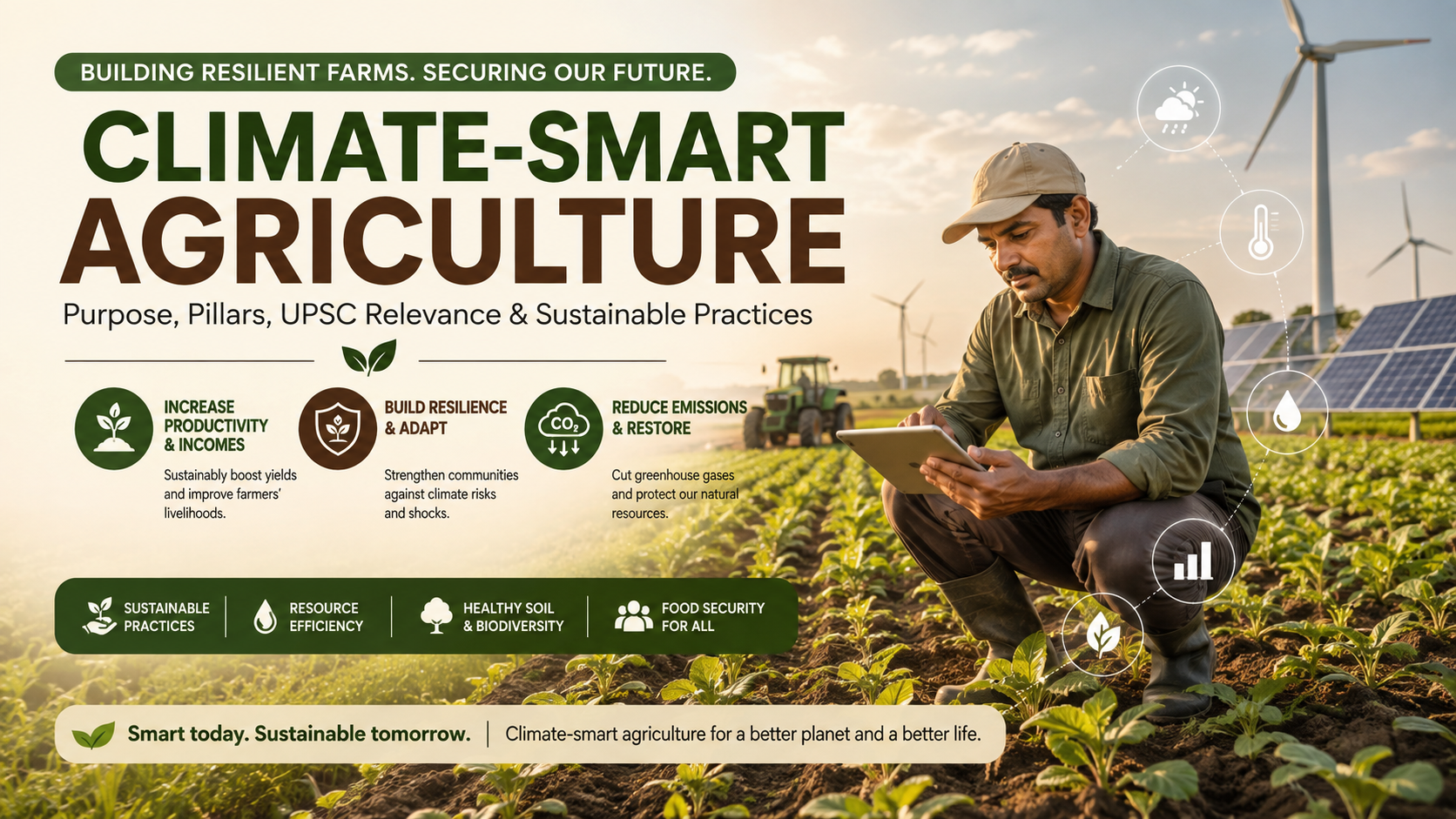
Climate-smart agriculture focuses on three connected outcomes. First, it aims to sustainably increase agricultural productivity and farmers’ incomes. Second, it strengthens resilience and adaptive capacity so farming communities can better handle climate-related shocks. Third, it seeks to reduce or remove greenhouse gas emissions where practical.
These goals can support one another, but trade-offs may occur. For example, a practice that increases productivity may not always reduce emissions. Farmers therefore need solutions based on local resources, climate risks, and economic conditions.
Ultimately, CSA helps protect food production while conserving the natural resources agriculture depends on.
Enhancing Food Security and Economic Viability
Improving food security is a central objective of climate-smart agriculture. Climate-resilient farming practices can help farmers maintain more stable production when weather conditions become unpredictable. This is especially important for smallholder farmers who often have limited financial resources and fewer options for recovering from crop losses. Understanding the broader impacts of climate change on food security can also help explain why these practices are increasingly important.
Better resource management can also improve farm profitability. Efficient irrigation, balanced nutrient management, improved crop varieties, and integrated farming systems can reduce unnecessary input use. These practices may lower production costs while supporting more reliable yields.
However, adoption depends on local conditions. Farmers need access to affordable technology, reliable information, suitable seeds, credit, markets, and extension services. Without these supporting systems, climate-smart practices may remain difficult to scale.
The broader goal is therefore not simply higher yields. It is a more productive, resilient, and economically viable agricultural system that can continue supplying nutritious food while protecting soil, water, and other natural resources.
What are the three pillars of climate-smart agriculture?
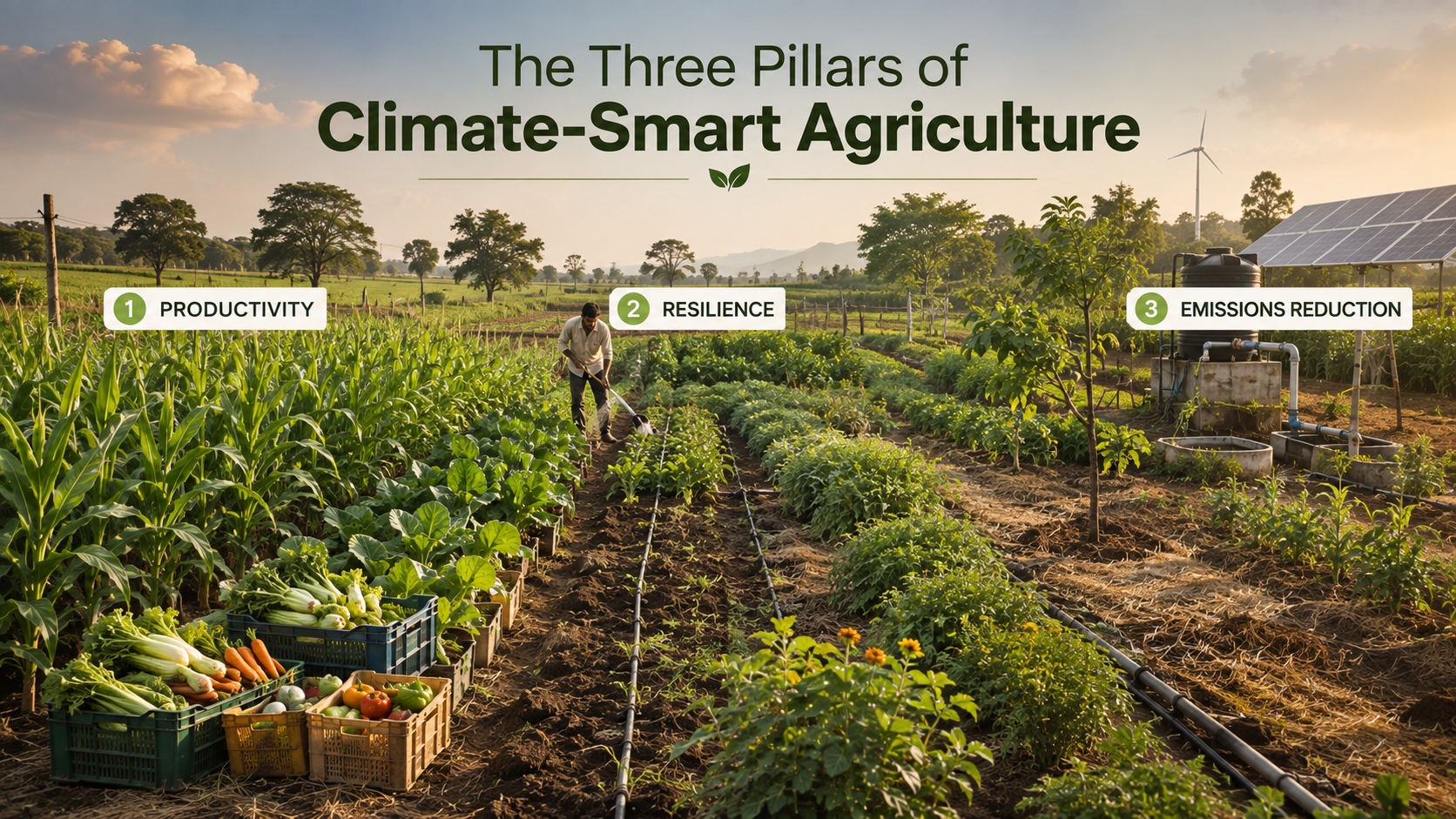
The three pillars of climate-smart agriculture provide a framework for balancing agricultural productivity, climate adaptation, and emissions reduction. The Food and Agriculture Organization (FAO) defines CSA around three main objectives. These objectives are designed to work together while recognizing that priorities can differ between regions and farming systems.
- Increase productivity and incomes sustainably: Farming systems should produce enough food while maintaining the natural resources needed for future production.
- Build resilience and adapt to climate change: Farmers should become better prepared for droughts, floods, heat, changing rainfall, pests, and other climate-related risks.
- Reduce or remove greenhouse gas emissions where possible: Agricultural practices should reduce emissions or increase carbon storage when technically and economically feasible.
The three pillars do not require every farm to achieve the same outcome. Local climate conditions, available resources, economic priorities, and farming systems influence which practices are most appropriate.
This flexible approach makes CSA a framework rather than a single farming technology or production system.
Balancing Productivity and Emission Reductions
Balancing productivity with emissions reduction requires farmers to use resources more efficiently. Practices such as precision nutrient management can reduce unnecessary fertilizer application while maintaining crop productivity. Understanding the main nutrients in commercial fertilizers can also help explain how nutrient management affects crop production. Improved livestock feeding strategies can also help reduce methane emissions from certain production systems.
Other approaches include better water management, conservation agriculture, agroforestry, improved manure management, and the use of renewable energy where suitable. However, their benefits vary according to climate, soil conditions, farm size, and available technology.
This is why climate-smart agriculture does not assume that one practice works everywhere. A method that reduces emissions in one region may have different results elsewhere. Farmers and policymakers must consider both environmental outcomes and economic feasibility.
The goal is to identify combinations of practices that improve productivity and resilience while reducing the agricultural sector’s climate impact. FAO describes this balance as an important part of achieving food security, adaptation, and mitigation together.
Who introduced climate-smart agriculture?
Climate-smart agriculture was not invented by one individual. The concept was developed and promoted by the Food and Agriculture Organization of the United Nations (FAO). The important historical correction is that the concept is generally identified as having been first launched by FAO in 2010, rather than being formally introduced at a 2009 FAO expert conference.
FAO’s 2010 publication, “Climate-Smart” Agriculture: Policies, Practices and Financing for Food Security, Adaptation and Mitigation, brought together approaches focused on productivity, resilience, and greenhouse gas reduction.
The concept built on earlier work linking agriculture with food security, climate adaptation, and emissions mitigation. Researchers, governments, development organizations, and agricultural institutions later expanded and applied the framework in different regions.
Therefore, it is more accurate to describe FAO as the organization that developed and launched the climate-smart agriculture framework, rather than crediting a single inventor.
Today, CSA is used as a broad approach for designing agricultural policies, projects, and practices that respond to local climate and development challenges.
The Evolution of Global Agricultural Policy
The development of climate-smart agriculture reflected a growing recognition that food security and climate change cannot be addressed independently. Before CSA became widely established, agricultural development, climate adaptation, and emissions mitigation were often considered separate policy areas.
The CSA framework helped connect these objectives within a single approach. FAO’s 2010 work emphasized policies, practices, and financing that could simultaneously improve productivity, strengthen resilience, and reduce or remove greenhouse gas emissions.
This approach also shifted attention toward context-specific solutions. Different countries face different combinations of drought, flooding, heat, water scarcity, soil degradation, and market risks. As a result, climate-smart agriculture does not prescribe one universal technology.
Governments can instead combine research, agricultural extension, infrastructure, financial support, climate information, and suitable farming practices. This policy approach helps connect international climate goals with practical decisions made by farmers and agricultural institutions.
The framework continues to evolve as new technologies, scientific evidence, and climate risks influence agricultural planning.
What is climate-smart agriculture UPSC?
For the UPSC examination, climate-smart agriculture is relevant to topics involving agriculture, geography, environment, climate change, sustainable development, and the Indian economy. Aspirants should understand CSA as an approach that connects agricultural productivity with climate adaptation and emissions mitigation. It is also useful to connect these concepts with major current environmental problems affecting the planet.
In India, the concept is particularly relevant because agriculture faces risks from changing rainfall patterns, droughts, heat, water scarcity, soil degradation, and other climate-related stresses. Government initiatives also promote practices related to water efficiency, soil health, integrated farming, and climate resilience.
The National Mission for Sustainable Agriculture (NMSA) is an important example. It was launched under the National Action Plan on Climate Change and aims to make Indian agriculture more productive, sustainable, remunerative, and climate resilient.
For UPSC preparation, candidates should connect CSA with food security, sustainable development, farmer livelihoods, resource conservation, and India’s climate commitments. Questions may require both conceptual understanding and policy analysis.
Integrating Policy Frameworks with Local Reality
For UPSC answers, it is not enough to define climate-smart agriculture. Candidates should explain how policies translate into practical benefits for Indian farmers. This requires connecting national programmes with issues faced at the farm and community levels, as well as understanding how to promote the environment more powerfully through practical action.
The National Mission for Sustainable Agriculture promotes several interventions linked to climate resilience. These include integrated farming systems, soil and moisture conservation, soil health management, and efficient water management. The Per Drop More Crop initiative also promotes micro-irrigation to improve water-use efficiency.
A strong UPSC answer can also discuss implementation challenges. Small farmers may face high upfront costs, limited access to credit, inadequate technical knowledge, fragmented landholdings, and weak market access.
Therefore, successful climate-smart agriculture requires more than subsidies. It needs effective extension services, research, infrastructure, affordable technologies, reliable climate information, and farmer participation.
This policy-to-farm connection helps explain why local conditions are central to climate-smart agriculture.
What are the 7 steps of agricultural practices?
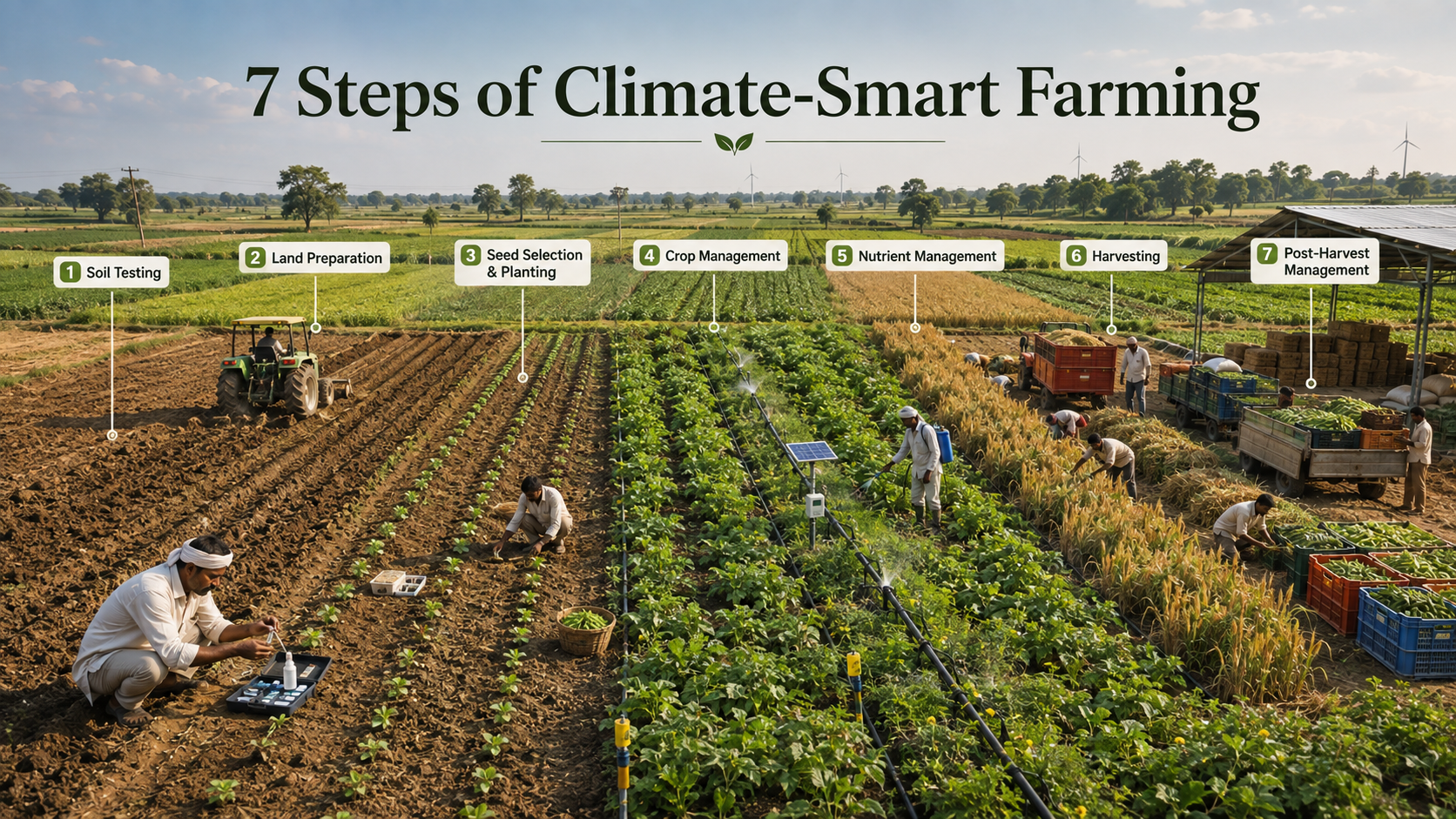
There is no single globally standardized set of seven steps of agricultural practices. However, farming operations can be explained through a practical seven-stage sequence covering production from preparation to marketing. The exact steps vary by crop, region, and farming system.
- Soil testing: Farmers assess soil nutrients, pH, and other characteristics before planting.
- Land preparation: Plowing, leveling, or other preparation creates suitable conditions for crop establishment.
- Seed selection and planting: Farmers select suitable, high-quality, and climate-resilient varieties where available.
- Crop management: Irrigation, weed control, pest management, and field monitoring support healthy crop growth.
- Nutrient management: Fertilizers and organic inputs are applied according to crop and soil requirements, making nutrient management an important part of efficient and sustainable farming.
- Harvesting: Crops are harvested when they reach an appropriate maturity stage.
- Post-harvest management: Produce is cleaned, stored, processed, transported, and marketed.
Using this sequence can improve planning and resource efficiency while reducing avoidable losses.
Optimizing Resource Use Through Structured Steps
A structured farming process can help farmers use water, nutrients, labor, and other inputs more efficiently. The biggest benefit comes from making decisions according to actual field conditions rather than following fixed schedules.
For example, farmers can use soil information to guide nutrient application. Soil moisture measurements and weather information can help determine when irrigation is necessary. Integrated pest management can also reduce unnecessary pesticide use by combining monitoring, biological controls, and targeted treatments.
These approaches fit closely with the goals of climate-smart agriculture because they can improve resource efficiency while strengthening farm resilience. However, access to technology is not equal across all farming communities.
Simple methods can also deliver benefits. Better crop planning, appropriate planting dates, improved seed selection, mulching, crop diversification, and efficient irrigation can support more sustainable production.
The key principle is to match farm inputs with actual crop requirements. This reduces waste and can protect soil, water, and surrounding ecosystems from unnecessary degradation.
What are the five pillars of sustainable agriculture?
The phrase five pillars of sustainable agriculture does not represent one universally standardized framework. Different organizations use different models to describe agricultural sustainability. For a practical explanation, five commonly discussed dimensions are environmental protection, economic viability, social responsibility, animal welfare, and continuous innovation.
Environmental protection focuses on conserving soil, water, biodiversity, and other natural resources. Economic viability ensures that farmers can operate profitable and financially sustainable businesses. Social responsibility considers safe working conditions, fair treatment, community welfare, and inclusion. These priorities are closely connected to the environmental risks facing the world today.
Animal welfare is particularly important in livestock systems because sustainable production also depends on healthy and appropriately managed animals. Innovation supports the adoption of research-based technologies and practices that improve efficiency and resilience.
These dimensions are interconnected. A farm cannot remain sustainable if it protects natural resources but consistently loses money. Similarly, higher profits may not represent sustainable progress if they depend on severe environmental degradation.
Together, these five dimensions provide a useful way to evaluate agricultural sustainability from environmental, economic, social, and technological perspectives.
Fostering Social Responsibility in Rural Farming
Social responsibility is an important part of sustainable agriculture because farming systems depend heavily on people and rural communities. Sustainable agricultural development should support safe working environments, fair economic opportunities, and access to essential resources.
Smallholder farmers can face challenges involving market access, financing, technology, infrastructure, and climate risks. Addressing these barriers can strengthen both household livelihoods and local food systems. Inclusive agricultural programmes can also improve opportunities for women and other groups that may face barriers to resources or decision-making.
Social sustainability should not be treated separately from environmental protection. Farmers are more likely to maintain sustainable practices when those practices are economically practical and supported by reliable institutions.
A resilient rural economy can also help communities cope with climate-related shocks. Diversified livelihoods, stronger local markets, agricultural extension services, and access to climate information can reduce vulnerability.
Ultimately, sustainable agriculture should benefit farmers, workers, consumers, communities, and ecosystems. Its long-term success depends on combining environmental responsibility with practical economic and social support.
Frequently Asked Questions
How does climate-smart agriculture differ from traditional farming?
Climate-smart agriculture explicitly integrates climate adaptation and greenhouse gas mitigation into traditional productivity goals. While conventional farming focuses primarily on maximizing immediate yields, this approach evaluates the long-term environmental impact, carbon footprint, and resilience of the entire farming ecosystem against future weather extremes.
Can smallholder farmers easily adopt climate-smart practices?
Yes, many climate-smart techniques are scale-neutral and accessible to smallholder farmers with proper guidance. Simple practices like crop rotation, rainwater harvesting, and minimal tillage require little upfront capital while immediately improving soil health, lowering input costs, and stabilizing annual crop yields.
What role do digital technologies play in this framework?
Digital technologies provide critical data that helps farmers make precise, climate-smart decisions. Weather forecasting apps, soil sensors, and satellite imaging allow agriculturalists to optimize water usage, apply fertilizers accurately, and anticipate extreme weather events before crop damage occurs.
How does soil health impact climate resilience?
Healthy soils rich in organic matter act like a sponge, absorbing heavy rainfall and retaining moisture during dry spells. This natural sponge effect prevents devastating soil erosion, reduces nutrient runoff, and stores significant amounts of carbon underground, mitigating overall climate change pressures.
Conclusion
The transition toward climate-smart agriculture represents a vital evolution for global food systems facing unprecedented environmental pressures. By embracing the core pillars of productivity, adaptation, and emission reduction, farmers and policymakers can secure long-term food supplies while healing the planet. Implementing these proven practices ensures that agricultural communities remain resilient against future climate shocks. We encourage growers, researchers, and policymakers to apply these sustainable principles today, building a more secure and prosperous agricultural future for everyone.