
How Many Subwoofers Do I Need for Home Theater?
How many subwoofers do I need for home theater? For most dedicated rooms, two subwoofers provide an excellent balance of bass consistency, output, and value. A single quality subwoofer can still work well, especially in a small room or with one primary listening position.
However, room acoustics can make bass difficult to manage. Standing waves, room modes, and bass nulls can create major differences between listening positions. One seat may sound powerful, while another sounds thin or almost silent.
According to established acoustic principles, low-frequency waves interact strongly with room boundaries. Reflections from walls, floors, and ceilings can reinforce some frequencies while cancelling others. This effect becomes especially noticeable with a single subwoofer.
So, how many subwoofers do you need for a home theater? For most dedicated rooms, two subwoofers offer the best balance of performance, consistency, and cost. This guide explains why dual subwoofers work so well, where to place them, and when adding a third unit makes sense.
How many subwoofers do I need for home theater?
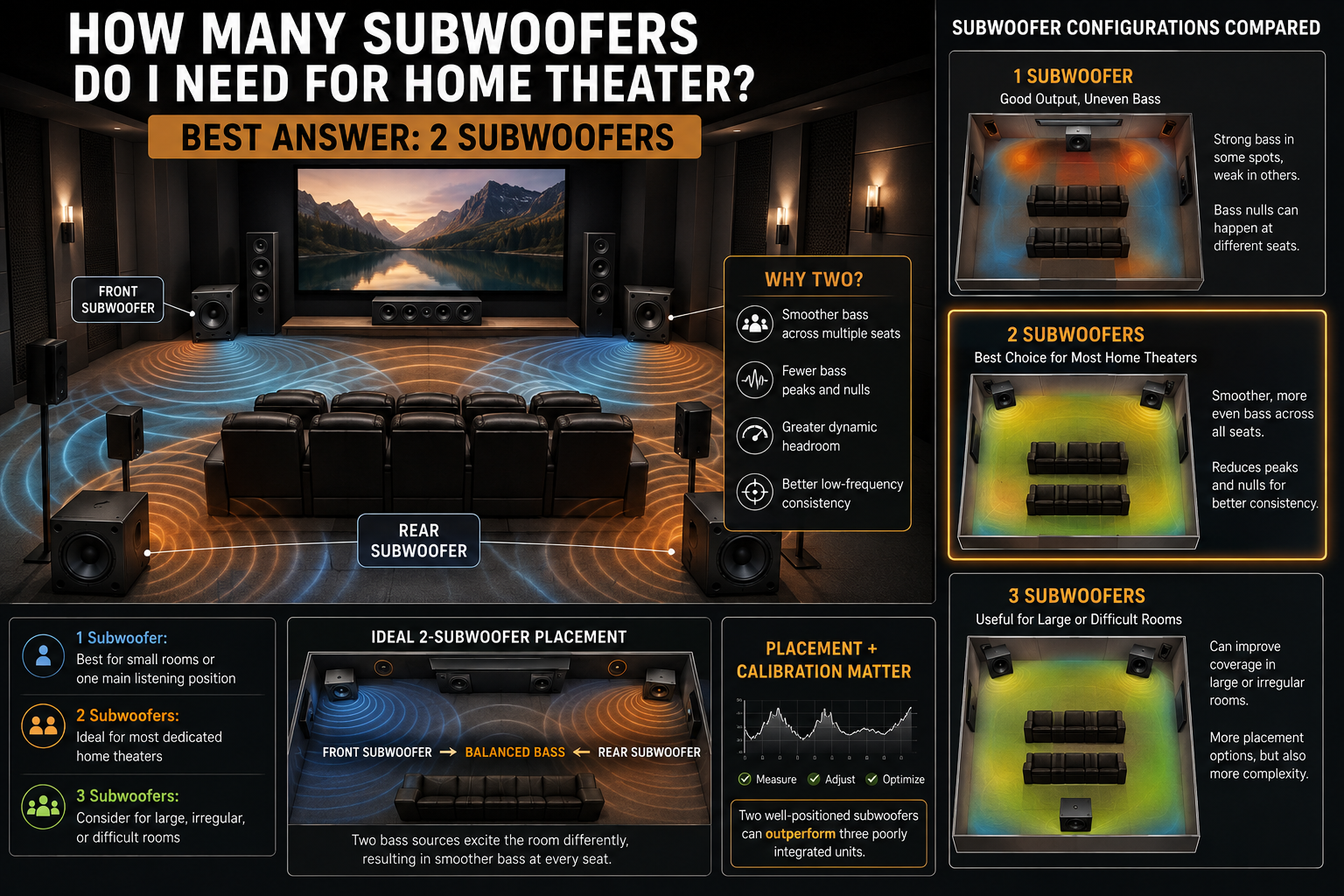
For most dedicated home theater rooms, two subwoofers are the ideal starting point. A single quality subwoofer can deliver excellent output, especially in a small room. However, one bass source often creates uneven frequency response across multiple seats.
Room dimensions and boundaries create peaks and nulls at different listening positions. As a result, one chair may have powerful bass while another has noticeably weaker bass.
Adding a second subwoofer helps distribute low-frequency energy more evenly. The two sources excite the room differently, which can reduce large variations between seats. This benefit is often more important than simply adding more volume.
A single subwoofer may be enough if you have one primary listening position. However, multiple seats or seating rows make dual subwoofers more valuable.
For most home theaters, two matched subwoofers provide an excellent combination of bass consistency, headroom, and manageable calibration. Larger rooms may require more output, but two capable units remain a strong baseline.

The Role of Listening Positions
Your seating arrangement plays an important role when deciding how many subwoofers you need. A single subwoofer cannot produce identical bass at every listening position because low frequencies interact strongly with room boundaries.
Multiple seats can therefore experience different bass levels and frequency balances. One position may sit near a room-mode peak, while another may fall inside a bass null.
A second subwoofer helps by introducing another bass source at a different location. When properly positioned and calibrated, the sources can produce a more consistent response across the listening area, much like the principles discussed in How 8D Audio Works.
This does not mean the second subwoofer simply cancels reflections. Instead, it changes how bass energy interacts with the room. That difference can reduce large peaks and nulls.
Dual subwoofers are particularly useful for:
- Multiple listening seats
- Wide seating areas
- Multiple rows of theater chairs
- Rooms with difficult dimensions
- Systems requiring greater dynamic headroom
For a dedicated cinema, consistent bass across the main seating area is often the biggest advantage of adding a second subwoofer.
What is the 83% rule for speakers?
The 83% rule is a practical speaker-placement guideline sometimes used to establish a balanced front soundstage. It describes a listening triangle where the spacing between the left and right speakers is roughly 83% of their distance from the primary listening position.
For example, if your listening position is 10 feet from each front speaker, the speakers would be approximately 8.3 feet apart.
This guideline can provide a useful starting point for positioning your left and right channels. However, it should not be treated as a universal acoustic law. Room dimensions, speaker design, listening distance, and personal preference can all affect the ideal arrangement.
The 83% rule also applies to main speaker geometry, not subwoofer placement. Subwoofers operate differently because very low frequencies are largely non-directional in typical rooms.
Therefore, use the rule to establish your front soundstage. Then optimize your subwoofer locations separately. Proper bass placement and room correction will have a much greater effect on low-frequency consistency, just as proper maintenance can preserve the performance of your audio equipment, as explained in How to Clean and Maintain Your Premium Headphones.
Enhancing Bass Integration with Front Channels
Good front-speaker placement helps create a coherent soundstage, but subwoofer integration requires additional attention. Your main speakers and subwoofers should work together smoothly around the crossover region.
An appropriate crossover prevents your main speakers from handling frequencies they cannot reproduce efficiently. It also allows the subwoofer to focus on deep bass.
An 80 Hz crossover is a common starting point for home theater systems. However, it is not mandatory for every setup. Speaker capabilities, room acoustics, and receiver settings can justify different crossover points.
The subwoofer should not sound like a separate source. Instead, bass should blend naturally with dialogue, music, and effects from the front speakers.
For the best integration:
- Set appropriate speaker crossover points.
- Confirm the subwoofer phase or polarity setting.
- Run your receiver’s room-correction system.
- Verify distances and levels after calibration.
- Use measurements if you want to optimize performance further.
Good integration preserves clear dialogue and directional effects while allowing the subwoofer to provide deep, powerful bass, complementing the broader principles of Spatial Audio in Headphones.
Is 2 subwoofers overkill?
No. Two subwoofers are rarely overkill for a dedicated home theater, particularly when several people use the room. The main advantage is not simply louder bass.
A second subwoofer can improve bass consistency throughout the listening area. Different subwoofer locations interact with room modes differently. When properly positioned and calibrated, this can reduce major peaks and nulls.
Dual subwoofers can also provide additional headroom. Each unit shares the required acoustic output, so neither has to work as hard to reach the same overall level.
This can reduce driver excursion and distortion during demanding movie scenes. Explosions, soundtracks, and low-frequency effects can therefore remain cleaner at high playback levels.
The benefits become especially noticeable when:
- The room has several listening seats.
- The seating area is wide.
- One subwoofer produces obvious bass differences between seats.
- You want higher output without pushing one subwoofer to its limits.
For a single-seat system, the improvement may be less dramatic. For a multi-seat home theater, however, dual subwoofers are usually a practical upgrade rather than unnecessary excess.
Gaining Headroom Without Added Distortion
Adding a second subwoofer can provide more dynamic headroom, although the exact improvement depends on placement, subwoofer design, amplification, and room acoustics.
When two similar subwoofers share the workload, each driver may need less excursion to achieve a given sound-pressure level. Lower excursion can help reduce mechanical and distortion-related stress.
This becomes useful during demanding movie scenes. Deep explosions, special effects, and musical peaks can require substantial low-frequency output. A single subwoofer may approach its limits sooner than two capable units.
Dual subwoofers can therefore provide a cleaner presentation at high playback levels. They may also reduce the likelihood of audible compression when the system is pushed hard.
However, a second subwoofer does not automatically eliminate distortion. Poor placement, incorrect settings, or inadequate subwoofer capability can still limit performance.
For the best results, match the units as closely as practical. Then calibrate their levels, delays, and equalization together.
The goal is not simply to make bass louder. It is to create cleaner, more controlled bass with greater reserve capacity when movie soundtracks become demanding, much like the importance of preserving sound quality when choosing between modern audio platforms in Spotify vs. Apple Music: Which Service Wins the Audio Crown?
Is it better to have 2 or 3 subwoofers?
For most residential home theaters, two subwoofers provide the best balance between performance and complexity. A third subwoofer can offer additional benefits, but the improvements are usually smaller.
Three units may help in unusually large, irregular, or acoustically difficult rooms. They can provide additional placement flexibility and may improve consistency when two locations cannot adequately address the room’s modes.
However, adding another subwoofer also increases setup complexity. Each unit needs appropriate level, delay, polarity, and equalization settings. The more sources you add, the more important measurement-based calibration becomes.
Two matched subwoofers are usually easier to integrate. They can provide substantial improvements in seat-to-seat consistency without requiring an especially complicated system.
A third unit makes more sense when:
- The room is unusually large.
- Two subwoofers cannot provide adequate output.
- The seating area is extensive.
- You have measurement and calibration tools.
- Your processor supports advanced multi-subwoofer control.
For most enthusiasts, however, two well-positioned and properly calibrated subwoofers are preferable to three poorly integrated units.
Calibration Challenges of Odd Subwoofer Layouts
Three subwoofers are not inherently difficult to use, but they can require more careful calibration. Each additional bass source creates another interaction with the room.
The goal is to align the subwoofers so they work together rather than create unnecessary cancellation. Their physical locations, distances, levels, polarity, and equalization can all affect the final response.
A capable home theater processor or digital signal processor can simplify this process. Measurement software can also reveal problems that are difficult to identify by ear.
With three units, independent adjustment becomes particularly valuable. You may need different delay or level settings for each subwoofer to achieve a smooth response across the seating area.
This does not mean three subwoofers always require professional installation. Modern room-correction systems can automate much of the process. However, manual measurement can still improve the final result.
For most users, two matched subwoofers remain easier to manage. They provide substantial room-response improvement without adding unnecessary calibration complexity.
If you choose three, focus on measurement and integration rather than simply adding another cabinet.
Will 2 subs be louder than 1?
Yes. Two subwoofers can produce more output than one, assuming the units have similar capabilities and are properly integrated. However, the exact increase varies with placement, frequency, room interaction, and available amplification.
A second identical subwoofer can provide meaningful additional output. Under favorable conditions, acoustic coupling can approach a 6 dB increase. In other situations, the gain may be closer to 3 dB.
That increase should not be confused with perceived loudness. Human hearing does not interpret a 3 dB increase as twice as loud. A much larger change is generally required for a dramatic subjective increase.
More importantly, dual subwoofers can provide greater dynamic headroom. Each unit shares the workload, allowing the system to reach demanding bass levels with less strain on each driver.
So, if your only goal is maximum volume, upgrading to a more powerful subwoofer may sometimes be more effective. If your goal is smoother bass across multiple seats, adding a second subwoofer is often the better solution, similar to how understanding How Noise Cancellation Works can help explain the interaction between sound and technology.
Understanding Acoustic Coupling Gains
When two subwoofers are positioned close enough to interact as a combined acoustic source, their outputs can reinforce each other. Under ideal conditions, this coupling can produce approximately 6 dB of additional acoustic output.
Placement matters, though. When subwoofers are deliberately separated to improve room coverage, their interaction becomes more complex. The goal then shifts from maximum coupling to smoother bass throughout the seating area.
Depending on the locations and frequencies involved, you may see different output gains. Room boundaries can also increase or reduce the measured response.
This explains why simply adding a second subwoofer does not guarantee a fixed 3 dB or 6 dB increase at every frequency.
The practical benefit is broader than output alone. Properly placed dual subwoofers can reduce large variations between seats while also providing more headroom.
Think of acoustic coupling as one part of the equation. Placement, room response, calibration, and subwoofer capability all influence the final result.
For most home theaters, optimizing these factors matters more than chasing a specific decibel figure.
Frequently Asked Questions
Can I mix different subwoofer brands or driver sizes?
Mixing different brands or driver sizes is generally discouraged for surround setups. Different models possess unique phase responses, frequency roll-offs, and port tunings that frequently clash. These physical differences can trigger destructive phase cancellations across your room. Using identical models guarantees uniform acoustic output and simplifies calibration.
Where is the best place to position two subwoofers?
The most effective placement strategy involves placing dual subwoofers at opposing mid-wall locations, such as centered along the front and rear walls. Alternatively, placing units in opposing diagonal corners yields exceptional boundary reinforcement. Always test locations using room measurement software to identify optimal response before permanently routing cables.
Do I need two subwoofers in a small room?
Dual subwoofers remain highly beneficial in small rooms because compact spaces suffer from severe, closely spaced room modes. While small rooms do not need massive output capacity, dual smaller units smooth out low-frequency standing waves. This results in fast, articulate bass without overwhelming the physical listening area.
What crossover frequency should I set for my subwoofers?
The standard recommendation across home audio is an 80 Hz crossover frequency. This standard setting routes directional frequencies above 80 Hz to your main speakers while directing omnidirectional low frequencies to your subwoofers. Always calibrate your speakers using your receiver’s automated room correction system first.
Conclusion
Determining how many subwoofers you need for a home theater depends on room size, seating, acoustics, and performance goals. Still, two subwoofers are the best choice for most dedicated rooms.
A single subwoofer can deliver impressive bass. However, room modes can create significant differences between listening positions. Some seats may experience strong peaks, while others fall into deep nulls.
Adding a second subwoofer gives you another source that interacts with the room differently. With careful placement and calibration, this can produce smoother bass across multiple seats.
Dual subwoofers can also provide additional headroom. Each unit shares the workload, which can help reduce strain and distortion during demanding movie scenes.
A third subwoofer can help in larger or unusually difficult rooms. However, the extra complexity often provides smaller returns for typical residential systems.
Before upgrading, optimize placement and calibration. If possible, measure your room response from several seats.
Ultimately, the answer to “how many subwoofers do I need for home theater?” is usually two. For the best results, prioritize proper placement, matched performance, and accurate calibration over simply adding more bass.