
The Evolution of Spatial Audio in Modern Headphone Technology
The evolution of spatial audio in headphones is one of the biggest changes in personal listening. Modern headphones do more than separate sound between the left and right channels. They can create a three-dimensional sound field that feels closer to real-world hearing.
As noted by the Audio Engineering Society, advanced psychoacoustic rendering now allows personal devices to replicate complex speaker arrays.
This technology can make music, movies, and games feel more immersive. Sounds can appear to come from different directions, including above or behind you. Some systems also use head tracking to keep sounds anchored in virtual space. Learn how noise cancellation works
As audio engineering has advanced, digital processing can now simulate complex speaker arrangements through headphones. This guide explains what spatial audio is, how headphones evolved, and how modern systems create immersive sound. It also explores head tracking, personalized audio, object-based mixing, and Dolby Atmos vs. spatial audio.

What Is Spatial Audio in Headphones and How Does It Create a 3D Soundstage?
Spatial audio in headphones is a technology that creates the impression of sound coming from different positions around you. Traditional stereo mainly separates audio into left and right channels. Spatial audio adds directional cues that can make sounds seem to come from the front, sides, rear, or above.
Your brain uses small differences in timing, volume, and frequency to identify where sounds originate. Spatial audio processing recreates some of these cues digitally. It can therefore make headphones sound more like a surrounding speaker system.
The experience depends on the audio source, software, headphones, and processing method. Some systems render specially mixed spatial content. Others can process conventional stereo material to create a wider, more immersive effect.
How Head Tracking Enhances Realism
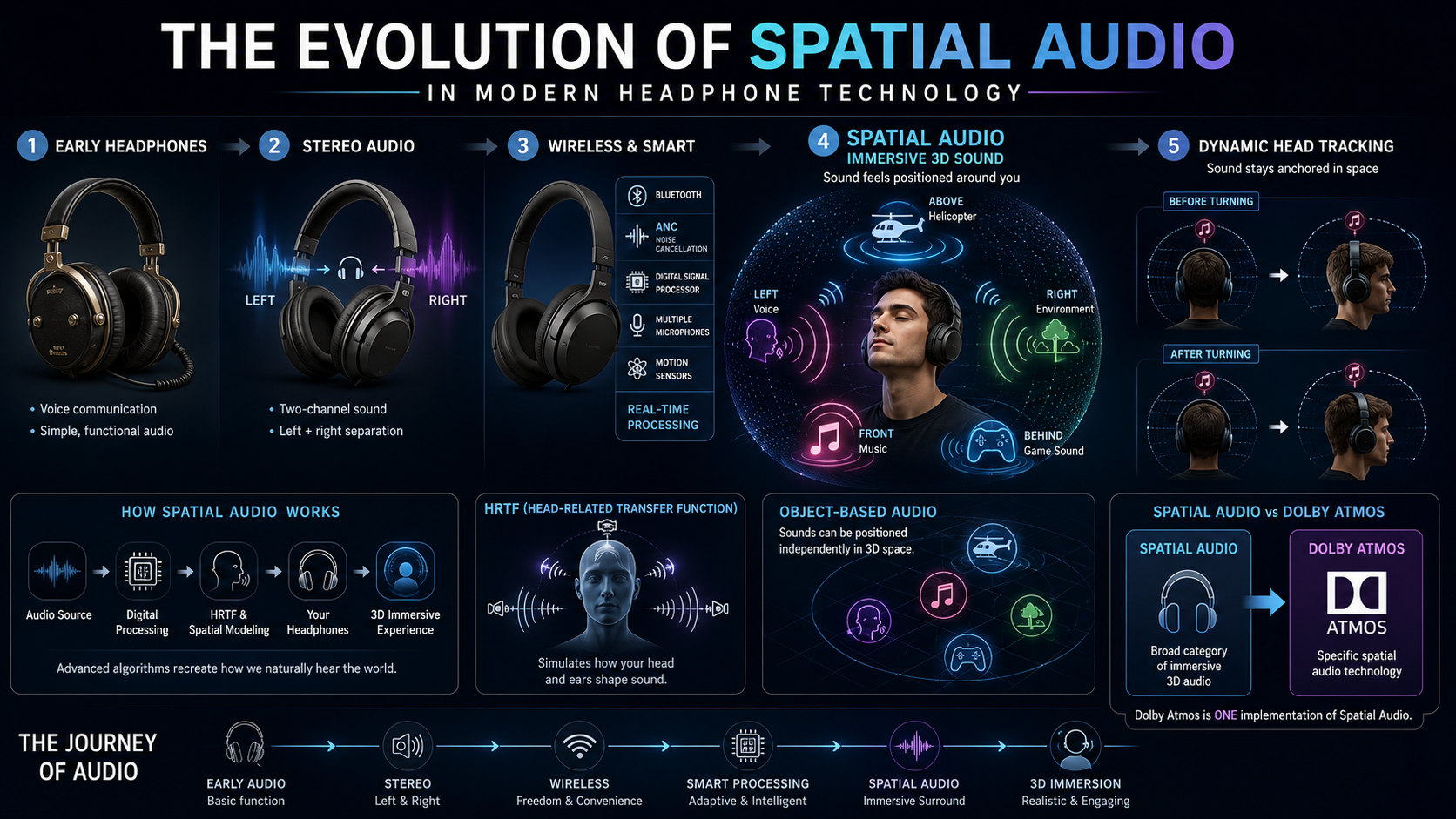
Dynamic head tracking can make spatial audio feel even more convincing. Compatible headphones use motion sensors to detect changes in head position. The audio processor then adjusts the virtual sound field as you move.
For example, imagine a vocalist positioned directly in front of you. If you turn your head right, the vocalist should remain anchored in front of the virtual scene. The sound therefore appears to shift toward your left ear.
This behavior helps create a stable sense of space. Without head tracking, the entire soundstage can move with your head instead.
How have headphones evolved over time?
Headphones have changed dramatically since their early use in telephone and radio communication. Early models were often large, heavy, and designed mainly for voice transmission. They were very different from today’s high-fidelity consumer headphones.
Stereo technology later introduced separate left and right channels. This created a basic sense of width and became a foundation of modern headphone listening. Manufacturers then improved frequency response, reduced distortion, and developed smaller, more comfortable drivers.
Digital technology accelerated this development. Wireless Bluetooth connectivity removed the need for physical cables. Active noise cancellation (ANC) added another layer of control by reducing unwanted environmental sounds.
Modern headphones now combine audio hardware with digital processors and sensors. These components can support features such as adaptive noise cancellation, spatial rendering, transparency modes, and head tracking. The focus has therefore moved beyond simple sound reproduction toward software-enhanced listening.
The Shift Toward Wireless and Smart Audio
The move from wired headphones to wireless devices changed personal audio significantly. Bluetooth headphones can now contain digital signal processors, microphones, motion sensors, and other compact components.
These processors perform audio calculations in real time. They can manage noise cancellation, equalization, spatial processing, and other features within a small device.
Wireless technology has also made advanced audio features more accessible. Users no longer need a home theater receiver or multiple physical speakers to experience virtual surround effects.
However, wireless headphones still depend on their hardware and software capabilities. Codec support, processing power, battery capacity, and device compatibility can all affect the final experience.
What is the latest technology in headphones?
The latest headphone technology combines advanced processing with improved wireless connectivity and personalization. Many premium models now include adaptive noise cancellation, spatial audio, head tracking, and sophisticated digital signal processing. For guidance on choosing between different ANC options, see how to choose the right noise-cancelling headphones.
Personalized sound is another important development. Some systems analyze the listener’s ears or use hearing-related measurements to adjust audio processing. The goal is to improve the accuracy of virtual sound placement.
Bluetooth audio codecs have also continued to evolve. Newer standards can support higher-quality wireless transmission, depending on the codec, source device, and headphones. However, codec support alone does not guarantee better sound.
Modern headphones also use multiple microphones and sensors. These components can monitor environmental noise and head movement. The processor can then adjust audio output in real time. Proper maintenance also matters, so learning how to clean and maintain premium headphones can help preserve their performance.
Together, these technologies create a more responsive listening experience. Instead of simply playing an audio signal, today’s headphones can continuously adapt to the listener and surroundings.
How Personalized Head-Related Transfer Functions Improve Spatial Accuracy
A Head-Related Transfer Function (HRTF) describes how your head, ears, and upper body affect incoming sound. These physical features change the frequency and timing of sounds before they reach your eardrums.
Spatial audio systems use HRTF-based processing to reproduce these directional cues. This helps the brain identify the apparent position of a virtual sound source.
Generic HRTFs can work well, but they do not perfectly match every listener. Ear shape, head size, and other physical differences can affect spatial perception.
Personalized audio systems attempt to account for these differences. Some use measurements, photographs, or guided calibration methods. Others rely on carefully designed generic profiles.
The result can be more accurate positioning and a more natural sense of space. However, personalization is not equally effective for everyone. The quality of the measurement and rendering system also matters.
How is spatial audio achieved?
Spatial audio combines several technologies to create the impression of three-dimensional sound. Digital signal processing (DSP) is central to this process. It modifies audio signals before they reach the headphone drivers.
One important technique uses HRTFs. These filters simulate how sound changes as it travels around the head and reaches the ears. The resulting timing and frequency differences provide the brain with directional information.
Spatial systems can also process multi-channel or object-based audio. Instead of sending fixed signals to individual speakers, object-based mixes describe where sounds should appear within a virtual environment.
The playback system then renders those sounds for the listener’s headphones. Head tracking can add another layer by changing the rendering as the listener moves.
Importantly, spatial audio does not require physically separate speakers around your head. Standard headphone drivers can reproduce the processed signals. The illusion comes from the interaction between digital processing and human hearing.
How Object-Based Audio Mixing Creates Flexible Sound Placement
Object-based audio treats individual sounds as separate elements within a three-dimensional scene. A dialogue track, musical instrument, sound effect, or aircraft can each be treated as an audio object.
Each object can have information describing its position or movement. The playback system uses that information to calculate how the sound should reach the listener.
This approach differs from traditional channel-based audio. A conventional mix may assign sounds to fixed channels such as left, right, center, or surround speakers.
Object-based mixing offers greater flexibility. The same content can be rendered for different playback systems and speaker configurations.
For headphones, the renderer converts the scene into signals suitable for two headphone drivers. HRTF processing can then add the acoustic cues needed for directional perception.
This approach helps spatial audio remain adaptable across earbuds, over-ear headphones, soundbars, and larger speaker systems.
What is Dolby Atmos vs spatial audio?
Spatial audio is a broad term for technologies that create a three-dimensional listening experience. Dolby Atmos is a specific audio format and technology developed by Dolby. Therefore, Dolby Atmos can be considered one implementation within the wider spatial audio category.
Dolby Atmos uses object-based audio to position sounds within a three-dimensional environment. Supported content can place effects and other audio elements around the listener, including overhead.
Other spatial formats also exist. Examples include Sony’s 360 Reality Audio and Apple’s spatial audio features. These systems can use different processing methods and ecosystems while pursuing similar immersive results. For listeners comparing major music platforms, Spotify vs. Apple Music is another useful comparison to consider.
Compatibility is important when comparing these technologies. The content, playback device, operating system, application, headphones, and processing system can all affect the result.
Standard stereo content can also receive spatial processing on some devices. However, this is different from listening to audio that was specifically mixed for a spatial format. The streaming service you choose can also affect your access to content, making YouTube Premium vs. Spotify Premium worth comparing.
Proprietary Standards Versus Flexible Spatial Audio Formats
The spatial audio market includes several competing technologies and ecosystems. Each can use different codecs, renderers, processing methods, and hardware requirements.
Dolby Atmos is widely used for movies, television, games, and music. Compatible content is created and mastered to support the format. Playback devices then render the content for the available hardware.
Other platforms use their own spatial audio systems. Some focus on music, while others target movies, gaming, or general headphone playback.
The main difference is not simply sound quality. Content availability and device compatibility can be equally important. A listener may have excellent headphones but limited access to compatible spatial content.
When choosing a system, consider the services and devices you already use. Also check whether your headphones support the required spatial features. This approach can help you avoid paying for capabilities that your existing setup cannot use.
Frequently Asked Questions About Spatial Audio in Headphones
Does spatial audio work with all headphones?
Basic spatial audio processing can work with almost any pair of headphones because the software magic happens inside your playback device or source app. However, achieving true, optimal immersion usually requires certified hardware equipped with built-in gyroscopes, accelerometers, and custom tuning. Standard analog headphones will give you a simulated spatial effect, but modern wireless models with dynamic head tracking deliver a significantly more convincing and realistic three-dimensional listening experience overall.
Does spatial audio drain battery life faster?
Yes, using spatial audio features typically consumes more battery power than listening to standard stereo tracks. This increased energy consumption happens because the internal processor must continuously run complex psychoacoustic algorithms and track your head movements in real time. Sensors like gyroscopes and accelerometers require constant power to monitor your physical orientation. Fortunately, most modern headphones manage this power draw efficiently, though turning spatial audio off can still extend your daily listening time.
Can you use spatial audio for gaming?
Spatial audio is exceptionally popular in gaming because it provides a major competitive advantage by improving directional awareness. Gamers can pinpoint exact audio cues like footsteps, gunfire, or vehicle engines approaching from behind or above. Many modern gaming headsets feature dedicated spatial software to enhance these positional cues. This level of precise acoustic detail helps players react faster and immerses them deeply into virtual game worlds, making it an essential feature for modern competitive gaming setups.
Do I need special music tracks for spatial audio?
You do not strictly need special tracks, as many devices can upscale standard stereo music into spatial audio automatically. However, experiencing the highest quality spatial sound requires music specifically mixed and mastered in formats like Dolby Atmos Music. Streaming services now offer extensive catalogs of these specially mixed tracks. These dedicated recordings give sound engineers precise control over where every instrument and vocal sits in the virtual three-dimensional soundstage around you.
Conclusion: Why Spatial Audio Is Shaping the Future of Headphone Technology
The evolution of spatial audio in headphones has changed the way people experience music, movies, and games. Headphones have moved from simple stereo reproduction toward intelligent systems that combine processing, sensors, and advanced acoustic modeling.
Spatial audio can create a convincing sense of three-dimensional space. HRTF processing provides important directional cues, while object-based audio enables flexible sound placement. Head tracking can further stabilize the virtual scene as you move.
Modern headphone technology also continues to improve personalization. Adaptive processing, better wireless standards, noise cancellation, and customized audio profiles are making immersive listening more accessible.
Dolby Atmos remains one important spatial audio technology, but it is not synonymous with spatial audio as a whole. Other formats and processing systems can create similar immersive experiences.
When choosing headphones, consider more than sound quality alone. Check spatial audio support, head tracking, device compatibility, content availability, battery life, and personalization features.
As these technologies continue to develop, headphones will become increasingly capable of recreating the depth and realism of a real acoustic environment.