The Ultimate Guide to Flame Test Colours and Element Identification
Flame test colours help identify metal ions through the distinctive light they emit when heated in a flame. This classic qualitative analysis technique is widely used in chemistry education and laboratory experiments. Each element produces a characteristic emission spectrum, which can help distinguish it from other elements. The Royal Society of Chemistry’s flame colours demonstration provides a practical example of this phenomenon.
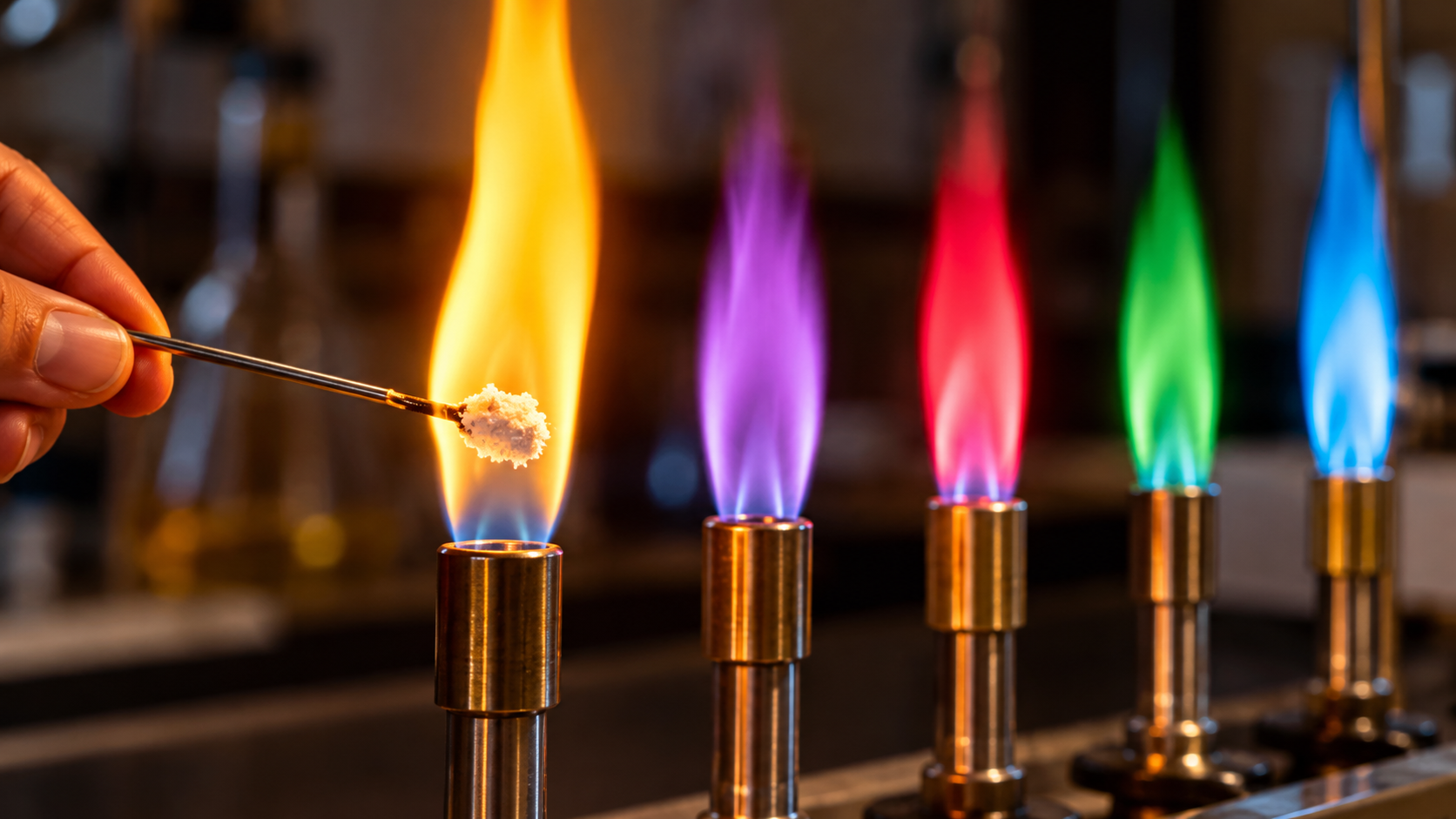
When a metal-containing compound is heated in a Bunsen burner flame, its electrons absorb energy and move to higher energy levels. As they return to lower energy levels, they release energy as light. The wavelength of this light determines the observed colour.
Understanding flame test colours is essential for chemistry students and anyone studying elemental identification. This guide explains the science behind flame tests, offers practical memorization techniques, and explores the characteristic colours of common elements. You will also learn how to identify potassium and barium, recognize potential sources of interference, and understand the limitations of this laboratory method.
Why does a flame test give color?
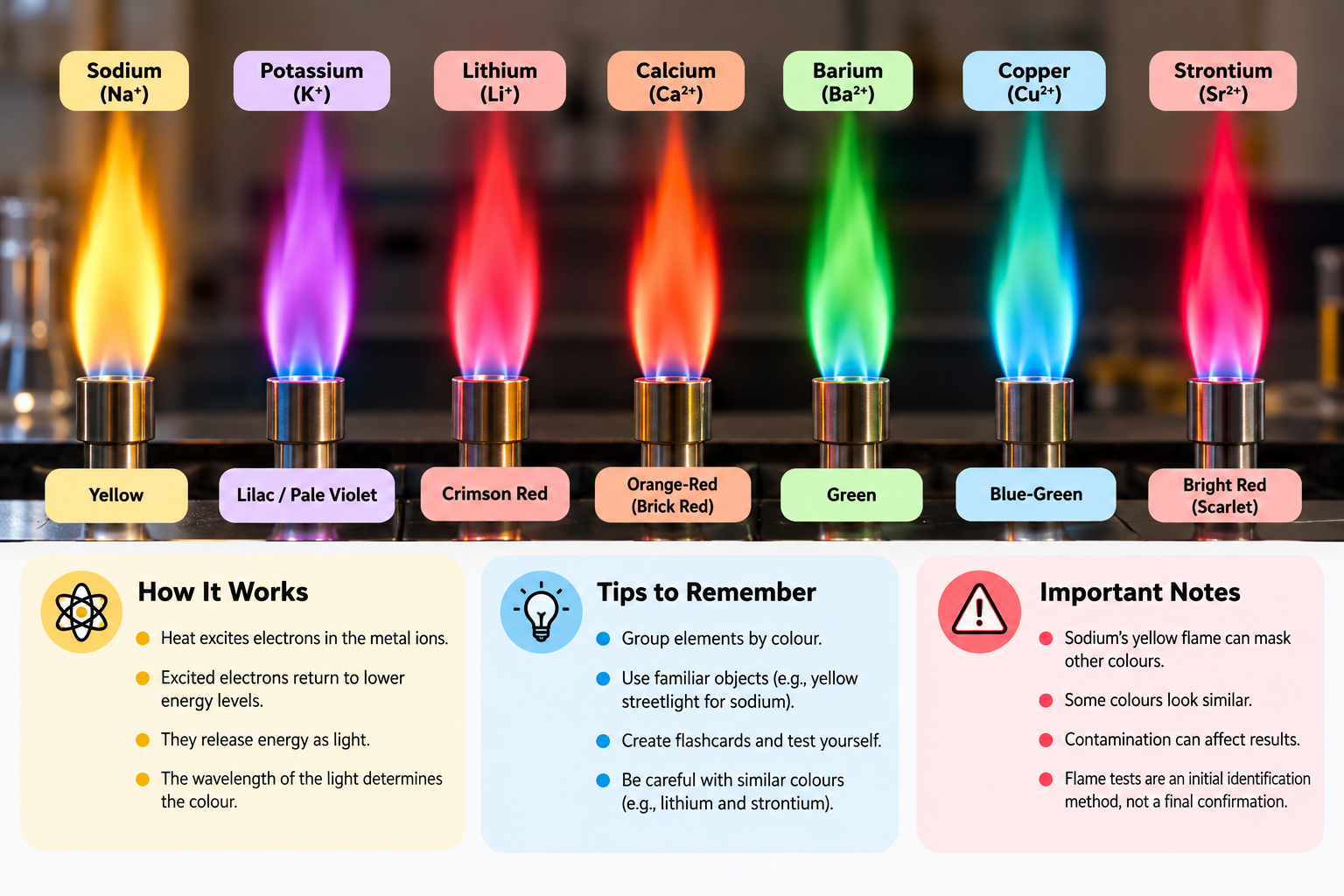
A flame test produces colour because heat excites electrons in atoms or ions. These electrons absorb energy and move to higher energy levels. This excited state is unstable, so the electrons eventually return to lower energy levels. During this transition, they release energy as photons, which are particles of light. For more information about laboratory equipment used in chemistry experiments, explore this guide to basic laboratory glassware and its uses.
The energy difference between the electron levels determines the wavelength of the emitted light. Different wavelengths correspond to different visible colours. For example, sodium produces an intense yellow flame, while potassium produces a pale lilac flame.
Each element has a distinctive set of electron energy levels. Therefore, it can produce a characteristic emission spectrum. This property makes flame tests useful for identifying certain metal ions in unknown samples. However, the results are not always conclusive because some colours overlap, and contamination can affect observations. Flame tests are best used as an initial identification method alongside other chemical tests.
The Role of Electron Transitions in Light Emission
Electron transitions explain why different elements produce different flame test colours. When a sample enters a hot flame, thermal energy excites its electrons. These electrons move from lower energy levels to higher ones. They then release energy as they return to lower levels.
The energy released determines the wavelength and colour of the emitted light. Higher-energy transitions can produce blue or violet light, while lower-energy transitions can produce red or orange light. The exact colour depends on the energy difference between the electron levels.
For example, sodium emits strong yellow light, whereas potassium produces a characteristic lilac colour. These emissions form recognizable patterns that help chemists distinguish elements. In practice, however, the observed flame colour depends on the sample, flame conditions, and possible contamination. Sodium contamination is particularly troublesome because its bright yellow emission can overwhelm weaker colours.
How to remember flame test colours?
Memorizing flame test colours can be challenging because several elements produce similar shades. The most effective approach is to group elements by colour and connect each shade with a familiar object. These associations make the information easier to recall during chemistry examinations and laboratory practicals.
For example, remember sodium as a yellow streetlight, potassium as a pale purple flower, and calcium as a red brick. Associate barium with green apples and copper with a blue-green flame. Lithium and strontium both produce red flames, but lithium is typically described as crimson red, while strontium produces a strong crimson or scarlet-red colour.
Flashcards can also help reinforce these associations. Write the element name and symbol on one side, then place its characteristic flame colour on the other. Test yourself regularly instead of simply rereading the list. This active-recall method helps you identify the correct colour more quickly and distinguish similar-looking flames.
Using Mnemonics and Color Association Techniques
Mnemonics and visual associations make flame test colours easier to remember. Instead of memorizing an isolated list, connect each element with a familiar colour or object. This creates a mental reference that you can recall during an examination.
Try these associations:
- Sodium (Na⁺): Yellow streetlight
- Potassium (K⁺): Pale lilac flower
- Lithium (Li⁺): Crimson-red cherry
- Calcium (Ca²⁺): Red brick
- Barium (Ba²⁺): Green apple
- Copper (Cu²⁺): Blue-green gemstone
- Strontium (Sr²⁺): Bright red signal flare
Pay particular attention to elements with similar colours. Lithium and strontium both produce red flames, while calcium produces an orange-red or brick-red flame. Potassium and sodium also require care because sodium’s intense yellow emission can mask potassium’s weaker lilac colour.
Review these associations regularly and practise recalling the colour before checking the answer. Combining visual memory with repeated testing makes the flame test colour chart easier to learn and retain.
What color is K+ in a flame test?
Potassium ions (K⁺) produce a characteristic lilac or pale violet flame during a flame test. When heat excites a potassium-containing compound, its particles emit light at characteristic wavelengths. This light creates the familiar purple-pink colour associated with potassium.
However, sodium can make potassium’s flame colour difficult to observe. Even small amounts of sodium contamination produce an intense yellow emission that can overwhelm potassium’s weaker lilac colour. As a result, observers may misidentify the sample if they rely on colour alone.
Chemists use cobalt blue glass to filter out much of the interfering yellow light. This allows them to observe potassium’s lilac emission more clearly. The filter does not create the colour; it simply reduces the unwanted yellow light.
For reliable results, clean the wire loop before testing each sample. When accuracy matters, confirm potassium’s presence with additional analytical methods.
What color does barium give in a flame test?
Barium ions (Ba²⁺) typically produce an apple-green or pale green flame during a flame test. This distinctive colour results from light emitted by excited species as they return to lower energy states. It can help identify barium-containing compounds during qualitative chemical analysis.
The exact appearance may vary with the sample and experimental conditions. Barium’s green flame can sometimes be confused with the colours produced by copper or boron. Copper commonly produces a blue-green flame, while boron compounds can produce a bright green colour under suitable conditions.
To improve identification, use a clean wire loop and avoid contaminating the sample with other substances. Observe the flame under suitable lighting and compare its colour with a reliable flame test chart. If the result is uncertain, perform additional confirmatory tests.
Flame tests provide useful preliminary evidence, but they cannot always identify a substance conclusively. This is especially important when several elements produce similar colours or when a sample contains multiple metal ions.
What are the flame test colors?
The flame test colour chart lists the characteristic colours associated with different elements. These colours help students and laboratory workers identify certain metal ions through qualitative analysis. The most familiar examples include sodium’s intense yellow flame, potassium’s lilac flame, and barium’s apple-green flame.
Other common flame test colours include lithium’s crimson red, strontium’s bright red, calcium’s brick red or orange-red, and copper’s blue-green. Rubidium generally produces a red-violet flame, while cesium can produce a blue-violet flame. Under suitable conditions, boron compounds may show a bright green flame.
Lead-containing samples may produce a pale blue-white or grayish-white appearance, although this observation is less reliable for routine identification. Flame colours can vary with the compound, sample purity, and experimental conditions.
| Element or ion | Characteristic flame test colour |
|---|---|
| Sodium (Na⁺) | Intense yellow or golden-yellow |
| Potassium (K⁺) | Lilac or pale violet |
| Lithium (Li⁺) | Crimson red or carmine red |
| Strontium (Sr²⁺) | Bright red or deep crimson |
| Calcium (Ca²⁺) | Brick red or orange-red |
| Copper (Cu²⁺) | Blue-green |
| Barium (Ba²⁺) | Apple green or pale green |
| Rubidium (Rb⁺) | Red-violet |
| Cesium (Cs⁺) | Blue-violet |
| Boron-containing compounds | Bright green |
| Lead (Pb²⁺) | Sometimes described as blue-white or gray-white; not a reliable routine test |
Grouping Elements by Their Emission Characteristics
Grouping elements by their flame colours makes the chart easier to learn. Instead of memorizing every element separately, focus on colour families and the differences between similar shades.
Yellow and violet: Sodium produces an intense yellow flame, while potassium produces a pale lilac flame. Sodium’s strong emission can hide potassium’s weaker colour.
Red and orange-red: Lithium and strontium produce crimson or bright red flames. Calcium typically produces a brick-red or orange-red flame.
Green and blue-green: Barium produces an apple-green flame. Copper commonly produces a blue-green flame, while boron-containing compounds can produce bright green under suitable conditions.
Other colours: Rubidium generally appears red-violet, and cesium can appear blue-violet.
These groupings are useful for revision, but remember that observed colours are not perfectly consistent. Sample purity, contamination, and experimental conditions can influence the result. Use the colour chart as a starting point rather than definitive proof of an element’s identity.
What is the rarest flame color?
There is no universally accepted single rarest flame colour. The visibility of a flame colour depends on the element, the intensity of its emission, the flame conditions, and the sensitivity of the observer or instrument. Some colours are simply harder to distinguish in routine classroom experiments.
For example, potassium’s lilac flame can be difficult to observe because sodium produces a much stronger yellow emission. This does not make lilac the rarest colour in nature; it makes the observation more challenging under common laboratory conditions.
Some elements also produce weak, complex, or less familiar emission spectra that are difficult to observe with the naked eye. Specialized instruments, such as spectrometers, can detect wavelengths that are not easily distinguished visually.
It is also important not to confuse flame colour with the colour of a chemical compound itself. A substance’s appearance at room temperature does not necessarily predict its flame-test result. The most useful approach is to identify the characteristic emission, control contamination, and confirm uncertain results with another analytical method.
FAQ SECTION
How do you clean a nichrome wire before performing a flame test?
You clean a nichrome wire by dipping it into concentrated hydrochloric acid and holding it in a hot Bunsen burner flame until no color is imparted to the flame. This process removes any lingering chemical impurities from previous experiments that might distort your current results. Repeating this cleaning step multiple times ensures the wire is completely sterile and chemically pure. Once the flame remains colorless during heating, the wire is ready for dipping into your next test sample, guaranteeing accurate and reliable identification every time.
Can a flame test identify mixtures of different metal ions?
A flame test can struggle to identify mixtures because one dominant metal color will often mask the hues of other present elements. For instance, the intense yellow emission from sodium easily overpowers the faint lilac of potassium or the green of barium. While experienced chemists can sometimes use optical filters like cobalt glass to isolate specific wavelengths, quantitative techniques or spectroscopic methods are generally required for precise analysis of complex multi-element chemical mixtures in professional laboratory settings.
Why is a non-luminous Bunsen burner flame used for testing?
A non-luminous Bunsen burner flame is used because it burns cleanly and hot without producing bright yellow soot or distracting background light. Opening the burner air hole allows oxygen to mix thoroughly with the gas, resulting in a pale blue, nearly invisible flame that provides a neutral background. This ensures that any observed color comes exclusively from the excited metal ions in your sample rather than incomplete combustion byproducts or soot interference during the qualitative testing process.
Conclusion
Mastering flame test colours is an essential milestone for anyone exploring the captivating and dynamic world of laboratory chemistry. Throughout this comprehensive guide, we examined the underlying atomic mechanics that cause electrons to emit specific light wavelengths when heated, practical memory techniques, individual element profiles like potassium and barium, the complete color spectrum, and the nuances of rare hues. By understanding how thermal energy excites electrons and how to eliminate common contaminants like sodium using cobalt glass filters, you are well-equipped to perform accurate qualitative analyses. We strongly encourage you to apply these valuable insights in your next laboratory session, practice active recall with common element hues, and continue exploring the fascinating intersections of physical science and chemistry. Whether you are a student preparing for an important examination or an enthusiast expanding your scientific knowledge, recognizing these brilliant luminous signatures brings theoretical chemistry to life in vivid, memorable ways.