
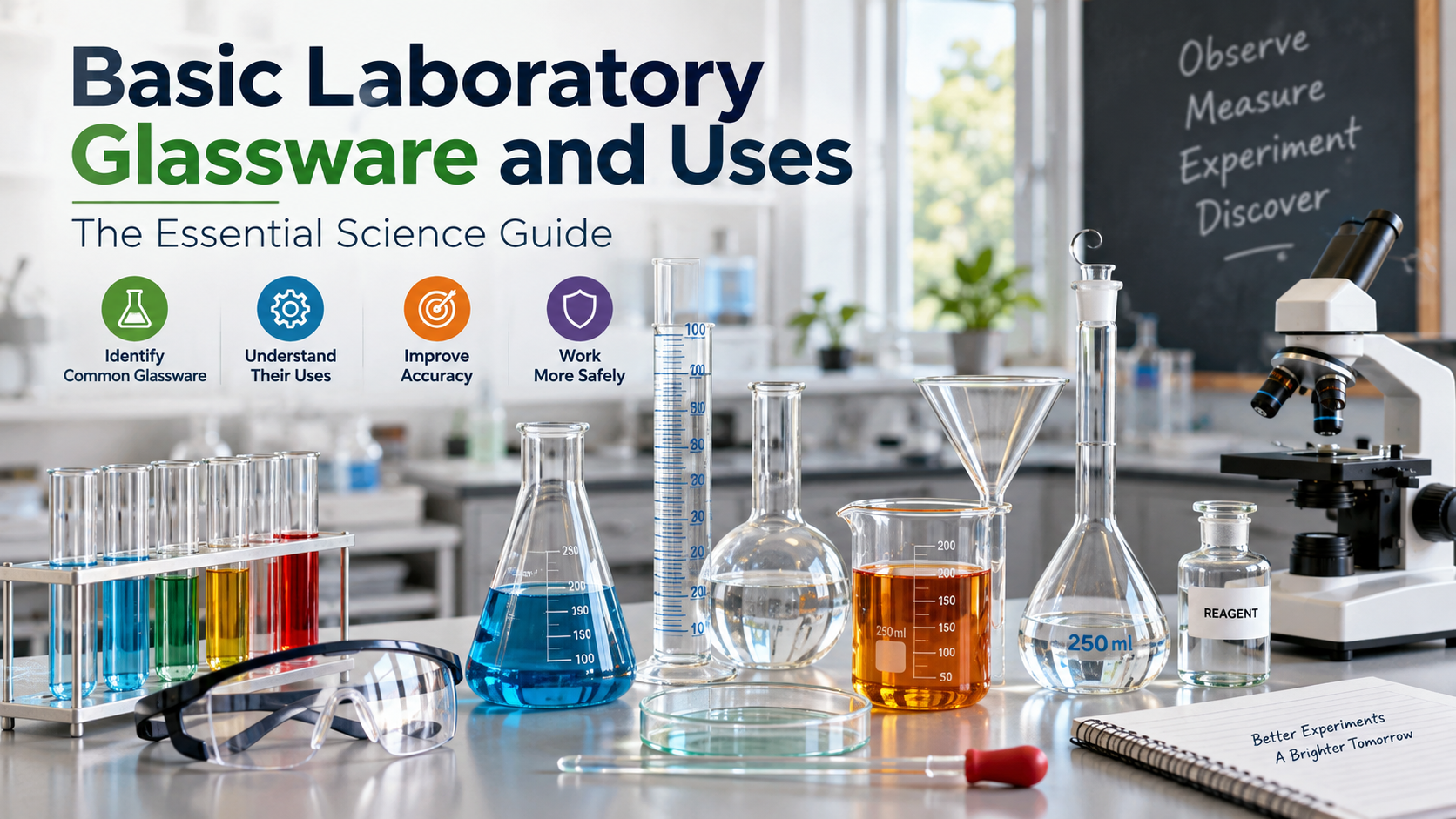
Basic Laboratory Glassware and Uses: The Essential Science Guide
Working safely and efficiently in any scientific environment starts with selecting the right equipment. Understanding basic laboratory glassware and uses helps researchers, students, and technicians perform accurate measurements, manage chemical reactions, and reduce contamination risks. Each vessel has a specific purpose, and choosing the wrong one can affect experimental results.
Precision instruments also depend on recognized measurement standards. Organizations such as the National Institute of Standards and Technology support measurement practices that help laboratories maintain reliable and traceable results.
Selecting an unsuitable vessel can cause volume errors, contamination, chemical damage, or thermal failure. Glassware must therefore match the chemical, temperature, pressure, and procedure involved.
This practical guide explains common laboratory glassware, its uses, and the differences between major glass types. It covers ten essential vessels, expands the list to fifteen common items, and introduces twenty laboratory apparatus and their functions. You will also learn why laboratories commonly use borosilicate glass and how different technical glass categories serve different applications.
What are 10 common laboratory glassware items?
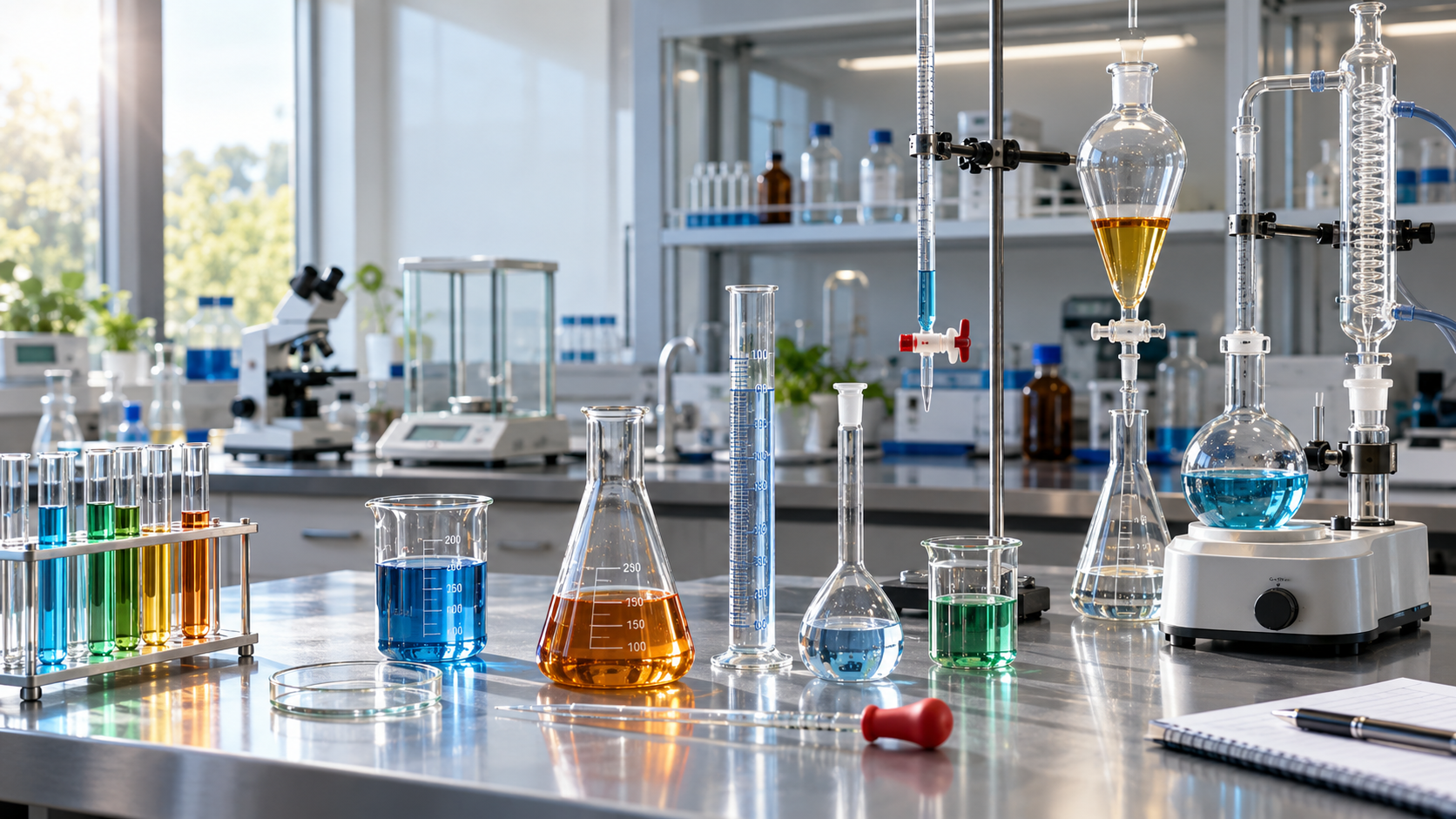
Ten basic glassware items appear regularly in chemistry, biology, educational, and analytical laboratories. Each item supports a different stage of preparation, measurement, transfer, heating, or observation. Understanding these differences is essential for safe and accurate laboratory work and supports peer-reviewed research.
The ten common items are:
- Beakers for mixing, holding, and heating liquids.
- Erlenmeyer flasks for mixing solutions and reducing splashing.
- Graduated cylinders for measuring approximate liquid volumes.
- Volumetric flasks for preparing solutions to precise volumes.
- Test tubes for small-scale reactions and sample handling.
- Pipettes for transferring measured liquid volumes.
- Burettes for controlled liquid delivery during titrations.
- Watch glasses for covering containers or holding small samples.
- Glass funnels for transferring liquids or filtering mixtures.
- Stirring rods for manually mixing liquids and guiding transfers.
These vessels form the foundation of many routine laboratory procedures. However, their accuracy varies. Beakers are suitable for general handling, while volumetric flasks, pipettes, and burettes support more precise measurements.
Primary Functions of Core Lab Vessels
The primary function of laboratory glassware depends on its shape, calibration, and construction. Beakers and Erlenmeyer flasks are mainly used for holding, mixing, dissolving, and heating liquids. Their graduations provide useful estimates, but they are not designed for highly accurate volume measurements. Understanding primary vs secondary sources can also help researchers evaluate information used alongside laboratory work.
Graduated cylinders provide better volume measurements for routine work. Volumetric flasks are designed to contain one specific volume at a defined temperature. They are therefore preferred when preparing solutions with accurately known concentrations.
Pipettes transfer measured quantities of liquid, while burettes deliver controlled volumes during titrations. Their graduations allow technicians to determine how much liquid has been transferred.
Choosing the correct vessel improves repeatability and reduces experimental error. For quantitative procedures, technicians should use calibrated glassware rather than relying on general-purpose containers.
Glassware also requires appropriate handling. Inspect vessels for chips, cracks, or scratches before use. Damaged glass can fail during heating, mixing, or pressure changes.
What are 15 common glassware items used in a laboratory?
Fifteen common laboratory glassware items cover a wider range of preparation, measurement, separation, heating, and storage tasks. The first group includes beakers, Erlenmeyer flasks, volumetric flasks, graduated cylinders, test tubes, pipettes, burettes, watch glasses, and funnels.
Several specialized items extend these capabilities. Florence flasks, also called boiling flasks, have rounded bodies that support more uniform heating. Separatory funnels separate immiscible liquids based on differences in density. Condensers cool vapors and convert them back into liquids during distillation or reflux.
Other useful items include:
- Petri dishes for culturing microorganisms or holding samples.
- Desiccators for protecting materials from atmospheric moisture.
- Weighing bottles for storing and weighing small solid samples.
- Dropping bottles for controlled dispensing of small liquid quantities.
- Reagent bottles for storing laboratory chemicals.
Each vessel serves a defined purpose. Using specialized glassware correctly can improve efficiency, reduce contamination, and support safer experimental procedures.
Advanced Analytical Applications
Specialized laboratory glassware becomes important when basic vessels cannot provide the required separation, purification, or environmental control. Separatory funnels are widely used during liquid-liquid extraction. They allow two immiscible liquid phases to separate before each layer is collected independently.
Condensers perform another important function. During reflux, they cool rising vapors and return condensed liquid to the reaction vessel. This allows reactions to continue at elevated temperatures while limiting solvent loss. Condensers are also used in distillation systems to collect purified liquid.
Desiccators provide a controlled, low-moisture environment for samples and chemicals that can absorb water from the air. Some designs use drying agents, while vacuum desiccators reduce pressure to accelerate drying.
These applications demonstrate why glassware selection matters. Specialized vessels improve separation, purification, drying, and solvent recovery. However, users must still check chemical compatibility and inspect joints, stopcocks, and seals before beginning a procedure. Understanding levels of scientific evidence can also help when interpreting findings produced through laboratory procedures.
What are the 20 common laboratory apparatus and their uses?
A working laboratory combines glassware with mechanical and electrical apparatus. Together, these tools support heating, measurement, sample preparation, handling, and separation.
Common laboratory apparatus include:
- Beakers for general liquid handling and mixing.
- Erlenmeyer flasks for mixing and reaction work.
- Graduated cylinders for routine volume measurements.
- Volumetric flasks for precise solution preparation.
- Test tubes for small reactions.
- Burettes for controlled titration delivery.
- Pipettes for measured liquid transfer.
- Separatory funnels for liquid-liquid separation.
- Condensers for cooling vapors.
- Watch glasses for covering or holding samples.
- Bunsen burners for direct heating.
- Ring stands and clamps for supporting apparatus.
- Wire gauze for distributing heat under vessels.
- Thermometers for measuring temperature.
- Analytical balances for precise mass measurements.
- Tongs for handling hot equipment.
- Spatulas for transferring solid materials.
- Test tube racks for organizing tubes.
- Wash bottles for dispensing purified water or solvents.
- Centrifuges for separating suspended materials.
The correct apparatus depends on the procedure, material, and required accuracy.
Integrating Glassware with Supporting Hardware
Laboratory glassware often requires supporting hardware to remain stable during use. Ring stands, clamps, and wire gauze help position vessels safely during heating, filtration, and other procedures. Proper support is especially important when working with flasks, condensers, and distillation assemblies. Safe laboratory practices also include proper handling and medical waste disposal when applicable.
Wire gauze distributes heat from a burner across the base of suitable glassware. However, not every glass vessel should be heated directly. Users must check the manufacturer’s specifications and the procedure before applying heat.
Clamps should hold apparatus firmly without placing excessive pressure on glass. Overtightening can create stress points that may lead to cracking. Condensers and distillation flasks should also be supported at appropriate points to prevent strain on joints.
Direct flame, rapid temperature changes, and damaged glass can increase failure risks. Thermal shock is especially dangerous because even apparently intact glass can fracture suddenly.
Safe laboratory setups therefore combine suitable glassware with stable supports, controlled heating, and regular equipment inspection.
Which type of glass is used in laboratories?
Borosilicate glass is one of the most widely used materials for laboratory glassware. It contains a high proportion of silica and boric oxide, giving it a relatively low coefficient of thermal expansion. This property helps it resist cracking when exposed to temperature changes.
Borosilicate glass also offers good chemical durability against many common laboratory substances. It is therefore used for beakers, Erlenmeyer flasks, test tubes, bottles, condensers, and other laboratory equipment used across healthcare careers and scientific settings.
However, borosilicate glass is not resistant to every chemical or condition. Strong alkalis and certain aggressive reagents can attack glass surfaces. Users should always check compatibility before selecting a vessel.
For applications involving extremely high temperatures or ultraviolet transmission, fused silica or fused quartz may be more appropriate. These materials contain very high levels of silicon dioxide and offer excellent thermal and optical properties.
Soda-lime glass may also appear in laboratories, particularly for general-purpose bottles and containers that do not face significant thermal stress.
The best glass depends on the required temperature resistance, chemical durability, optical properties, and mechanical conditions.
Superior Thermal Properties of Borosilicate
Borosilicate glass offers low thermal expansion and strong resistance to thermal shock. These properties make it suitable for laboratory procedures involving controlled heating and moderate temperature changes.
When you heat glass, different parts of the vessel can expand at different rates. Large temperature differences create internal stresses. Glass with a lower coefficient of thermal expansion generally experiences less stress during heating and cooling.
This property helps borosilicate glass perform well with hot plates, water baths, heating mantles, and other controlled heating methods. However, no glass vessel remains completely safe from breakage.
Rapid heating, rapid cooling, uneven heating, and existing scratches can cause failure. Never place a hot glass vessel directly on a cold or wet surface unless the equipment specifically supports that procedure.
Glass formulations and manufacturers may specify different temperature limits. Always follow the manufacturer’s operating limits instead of assuming that every borosilicate vessel has the same maximum temperature.
Good laboratory practice combines suitable glass with gradual heating, controlled cooling, and regular inspection for chips or cracks.
What are the 7 types of glass and their uses?
Material scientists classify glass into several families according to composition and performance. Seven commonly discussed categories include soda-lime, borosilicate, lead glass, aluminosilicate, fused silica, high-silica glass, and glass-ceramics.
Manufacturers use soda-lime glass for windows, bottles, and general containers because it offers economical production. Borosilicate glass provides better thermal and chemical resistance, making it common in laboratory equipment and cookware.
Specialized manufacturers use lead glass for optical and radiation-shielding applications. Safety requirements and regulations determine where technicians can use it. Aluminosilicate glass provides strong mechanical and thermal performance for demanding applications.
Fused silica contains very high-purity silicon dioxide. Its excellent thermal stability and ultraviolet transmission make it valuable for optics and scientific instruments.
Manufacturers develop high-silica glasses for demanding thermal environments. Glass-ceramics combine glass processing with controlled crystallization to produce very low thermal expansion.
The correct material depends on temperature, chemical exposure, mechanical stress, optical requirements, and cost.
Industrial Applications Across Glass Categories
Manufacturers select different glass compositions according to the conditions each material must withstand. Soda-lime glass remains common in packaging because it offers acceptable performance at relatively low production costs. However, laboratories generally avoid it for repeated high-temperature heating.
Borosilicate glass provides better performance for laboratory vessels and industrial equipment exposed to thermal cycling. Its resistance to thermal shock makes it useful in chemical processing, scientific instruments, and cookware.
Aluminosilicate glass combines high strength with good temperature resistance. These properties support demanding technical and consumer applications.
Engineers choose fused silica when applications require exceptional thermal stability or ultraviolet transmission. Laboratories may use it in optical systems, semiconductor processing equipment, and specialized scientific instruments.
Glass-ceramics provide extremely low thermal expansion. They can tolerate substantial temperature changes while maintaining greater dimensional stability than ordinary glass.
No single glass type suits every application. Choose glass according to the operating environment, including temperature, pressure, chemical exposure, mechanical loading, and optical requirements.
What is Type 2 glass?
Type 2 glass is a pharmaceutical glass classification for soda-lime-silica glass with improved hydrolytic resistance. Manufacturers treat the glass surface to reduce the release of soluble glass components into aqueous products.
This treatment creates a more chemically resistant inner layer. As a result, Type 2 glass offers better protection for aqueous pharmaceutical preparations than untreated soda-lime glass.
Manufacturers can use Type 2 containers for certain pharmaceutical products, including many neutral and acidic aqueous preparations. These containers provide a practical alternative when the formulation does not require the higher chemical resistance of Type 1 borosilicate glass.
The classification does not indicate that one glass type is simply “better” than another. Manufacturers select glass according to the product and its storage conditions.
Pharmaceutical packaging standards distinguish Type 1, Type 2, and Type 3 glass according to hydrolytic resistance and composition. Factors such as pH, formulation, sterilization, storage duration, and regulatory requirements influence the appropriate choice.
Therefore, Type 2 glass refers to treated soda-lime glass that provides improved chemical durability for suitable pharmaceutical applications.
Pharmaceutical Role and Limitations
Type 2 glass is useful when pharmaceutical products require better hydrolytic resistance than ordinary soda-lime containers can provide. Its treated internal surface helps reduce the interaction between the container and aqueous contents.
This makes Type 2 glass suitable for many neutral or acidic aqueous preparations. It can provide a cost-effective packaging option when the formulation does not require the higher resistance associated with Type 1 glass.
However, Type 2 glass is not universally suitable for pharmaceutical products. Strongly alkaline formulations can attack the protective surface and may require a different container material.
Compatibility also depends on the formulation, storage period, temperature, sterilization process, and regulatory requirements. Container selection should therefore follow validated pharmaceutical packaging standards rather than relying only on glass classification.
Type 2 glass should also not be treated as equivalent to laboratory borosilicate glass simply because both provide improved chemical resistance.
In practice, manufacturers evaluate the glass-container interaction before selecting packaging. Proper classification helps protect product stability, reduce contamination risks, and maintain compliance throughout the intended shelf life.
Frequently Asked Questions
Why is borosilicate glass preferred over soda-lime glass in laboratories?
Borosilicate glass offers better thermal shock resistance and chemical durability than soda-lime glass. Understanding basic laboratory glassware and uses helps technicians choose safer vessels for heating, mixing, and chemical reactions.
How should volumetric glassware be properly cleaned to preserve accuracy?
Clean volumetric glassware with mild laboratory detergent and warm water. Rinse thoroughly with deionized water and avoid abrasive materials. Proper basic laboratory glassware and uses knowledge also helps preserve calibration and measurement accuracy.
What is the difference between TD and TC markings on laboratory glassware?
TC (To Contain) glassware holds its marked volume, while TD (To Deliver) glassware delivers its marked volume under specified conditions. Knowing basic laboratory glassware and uses helps users select the correct vessel for precise measurements.
Can laboratory glassware withstand strong alkaline solutions?
Glass generally handles acidic and neutral solutions well, but concentrated alkaline solutions can gradually damage silicate glass. Knowledge of basic laboratory glassware and uses helps technicians choose suitable plastic or specialized containers for strong bases.
Conclusion
Understanding basic laboratory glassware and uses is essential for safe and accurate scientific work. From beakers and test tubes to condensers and volumetric flasks, each item has a specific purpose. Knowing basic laboratory glassware and uses helps prevent measurement errors and equipment damage. Proper handling, cleaning, and storage also improve laboratory safety. By choosing the right glassware for each procedure, researchers can achieve reliable, consistent, and reproducible results and better understand scientific research methods.