
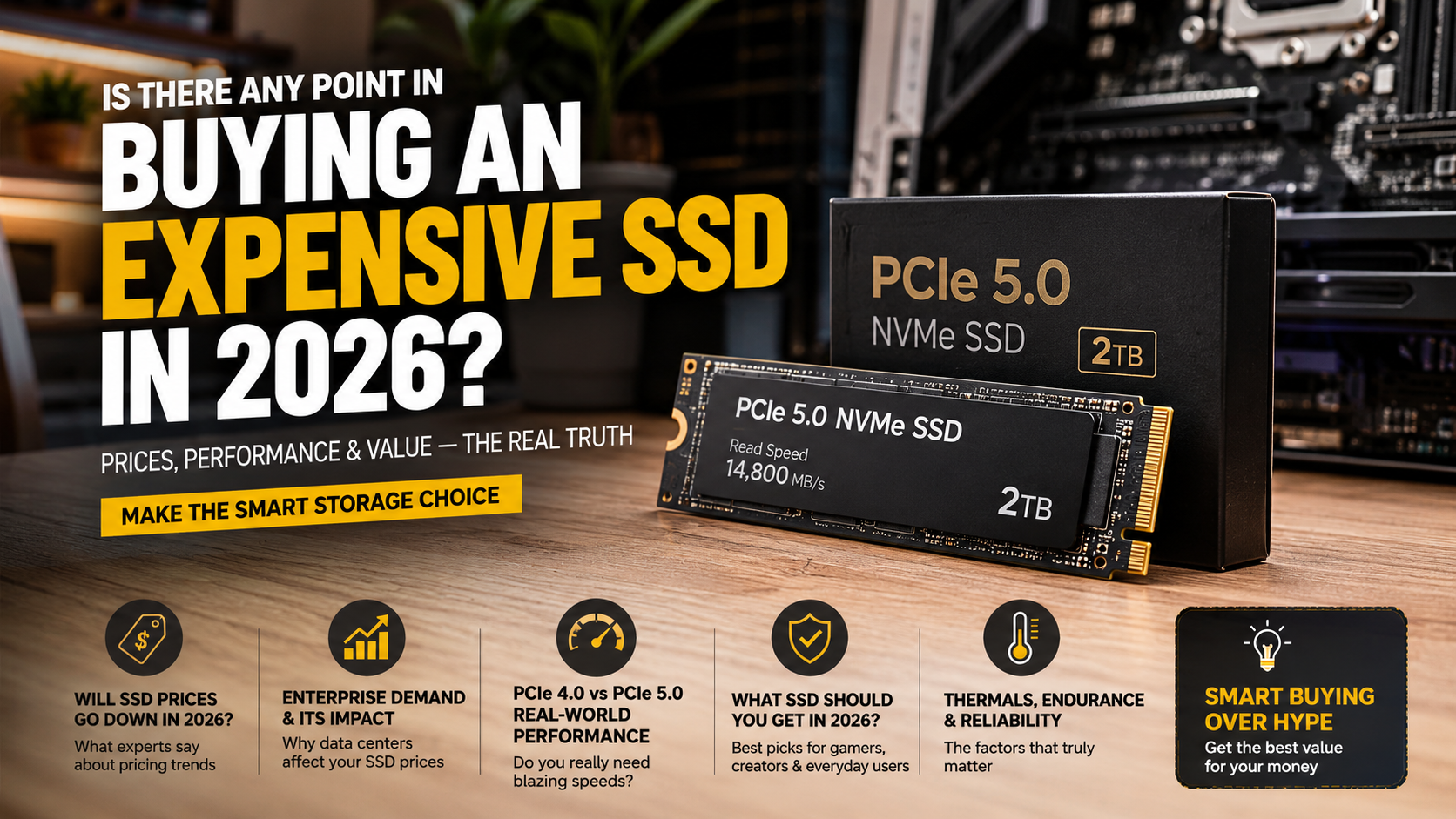
Is There Any Point In Buying An Expensive SSD In 2026?
Buying an expensive SSD in 2026 can be tempting, especially when flagship PCIe 5.0 drives advertise enormous speeds. However, those benchmark numbers do not always translate into noticeably faster everyday computing. For most users, the real question is whether the extra performance justifies the higher price.
For many users, an expensive SSD in 2026 may offer limited value. PCIe 5.0 NVMe drives can reach extremely high sequential speeds. Yet most operating systems, applications, and games cannot fully use that bandwidth.
Real-world workloads matter more than maximum specifications. A good PCIe 4.0 SSD can already deliver fast boot times, responsive applications, and quick game loading. It can also produce less heat than some premium Gen 5 models.
NAND flash manufacturing also affects SSD availability and pricing. Enterprise demand can influence supply and pricing across the consumer market. These factors make timing an SSD purchase more complicated.
This guide examines current SSD pricing, future price trends, and the features that actually matter. It also explains when paying more for premium storage makes sense.
Will SSD prices go down in 2026?
SSD prices can fluctuate throughout 2026, but buyers should not expect guaranteed major reductions. NAND flash pricing depends on production levels, inventory, demand, and manufacturer decisions. When suppliers reduce output, retail prices can remain firm.
Enterprise storage demand is another important factor. Data centers need large amounts of high-density flash storage. AI infrastructure can further increase demand for storage products and related components.
Consumers may still find temporary discounts during major shopping events. However, a short-term promotion does not necessarily signal a long-term market decline. Premium drives can also remain expensive because of newer controllers, faster NAND, and advanced cooling requirements.
If you are considering an expensive SSD in 2026, focus on your actual workload first. Compare the current cost per terabyte across several models. Also consider endurance, warranty coverage, controller quality, and thermal performance.
Waiting for a dramatic price collapse can create unnecessary delays. If you need storage now, a well-priced PCIe 4.0 model may provide better value. Market timing matters, but it should not replace practical buying criteria.
Enterprise Demand Keeps Consumer Costs Elevated
Enterprise demand can influence consumer SSD pricing because manufacturers must allocate production capacity across different markets. Large data-center customers often purchase storage in significant volumes. This can create strong incentives to prioritize enterprise contracts.
However, enterprise demand does not automatically mean consumer SSD prices will remain high throughout 2026. Retail pricing also depends on NAND inventory, production capacity, competition, distribution, and consumer demand.
High-density flash is particularly important for modern data centers. AI workloads and large computing systems can require substantial storage capacity. These requirements can add pressure to the broader NAND supply chain.
For consumers, the important lesson is to avoid assuming that prices will follow one predictable direction. An expensive SSD in 2026 can become less attractive if a competing model receives a major discount.
Before buying, compare similar drives from different manufacturers. Check capacity, NAND type, endurance, sustained performance, and warranty terms.
If a drive already provides everything your system needs at a reasonable price, waiting for a perfect market bottom may not help. The best purchase is usually based on current value rather than an uncertain prediction.
What SSD should I get in 2026?
For most PC users, a reliable PCIe 4.0 NVMe SSD with TLC NAND remains a strong choice. Drives delivering around 5,000 to 7,000 MB/s can handle operating systems, applications, gaming, and many creative workloads with ease. For a broader look at NVMe storage, see our guide to NVMe SSDs and their benefits.
A premium PCIe 5.0 drive can make sense for specialized users. Professional video editors, large-data workflows, and users who frequently transfer huge files can benefit from higher sustained bandwidth.
For ordinary gaming and office work, the difference is usually much smaller. Modern applications rarely keep an SSD operating at its maximum sequential speed for long periods.
When choosing an SSD, look beyond headline specifications. Controller quality, NAND type, endurance, firmware stability, warranty support, and thermal behavior all matter.
Capacity should also influence your decision. A fast SSD can become frustrating if it fills too quickly. For many systems, 2TB offers a practical balance between capacity and cost.
If you are comparing an expensive SSD in 2026 with a strong Gen 4 alternative, calculate what the additional performance actually provides. The money saved could improve another component, such as the GPU or RAM. You can also explore ways to get more out of your GPU without overclocking before reallocating your hardware budget.
Pick Mature PCIe 4.0 Hardware Over Thermal Headaches
PCIe 4.0 SSDs offer an attractive balance between performance, efficiency, heat, and price. Their bandwidth is already sufficient for most desktop workloads. This makes mature Gen 4 hardware appealing for users who want fast and dependable storage.
PCIe 5.0 SSDs can provide considerably higher sequential bandwidth. However, some high-performance models generate more heat during sustained workloads. Depending on the design, they may require larger heatsinks or stronger airflow. This makes air cooling vs. liquid cooling worth considering when planning a high-performance PC.
This difference can matter inside compact systems. Additional cooling increases installation complexity and can add to the real cost of an SSD upgrade.
Gaming workloads usually do not continuously push an SSD at maximum sequential throughput. A good Gen 4 drive can therefore provide similar practical loading performance in many games.
Look for consistent sustained performance and sensible thermal management. Independent reviews can reveal behavior that specifications do not show.
If an expensive SSD in 2026 requires additional cooling for performance you rarely use, the premium may not be justified. PCIe 5.0 remains useful for demanding workloads, but Gen 4 is often the more balanced option for mainstream PCs.
Are SSDs overpriced right now?
Whether SSDs are overpriced depends on the comparison point. SSD technology continues to improve, but retail prices can change considerably between market cycles. A drive may appear expensive compared with an earlier sale without being poor value today.
NAND manufacturers can adjust production based on inventory and profitability. Those changes influence wholesale pricing and can eventually affect consumer products. Enterprise demand can also influence available supply.
Instead of asking whether an SSD is simply expensive, compare its current cost per terabyte with competing models. Also consider performance, endurance, warranty, controller quality, and NAND type.
Flagship drives can carry a premium because they use newer controllers and faster memory. However, higher specifications do not guarantee a noticeably faster desktop experience.
For mainstream users, a reasonably priced 2TB PCIe 4.0 drive may offer better value than a premium Gen 5 model. Professional users with sustained transfer workloads may have a different calculation. If you are considering alternatives, learn whether a SATA SSD is still worth it for your particular workload.
If you are considering an expensive SSD in 2026, evaluate the complete package. A higher purchase price is easier to justify when the drive solves a real performance problem.
The goal should not be finding the cheapest SSD. It should be finding the best storage value for your workload and budget.
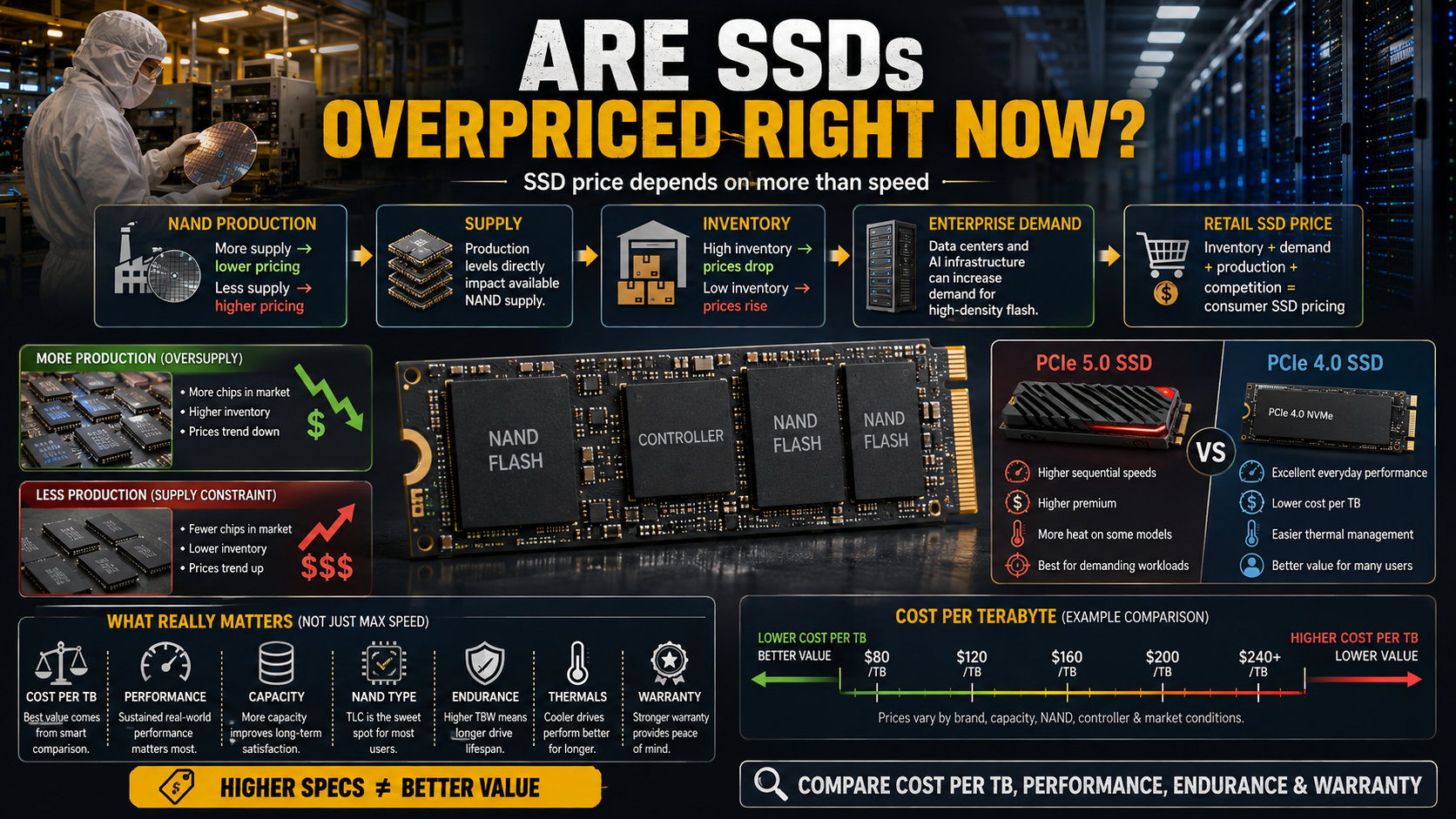

Flash Memory Fabrication Strategies Inflate Your Retail Cost
NAND flash pricing is strongly influenced by manufacturing decisions. When suppliers produce more memory than the market can absorb, excess inventory can push prices lower. Manufacturers may then reduce production to restore supply and demand balance.
These production changes can eventually affect consumer SSD prices. However, the effect is not immediate. Retail prices can also reflect existing inventory, distribution costs, contracts, competition, and retailer strategies.
A reduction in NAND production does not automatically make every SSD more expensive. Different products can follow different pricing trends based on their components and inventory levels.
The broader issue is that SSD pricing is cyclical. Prices can decline during periods of oversupply and recover when manufacturers reduce production.
This makes long-term predictions difficult. Someone waiting for the perfect price could delay an upgrade for months without knowing the next market direction.
Instead, compare current prices across reputable models. If an expensive SSD in 2026 costs substantially more than a capable alternative, determine whether your workload can actually use the additional performance.
Buying a proven SSD at a reasonable current price can be more practical than trying to predict every movement in the NAND market.
Will SSD prices go down in 2027?
SSD prices could become more favorable in 2027 if NAND production expands and manufacturing efficiency improves. However, the timing and size of any decline remain uncertain.
Storage prices depend on several factors. These include supply, demand, manufacturing yields, inventory, enterprise purchasing, and broader economic conditions.
Higher-layer NAND technology could eventually reduce manufacturing costs per gigabyte. As production processes mature, manufacturers may produce greater storage density from the same manufacturing footprint.
However, cheaper manufacturing does not automatically mean cheaper retail SSDs. New technologies can initially involve higher development and production costs. Manufacturers may also adjust output to prevent severe oversupply.
Enterprise demand is another important variable. If data-center and AI infrastructure spending remains strong, additional NAND supply could be absorbed by commercial customers.
Therefore, 2027 should be treated as a possible buying opportunity rather than a guaranteed price-collapse year. If you need an expensive SSD in 2026, waiting only because prices might fall later may not be worthwhile.
Base your purchase on today’s requirements. If your storage needs are not urgent, monitoring prices and waiting for promotions can still make sense.
Next-Gen High-Layer NAND Production Restores Consumer Balance
Higher-layer 3D NAND increases storage density by placing more memory layers into a single chip structure. Greater density can potentially reduce manufacturing resources required for each gigabyte.
As these technologies mature, manufacturers can improve production yields and increase output. This can create conditions for lower manufacturing costs and higher storage capacities.
However, manufacturing costs do not directly determine retail prices. Demand, inventory, competition, controller costs, packaging, distribution, and manufacturer strategy also influence what consumers pay.
Strong enterprise demand could absorb additional production before major savings reach consumers. New manufacturing technologies may also require time to reach efficient high-volume production.
For that reason, next-generation NAND should not be treated as a guaranteed trigger for dramatically cheaper SSDs. The impact depends on production volume and market demand.
Consumers can still benefit from the broader shift toward denser NAND. Higher capacities may become easier to manufacture as these processes mature.
If you are deciding whether to buy an expensive SSD in 2026, do not assume that waiting automatically guarantees a better deal in 2027. Technology roadmaps provide possibilities, not certainty.
If you need storage now, choose based on current price, capacity, performance, and reliability.
Will SSD prices fall soon?
A sharp short-term SSD price collapse is difficult to predict. NAND pricing moves through multi-quarter supply cycles. Manufacturers can also change production levels as inventory conditions evolve.
Retail prices may therefore remain stable for a period before moving significantly. Seasonal promotions can still create temporary opportunities for buyers.
Major shopping events may reduce the prices of selected SSD models. However, a discount on one product does not necessarily indicate a broad market decline.
Buyers should also separate technological progress from pricing. A newer SSD can become faster without becoming cheaper. An older PCIe 4.0 model can also remain excellent value.
If you urgently need additional storage, delaying your purchase for a hypothetical discount has an opportunity cost. You may spend months managing limited capacity.
Instead, establish a target price based on capacity, NAND type, endurance, and workload. Then compare several available models.
For users without an urgent requirement, waiting for a sale can be sensible. But expecting prices to suddenly fall by half is unreliable.
If you are considering an expensive SSD in 2026, focus on whether its current price matches your needs. A smaller discount later may not outweigh months of waiting.
Production Quotas Prevent Sudden Short-Term Price Drops
Manufacturers can adjust NAND production when supply and demand move out of balance. Production reductions can limit excess inventory. Increased output can support growing demand.
These decisions contribute to the cyclical nature of SSD pricing. However, production quotas do not completely prevent short-term retail changes.
Retailers can discount individual products to clear inventory. Competition can also create significant differences between similar SSD models.
SSD prices are shaped by several layers of the supply chain. Factory output is only one factor. Inventory levels, distributor pricing, retailer promotions, product launches, and consumer demand also matter.
This is why shoppers should avoid assuming that every SSD will follow the same trend. One model may become cheaper while another remains expensive.
For a planned PC build, monitor multiple models instead of waiting for one exact product. Compare cost per terabyte and real-world performance.
If the right expensive SSD in 2026 reaches a reasonable price, buying can still make sense. The goal is not to predict the market perfectly.
Instead, aim for useful storage capacity, reliable performance, and a price that fits your overall PC budget.
Frequently Asked Questions
Does PCIe 5.0 storage make games load faster?
PCIe 5.0 solid-state drives offer virtually no tangible loading speed advantages over mature PCIe 4.0 drives in current titles. Modern gaming engines remain limited by CPU asset decompression routines rather than raw drive bandwidth limits. A top-tier Gen 4 drive loads assets within fractions of a second compared to the fastest Gen 5 alternative, rendering the extreme price premium practically pointless for dedicated gaming rigs.
How much storage capacity should I buy for a modern PC?
A 2TB drive is currently the absolute sweet spot for modern desktop computers. Operating systems, expansive creative software suites, and contemporary gaming installations easily consume hundreds of gigabytes each. Opting for a 1TB drive often leads to frustrating storage management issues within months, while 4TB models still carry an unfavorable price-per-gigabyte markup that challenges conventional consumer budgets.
Do ultra-fast drives require specialized active heatsinks?
Yes, high-end Gen 5 drives generate intense heat and frequently demand massive dedicated heatsinks or miniature active cooling fans. Without sufficient thermal dissipation hardware, these drives rapidly reach critical temperature thresholds during heavy write sessions. When that happens, the onboard controller violently throttles performance, lowering transfer speeds down to standard SATA levels to protect the underlying flash storage.
Does DRAM cache matter for everyday computing?
DRAM cache provides meaningful benefits for system boot drives and demanding professional workflows involving continuous directory writes. It stores the memory translation mapping tables directly inside high-speed RAM, ensuring swift random data access. While modern Host Memory Buffer (HMB) technology makes DRAM-less drives acceptable for secondary game libraries, a dedicated DRAM controller is essential for long-term OS drive performance.
Conclusion
Deciding whether to buy an expensive SSD in 2026 requires more than comparing sequential read and write speeds. High-end PCIe 5.0 drives can deliver exceptional benchmark performance. Yet mainstream users may see limited benefits in everyday applications.
Gaming is a clear example. A capable PCIe 4.0 SSD can already provide fast loading and responsive system performance. Paying substantially more for a flagship Gen 5 model may therefore produce a smaller improvement than expected.
Flash memory manufacturing continues to evolve, pushing density limits higher while reshaping the retail landscape. According to historical semiconductor market analyses from TrendForce, NAND production cuts and allocation toward enterprise artificial intelligence infrastructure frequently create ripples across consumer retail pricing. Because of these rapid supply swings, buyers must weigh their actual workload demands against inflated flagship price tags.
For most users, prioritize capacity, reliability, endurance, thermals, and cost per terabyte. A mature PCIe 4.0 SSD with TLC NAND can provide an excellent balance.
Market timing should also remain secondary. NAND pricing can change as manufacturers adjust production and demand shifts. Future price reductions are possible, but they are not guaranteed.
Ultimately, the best SSD is not necessarily the one with the highest benchmark score. It is the drive that provides enough capacity and sustained performance for your workload.
Before buying an expensive SSD in 2026, compare its real-world benefits against cheaper alternatives. If the difference does not improve your daily tasks, save the money for a component that will.