
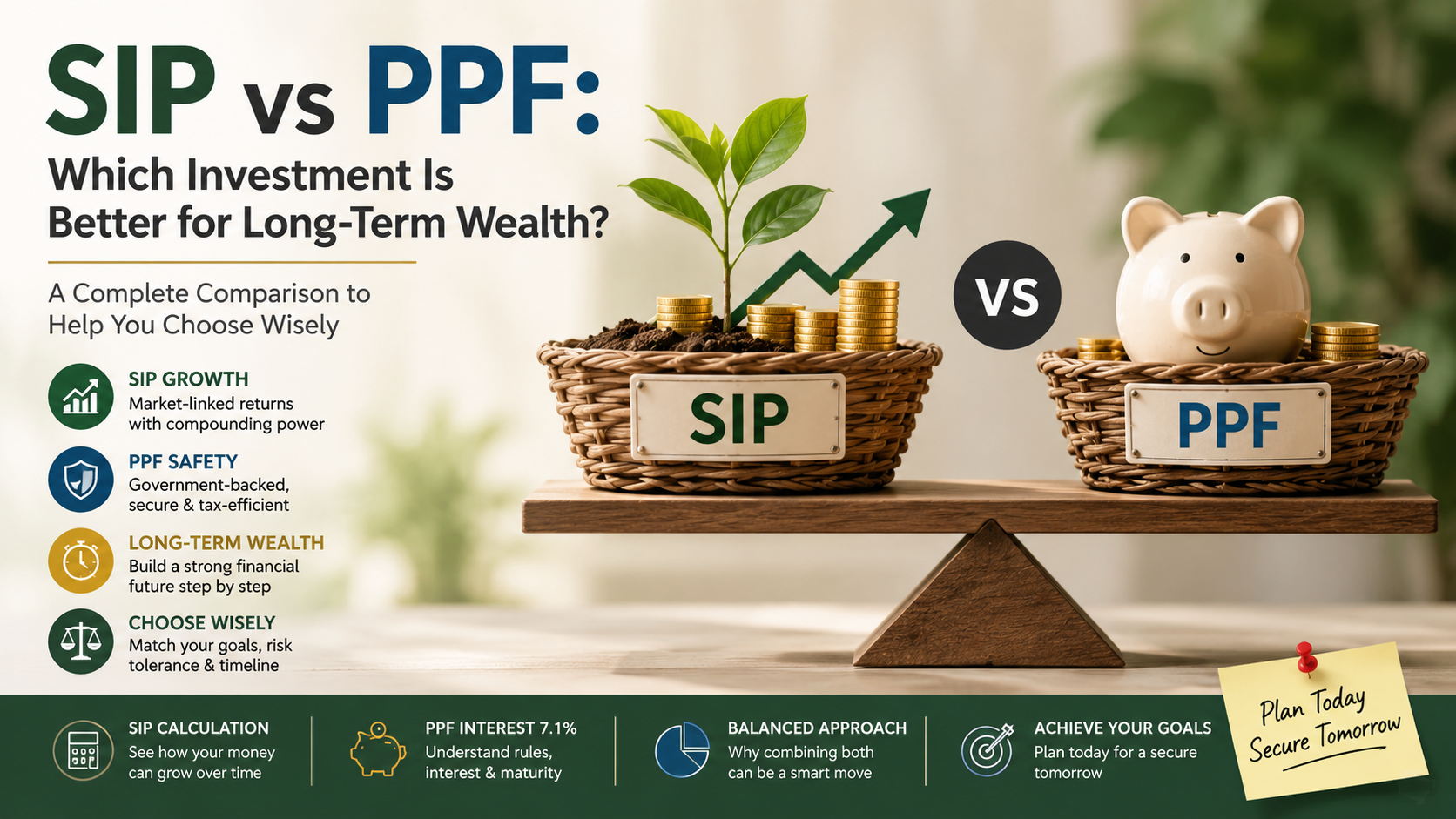
SIP vs PPF: Which Investment Is Better for Long-Term Wealth?
Choosing between different investment options can feel difficult when your goal is long-term financial security. SIP vs PPF is a common comparison because the two options serve very different purposes. A Systematic Investment Plan (SIP) gives investors a disciplined way to invest in mutual funds, including equity-oriented funds with higher growth potential. The Securities and Exchange Board of India (SEBI) provides investor education resources on mutual funds and market-linked investments. The Public Provident Fund (PPF), meanwhile, offers government-backed savings with a fixed tenure and interest rate that is notified periodically. You can check the latest small-savings rates through the Department of Economic Affairs.
Neither option is automatically better for every investor. SIPs involve market risk, while PPF focuses on capital protection and tax-efficient savings. Your investment horizon, risk tolerance, financial goals, and need for liquidity should guide the decision. This comparison looks at PPF and SIP calculations, interest rules, investment timelines, and maturity options. It also explains when combining both approaches may make more sense than choosing only one.
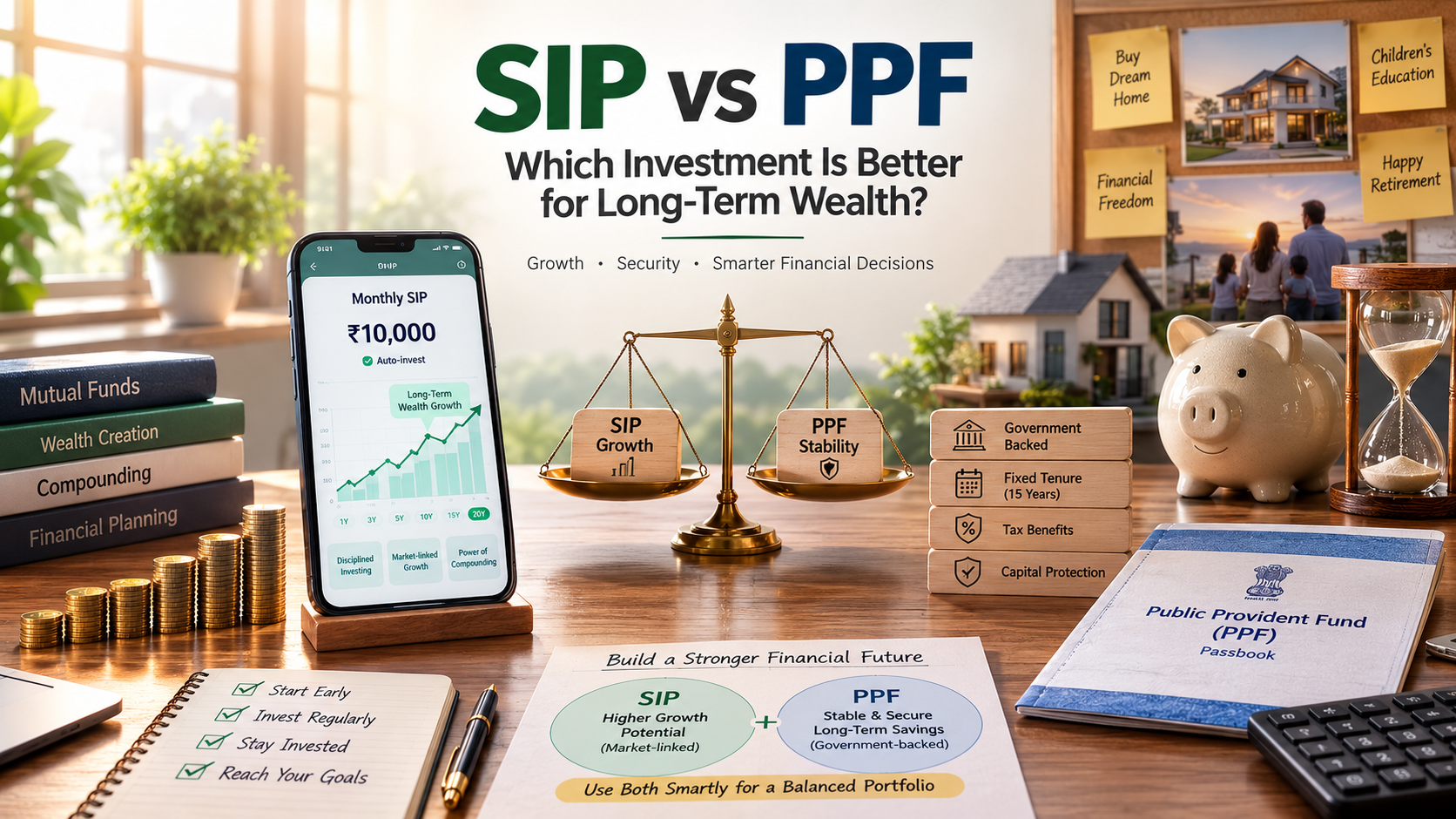

How Much Will I Get If I Invest ₹10,000 Monthly in PPF for 15 Years?
Investing ₹10,000 every month in PPF means contributing ₹1.2 lakh each year. This stays within the current PPF annual deposit limit of ₹1.5 lakh. PPF has a 15-year maturity period, and the government currently lists the interest rate at 7.1% per year.
At a constant 7.1% rate, a ₹10,000 monthly contribution can grow to approximately ₹32.55 lakh over 15 years when deposits are made early enough to receive the applicable monthly interest. Your total contributions would be ₹18 lakh, while the remaining amount would come from interest. India Post provides a corresponding calculation for a ₹1,000 monthly contribution, which scales to approximately this amount.
The actual maturity value can differ if the government changes the PPF interest rate during the investment period. Therefore, ₹32.55 lakh should be treated as an illustration rather than a guaranteed 15-year projection.
Understanding PPF Interest Calculation
PPF interest is calculated each month using the lowest balance between the close of the fifth day and the end of that month. The interest is then credited to the account at the end of the financial year. This makes the timing of your deposits important.
If you invest your monthly contribution before the fifth day, that amount can generally qualify for interest for that month. Depositing later can reduce the interest earned for that month.
For a long-term PPF investor, this simple timing habit can improve the overall outcome. However, the interest rate itself is not permanently fixed for all 15 years. The government notifies small-savings interest rates periodically, so future returns may differ from a calculation using 7.1% throughout.
Which Type of Investment Is Best for the Long Term?
There is no single investment that is best for every long-term investor. The right choice depends on your financial goals, risk tolerance, investment horizon, and inflation expectations. SIPs can provide exposure to equity mutual funds, which may offer stronger long-term growth but also carry market risk. PPF provides a government-backed savings route with interest rates notified periodically. A useful comparison is risk vs return in investing, especially when deciding how much volatility you can accept.
For goals several decades away, equity investments can play an important role because they offer greater growth potential. However, returns are not guaranteed, and short-term market declines can be significant. PPF can provide stability and tax-efficient accumulation, but its fixed-income nature may offer less growth potential than equities over long periods.
A balanced approach can therefore be more practical for many investors. You might use PPF for the stable portion of your portfolio while using equity mutual fund SIPs for long-term growth. The right mix should reflect your ability to tolerate market fluctuations.
Balancing Risk and Inflation
Inflation gradually reduces the purchasing power of money. This makes inflation-adjusted returns and risk vs return in investing important when comparing PPF with equity-oriented mutual funds.
PPF offers stability and government-backed interest, but its future rate is subject to periodic government notifications. Equity investments can potentially deliver higher long-term returns, but they can also lose value during market downturns. There is no guaranteed return from an equity mutual fund SIP.
Consider the purpose of the money before choosing an investment. PPF may suit investors who value capital stability and predictable long-term saving. Equity SIPs may suit investors who can tolerate volatility and remain invested for many years.
Using both can reduce concentration risk. PPF can provide a stable component, while an equity SIP can target higher long-term growth. Your allocation should depend on your goal and risk capacity rather than simply choosing whichever option has the higher projected return.
How Much Is a ₹50,000 Monthly SIP for 5 Years?
Investing ₹50,000 per month in an SIP for five years means contributing ₹30 lakh in total. The final value depends entirely on the performance of the mutual fund and therefore cannot be guaranteed in advance.
For illustration, assuming an annualized return of 12% and monthly compounding, the investment could grow to approximately ₹40.8 lakh after 60 monthly investments. That would represent an estimated gain of about ₹10.8 lakh over the ₹30 lakh invested. The actual value could be considerably higher or lower because mutual fund returns fluctuate with market conditions.
Five years is also relatively short for an equity-focused investment. A major market correction near the end of the period could significantly reduce the final value. Investors should therefore avoid treating a 12% assumption as a promised SIP return.
Before choosing a fund, consider its investment strategy, risk level, costs, and suitability for your financial goal.
The Role of Rupee Cost Averaging
A monthly SIP automatically invests a fixed amount at regular intervals. When prices are lower, the same contribution purchases more mutual fund units. When prices are higher, it purchases fewer units.
This process is commonly associated with rupee cost averaging. It can reduce the pressure of trying to predict the perfect time to invest. However, it does not guarantee profits or protect investors from market losses.
SIP works best as a disciplined investing method rather than a return guarantee. The investor remains exposed to the performance of the underlying mutual fund. A poorly performing fund can still produce disappointing results despite regular investments.
For long-term investors, consistency can be more practical than attempting to predict short-term market movements. However, the investment should still be reviewed periodically. Changes may be necessary if the fund no longer matches your goals, risk tolerance, or asset-allocation strategy.
What Happens After 20 Years of a PPF Account?
A PPF account does not automatically have a 20-year maturity period. The standard PPF tenure lasts 15 years, after which you can close the account or extend it in five-year blocks. An investor can therefore continue the account beyond 15 years and reach a 20-year investment period through an extension.
After the initial maturity, you can withdraw the full balance and close the account. You can also keep the account open without making additional deposits. In that case, your existing balance continues to earn interest at the applicable PPF rate, and you can make one withdrawal during each financial year.
If you want to continue making contributions, you can extend the account for another five-year block by submitting Form-4 within one year of maturity. The extended account follows specific withdrawal rules, including a 60% limit during the five-year extension period.
Extension Options Without Fresh Deposits
After PPF maturity, you can retain the account without making additional contributions. The existing balance continues earning interest at the applicable PPF rate. You can also make one withdrawal in each financial year, subject to the rules governing the account.
This option can suit investors who want to preserve their accumulated PPF corpus while gradually accessing the money. It can also provide flexibility after retirement or when a major financial goal approaches.
There is an important distinction between continuing without deposits and extending with deposits. If you want to keep contributing after maturity, you must choose the contribution-based extension within the prescribed one-year period. The current PPF Scheme uses Form-4 for this extension.
If you continue the account without deposits for more than one year, you cannot later switch back to the contribution-based extension option. Therefore, investors should understand the consequences before choosing their post-maturity route.
Which Is Better, SIP or PPF?
The answer to SIP vs PPF depends on what you want the investment to accomplish. SIP is a method of investing in mutual funds and can provide equity exposure with higher long-term growth potential. PPF is a government-backed savings scheme designed for long-term, relatively stable accumulation. For another perspective, see this guide on SIP vs FD and which option is better.
For investors with a long horizon and higher risk tolerance, an equity-oriented SIP may offer greater wealth-creation potential. However, market returns are not guaranteed. PPF may be more suitable for investors who prioritize stability, tax-efficient savings, and government-backed interest.
PPF also has a 15-year initial tenure, while SIP investments generally offer greater flexibility because investors can change or stop contributions according to the mutual fund’s rules. However, SIP investors must accept market fluctuations and potential losses.
Rather than treating the choice as an either-or decision, many investors can use both. PPF can provide a stable foundation, while SIPs can provide growth exposure. The appropriate allocation depends on your financial goals, risk profile, and investment horizon.
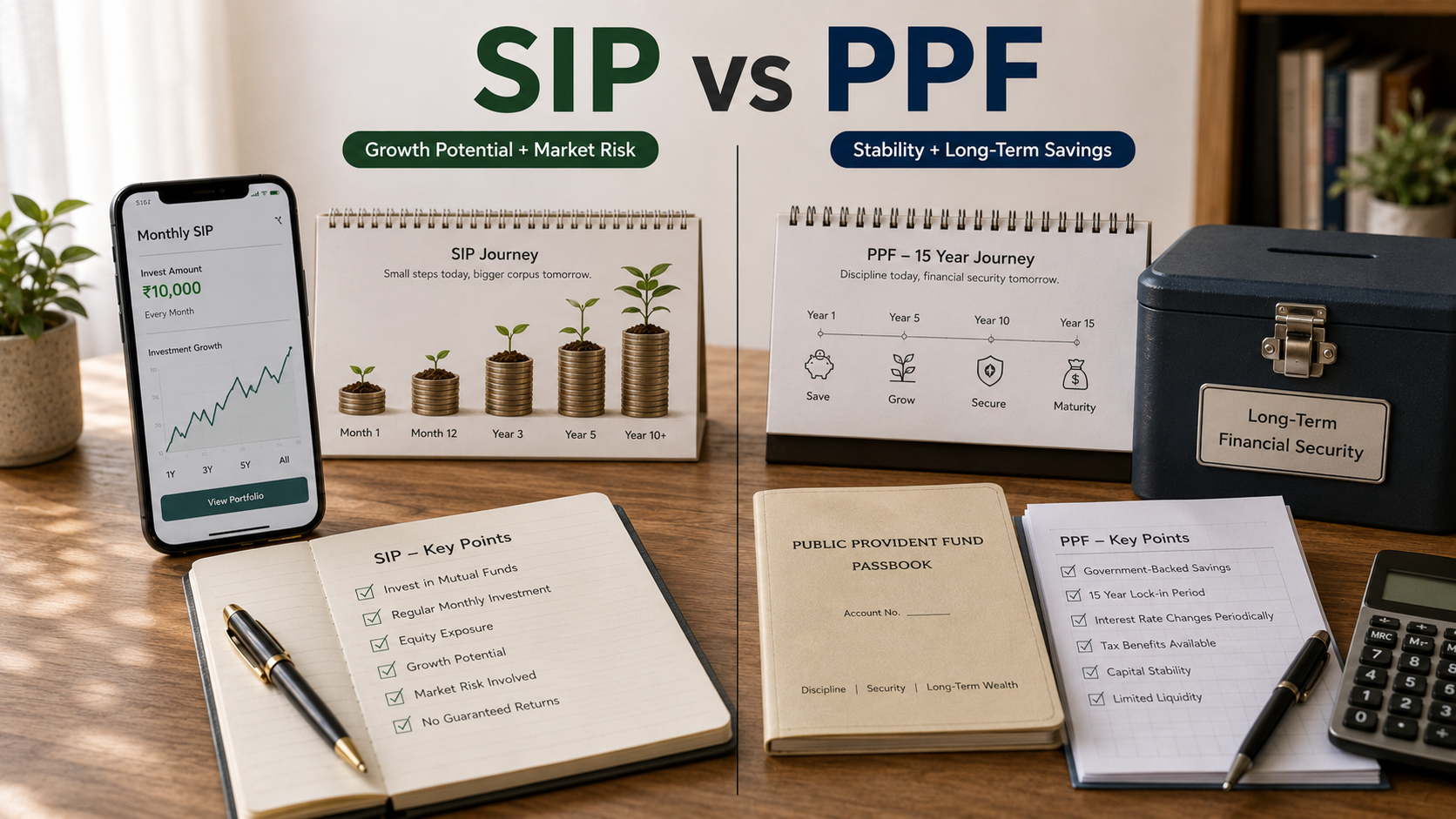

Aligning Investments With Life Goals
The most useful way to compare SIP and PPF is to start with the financial goal, not the investment product. Different goals require different levels of growth, stability, and liquidity. Before deciding where to place your money, it can also help to review the best places to keep your savings safely.
For long-term wealth creation, an equity-oriented SIP may be suitable for investors who can tolerate market volatility. It can be useful for goals such as retirement or long-term wealth accumulation. PPF may work better for investors who want a government-backed component within their long-term savings.
Your time horizon also matters. Money needed in the near future should generally not depend heavily on volatile equity markets. Long-term money can tolerate more fluctuations because the investor has more time to recover from temporary declines.
A combination can therefore be useful. You could use PPF for stable, long-term savings and SIPs for potential growth. Review the allocation as your goals, income, and risk tolerance change.
Ultimately, the better choice in SIP vs PPF is the one that matches your financial objective rather than the one with the highest projected return.
Frequently Asked Questions
Can I Withdraw Money From a PPF Account Before the 15-Year Maturity?
Yes, PPF allows partial withdrawals from the seventh financial year, subject to the withdrawal limits and conditions prescribed under the PPF rules. The withdrawal amount is restricted based on the eligible balance in the account. Before the seventh year, investors may also use the loan facility against their PPF balance. This makes PPF useful for long-term savings with limited liquidity.
Are SIP Returns Guaranteed by the Government or Financial Institutions?
No. SIP returns are not guaranteed because an SIP is simply a method of investing regularly in mutual funds. The value of your investment depends on the underlying securities and market conditions. This is an important distinction in any SIP vs PPF comparison. Unlike PPF, mutual fund investments can rise or fall, and investors can experience losses.
Can I Invest in Both SIP and PPF Simultaneously?
Yes, you can invest in both SIP and PPF at the same time. They serve different purposes within a financial plan. An equity mutual fund SIP can provide long-term growth potential, while PPF can add stability and government-backed savings. In an SIP vs PPF strategy, combining both can help diversify your investments instead of depending entirely on one option.
What Tax Benefits Do SIP and PPF Offer Investors?
PPF contributions qualify for a deduction under Section 80C, subject to the applicable overall limit. PPF interest and eligible maturity proceeds are generally tax-exempt under current rules. A regular mutual fund SIP does not receive a Section 80C deduction. However, SIP investments in ELSS mutual funds can qualify for Section 80C benefits. Mutual fund gains remain subject to applicable capital gains tax rules.
Conclusion
The SIP vs PPF decision should depend on your financial goals, investment horizon, and ability to handle risk. SIPs can provide greater long-term growth potential through market-linked mutual funds, but market performance determines your returns. PPF offers government-backed savings and greater stability, although it may deliver lower long-term growth than equity investments.
For investors comfortable with market fluctuations, an equity SIP can support long-term wealth creation and retirement planning. PPF can complement that strategy by providing a stable, tax-efficient component. Rather than asking which option is universally better, consider SIP vs FD and which is better for your overall savings and investment goals.
The right SIP vs PPF strategy may involve using both. SIP can target growth, while PPF can provide stability and disciplined long-term savings. Review your investments periodically as your income, goals, and risk tolerance change. Always consider current tax rules and scheme regulations before making investment decisions.