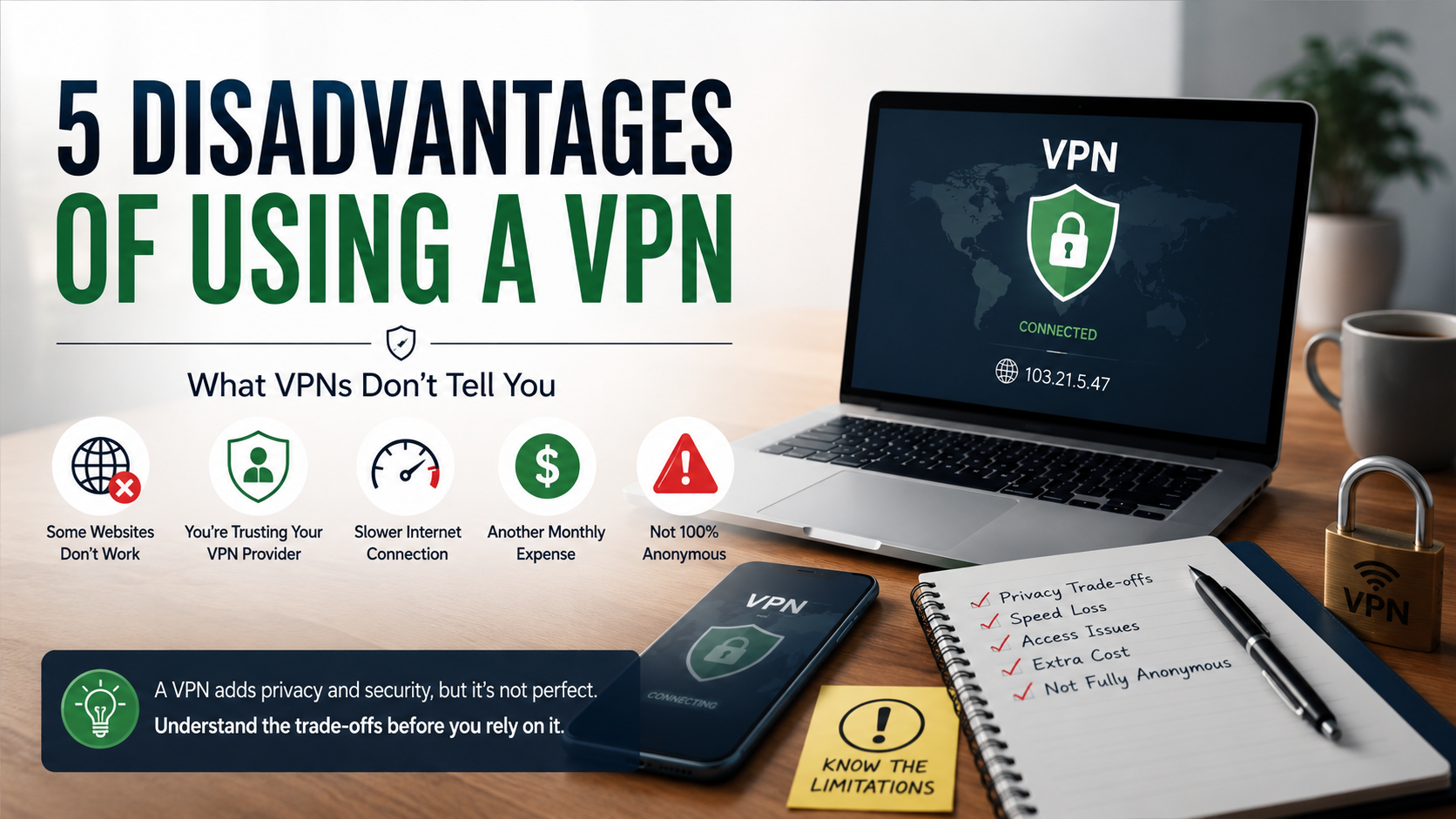
5 Disadvantages Of Using A VPN
Virtual Private Networks are often marketed as complete shields for online privacy and security. Millions of users activate them to encrypt network traffic and access restricted content. However, there are important disadvantages of using a VPN that many users overlook.
A VPN encrypts traffic between your device and the VPN server. It can protect data on untrusted networks, but it also creates a new trust relationship. Instead of relying only on your internet service provider, you now trust the VPN provider with your connection.
That trade-off matters because VPN services can affect privacy, speed, account access, and everyday browsing. A poorly managed service can also create security risks instead of reducing them.
Authoritative cybersecurity guidance from the Cybersecurity and Infrastructure Security Agency (CISA) highlights that third-party network tools introduce new trust dependencies and operational vectors.
Understanding these limitations helps you decide when a VPN makes sense. It also helps you avoid expecting a VPN to provide complete anonymity online.
1. Some Websites and Services Don’t Work Well With VPNs
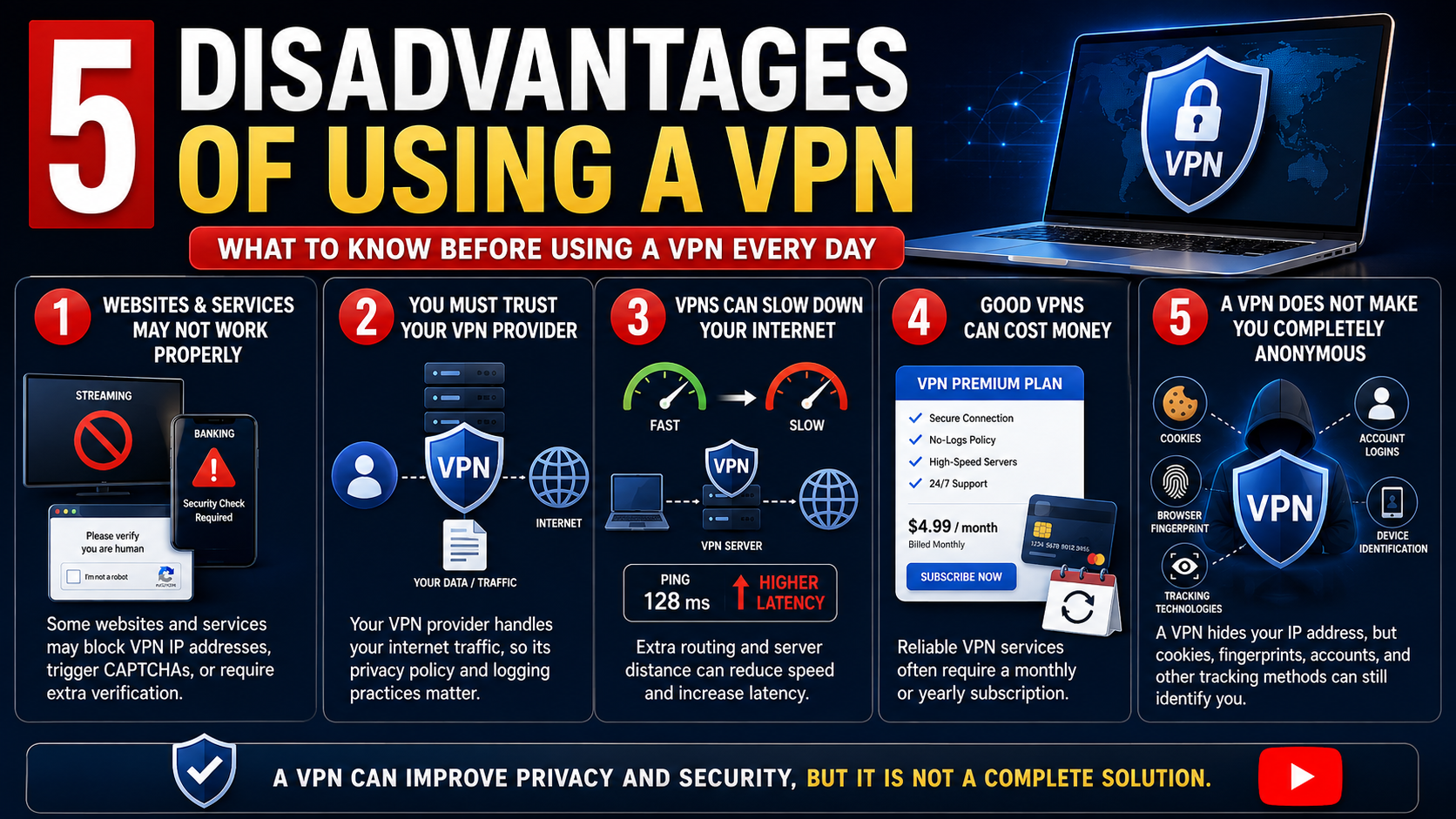
Some of the biggest disadvantages of using a VPN involve website and service compatibility. VPNs can interfere with streaming platforms, banking services, shopping websites, and other online services. Many platforms monitor IP addresses to detect suspicious activity, prevent fraud, or control access to certain content, especially when users connect through public Wi-Fi networks.
Because VPN servers often use shared IP addresses, several unrelated users may appear to come from the same location. This can lead to more CAPTCHA challenges, additional security checks, or temporary access problems.
Some streaming services also block known VPN IP addresses. This can prevent you from accessing content that normally works through your regular internet connection. Banking and payment platforms may also treat VPN connections differently.
A sudden change in location or an IP address associated with a data center can trigger additional verification. Websites may also show the wrong currency, language, products, or regional content.
These are common disadvantages of using a VPN, although they do not affect every user. Still, they are worth considering before keeping a VPN active all the time.
2. You’re Trusting Your VPN Provider With Your Traffic Data
Another important disadvantage of using a VPN is that you must trust the VPN provider with your internet traffic. Without a VPN, your internet service provider can see certain information about your connection. With a VPN, your traffic is routed through the VPN provider’s servers instead.
A VPN can prevent your ISP or someone on the same public Wi-Fi network from easily seeing the websites you access. However, the VPN provider becomes an important part of your internet connection.
This makes the provider’s privacy policy and logging practices extremely important. Some providers claim to follow strict no-logs policies. Others may collect connection data, account information, diagnostic details, or other usage information. Understanding how companies collect and handle personal information is an important part of practicing good digital citizenship.
Free VPN services require particular caution. Some may rely on advertising or data collection to generate revenue. Installing software from an unknown provider can also create additional security risks.
Before choosing a VPN, check its reputation, privacy policy, ownership, security features, and independent audits where available. A VPN should improve your privacy without creating another unnecessary data risk.
Understanding this trust relationship is essential when considering the disadvantages of using a VPN.
3. VPN Can Slow Down Your Internet Connection
One of the most noticeable disadvantages of using a VPN is slower internet performance. Your data travels through an additional VPN server before reaching its final destination. This extra routing can affect both speed and latency.
The amount of slowdown depends on several factors. These include the VPN protocol, server location, server load, and quality of your internet connection. Your home network setup and router can also influence the overall performance you experience.
A nearby VPN server usually provides better performance than a server located thousands of miles away. However, even a nearby server can become slow when too many users connect to it at the same time.
The effect can be more noticeable during activities that require fast and stable connections. Online gaming, video calls, live streaming, and large downloads can suffer when latency increases or bandwidth decreases.
Free VPN services may experience more performance problems because their servers often have limited resources. Premium services usually offer better infrastructure, although performance can still vary.
If you notice slower speeds, try connecting to a different nearby server. You can also test another VPN protocol if your provider supports it.
For users who need maximum speed and minimum latency, a direct connection will usually perform better. This makes speed another important factor among the disadvantages of using a VPN.
4. Good VPN Services Can Become Another Monthly Expense
The cost is another potential disadvantage of using a VPN. A reliable VPN service can provide useful privacy and security features, but good services often come with a recurring subscription.
Many providers offer free plans, but these options may have limitations. Common restrictions include fewer servers, slower speeds, data limits, advertisements, and fewer security features.
Paid VPN services generally provide better infrastructure and additional features. However, the subscription becomes another monthly or yearly expense alongside your other digital services.
For someone who rarely needs a VPN, paying for a premium service may not provide enough value. The decision depends on how often you use the service and what you need it to protect.
You should also look beyond the advertised introductory price. Some providers offer discounted rates during the first billing period and charge more when the subscription renews.
Before subscribing, compare the features, renewal price, server locations, privacy policy, and cancellation terms. Avoid choosing a VPN simply because it has the lowest price.
A VPN can be worth paying for if you regularly use public Wi-Fi, travel frequently, work remotely, or have specific privacy needs. Otherwise, the cost can become one of the unnecessary disadvantages of using a VPN.
5. A VPN Doesn’t Make You Completely Anonymous on the Internet
A major disadvantage of using a VPN is that it does not make you completely anonymous online. A VPN can hide your public IP address and encrypt traffic between your device and the VPN server. However, it does not remove every method used to identify or track you.
Websites can still recognize you through cookies, browser fingerprinting, account logins, device information, and tracking technologies. If you log into Google, Facebook, your bank, or another personal account, that service can still associate your activity with your account.
A VPN also does not protect you from phishing attacks, malware, weak passwords, or unsafe websites. It is a privacy and security tool, not an invisible shield against every online threat.
Your VPN provider may also have access to certain connection information. The amount of information depends on its technology, configuration, and logging practices.
For stronger privacy, combine a VPN with secure passwords, multi-factor authentication, updated software, privacy-focused browser settings, and careful online habits. These basic practices are especially important for maintaining good cybersecurity in everyday online activities.
A VPN can provide greater privacy, but it should never be confused with complete anonymity. This limitation is one of the most important disadvantages of using a VPN that users should understand before relying on the service.
What are the risks of VPN?
The main risks of using a VPN involve privacy, security, and trust. When your traffic passes through a VPN server, the provider becomes an important part of your connection. Your provider may have access to connection metadata, depending on its technology and logging practices.
The biggest concern is choosing an unreliable VPN service. Some free or poorly managed VPNs may collect browsing information, display advertisements, or share user data with third parties. A provider with weak security can also expose traffic through technical problems such as DNS or IP leaks.
VPN software itself can create another risk. Vulnerable or malicious applications may request excessive permissions or contain security flaws. Installing VPN software from unknown sources can therefore put your device and personal data at risk, which is why malware protection should remain an important part of your overall security strategy.
Another concern is false confidence. A VPN protects network traffic in specific ways, but it does not stop phishing, malware, weak passwords, browser fingerprinting, or account-based tracking.
Before choosing a VPN, check its privacy policy, security features, ownership, protocol support, and logging practices. A VPN should reduce risk, not simply move your trust from one provider to another.
Unverified Logging Practices
One of the biggest disadvantages of using a VPN is uncertainty about what the provider records. Many VPN companies advertise no-logs policies, but users should understand exactly what those policies cover.
A no-logs claim may not mean that absolutely no information is collected. Some providers may still store account details, payment information, diagnostic data, or connection-related information.
Independent security audits can provide additional confidence. However, users should still read the provider’s privacy policy and understand its data-retention practices.
Logging becomes especially important when a provider operates under different legal requirements. Government requests or legal processes may affect how stored information is accessed and handled.
A trustworthy VPN should clearly explain what information it collects, why it collects it, and how long it keeps it. Avoid services that make vague privacy promises or hide important details in complicated policies.
Ultimately, using a VPN does not eliminate the need for trust. It simply changes which organization handles an important part of your internet connection.
Is there any harm in using VPN?
Using a VPN is not automatically harmful, but it can create practical problems when used without considering the situation. A VPN changes your apparent IP address and routes traffic through another server.
This change can affect how websites and security systems recognize your connection. Banks, payment services, corporate platforms, and online stores may use IP reputation as part of their security checks.
A shared VPN address may have been used by hundreds or thousands of unrelated users. If that address has a poor reputation, you may face additional verification or access challenges.
VPN software can also create security risks when users install unreliable applications. Free services from unknown developers may contain aggressive advertising, unwanted software, or weak security controls.
Another issue is false confidence. A VPN does not protect you from every online threat. Phishing attacks, malware, weak passwords, unsafe websites, and account tracking can still put your information at risk.
The safest approach is to treat a VPN as one layer of online security, rather than a complete security solution. Use reputable software, keep it updated, and understand its limitations before relying on it.
Unexpected Account Suspension Risks
VPN use can sometimes trigger additional security checks on banking, shopping, payment, and other sensitive accounts. This often happens because commercial VPNs assign the same public IP address to many users.
Fraud detection systems may notice unusual location changes, unfamiliar IP addresses, or repeated activity from shared data-center networks. These signals can lead to CAPTCHA challenges, identity verification, temporary restrictions, or login alerts.
However, it is not accurate to say that every bank or online platform blocks VPN connections. Policies vary between services, and many users can access their accounts through VPNs without problems.
The bigger issue is unusual connection behavior. Switching between different countries several times in one day can look suspicious. A sudden change from a residential IP address to a data-center IP can also trigger additional checks.
If a financial service repeatedly challenges your VPN connection, consider disabling the VPN when accessing that service. You should also use the official banking app or website and enable multi-factor authentication.
A VPN should improve your security without creating unnecessary access problems. For sensitive accounts, consistent login behavior can sometimes be more useful than changing your apparent location.
Is VPN good or bad?
A VPN is neither completely good nor completely bad. Its usefulness depends on why you use it, which service you choose, and what you expect from it.
VPNs can provide valuable protection when using untrusted public Wi-Fi. They can also help remote workers securely connect to private company resources.
However, a consumer VPN is not necessary for every online activity. Websites that use HTTPS already encrypt data between your browser and the website.
A VPN can still provide additional privacy from local networks and your internet service provider. However, it does not make you completely anonymous online.
Using a VPN can also introduce speed reductions, connection problems, CAPTCHA challenges, and compatibility issues. Some websites may treat VPN traffic differently because shared IP addresses can have poor reputations.
The best approach is to use a VPN when its benefits match your needs. Choose a reputable provider, understand its privacy policy, and avoid assuming that encryption solves every privacy and security problem.
The Realities of Disadvantages of Using a VPN
The practical disadvantages of using a VPN become easier to understand when you consider everyday browsing. A VPN adds another connection point between your device and the websites you visit.
That extra routing can increase latency and sometimes reduce connection speed. Shared VPN addresses can also cause problems with search engines, websites, and online services.
Search engines may show more CAPTCHA challenges when an IP address generates unusual traffic patterns. Streaming platforms may also block known VPN addresses or restrict access to certain content.
Location-based services can behave differently as well. Websites may display the wrong regional results, currency, language, or product availability when they detect a VPN server in another location.
These problems do not mean VPNs are useless. They simply show why always-on VPN use is not ideal for everyone.
For normal home browsing, HTTPS, updated software, strong passwords, and multi-factor authentication remain important protections. A VPN can complement these measures rather than replace them.
The right choice depends on your security needs. Public Wi-Fi and remote work may justify VPN use, while routine home browsing may not require one.
What are some common problems with VPNs?
The most common VPN problems affect speed, reliability, website access, and convenience. Encryption requires processing, while routing traffic through another server can increase the distance data must travel.
Speed loss varies between providers, protocols, and servers. A nearby, well-maintained server may have little noticeable impact. A distant or overloaded server can create significant slowdowns.
VPN connections can also drop unexpectedly. Depending on the device and settings, traffic may stop temporarily or continue through your normal connection.
A reliable kill switch can help prevent accidental traffic exposure when the VPN disconnects. However, users should check that this feature is enabled and working correctly.
Streaming services may block VPN addresses because those addresses are often shared by many users. Search engines can also show more CAPTCHA challenges when an IP address generates unusual traffic.
Other common problems include:
- Higher latency during gaming or video calls.
- Increased battery usage on mobile devices.
- Websites showing incorrect regional content.
- Extra login or identity verification requests.
- Compatibility problems with certain apps and networks.
Choosing a nearby server and a reputable provider can reduce many of these problems. Still, some inconvenience is an unavoidable trade-off of VPN routing, particularly for people who depend on a stable connection while working remotely.
High Latency and Server Overhead
High latency is one of the most noticeable disadvantages of using a VPN. Your internet traffic normally travels between your device and the destination server.
A VPN adds another step because your traffic first travels to the VPN server. The extra distance can increase the time required for data packets to reach their destination.
This matters most during activities that require quick responses. Online gaming, video calls, live streaming, and real-time collaboration can all be affected by increased latency.
Server congestion can make the problem worse. Free and budget VPN services may place many users on limited server resources.
That can result in slower downloads, buffering, unstable connections, or sudden latency spikes. Choosing a VPN server closer to your physical location can often improve performance.
Modern VPN protocols can also reduce overhead compared with older technologies. However, no VPN can completely eliminate the physical limits of network distance.
For routine browsing, the difference may be small. For gaming, streaming, and real-time communication, even a modest increase in latency can become noticeable.
If maximum speed and minimum latency are your priorities, a direct internet connection will usually perform better.
Is VPN illegal in India?
Using a VPN is not generally illegal for individuals in India. However, VPN providers can face specific regulatory requirements under Indian cybersecurity rules.
In 2022, CERT-In issued cybersecurity directions covering several categories of service providers. These directions include VPN service providers and require certain information to be maintained.
For covered VPN providers, the rules require specific subscriber information to be maintained. This can include validated customer names, service periods, IP information, contact details, and other specified records.
The rules also require covered organizations to maintain certain ICT system logs for a specified period. VPN providers operating within the scope of these requirements therefore need to consider Indian regulatory obligations.
These regulations do not mean that individual users are prohibited from using VPNs. The important distinction is between VPN usage by individuals and the compliance requirements placed on covered service providers.
Some international VPN companies have changed their server arrangements in India because of these requirements. Some have removed physical VPN servers from India and instead provide virtual Indian locations using infrastructure outside the country.
The legal situation can change as regulations develop. Users should therefore check current laws and their VPN provider’s policies before making decisions based on location or privacy expectations.
The CERT-In Logging Mandate
The CERT-In logging requirements are an important consideration for VPN users in India. The cybersecurity directions introduced specific data-retention requirements for covered VPN service providers.
These requirements include information such as validated subscriber names, service periods, IP addresses, registration details, contact information, and the stated purpose of using the service.
Covered VPN providers must retain certain information for five years or longer where required by law after cancellation or withdrawal of registration. Separate requirements also apply to the retention of ICT system logs.
These rules do not mean that individual VPN users must maintain the same records themselves. The requirements are directed at specified organizations and service providers covered by the directions.
The regulations have also influenced how VPN companies operate in India. Some providers have chosen to remove physical servers from the country rather than operate under the applicable local requirements.
For users, the main point is simple. A VPN cannot override local laws or regulatory requirements.
If privacy is your main reason for using a VPN, check where the provider operates its servers. Also review its current privacy policy and understand what information it collects.
This can help you choose a service that fits both your privacy expectations and your intended use.
Frequently Asked Questions
Do VPNs drain smartphone battery life quickly?
A VPN can increase battery consumption because it keeps an encrypted connection active. The impact depends on your device, VPN protocol, network quality, and amount of data used.
Heavy data activity generally consumes more battery than light browsing. Modern VPN applications are also designed to reduce unnecessary background activity.
Can a VPN bypass all forms of internet tracking?
No. A VPN mainly changes your network path and hides your public IP address. Cookies, browser fingerprinting, account logins, device identifiers, and other tracking methods can still identify you.
Why do banks block traffic coming from VPNs?
Banks may treat some VPN addresses as higher-risk because they are shared by many users. Unusual locations or repeated login patterns can also trigger additional verification.
However, not every bank blocks VPN traffic. Policies vary between financial institutions.
Does using a VPN make you completely anonymous online?
No. A VPN provides network privacy, not complete anonymity. Your VPN provider may still see certain connection information, depending on its technology and privacy practices.
Websites can also identify users through accounts, cookies, browser fingerprints, and other tracking methods.
A VPN is therefore best viewed as one privacy tool among several. It should support secure browsing habits rather than replace them.
Conclusion
The disadvantages of using a VPN mainly involve performance, privacy, trust, compatibility, and account access. A VPN can reduce internet speed, increase latency, trigger CAPTCHA challenges, and cause some websites to restrict access.
These issues become more noticeable when users connect to distant or overloaded servers. Shared VPN addresses can also affect how websites and financial services treat your connection.
Privacy depends heavily on the VPN provider. A VPN does not remove the need to trust a company with part of your internet connection.
Poor logging practices, weak software security, or unclear privacy policies can reduce the benefits of using a VPN. Choosing a reputable provider is therefore essential.
Regional regulations are another consideration. In India, CERT-In’s cybersecurity directions impose specific requirements on covered VPN service providers. These requirements do not make VPN use illegal for individual users.
The best approach is to use a VPN based on your actual security needs. Public Wi-Fi, remote work, and specific privacy requirements can justify VPN use.
For everyday home browsing, combine HTTPS, secure passwords, multi-factor authentication, updated software, and sensible privacy settings. A VPN can complement these protections, but it should not be treated as a complete privacy solution.
By understanding the risks and disadvantages of VPNs, you can make a more informed decision about when to use one.