
Understanding the Difference Between Generative AI and Multimodal AI
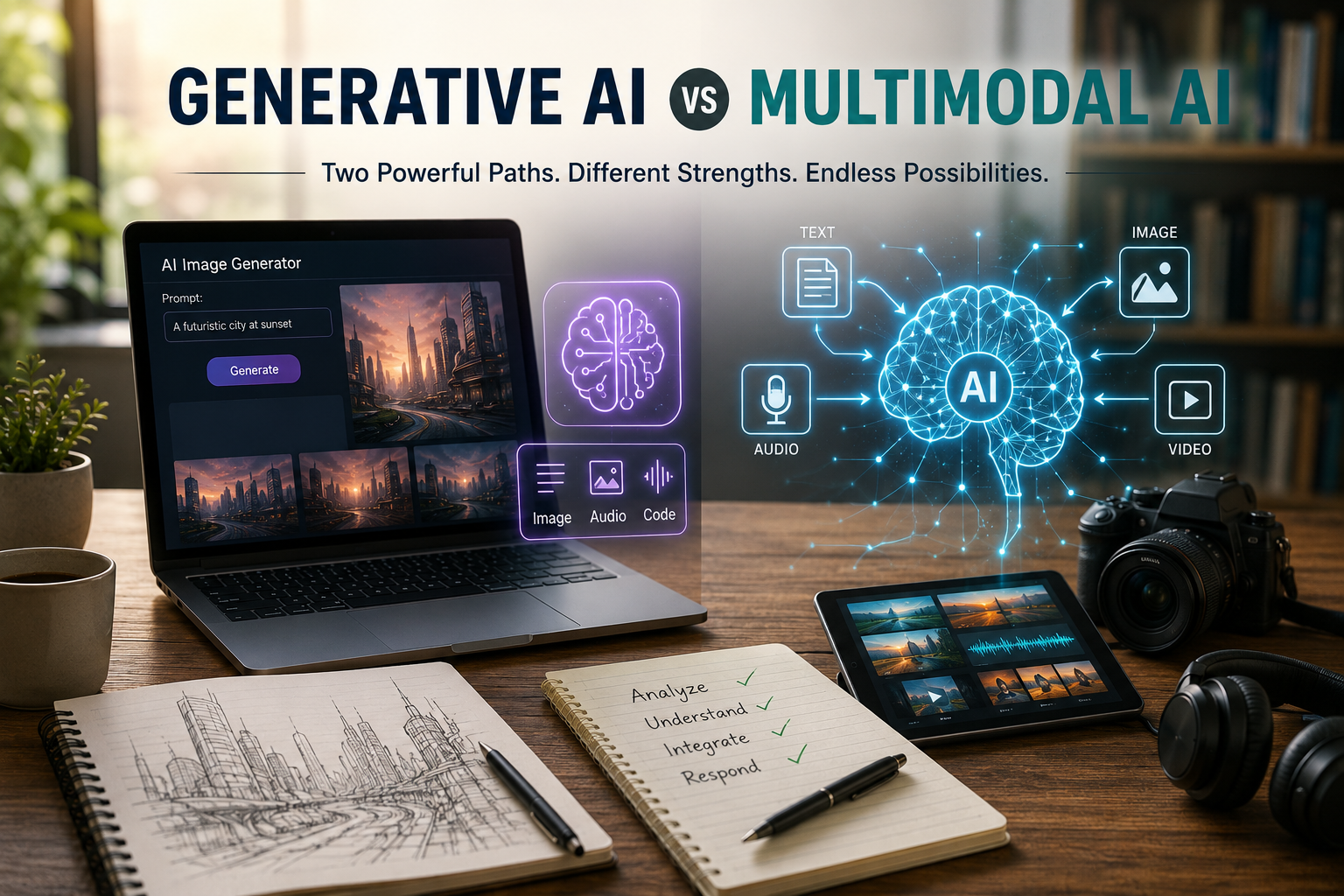
Artificial intelligence is evolving quickly and changing how we work, create, and use technology. Understanding the difference between generative AI and multimodal AI makes modern AI tools easier to evaluate. These terms are often confused because many applications now combine both capabilities.
Generative AI focuses on creating new content from patterns learned during training. Multimodal AI focuses on processing and understanding different types of information. These can include text, images, audio, and video.
The two concepts can overlap within the same AI system. However, they describe different capabilities. Generative AI mainly concerns content creation, while multimodal AI concerns data understanding across multiple modalities. According to research published by OpenAI, understanding model design enables better deployment strategies.
This distinction also helps explain related concepts, including large language models, multi-model systems, and analytical AI. The sections below explain these differences with practical examples and clear comparisons.
What Is the Key Difference Between Multimodal AI and Generative AI?
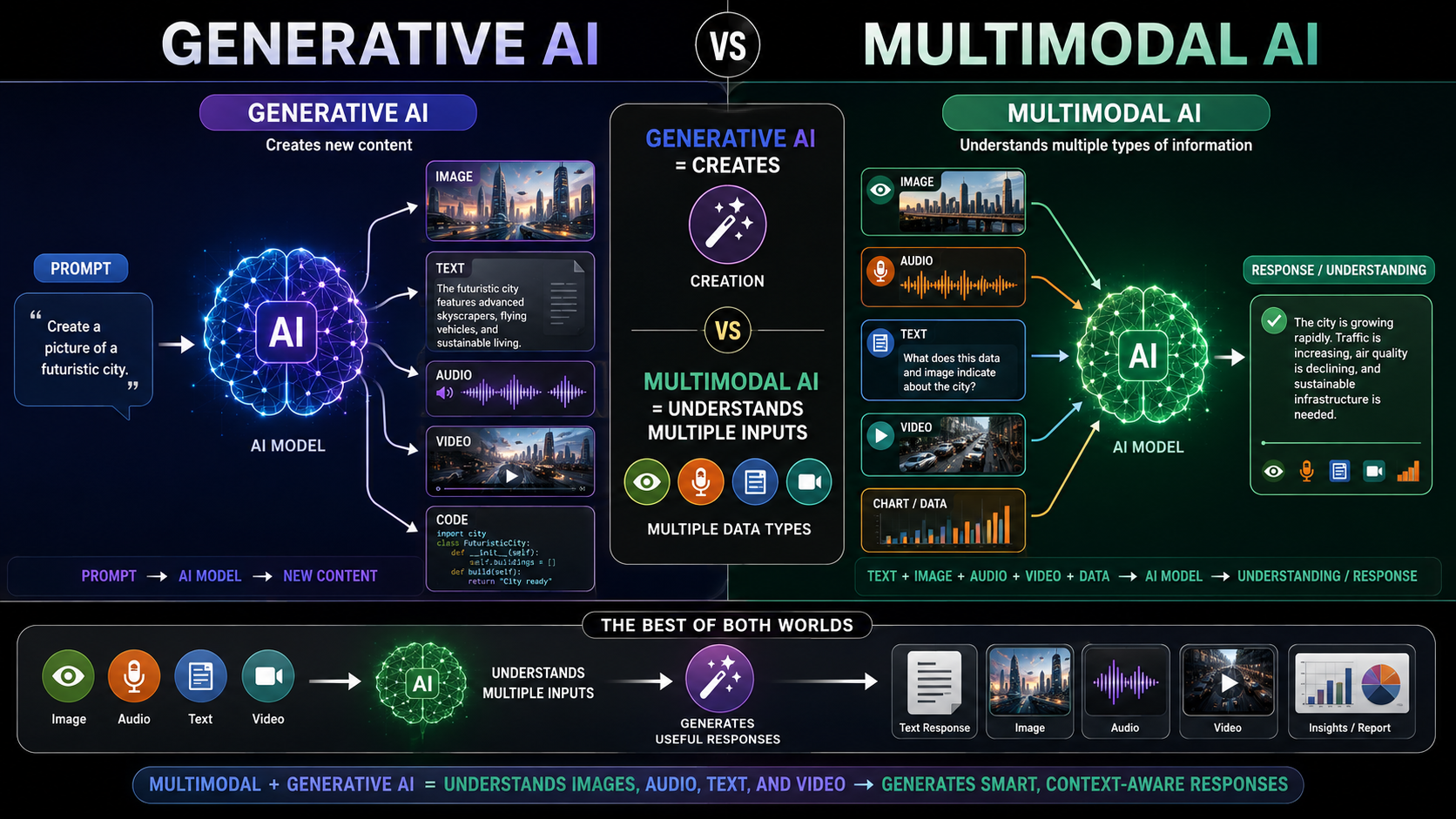
The main difference between generative AI and multimodal AI is their primary function. Generative AI focuses on creating new content from patterns learned during training. Multimodal AI focuses on processing and understanding different types of information. These can include text, images, audio, and video. For a broader introduction, see what generative AI is.
Multimodal AI processes multiple types of information within one system. These inputs may include text, images, audio, or video. A multimodal system can understand an image while also processing a written question about it.
The two capabilities are not mutually exclusive. A model can be both generative and multimodal. For example, an AI assistant may analyze an uploaded image and generate a detailed written response.
The key distinction can be summarized as follows:
- Generative AI: focuses on creating new content.
- Multimodal AI: focuses on understanding multiple data types.
- Generative multimodal AI: combines both capabilities.
This combination enables AI assistants to analyze charts, interpret photographs, understand voice commands, and generate useful responses from several input types.

Understanding Input Versus Output Capabilities
Input and output capabilities provide another useful way to understand the difference between generative AI and multimodal AI. Multimodal systems can accept different forms of input. These inputs may include written prompts, photographs, audio recordings, or videos.
Generative systems focus more strongly on what they produce. They can transform a prompt into an original article, image, song, summary, or computer program.
Modern AI systems often combine both capabilities. For example, an assistant could receive a photograph of a chart and a spoken question. It could then analyze the chart and generate a written explanation.
This creates a more natural interaction between people and machines. Users no longer need to convert every type of information into plain text first.
The distinction remains important, however. Multimodality describes the range of information a system can understand, while generation describes its ability to create new outputs.
What Is the Difference Between Multimodal and Multi-Model AI?
Multimodal AI and multi-model AI sound similar, but they describe different system designs. Multimodal AI refers to systems that can work with multiple types of data. These modalities can include text, images, audio, and video.
Multi-model AI, by contrast, involves multiple AI models working within the same workflow. Each model may perform a different task. One model could detect sentiment, another could translate text, and a third could create a summary.
For example, a customer service platform might use several specialized models. A language model could classify a request, while another model translates the message. A separate model could then generate the final response.
A multi-model architecture can offer several practical advantages:
- Specialized models can handle specific tasks.
- Individual components can be replaced independently.
- Organizations can select models based on cost or performance.
- Developers can isolate problems more easily.
The simplest distinction is this: multimodal means multiple data types, while multi-model means multiple AI models.
Collaborative Workflows in Multi-Model Systems
Multi-model systems use separate AI models to complete different parts of a larger task. This approach can be useful when one model cannot perform every required function efficiently.
Consider an international customer support workflow. A classification model could identify the customer’s issue first. A translation model could convert the message into another language. A summarization model could then extract the key details.
An orchestration layer coordinates these individual steps. It determines which model should process the information and when the next model should receive the result.
This modular structure provides several benefits:
- Flexibility: Teams can replace individual models when better options appear.
- Specialization: Each model can focus on a narrow task.
- Control: Developers can monitor individual stages.
- Scalability: Components can be adjusted based on workload.
However, multi-model systems also introduce additional complexity. Developers must manage communication between models and monitor the complete workflow.
Therefore, multi-model architecture is best understood as a collaborative system of separate models, rather than a single model handling multiple modalities.
What Is a Multimodal AI Example?
A practical example of multimodal AI is an assistant that can analyze a handwritten equation from a photograph. The user could upload the image and ask a question about the equation using text or voice.
The system must understand more than one information type. It needs to interpret the visual content and understand the user’s request. It can then generate a response explaining the solution.
Other multimodal AI examples include systems that combine medical images with written records. A healthcare application might analyze an X-ray while processing relevant patient information. Such systems can help professionals examine different information sources together.
Multimodal AI can support many everyday applications, including:
- Vision and voice assistants that understand camera feeds and spoken instructions.
- Document analysis tools that interpret text, tables, and images.
- Educational systems that analyze diagrams and written questions.
- Media applications that process audio, video, and text together.
These examples show why multimodal AI differs from traditional text-only systems. It can connect information from different sources and interpret them within the same interaction.
Real-World Vision and Voice Integration
Vision and voice integration demonstrates how multimodal AI can make technology easier to use. A user can point a camera at an object while asking a spoken question about it.
The system can process the visual information and the spoken request together. It can then generate an answer based on both inputs.
For example, someone could photograph a household device and ask how to use it. A multimodal assistant could examine the device and explain its controls.
This approach reduces the need for manual data entry. Users can communicate naturally instead of describing every detail through typed text.
Common applications include:
- Smartphone assistants that combine cameras, microphones, and language models.
- Accessibility tools that describe visual content through spoken language.
- Education platforms that analyze diagrams alongside student questions.
- Customer support tools that process screenshots and voice messages.
The technology also creates opportunities for more intuitive human-computer interaction. Instead of treating text, images, and audio as separate inputs, multimodal systems can connect them.
As these systems improve, multimodal interaction may become a standard feature across consumer and enterprise applications.
What Are the Different Types of AI Other Than Generative AI?
Generative AI is only one category within the broader field of artificial intelligence. Other AI approaches focus on analysis, prediction, classification, interaction, and perception.
Analytical AI examines data to identify patterns and support predictions. Businesses can use it for sales forecasting, trend analysis, and risk assessment.
Discriminative AI focuses on distinguishing between categories. For example, an email system can determine whether a message belongs in the spam folder.
Other systems focus on interaction and physical environments. Conversational AI supports customer service and digital assistants. Perception AI helps machines interpret their surroundings. Robotics AI combines perception, decision-making, and control to perform physical tasks.
These categories can overlap. A single application may use several AI approaches at once.
Important AI categories include:
- Analytical AI: analyzes data and identifies patterns.
- Discriminative AI: classifies or separates information.
- Conversational AI: supports human-like interactions.
- Perception AI: interprets sensory information.
- Robotics AI: enables machines to perceive and act.
Understanding these categories makes it easier to see where generative AI and multimodal AI fit within the larger AI landscape.
Analytical and Discriminative Intelligence Models
Analytical and discriminative AI systems solve different problems from generative models. it examine data to identify patterns, relationships, and possible future outcomes.
For example, a business could use analytical AI to forecast customer demand. Traditional statistical methods, regression techniques, and machine learning models can support these predictions.
Discriminative models focus on classification. They learn how to distinguish between different categories within data. Spam detection provides a simple example. The model determines whether an incoming message belongs to the spam or legitimate category.
These systems do not need to generate creative content. Their main purpose is to analyze existing information and make decisions or predictions.
Analytical and discriminative approaches remain important across many industries. Businesses use them for fraud detection, forecasting, recommendation systems, quality control, and risk assessment.
Modern applications may combine these techniques with generative AI. For example, an analytical model could identify an unusual transaction. A generative model could then produce a natural-language explanation.
This demonstrates an important point: AI systems can combine multiple approaches rather than fitting into one category.
Is ChatGPT an LLM or Generative AI?
ChatGPT can be described as both an LLM and generative AI. These terms describe different aspects of the technology.
LLM stands for Large Language Model. It refers to a class of AI models designed to understand and generate language. These models learn statistical patterns from large amounts of training data.
Generative AI describes a broader capability. It refers to AI systems that create new content in response to user instructions. ChatGPT can generate text, summarize information, write code, and perform many other content-generation tasks.
Modern versions of ChatGPT can also support multimodal interactions. Depending on the available features and model, users may provide information through different formats. The system can then interpret that information and generate an appropriate response.
Therefore, the labels are not competing definitions:
- LLM: describes the model’s language-focused technology.
- Generative AI: describes its content-generation capability.
- Multimodal AI: describes its ability to work with multiple information types.
This distinction explains why one AI system can belong to several categories simultaneously.
The Evolution Toward Universal Capabilities
Modern AI systems increasingly combine capabilities that were once handled by separate tools. Language understanding, image analysis, audio processing, reasoning, and content generation can now work together.
This evolution has changed how users interact with AI. People can provide information through text, images, voice, or other supported formats. The system can then interpret that information and produce a useful response.
These capabilities blur traditional boundaries between AI categories. A single assistant can function as a language model, a generative system, and a multimodal interface.
This does not mean that all AI models work identically. Different systems use different architectures, training methods, and supported modalities. Their capabilities also depend on the specific model and application.
The broader trend is clear, however. AI is moving toward systems that can understand and generate across multiple information types.
For users, this means AI tools are becoming more flexible. For developers, it creates new opportunities for building applications that combine perception, reasoning, and generation.
Understanding these overlapping capabilities makes modern AI terminology much easier to navigate.
Frequently Asked Questions
Can a Generative AI Model Also Be Multimodal?
Yes. A generative AI model can also be multimodal when it can process multiple types of input and generate content from them.
For example, a multimodal generative system could receive a photograph and a written question. It could analyze the image and produce a detailed text response. Some systems can also work with audio or video inputs.
The two terms describe different capabilities. Generative AI describes what the system creates, while multimodal AI describes the types of information it can process.
This combination is increasingly common in modern AI applications. It allows users to interact with systems through more natural inputs.
A multimodal generative system might support tasks such as:
- Describing an uploaded image.
- Answering questions about a chart.
- Transcribing and summarizing audio.
- Analyzing visual documents.
- Generating content from mixed inputs.
Therefore, asking whether a system is generative or multimodal is not always an either-or question. A single model or application can support both capabilities.
The important distinction is understanding what each label describes. Generative AI concerns content creation, while multimodal AI concerns information processing across different modalities.
How Do Multimodal Systems Process Different Data Types?
Multimodal AI systems must represent different forms of information in ways that a neural network can process. Text, images, and audio have very different original structures.
A system can convert these inputs into numerical representations called embeddings or other learned representations. These representations allow the model to identify relationships between different information types.
For example, an image can be transformed into a representation that captures visual features. Text can receive a representation that captures words and their relationships. Audio can undergo a similar transformation into a form the model can process.
The system can then combine these representations within its architecture. Attention mechanisms and other neural network techniques can help the model identify relationships across modalities.
This enables tasks such as:
- Answering questions about images.
- Connecting spoken instructions with visual information.
- Summarizing multimedia content.
- Generating descriptions from photographs.
The exact architecture varies between AI systems. Not every multimodal model processes every modality in exactly the same way.
The central idea remains consistent: multimodal AI connects different information types so the system can understand them together.
Why Is Multi-Model Architecture Preferred in Enterprise Settings?
Enterprises may choose multi-model architectures because they provide flexibility and specialization. Instead of depending on one model for every task, organizations can combine several specialized systems.
For example, one model might classify customer requests. Another could translate messages, while a third generates responses. Each component can be selected according to its performance, cost, speed, or security requirements.
This modular design can make enterprise AI systems easier to maintain. Developers can replace one model without redesigning the entire application.
Key benefits include:
- Flexibility: Teams can select different models for different tasks.
- Specialization: Each model can focus on a specific function.
- Cost control: Organizations can use smaller models for simpler tasks.
- Maintainability: Individual components can be updated independently.
- Scalability: Workloads can be distributed across different services.
However, multi-model systems require careful orchestration. Developers must manage communication, monitoring, latency, and failure handling across components.
For this reason, multi-model architecture is not automatically better. It is useful when specialized models provide meaningful advantages over a single general-purpose system.
Does Analytical AI Require Massive Neural Networks?
No. Analytical AI does not necessarily require large neural networks or extensive computing resources.
Traditional analytical systems can use methods such as linear regression, decision trees, statistical models, and other machine learning techniques. These approaches can work well for structured business data.
For example, a company could use regression to forecast sales based on historical performance. A decision tree could help classify customers according to specific business criteria.
Deep learning is also used for analytical tasks. It can be valuable when datasets are large or highly complex. However, larger neural networks are not always the most practical solution.
Traditional approaches can provide several advantages:
- They may require less computing power.
- They can be easier to interpret.
- They often work well with structured datasets.
- They can be simpler to deploy and maintain.
- They may perform effectively with smaller datasets.
The right approach depends on the problem, available data, performance requirements, and business goals.
Therefore, analytical AI should not be defined by model size. Its defining feature is its focus on examining information to identify patterns, make predictions, or support decisions.
Conclusion
Understanding the difference between generative AI and multimodal AI makes modern AI terminology easier to navigate. Generative AI focuses on creating new content. Multimodal AI focuses on understanding multiple forms of information.
The two capabilities can work together. A multimodal generative system can understand an image, process a voice request, and generate a useful response.
It is also important to distinguish multimodal AI from multi-model AI. Multimodal systems work across different data types. Multi-model architectures combine separate AI models within a larger workflow.
Other AI categories, including analytical and discriminative AI, solve different problems. They can analyze information, classify data, predict outcomes, or support business decisions.
As AI continues to develop, individual systems will increasingly combine several capabilities. Understanding these distinctions can help you choose the right tools and evaluate AI products more effectively.
Ultimately, the key difference is simple: generative AI creates, while multimodal AI understands across multiple types of information. When these capabilities come together, they enable more flexible and natural AI experiences. For a deeper look at one important generative AI technique, explore generative adversarial networks.