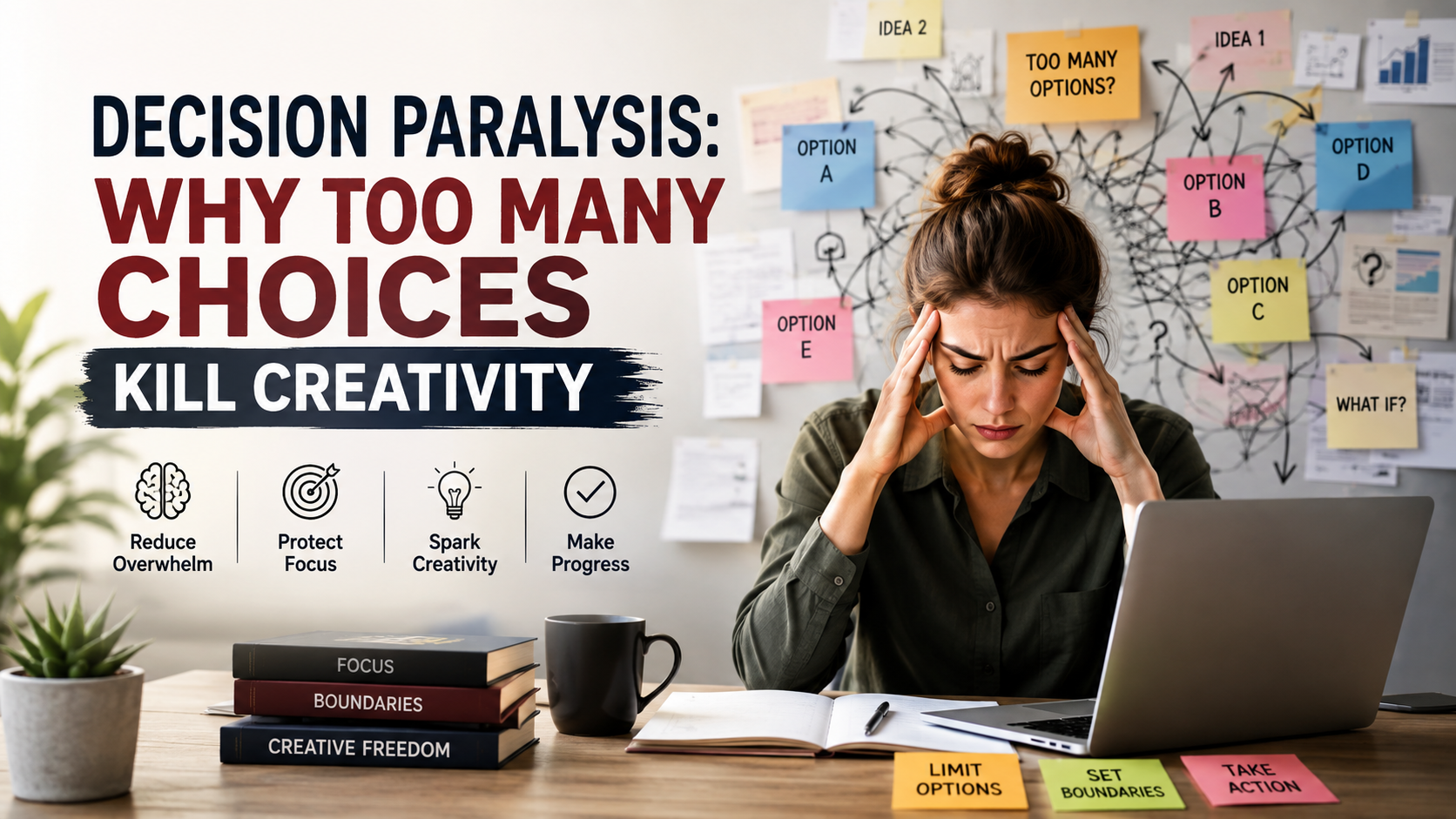
Decision Paralysis: Why Too Many Choices Kill Creativity
Have you ever stared at a blank page, overwhelmed by endless possibilities, only to produce nothing? Modern culture celebrates variety, yet too many alternatives can create mental fatigue instead of original ideas. When you face an overabundance of paths, decision paralysis can set in and bring your creative process to a standstill.
Research discussed by the American Psychological Association highlights how cognitive overload can impair executive functioning and problem-solving. When your mental energy goes toward evaluating minor options, less capacity remains for innovative thinking. Creative work needs focus, clarity, and room for experimentation. Evidence-based decision making can also help create a more structured approach to evaluating options without getting trapped in endless comparison.
Understanding this pattern can help you regain creative control. This guide explains what triggers decision paralysis and how choice overload affects original thinking. You will also learn how evaluation fatigue disrupts daily routines. Finally, you will discover practical ways to create boundaries, protect your focus, and restore creative momentum.
What is a decision paralysis?
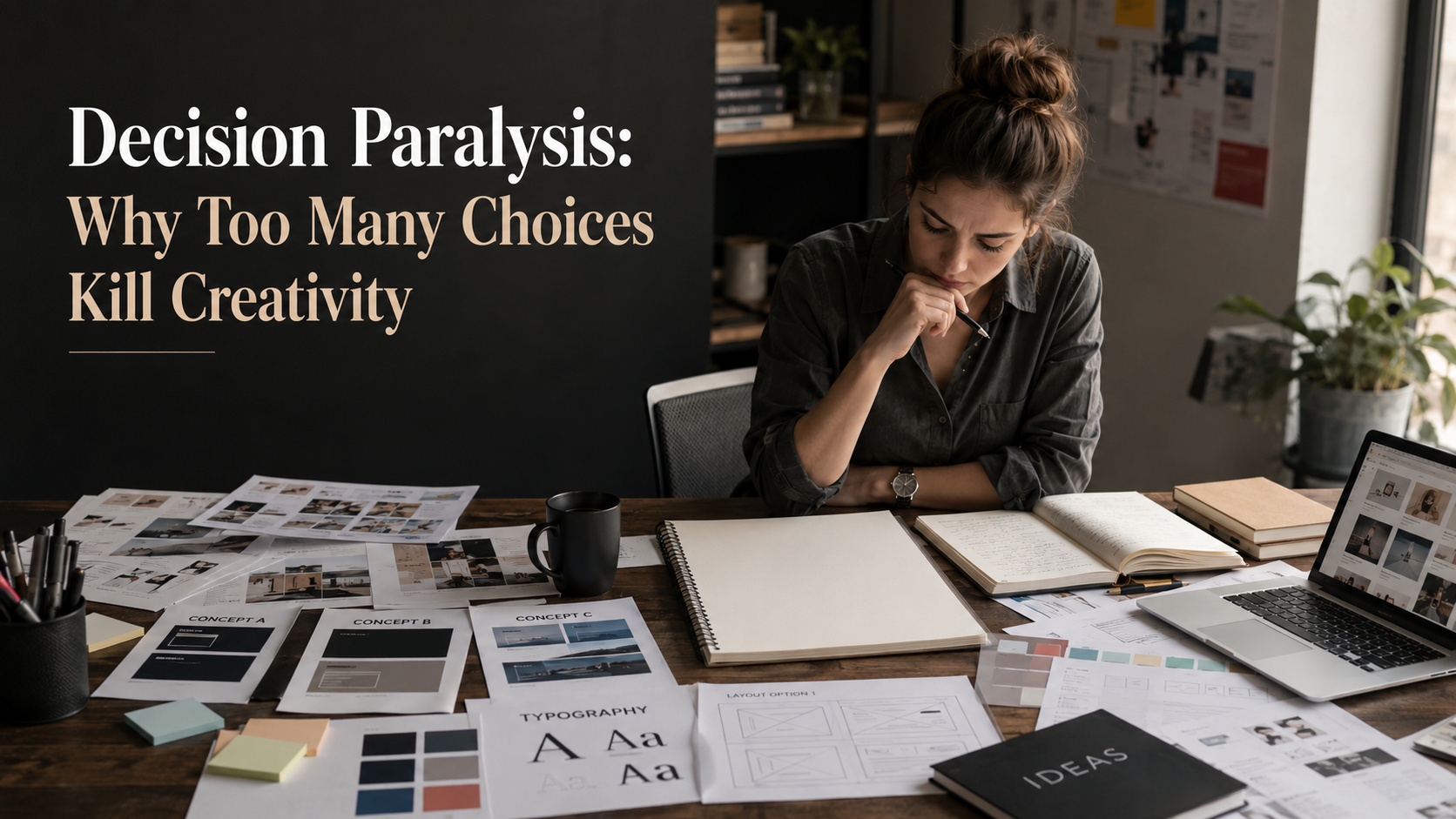
Decision paralysis is a state of cognitive overload that makes choosing difficult when too many options compete for attention. When you face excessive information, your brain may struggle to compare outcomes and identify the most useful path. Instead of making a practical choice, you may analyze every possible consequence. Understanding how strategic thinking supports better decisions can provide a more structured way to evaluate competing possibilities.
The problem often becomes worse when you believe one option must be perfect. Choosing one direction can feel like permanently rejecting every alternative. That pressure increases hesitation and makes even simple decisions feel unusually important.
Decision paralysis can affect creative work particularly strongly. Creative projects already involve uncertainty, experimentation, and incomplete information. If you keep evaluating possibilities instead of testing an idea, progress stops before meaningful work begins.
The result is often a frustrating cycle. You research more, compare more, and delay action. Yet additional information does not always create greater clarity. Sometimes, it creates more variables to consider.
A useful response is to define limits before you start. Set a deadline, narrow your options, or choose clear evaluation criteria. These constraints reduce mental friction and make action easier.
The Mechanism of Analysis Freeze
Analysis freeze begins when the demands placed on working memory become difficult to manage. Every additional option introduces another comparison, trade-off, or possible outcome. As these variables accumulate, evaluating them becomes increasingly exhausting.
Uncertainty can make the problem worse. You may worry about choosing incorrectly, so you continue searching for more information. Instead of increasing confidence, this search can create even more uncertainty.
This process explains why decision paralysis often affects seemingly simple tasks. The decision itself may not be difficult. The number of factors surrounding it creates the difficulty.
Mental fatigue also reduces your willingness to experiment. You become more focused on avoiding mistakes than discovering better possibilities. That mindset is especially damaging during creative work, where imperfect attempts often lead to stronger ideas.
Recognizing your cognitive limits gives you a practical advantage. Reduce unnecessary choices before they reach your attention. Use defaults, deadlines, and simple rules whenever possible.
You do not need to eliminate uncertainty completely. You need enough structure to make forward movement possible.
What are some things that can kill creativity?
Several factors can weaken creativity, but excessive choice, perfectionism, interruptions, and fear of judgment are especially damaging. Unlimited tools, formats, colors, platforms, or storylines can force your working memory to spend more effort filtering options. That leaves less energy for developing original concepts.
Perfectionism creates another barrier. When you expect an idea to emerge fully formed, experimentation starts to feel dangerous. You may reject rough concepts before they have enough time to develop.
Digital distractions also interfere with creative concentration. Notifications, messages, and frequent task switching break sustained attention. Without enough uninterrupted time, your mind may struggle to develop deeper connections between ideas.
Rigid routines can create problems when they leave no room for exploration. Harsh self-criticism adds another layer of pressure. Fear of judgment can then push you toward predictable choices instead of unusual ones.
Decision paralysis can connect several of these problems. Too many choices increase evaluation, while perfectionism raises the perceived cost of every mistake.
Reducing these pressures creates more room for creative risk. Limit your tools, protect focused work periods, and treat early ideas as experiments rather than final products.
The Destructive Impact of Perfectionism
Perfectionism can suppress creativity because it treats early work as if it should already meet final standards. That expectation creates unnecessary pressure at the beginning of a project.
Creative work rarely develops in a straight line. Early drafts often contain weak ideas, awkward sections, and unfinished concepts. Those imperfections provide material that you can revise and improve.
When perfection becomes the goal too early, experimentation becomes harder. You may spend excessive time correcting small details before discovering whether the larger idea actually works. This behavior can contribute to decision paralysis, especially when every creative choice feels permanent.
A healthier approach separates creation from evaluation. During the first stage, focus on producing possibilities. Review and refine them later.
Try setting a deliberately low standard for the first draft. Give yourself permission to create something incomplete. You can improve weak ideas once they exist.
Constraints can also reduce perfectionist pressure. Set a short deadline, limit revisions, or decide what “good enough” means before beginning.
The goal is not lower-quality work. The goal is to delay judgment until you have enough material to judge properly. That separation gives creativity space to develop before criticism takes over.
What are the psychological effects of having too many choices?
Too many choices can contribute to mental fatigue, anxiety, hesitation, and regret. When numerous alternatives appear equally attractive, you may assume that one perfect option exists. That belief encourages continued comparison instead of practical decision-making. Evidence from peer-reviewed research can help distinguish established effects of choice overload from assumptions about how people make decisions.
The search for the ideal choice can consume significant mental energy. You may repeatedly compare features, outcomes, and possible risks. Eventually, the decision itself becomes more stressful than the original problem.
After choosing, regret can continue the cycle. You may focus on the options you rejected and imagine better outcomes from each one. This creates dissatisfaction even when your selected option works well.
Over time, repeated decision paralysis can weaken confidence in your own judgment. Each difficult choice becomes evidence that you cannot trust yourself to decide efficiently. That perception can increase hesitation during future decisions.
Choice overload can also affect motivation. When every task requires extensive evaluation, starting feels increasingly difficult. Creative projects become especially vulnerable because they contain many subjective choices.
Reducing unnecessary alternatives can interrupt this pattern. Establish priorities before comparing options. Decide which factors matter most and ignore details that have little impact.
You do not need certainty to make a sound decision. You need a reasonable process that allows you to move forward.
The Burden of Buyer and Creator Regret
Choice overload increases the fear that a better alternative exists somewhere else. This problem affects consumers, but it can also affect creators. A writer may question every topic, a designer may compare endless layouts, and a business owner may constantly reconsider strategic directions. External influences can also affect business decisions, adding another layer of uncertainty when evaluating alternatives.
The more alternatives you examine, the harder it can become to feel satisfied with one choice. Even after making a decision, you may continue imagining what could have happened with another option.
This pattern creates regret, but it can also create unnecessary self-blame. If the result falls short, you may assume that a different choice would have produced a better outcome.
Creators face an additional problem. Constant reconsideration interrupts execution. Instead of improving the selected idea, they repeatedly return to the decision stage.
A simple way to reduce this burden is to establish decision criteria before evaluating options. Identify the two or three factors that matter most. Then choose the option that best satisfies those criteria.
You can also set a point where evaluation ends. Once the decision meets your requirements, begin execution.
The objective is not to find the perfect choice. It is to choose well enough and preserve your energy for the work that follows.
What are the factors that hinder creativity?
Several conditions can hinder creativity, including unclear goals, mental exhaustion, unmanaged stress, interruptions, and excessive choice. While complete freedom may sound ideal, unlimited possibilities can create ambiguity. Without boundaries, your brain must first determine what problem it should solve. Curiosity and the drive to explore new possibilities can be useful for creative thinking, but they also need structure to avoid becoming endless exploration.
Work environments can add further pressure. A chaotic workspace can increase distraction, while constant criticism can make experimentation feel unsafe. Tight deadlines may also push you toward familiar solutions instead of more exploratory thinking.
Stress can narrow attention and encourage habitual responses. When your mind focuses on avoiding problems, it has less room for divergent thinking and creative exploration. Lack of rest can intensify this effect by reducing mental energy.
Decision paralysis often appears when several of these factors overlap. Unclear goals create more choices, stress makes those choices feel more important, and fatigue makes evaluation harder.
The solution is not always greater freedom. Sometimes, creativity needs structure. Define the outcome, limit available tools, and establish a clear starting point.
A predictable process can reduce unnecessary decisions while preserving room for experimentation. You can then spend more mental energy solving the creative problem itself rather than managing every possible direction.
The Value of Helpful Constraints
Constraints can appear restrictive, but they often make creative work easier. When you limit the available choices, your brain has fewer variables to evaluate. That reduction can help you focus on generating and improving ideas.
For example, a writer might limit a draft to a specific word count. A designer could restrict a project to a small set of colors or typefaces. A photographer might work within one location or a fixed time window.
These boundaries do not eliminate creativity. They change the problem into something more specific and manageable. Instead of asking what could be done, you begin asking how to solve the defined challenge.
Helpful constraints can also reduce decision paralysis. Fewer choices mean fewer comparisons and less opportunity for endless reconsideration.
The key is choosing constraints that support the goal. A useful boundary should narrow the field without making the task impossible.
You can also experiment with temporary restrictions. Give yourself 30 minutes, choose one tool, or create a first draft without editing.
Once the constraint produces useful work, you can expand your options. The purpose is not permanent limitation. It is to create enough structure for creative momentum to begin.
How does decision paralysis affect daily life?
Decision paralysis does not only affect major creative projects. It can appear in ordinary routines and gradually drain your mental energy. Simple choices, such as selecting meals, choosing clothes, answering emails, or deciding what to watch, can become surprisingly time-consuming. Simple ways to create a calmer morning routine can help reduce unnecessary choices before the day’s more demanding decisions begin.
Each individual decision may seem insignificant. However, repeated hesitation creates decision fatigue throughout the day. By the afternoon, you may have less mental energy available for complex work.
At work, this can delay important projects. You may keep gathering information, comparing approaches, or revisiting earlier choices instead of taking the next practical step. Deadlines then create additional pressure, which makes future decisions harder.
At home, excessive choice can produce a similar pattern. You might scroll through streaming services for an hour without choosing anything. You may also postpone hobbies because deciding how to begin feels like another task.
The cumulative effect matters more than any single decision. When minor choices consume attention, meaningful activities receive less energy.
Reducing routine choices can protect your cognitive resources. Use default meals, repeatable workflows, simple schedules, and predetermined priorities.
The goal is not to eliminate choice. It is to reserve your best mental energy for decisions that genuinely deserve it.
The Compound Drain on Daily Momentum
Routine indecision creates psychological friction that can accumulate throughout the day. A single delayed choice rarely causes major damage. Repeated hesitation, however, can slow your entire routine.
Imagine starting the morning by reconsidering your schedule, delaying a difficult task, comparing several approaches, and checking unrelated notifications. None of these actions seems serious alone. Together, they can consume valuable attention before meaningful work begins.
This pattern can reinforce decision paralysis. Delayed action creates unfinished tasks, unfinished tasks create pressure, and pressure makes later choices feel more difficult.
One practical solution is to automate low-value decisions. Prepare recurring meals, establish standard work routines, and create default responses for common situations. These systems reduce the number of choices you need to make each day.
You can also protect your highest-energy periods. Schedule demanding creative work when your attention is strongest. Leave routine administration for times when your mental energy is lower.
The objective is not maximum productivity every minute. It is better allocation of attention.
When fewer trivial choices compete for your focus, you create more space for creative thinking, meaningful relationships, personal interests, and essential responsibilities.
Frequently Asked Questions
Why does having fewer options make people happier?
Having fewer options reduces cognitive strain and eliminates comparison fatigue. When you select from a curated list, you spend less time weighing trade-offs and evaluating alternatives. This simplicity minimizes the fear of missing out and reduces post-decision regret. As a result, you feel far more confident in your ultimate decision, leading to higher satisfaction, peace of mind, and greater creative energy.
How can I overcome choice overload in my creative work?
You can overcome choice overload by establishing strict constraints before starting any project. Limit your palette to three colors, set a strict 30-minute timer, or restrict yourself to a single tool. Deliberately reducing your options eliminates trivial decision-making and forces your mind to innovate within clear, manageable boundaries.
What is the paradox of choice?
The paradox of choice is a psychological concept stating that while some choice is good, excessive choice causes anxiety, paralysis, and dissatisfaction. Coined by psychologist Barry Schwartz, it demonstrates that abundant options increase expectations, complicate the decision-making process, and make people feel less satisfied with their final choices due to lingering doubts.
How does cognitive fatigue impact daily problem-solving?
Cognitive fatigue depletes your executive functioning, which is responsible for reasoning, emotional regulation, and original problem-solving. When you spend mental energy on countless minor choices, your brain naturally defaults to safe, low-effort habits. This depletion reduces your ability to think critically, navigate complex challenges, and generate innovative ideas.
Conclusion
Navigating a world filled with endless possibilities requires intentional boundaries. While unlimited options seem liberating, they routinely trigger decision paralysis, draining the cognitive reserves needed for true innovation. When your mind expends its energy weighing endless minor trade-offs, creative focus collapses under the weight of overthinking and self-doubt. Recognizing the psychological triggers behind choice overload is the first step toward reclaiming your mental clarity.
By introducing structured constraints, rejecting perfectionism, and limiting daily options, you protect your working memory from unnecessary fatigue. Creativity does not thrive in boundless chaos; it flourishes when focused against clear, deliberate parameters. Automate routine life choices to preserve mental energy for your most meaningful work. Embrace the freedom of limitations, trust your instincts over endless analysis, and take decisive steps forward. Transforming the way you manage options will unlock your creative potential and bring renewed momentum to your work.