
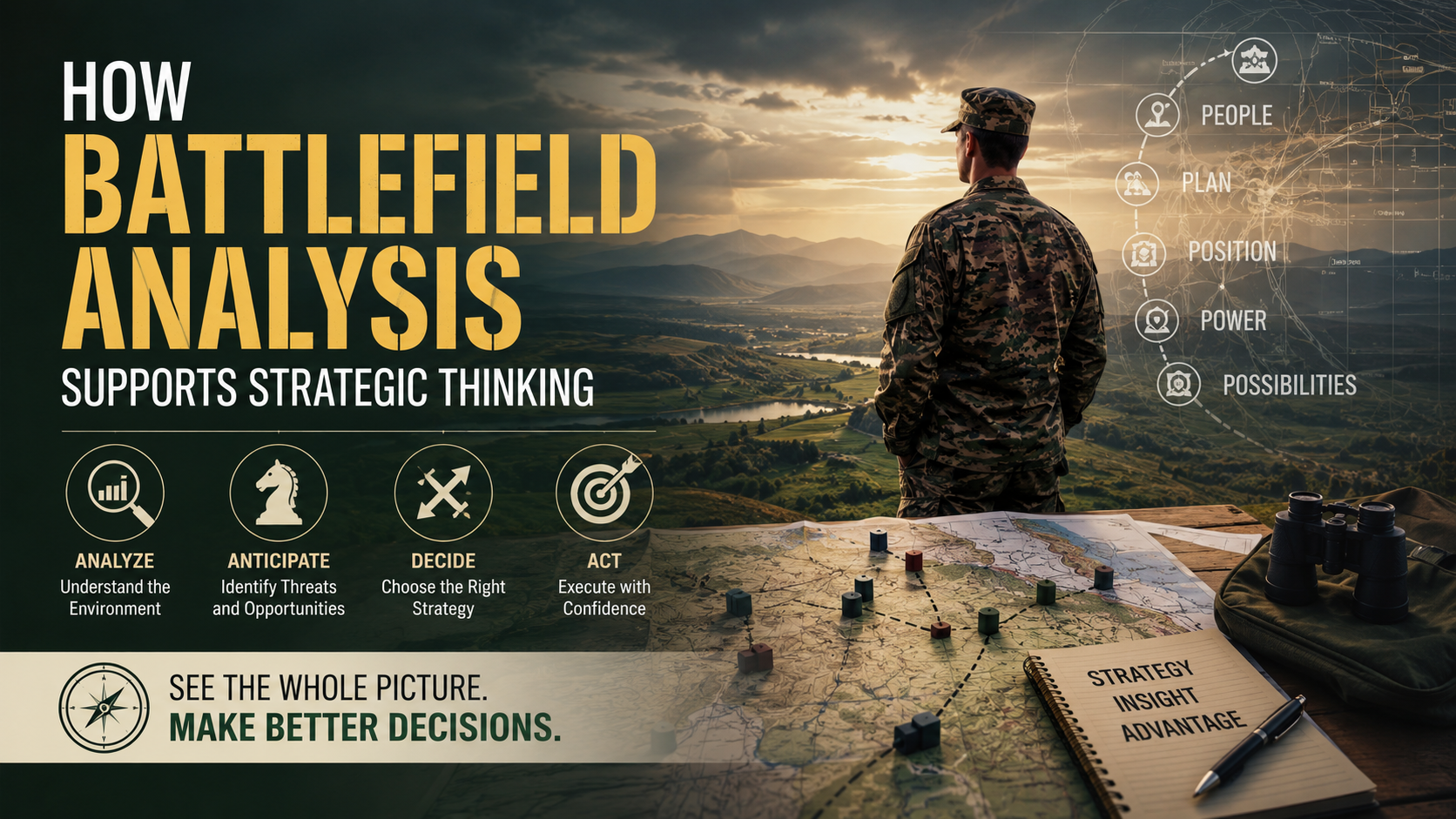
How Battlefield Analysis Supports Strategic Thinking
Understanding how Battlefield Analysis supports strategic thinking helps leaders make better decisions in complex environments. The approach evaluates terrain, resources, opposition capabilities, risks, and operational conditions before action begins. Although rooted in military science, these principles also apply to business strategy, political planning, and crisis management. Structured environmental assessment reduces the risk of relying only on intuition or incomplete information.
Battlefield Analysis encourages decision-makers to examine both internal capabilities and external pressures. It also helps them identify opportunities, constraints, threats, and possible responses. This process creates a stronger foundation for strategic decisions and long-term planning.
This article explains the relationship between Battlefield Analysis and strategic thinking. It also explores analytical versus strategic thinking, practical examples, the 5 P’s framework, and four major strategic thinking styles. For historical military analysis and doctrine, readers can explore resources from the U.S. Army Center of Military History. These concepts can help leaders navigate uncertainty with greater clarity and purpose.
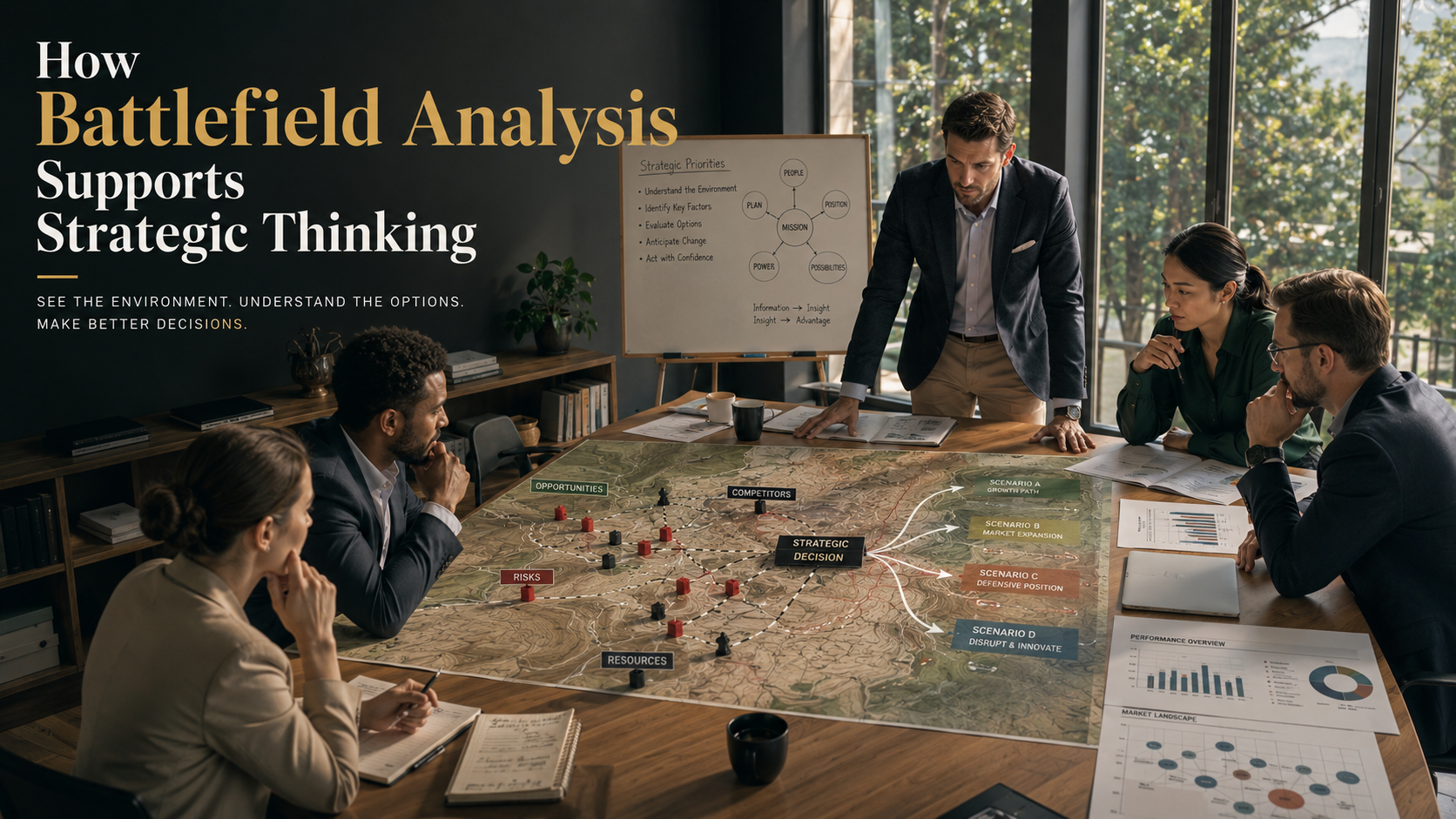
What Is the Difference Between Analytical and Strategic Thinking?
Analytical thinking breaks complex situations into smaller parts. It focuses on data, evidence, patterns, causes, and measurable results. Leaders use this approach to understand what happened and why it happened. It often relies on historical information, current metrics, and logical deductions. Evidence-based decision making can further strengthen this analytical approach by helping leaders evaluate information systematically.
Strategic thinking takes a broader and more forward-looking approach. It connects different factors, identifies patterns, considers uncertainty, and evaluates possible future outcomes. Instead of asking only what happened, strategic thinkers ask what could happen next. They also consider how different decisions may affect long-term objectives.
Battlefield Analysis can support both approaches. It provides structured information about conditions, resources, threats, and opportunities. Analytical thinking then examines those details, while strategic thinking connects them to larger goals.
Strong leaders need both skills. Analysis provides the evidence needed for sound judgment. Strategic thinking gives that evidence direction and purpose. Together, they help organizations respond effectively while preparing for future challenges.
Bridging Data With Long-Term Vision
Combining analytical and strategic thinking creates a stronger decision-making process. Analytical thinkers identify inefficiencies, risks, and important changes within available information. Strategic thinkers then consider what those findings mean for future goals and competitive positioning. Developing in-demand skills for jobs in 2026 can also help professionals strengthen the analytical and strategic capabilities needed in changing workplaces.
This transition requires more than collecting data. Leaders must interpret information within a wider context. They need to consider market conditions, organizational capabilities, competitor behavior, emerging risks, and changing customer expectations. Battlefield Analysis supports this process by encouraging leaders to assess the complete environment before choosing a response.
Strategic thinking also requires imagination. Future conditions rarely follow existing patterns perfectly. Leaders must therefore consider several possible scenarios instead of depending on one forecast.
A balanced approach connects evidence with long-term vision. It allows organizations to respond to current problems without losing sight of future opportunities. This combination can improve resilience, resource allocation, and strategic decision-making during periods of uncertainty.
What Is Strategic Thinking?
Strategic thinking is a deliberate process for understanding important factors and preparing for future challenges. It helps leaders position their organizations for long-term success rather than focusing only on immediate tasks. The process requires leaders to step away from daily operations and examine the wider environment.
Effective strategic thinkers question assumptions and connect information from different sources. They look for emerging trends, potential disruptions, competitive threats, and new opportunities. They also evaluate how present decisions may influence future outcomes.
Battlefield Analysis supports this mindset by encouraging a structured assessment of conditions before action. Leaders can examine resources, capabilities, external threats, environmental factors, and possible responses. This creates a clearer picture of the situation.
Strategic thinking does not mean following a rigid plan. Conditions can change quickly, so leaders must remain flexible. However, flexibility should not replace direction. Successful organizations maintain clear objectives while adapting their methods when circumstances change. This balance helps leaders make better decisions in uncertain environments.
Cultivating Long-Term Focus
Developing strategic thinking requires deliberate practice and continuous learning. Leaders often become trapped in urgent operational issues because immediate problems demand attention. Without dedicated reflection time, important long-term risks can remain unnoticed.
One effective approach is to schedule regular periods for strategic review. During these sessions, leaders can examine industry changes, organizational performance, competitor activity, and emerging opportunities. They can also revisit assumptions behind existing decisions.
Battlefield Analysis provides a useful mental model for these reviews. Leaders can assess the current environment, available resources, external pressures, and possible scenarios before deciding what requires attention.
Long-term focus also means separating important priorities from minor distractions. Not every problem deserves equal resources or immediate action. Leaders should identify decisions that can significantly influence future performance. Understanding how design constraints create better products can also illustrate why clear limitations and priorities can improve strategic outcomes.
By combining structured assessment with regular reflection, individuals can strengthen strategic judgment. This approach supports better prioritization, clearer objectives, and more adaptable decision-making across changing business environments.
What Is a Good Example of Strategic Thinking?
A practical example of strategic thinking occurs when a company changes its business model before a major technological disruption becomes unavoidable. Consider a traditional media company that notices declining cable viewership and growing demand for digital streaming. Instead of waiting for revenue to collapse, leadership could invest early in a dedicated streaming platform.
The decision requires more than recognizing a trend. Leaders must assess customer behavior, technology, competitors, financial resources, and internal capabilities. Battlefield Analysis provides a useful framework for evaluating these conditions before committing major resources.
The company might redirect investment toward digital infrastructure and retrain employees for new roles. It could also test different pricing models and monitor customer adoption. These actions reduce dependence on an aging business model while creating opportunities in a growing market. Upskilling and reskilling can help employees adapt as organizations respond to technological and market changes.
This example demonstrates strategic thinking because leadership responds to future possibilities rather than only current problems. The objective is not simply survival. It is to reposition the organization before changing conditions reduce its available choices.
Anticipating Market Disruptions
Recognizing early warning signals gives organizations more time to respond. Market disruptions often develop gradually through changes in technology, customer preferences, regulations, or competitor behavior. Leaders who monitor these signals can prepare before disruption becomes an immediate crisis.
Battlefield Analysis encourages decision-makers to examine the wider environment instead of focusing only on internal performance. Leaders can monitor emerging technologies, adjacent industries, competitor strategies, supply conditions, and changing customer expectations.
This approach also helps identify weak signals that may become significant later. A small change in customer behavior may appear unimportant at first. However, several related changes can reveal a broader market shift.
Preparation should also include scenario planning. Leaders can consider what happens if a disruption grows faster than expected, develops slowly, or affects only part of the organization. Each scenario may require a different response. Understanding how AI is transforming factories provides another example of how organizations can anticipate technological disruption and prepare for changing operating conditions.
Early preparation can reduce operational disruption and improve organizational resilience. It also gives leaders more choices because they are acting before circumstances force an immediate decision.
What Are the 5 P’s of Strategic Thinking?
The 5 P’s of strategy, developed by management scholar Henry Mintzberg, provide five different ways to understand strategy. They are Plan, Ploy, Pattern, Position, and Perspective. Each lens highlights a different aspect of strategic decision-making.
A Plan represents a deliberate course of action designed to achieve an objective. A Ploy is a specific maneuver intended to influence or outmaneuver a competitor. A Pattern describes consistent behavior that develops over time, whether planned or not.
Position considers how an organization fits within its external environment. It includes factors such as competitors, customers, markets, and available resources. Perspective focuses on the organization’s shared mindset, culture, and way of viewing its environment.
These five perspectives can complement Battlefield Analysis because they encourage leaders to examine strategy from multiple angles. A single planning method may overlook important factors.
Using the 5 P’s helps leaders connect actions, behavior, competitive positioning, and organizational thinking. It can therefore provide a broader foundation for strategic analysis and decision-making.
Applying Mintzberg’s Framework
Applying Mintzberg’s framework requires leaders to examine strategy beyond a written business plan. A plan may describe intended actions, but actual organizational behavior can reveal a different strategy. Looking at all five P’s helps identify these differences.
For example, leaders can review their intended objectives as the Plan. They can then examine competitive actions that may require a strategic Ploy. Reviewing repeated decisions can reveal a Pattern, while analyzing competitors and customers clarifies the organization’s Position.
The final element, Perspective, requires leaders to examine internal beliefs and assumptions. These beliefs can influence how teams interpret threats and opportunities. An organization may overlook a major opportunity simply because its established mindset limits its thinking.
Battlefield Analysis can strengthen this review by providing a structured assessment of the external and internal environment. Leaders can compare available resources with environmental pressures and strategic objectives.
Together, these perspectives reduce narrow thinking. They help teams identify blind spots, connect daily actions with long-term goals, and develop strategies that remain adaptable as conditions change.
What Are the Four Types of Strategic Thinking?
Strategic thinking can take several forms depending on organizational needs and the problem being addressed. Four commonly discussed approaches are systems thinking, conceptual thinking, directional thinking, and reflective thinking. Each approach focuses on a different part of strategic decision-making. These approaches also connect with evidence-based decision making, which helps leaders use reliable information when evaluating complex choices.
Systems thinking examines relationships between different parts of an organization. It helps leaders understand how one decision can create effects elsewhere. Conceptual thinking focuses on abstract ideas and broader connections. It helps leaders frame complex problems and identify alternative solutions.
Directional thinking emphasizes long-term goals and strategic priorities. It helps organizations maintain a clear direction while adapting their methods. Reflective thinking involves reviewing previous decisions, identifying lessons, and improving future actions.
These approaches can work together rather than operating independently. Battlefield Analysis can support each style by providing information about conditions, resources, risks, and possible responses.
For example, systems thinking can reveal interconnected risks, while directional thinking connects those risks to long-term objectives. Reflective thinking then helps leaders learn from outcomes. Combining these approaches creates a more flexible and complete strategic thinking process.
Balancing Different Cognitive Styles
Effective strategic leaders should avoid relying on only one cognitive style. Different situations require different ways of thinking. Systems thinking can reveal relationships, while conceptual thinking can generate new ways to frame difficult problems.
Directional thinking keeps teams focused on meaningful long-term objectives. Reflective thinking ensures that leaders learn from previous decisions instead of repeating the same mistakes. When combined, these approaches create a more balanced decision-making process.
Battlefield Analysis can connect these cognitive styles by providing a structured view of the environment. Leaders can examine resources, threats, constraints, opportunities, and possible outcomes before selecting a response.
The goal is not to use every approach equally in every situation. Instead, leaders should recognize which type of thinking the situation requires. A complex operational problem may benefit from systems thinking, while an uncertain future challenge may require conceptual thinking.
Strong strategic judgment comes from knowing when to shift between these perspectives. This flexibility helps organizations manage uncertainty, identify opportunities, reduce avoidable risks, and maintain progress toward their broader strategic objectives.
FAQ SECTION
How does battlefield analysis apply to business?
Battlefield analysis translates directly to business by helping executives assess competitive landscapes, resource constraints, and market risks. Leaders evaluate operational terrain, identify competitor vulnerabilities, and allocate capital strategically, much like military commanders evaluating physical geography and enemy positions to secure operational victory.
Is strategic thinking an innate talent or a learned skill?
Strategic thinking is primarily a learned skill developed through continuous practice, experience, and formal education. While some individuals naturally exhibit higher systems awareness, anyone can improve their strategic capabilities by studying mental models, analyzing past failures, and dedicating time to long-term planning.
How often should an organization review its strategic plan?
Organizations should conduct formal strategic reviews at least annually, supplemented by quarterly check-ins to monitor key performance indicators. Rapidly changing industries require more frequent adjustments, ensuring the organization remains agile enough to respond to unexpected market disruptions without losing sight of core objectives.
Can small businesses benefit from strategic thinking?
Small businesses benefit immensely from strategic thinking because limited resources make efficient allocation critical for survival. Strategic planning helps small enterprises identify unique market niches, outmaneuver larger competitors, and invest time and capital into high-yield growth opportunities rather than wasting effort.
Conclusion
Mastering how battlefield analysis supports strategic thinking transforms how leaders approach complex problems, resource allocation, and long-term planning. By breaking down the differences between analysis and strategy, understanding core definitions, reviewing practical examples, and applying frameworks like the 5 P’s and the four types of strategy, decision-makers gain a massive competitive advantage. Strategic thinking is not an abstract theory reserved for military generals or massive corporations. It is a practical, structured mindset that empowers anyone to navigate uncertainty with clarity and confidence. Take what you have learned today and apply these insights to your own projects. Evaluate your environment, look beyond immediate data, and build a resilient vision for the future.