
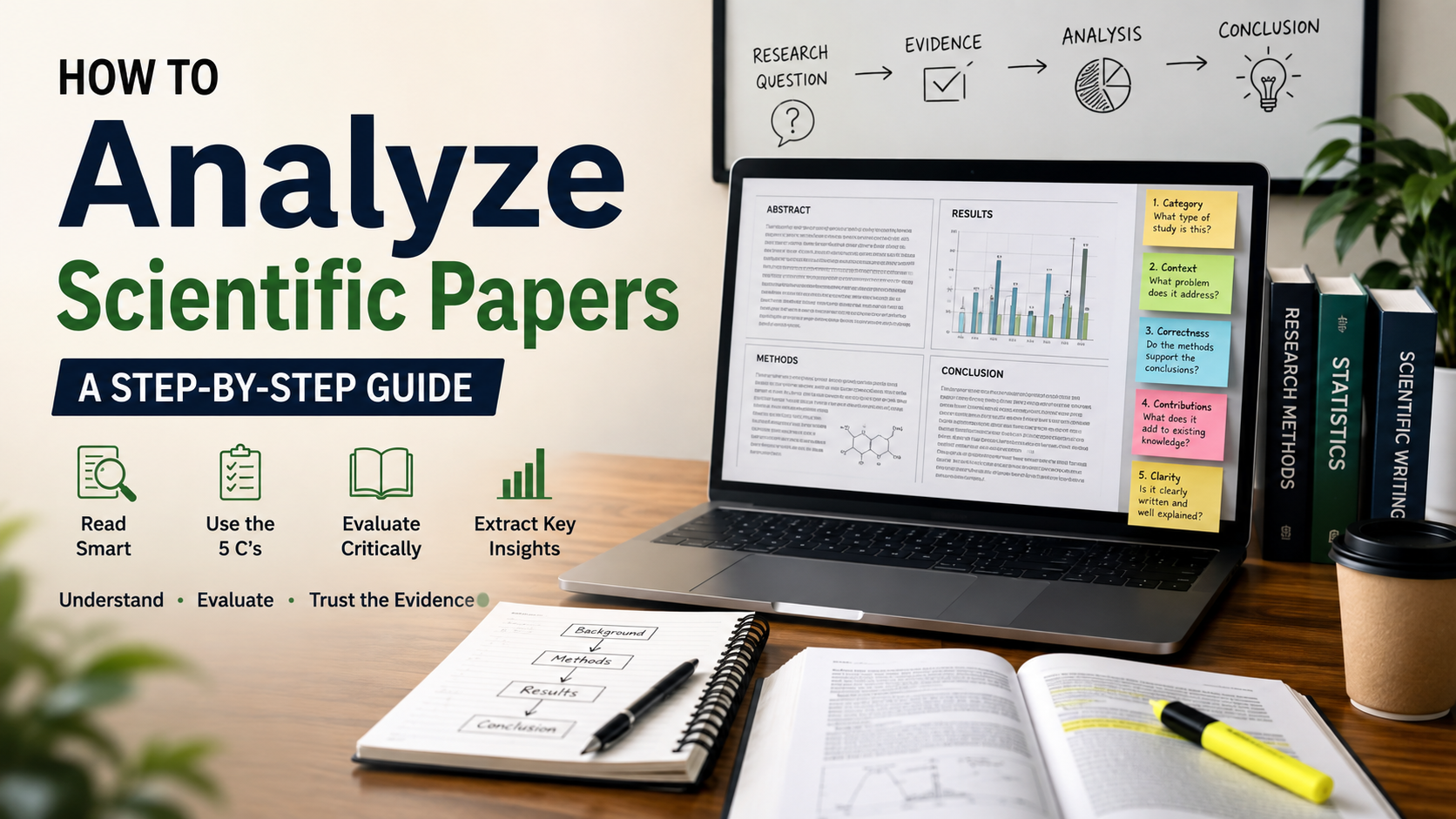
How to Analyze Scientific Papers: A Step-by-Step Guide
Reading academic literature can feel like deciphering a complex foreign language. Dense terminology, technical data, and unfamiliar methods can quickly become overwhelming. However, learning to analyze scientific papers is essential for students, researchers, and anyone who wants to separate evidence from sensationalized claims.
A structured reading process can make scientific literature easier to understand. Research and guidance from the National Center for Biotechnology Information (NCBI) can help readers develop more systematic approaches to understanding scientific literature.
Instead, active reading helps you identify the research question, understand the evidence, and evaluate the authors’ conclusions. This approach also reduces wasted time on papers that are not relevant to your goals.
In this guide, you will learn how to break down a research paper, use the 5 C framework, find reliable scientific literature through resources such as PubMed and Google Scholar, and perform a critical analysis. These techniques can help you turn complex academic literature into clear, useful knowledge.

How do I analyze a research paper?
To systematically analyze scientific papers, use a multi-pass reading method instead of reading every section in order. Start by identifying your purpose. Decide what you need from the paper before examining its details.
First, read the title, abstract, and conclusion. These sections reveal the study’s purpose, main findings, and overall claims. Then scan the figures, tables, headings, and results to understand the evidence presented. This approach can help you decide whether the paper deserves deeper attention. For more context, see the levels of scientific evidence and how different types of evidence affect research conclusions.
Next, examine the methodology and results carefully. Ask whether the study design can answer the research question. Check how participants, measurements, controls, and statistical methods were selected.
Finally, compare the evidence with the authors’ interpretation. Take notes in your own words and record unanswered questions. This active process makes complex papers easier to evaluate and remember.

The Three-Pass Reading Strategy
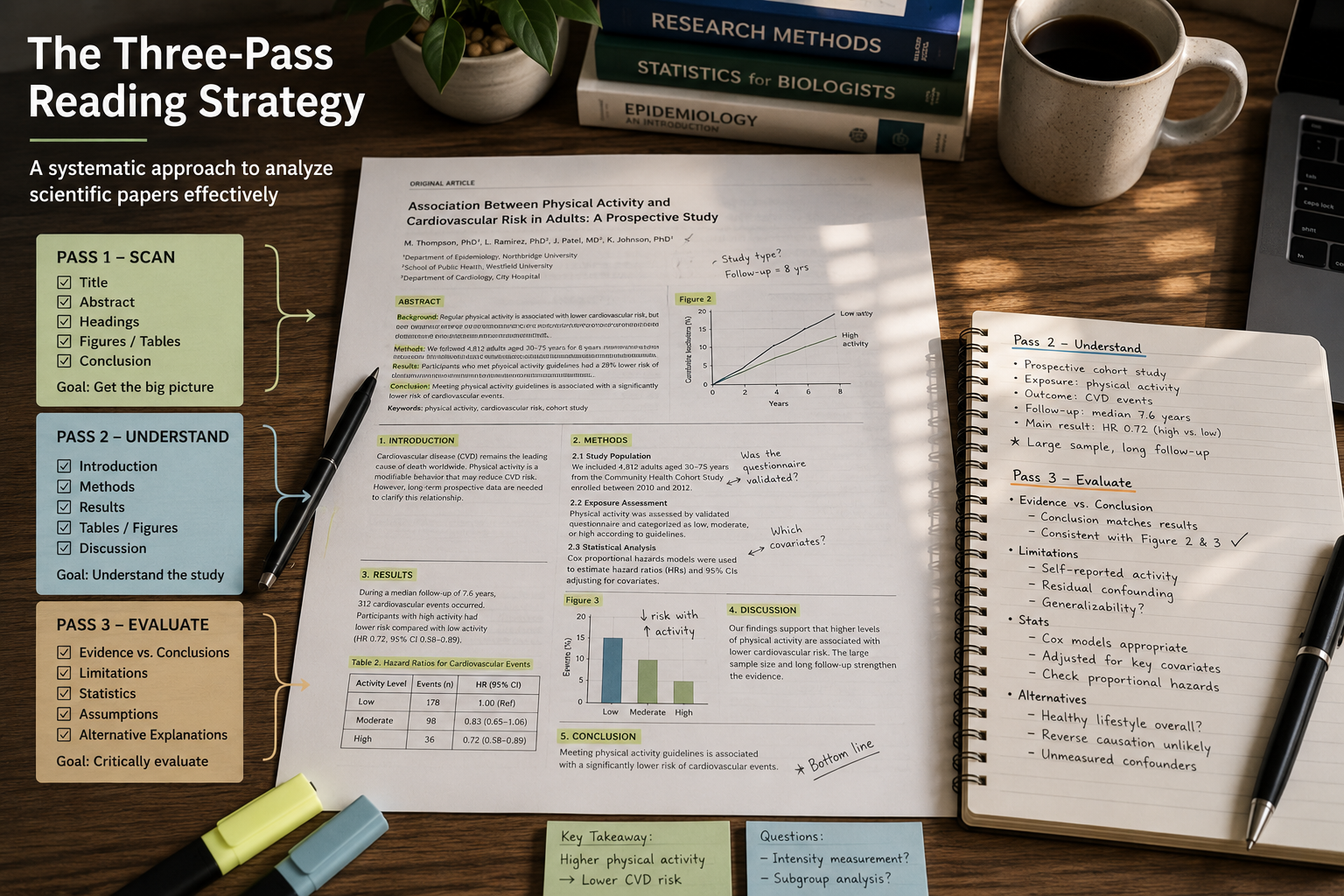
The three-pass approach divides scientific paper analysis into three stages: scanning, understanding, and deep evaluation. Each pass has a different purpose, so you do not waste time trying to understand every detail immediately.
During the first pass, read the title, abstract, conclusion, headings, and figures. Identify the research question, main result, and general study design. Your goal is to understand the paper’s direction, not every technical detail.
During the second pass, examine the introduction, methods, results, and discussion. Focus on how the researchers designed the study and how the evidence connects to their conclusions. Compare figures and tables with the claims made in the text.
During the third pass, scrutinize the study’s assumptions, limitations, statistics, and interpretation. Ask whether alternative explanations exist and whether the evidence supports the conclusions. This stage turns ordinary reading into critical analysis.
You may also consult cited studies or supplemental material when important questions remain unanswered.
What are the 5 C’s in research?
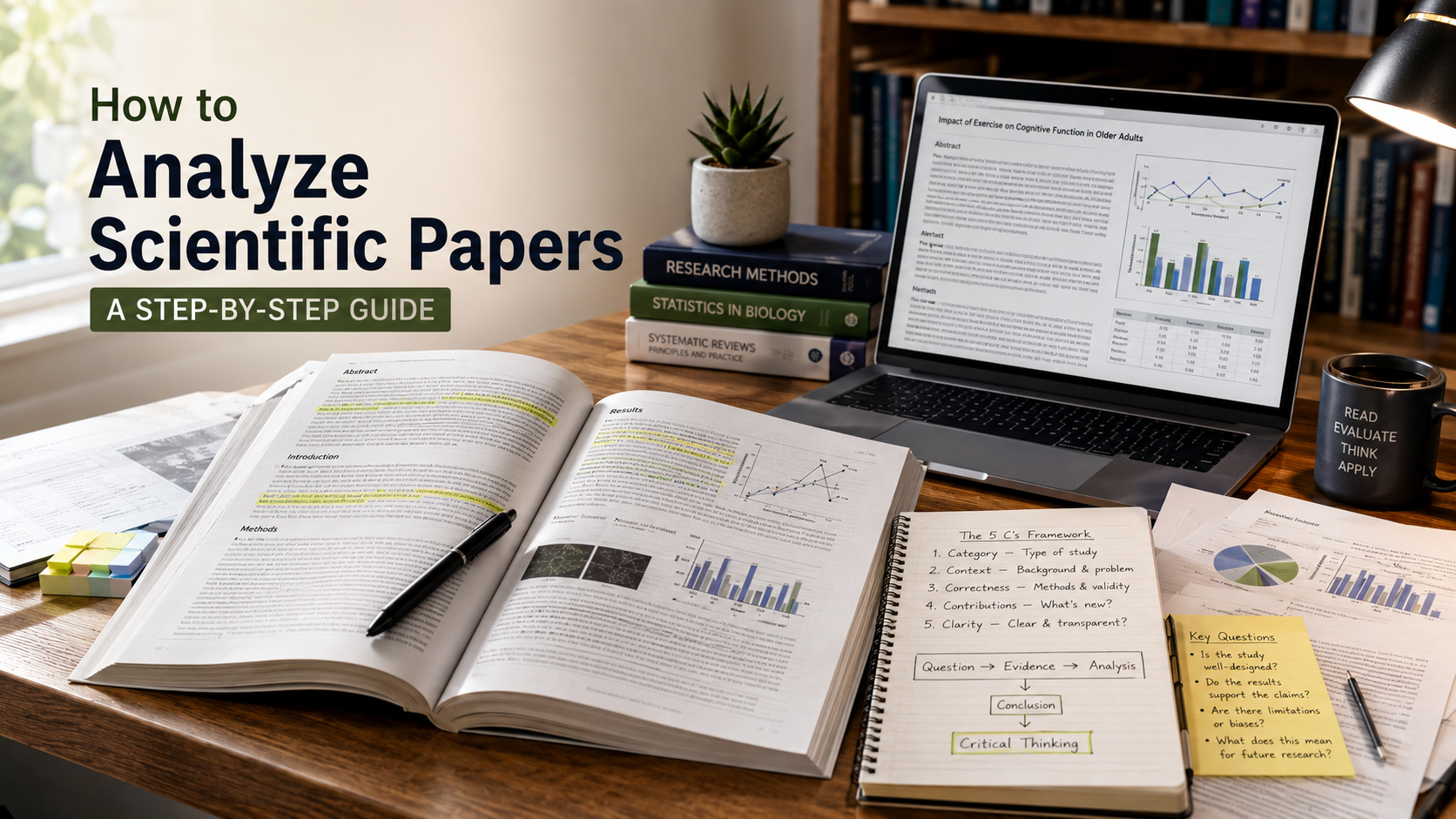
The 5 C framework provides a simple way to organize your analysis of a scholarly publication. The five components are Category, Context, Correctness, Contributions, and Clarity. Together, they help you move beyond simply understanding what a paper says. It is also useful to understand the difference between research-based and evidence-based approaches when evaluating scholarly information.
Start with Category. Identify the type of study, such as an experiment, observational study, systematic review, or meta-analysis. The research design affects how you should interpret its evidence.
Next, examine Context. Determine what problem the study addresses and how it relates to previous research. Then evaluate Correctness by asking whether the methods, data, and statistical analysis support the conclusions.
Consider Contributions next. Identify what the research adds to existing knowledge and whether that contribution is meaningful. Finally, assess Clarity. Check whether the authors explain their methods, findings, limitations, and interpretations clearly.
This framework helps you organize questions while reading. It also makes it easier to compare multiple studies during literature reviews or research projects.
Applying the 5 Cs Systematically
Applying the 5 C framework works best when you record your observations while reading. Instead of relying on memory, create a simple note-taking system with one section for each category.
Under Category, record the study design and research type. Under Context, summarize the research problem and relevant background. For Correctness, note whether the methods and evidence support the conclusions.
Then record the study’s Contributions. Identify the new finding, method, dataset, or interpretation it provides. Finally, assess Clarity by noting confusing explanations, missing details, or unsupported claims.
A simple table or spreadsheet can make this process easier when reviewing many papers. You can also add columns for the research question, sample size, major findings, limitations, and follow-up questions. If you are balancing research with other coursework, learning how to study for multiple subjects can also help you organize your time effectively.
This method creates consistent literature notes. It also helps you compare studies without relying on vague impressions. Over time, your notes can become a useful reference for literature reviews, thesis writing, research planning, and academic discussions.
Where can I read scientific papers?
You can find scientific papers through academic databases, institutional libraries, open-access repositories, and scholarly search engines. The best source depends on your subject area and the type of research you need. When searching online, it is also important to know how to avoid misinformation while studying online so that unreliable sources do not influence your research.
Google Scholar is useful for discovering papers, citations, related studies, and versions available through different institutions. PubMed is particularly valuable for biomedical and health-related research. Europe PMC provides another useful resource for life sciences literature.
Preprint repositories can provide early access to research before formal peer review. Examples include arXiv, bioRxiv, and OSF. However, preprints should be interpreted carefully because they may not have completed peer review.
University libraries can also provide access to subscription journals through institutional credentials. When a paper is behind a paywall, services such as Unpaywall can help locate legally available versions.
When you analyze scientific papers, always consider the publication status, journal quality, study design, and source credibility. Access alone does not determine reliability.
Using Open-Access Tools Ethically
Open-access tools can help you find research legally without relying on unauthorized copies. Unpaywall can identify openly available versions of scholarly articles hosted by legitimate repositories or publishers.
If you cannot access a paper through an open repository, check your university or public library. Many institutions provide journal access through library databases. Interlibrary loan services can also help locate articles that are not immediately available.
Another option is contacting the corresponding author. Researchers often share their work through institutional repositories or personal academic pages. Some may also provide a copy when contacted directly for legitimate research purposes.
Always check the source before downloading a paper. A legitimate open-access copy may appear on a university repository, government archive, journal website, or recognized scholarly platform.
Ethical access matters because it supports researchers and publishers while still allowing readers to obtain scientific information. Once you have the paper, evaluate its methods, evidence, limitations, and conclusions rather than assuming accessibility guarantees quality.
How do I critically analyse a research paper?
To critically analyse a research paper, evaluate whether its research question, methodology, evidence, and conclusions align. A paper can appear convincing while still containing important limitations. Peer review improves scholarly work, but it does not make every conclusion automatically correct. Understanding different levels of scientific evidence can also help you judge how strongly a study’s findings should be interpreted.
Start by identifying the research question and hypothesis. Then examine whether the study design can actually answer that question. Check the sample size, participant selection, controls, measurements, and data collection procedures.
Next, examine the statistical analysis. Ask whether the selected tests suit the data and whether the reported results support the stated claims. Pay attention to effect sizes and confidence intervals, not only statistical significance.
Look for potential biases and confounding variables. Selection bias, measurement bias, missing data, weak controls, and unblinded procedures can affect results. Also consider whether the findings apply beyond the study population.
Finally, compare the discussion with the actual evidence. Watch for claims that go beyond what the data can establish. A strong analysis separates demonstrated findings from interpretation and speculation.
Identifying Methodological Flaws and Bias
Identifying methodological flaws requires more than checking whether a study produced statistically significant results. You need to determine whether the research process could reasonably produce trustworthy evidence.
Start with the study population. Ask whether participants were selected appropriately and whether the sample represents the population discussed in the conclusions. Small or highly selective samples can limit generalizability.
Examine the controls, randomization, blinding, and measurement procedures when applicable. Poor controls can create alternative explanations for observed effects. Missing data or inconsistent measurements can introduce additional uncertainty.
Also look for confounding variables. A relationship between two variables does not automatically prove that one caused the other. Observational studies can identify associations, but stronger causal claims usually require stronger designs and supporting evidence.
Review the statistical methods and reported uncertainty. Check whether the analysis matches the study design and whether the authors acknowledge important limitations.
Finally, consider funding sources and conflicts of interest. These factors do not automatically invalidate research, but they can provide useful context. A rigorous critique asks what the study demonstrates, what remains uncertain, and what evidence would strengthen the conclusion.
Frequently Asked Questions
What is the most important section to read first in a research paper?
Start with the abstract, then review the introduction and conclusion. The abstract gives you the research question, methods, and main findings. The introduction explains why the study matters, while the conclusion summarizes what the researchers believe the evidence shows. This first overview helps you analyze scientific papers efficiently before spending time on technical details. It also helps you decide whether the study is relevant to your research or specific question.
How long should it take to thoroughly review an academic study?
A thorough review can take one to two hours for an experienced reader. Beginners may need three hours or longer, especially when the paper contains complex statistics, unfamiliar terminology, or detailed methodology. When you analyze scientific papers, avoid rushing through every section in one sitting. Use multiple reading passes instead. Start with the main argument, then examine the methods, results, figures, and limitations. The time required also depends on the paper’s complexity and your familiarity with its subject.
What are the main signs of a low-quality research paper?
Several warning signs can indicate a weak research paper. Look for vague methodology, inadequate sample sizes, missing control groups, poor statistical reasoning, and conclusions that exceed the evidence. Unclear figures or unexplained data can also raise concerns. When you analyze scientific papers, check whether the authors clearly describe how they collected and analyzed their data. Consider whether important limitations are acknowledged. Funding sources and conflicts of interest should also be reviewed because they provide useful context when assessing potential bias.
How can I keep track of papers I have already analyzed?
Use a reference management tool such as Zotero, Mendeley, or another organized research system. These tools can help you save papers, add tags, organize studies into folders, and store notes alongside references. When you analyze scientific papers, create a consistent summary for each study. Record the research question, methodology, key findings, limitations, and your assessment of the evidence. You can also use the 5 C framework to structure your notes, making it easier to compare studies during literature reviews and research projects.
Conclusion
Learning to effectively analyze scientific papers is an indispensable skill that transforms how you consume and apply knowledge. While academic literature can appear intimidating initially, following a structured workflow simplifies even the most technical studies. By adopting a multi-pass reading method and applying the 5 C framework, you can rapidly unpack core concepts and gauge their relevance to your work.
Furthermore, knowing where to source open-access literature and maintaining a healthy sense of critical skepticism ensures that your research builds on solid, verifiable evidence. Always scrutinize methodologies, check data integrity, and identify potential biases before accepting conclusions at face value.
As you practice these steps, your reading speed, retention, and critical thinking will improve dramatically. Choose an intriguing paper from an open repository today, apply the strategies outlined in this guide, and experience how rewarding active scientific analysis can be.