

How to Balance School and Competitive Exam Preparation
Managing board syllabi alongside high-stakes entrance tests can feel overwhelming. Students who want to balance school and competitive exam preparation often face homework, tests, mock exams, and revision at the same time. Without a structured routine, daily fatigue can quickly build up. Educational research on learning and memory supports active retrieval as an effective way to strengthen long-term learning. National Center for Biotechnology Information (NCBI)
Juggling schoolwork and entrance preparation also requires clear boundaries. Students who constantly extend their study hours may reduce sleep and recovery time. That approach can make consistent preparation harder.
You do not need to study for sixteen hours each day. Instead, focus on efficient study methods, planned revision, and realistic time management. This guide explains the 1-3-5-7 revision rule, syllabus integration, seven learning methods, the 3-2-1 study framework, and three practical techniques for stronger retention.
What is the 1-3-5-7 rule for studying?
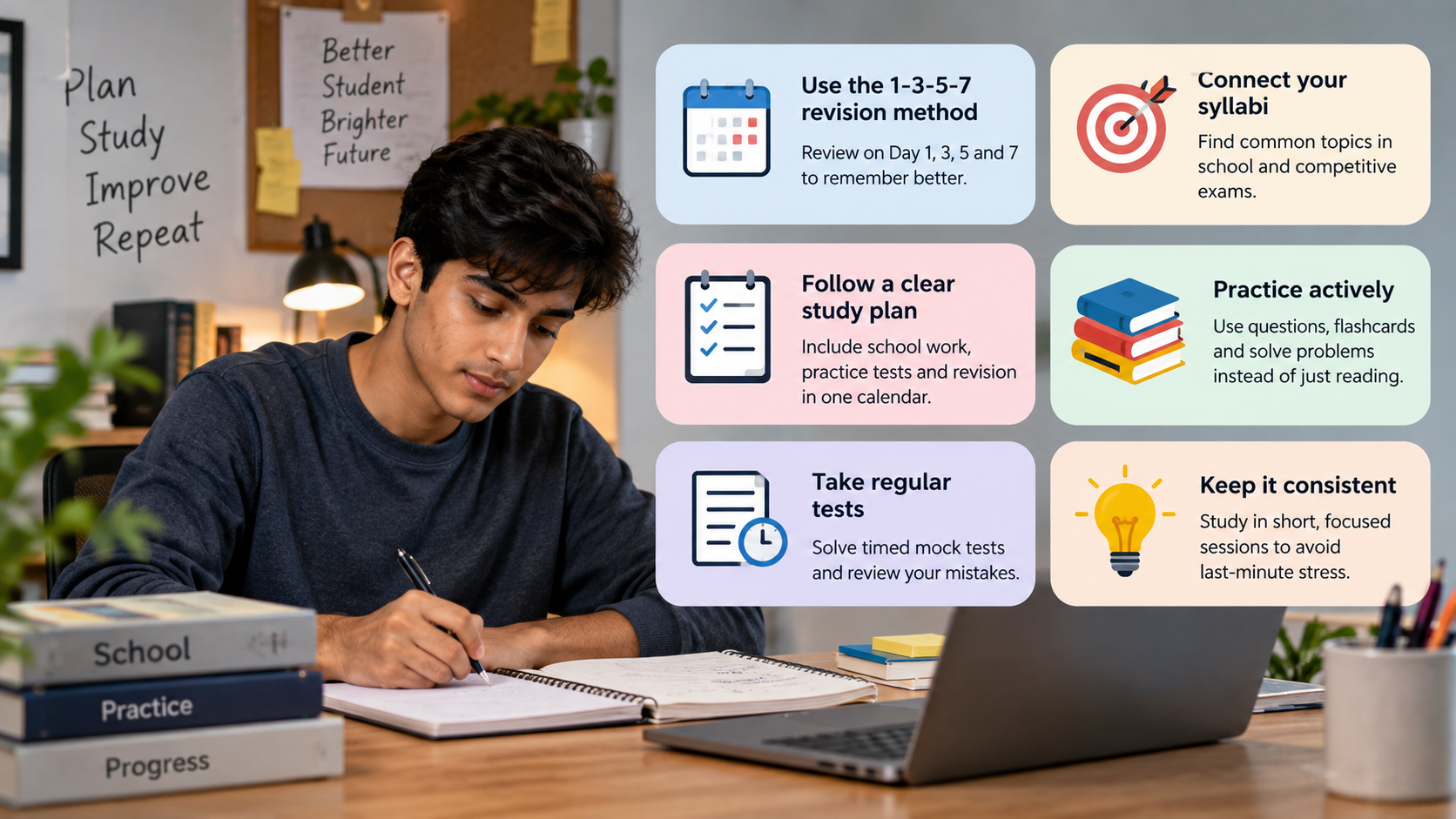
The 1-3-5-7 rule is a spaced-repetition approach that schedules reviews at specific intervals after learning new material. Under this method, you revisit a topic on days one, three, five, and seven. The goal is to review information before it becomes difficult to recall. This approach can be useful when you need to balance school and competitive exam preparation across several subjects.
Start with a focused review immediately after learning the concept. Return to it again after a short gap instead of waiting until the examination approaches. Each review can become shorter if your recall improves.
For example, use the method for physics formulas, historical dates, chemistry reactions, or mathematical concepts. The first review can focus on understanding. Later reviews should emphasize recall and problem-solving.
However, treat the 1-3-5-7 schedule as a flexible framework rather than a rigid rule. Adjust the intervals when a topic remains difficult or an important school test is approaching.
Practical Implementation for Daily Schedules
Apply the 1-3-5-7 rule by recording each new topic in a calendar, notebook, or digital planner. Write the learning date beside the topic so you can schedule its next reviews. This simple system prevents important chapters from disappearing from your revision plan.
On day one, review the concept and write a short summary without copying the textbook. Focus on the main formulas, definitions, processes, or ideas. On day three, close your notes and solve several practice questions from memory.
By day five, test yourself again using questions with slightly different difficulty levels. Identify concepts that still require explanation or additional practice. Do not spend equal time on every topic.
On day seven, complete a quick recall session using flashcards, practice questions, or a blank-page exercise. Mark topics that remain weak and schedule another review.
This method works best when combined with active recall rather than repeated passive reading. Keep the process simple enough to maintain alongside school assignments and regular competitive exam practice.
What is the best strategy for preparing for competitive exams?
There is no single preparation strategy that works equally well for every student or competitive exam. However, combining school concepts with competitive exam practice can reduce unnecessary duplication. Many entrance examinations test concepts that students also encounter in their regular school curriculum. Understanding how CBSE, ICSE, and state boards differ can help students identify how their school curriculum connects with competitive exam preparation, making it easier to balance school and competitive exam preparation.
Start by learning the fundamental concept through your school lessons or textbook. Make sure you understand definitions, formulas, processes, and basic applications before moving to advanced questions. If you need additional academic support, understanding the differences between tuition and coaching can help you choose an appropriate learning path. Then practice competitive questions based on the same topic.
This approach connects conceptual learning with exam application. It also helps you identify gaps that may not appear during ordinary classroom exercises.
Use previous-year questions and timed practice to understand the exam format. Track mistakes rather than simply counting correct answers. Your schedule should also include school assignments, board preparation, revision, and adequate rest.
The goal is not to study two separate syllabi continuously. Instead, connect related material whenever the subjects and learning objectives genuinely overlap.
Synergizing Classroom Lectures with Mock Drills
Your classroom lessons can become an important part of competitive exam preparation when you use them actively. Pay attention to the underlying concepts instead of focusing only on completing classroom notes. Building confidence in students can also make it easier to ask questions and participate when an explanation remains unclear.
After school, revisit the same topic briefly. Start with a recall exercise before opening your textbook. Write down the formulas, principles, or steps you remember. Then compare your answers with your notes.
Once the fundamentals are clear, solve competitive-level questions related to that topic. You do not need to complete a large question set every evening. A focused group of problems can reveal whether you understand the concept under pressure.
Use a timer occasionally to develop time-management skills. However, avoid making every practice session a timed test. Conceptual accuracy should come before speed.
This classroom-to-practice cycle creates a natural connection between school learning and entrance preparation. It also reduces the need to relearn the same topic from scratch later.
What are 7 secret methods for studying effectively?
There are no secret study methods that guarantee exam success. Effective preparation usually comes from applying proven learning principles consistently. Seven useful methods can make your study sessions more active and focused.
- Feynman Technique: Explain difficult ideas in simple language to expose gaps in understanding.
- Active recall: Test yourself instead of repeatedly rereading your notes.
- Interleaved practice: Mix related subjects or question types instead of studying one type continuously.
- Pomodoro intervals: Use focused work periods with planned short breaks.
- Dual coding: Combine words with simple diagrams, tables, or visual explanations.
- Error logging: Record mistakes and identify why each answer went wrong.
- Sleep hygiene: Maintain consistent sleep because adequate rest supports learning and memory.
These methods work differently, so you do not need to use all seven every day. Select techniques based on the subject and your current weakness.
For example, active recall may suit factual material, while problem-solving and error analysis may help with mathematics and science.
What is the 3-2-1 rule for study?
The 3-2-1 study rule can be used as a simple framework for organizing daily preparation. One interpretation divides study time into three hours of conceptual learning, two hours of problem-solving, and one hour of revision. This structure can help students give attention to different learning activities.
Another version uses the numbers as an end-of-session reflection. Students record three important concepts they learned, two questions that remain unclear, and one problem they solved independently.
Neither version should be treated as a universal formula. Your available study time depends on school hours, travel, homework, sleep, and personal commitments. A student with only three focused hours should not force a six-hour schedule.
Instead, scale the framework to fit your routine. For example, you might spend 90 minutes learning concepts, 60 minutes solving questions, and 30 minutes revising.
The central idea is structured study time. Dividing preparation into clear activities can prevent one task from consuming the entire evening.
Structuring Evening Study Sessions Efficiently
Use the 3-2-1 framework as a flexible template rather than a fixed requirement. After school, begin with the subject that requires the most concentration. If you are mentally tired, start with a short review before moving into difficult new material. Developing effective study habits that support education and career success can help you maintain this routine over time.
During your conceptual-learning period, focus on understanding rather than copying notes. Write brief summaries and test your recall after each topic. This creates a more active learning process.
Next, move to problem-solving. Practice questions that match your current level before attempting more difficult competitive problems. Review incorrect answers immediately when the reason for the mistake remains clear.
Use the final period for revision and planning. Review formulas, flashcards, error-log entries, or previously learned concepts. Then identify the first task for the following day.
If you have less time, reduce each block proportionally. Do not cut sleep simply to complete an arbitrary schedule.
A realistic evening routine should help you balance school and competitive exam preparation without creating unnecessary fatigue. Consistency matters more than following exact hourly numbers.
What are the 3 best study techniques?
Three widely used learning techniques are active recall, spaced retrieval, and the Leitner flashcard system. Each technique encourages students to retrieve information instead of relying mainly on repeated reading.
Active recall involves answering questions without looking at the answer first. You can use practice questions, flashcards, blank-page summaries, or self-quizzing. The effort required to retrieve information makes this approach more active than simply rereading notes.
Spaced retrieval spreads practice across multiple sessions. Instead of reviewing a chapter several times in one evening, revisit it over several days. This approach can help strengthen long-term retention.
The Leitner system applies spaced practice to flashcards. Cards are placed into groups based on how confidently you answer them. Difficult cards return more frequently, while familiar cards appear less often.
These techniques can complement each other. For example, you can create flashcards, test yourself with active recall, and schedule difficult cards for more frequent review.
When you need to balance school and competitive exam preparation, these methods can make revision more targeted without requiring longer study sessions.
Frequently Asked Questions
How many hours should I sleep while managing both preparations?
You should aim for seven to eight hours of quality sleep every night. Chronic sleep deprivation severely impairs working memory, concentration, and logical reasoning. During deep sleep cycles, your brain consolidates newly learned facts and clears metabolic waste. Cutting back on sleep to gain study hours creates diminishing returns, leads to careless mistakes, and ultimately slows your learning pace.
How do I handle school homework without wasting competitive exam time?
Treat school assignments as an active self-testing opportunity rather than a chore. Complete homework questions without checking your textbooks first, treating the assignment like a mini-quiz. If the topic overlaps with your competitive exam syllabus, solve related advanced problems immediately afterward. This approach transforms routine schoolwork into productive foundational preparation for your exams.
Should I study for school and competitive exams on the same day?
Yes, balancing both on the same day is the most effective approach. Align your subjects so that the topics you study for school match your competitive exam preparation. Dedicate your late afternoon to completing school-related tasks, then shift your evening toward competitive problem sets. Parallel learning reinforces comprehension and prevents either curriculum from falling behind.
What should I do when school exams and competitive mock tests clash?
When schedules collide, temporarily shift your daily time distribution to favor the immediate deadline. Allocate seventy percent of your study hours to your school exam topics while keeping thirty percent for competitive revision. Completely stopping competitive preparation causes loss of problem-solving speed, while maintaining light revision preserves test readiness without harming school grades.
Conclusion
Successfully preparing for dual academic challenges does not require sacrificing your well-being or giving up every moment of free time. To balance school and competitive exam targets sustainably, you must replace chaotic cramming with deliberate, evidence-based study routines. By aligning overlapping syllabi, applying spaced repetition systems like the 1-3-5-7 framework, and tracking your mistakes in an error log, you make every hour count. For students planning their longer-term goals, understanding the connection between education and career success can also provide useful context.
Remember that consistency always outperforms intermittent bursts of intense study. Protect your sleep schedule, treat school assignments as active retrieval drills, and systematically rotate subjects using the 3-2-1 structure. Academic excellence across both fronts is a marathon of strategic habit formation, not a sprint fueled by anxiety.
Choose one technique from this guide today—whether setting up your error journal or starting a Leitner flashcard deck—and integrate it into your afternoon study block. With clear priorities and steady execution, you will secure high school marks while earning top percentiles in your competitive entrance tests.