
Anthropic Claude Review
The artificial intelligence landscape has changed quickly, making an objective Anthropic Claude Review valuable for anyone choosing an AI assistant. Developed by Anthropic, Claude has earned attention for its natural writing, reasoning, and coding capabilities, as part of the broader evolution of generative AI.
Developed by Anthropic, Claude has quickly become a leading assistant known for its nuanced writing, deep reasoning, and advanced coding capabilities.
Choosing the right AI tool can save time, reduce repetitive work, and improve output quality. Claude targets these needs with a conversational interface and models designed for demanding knowledge work.
This Anthropic Claude Review examines Claude’s real-world performance, major use cases, pricing considerations, and availability in India. It also compares Claude with ChatGPT to show where each platform can be a better fit.
Claude is useful for more than casual questions. Developers can use it for coding and debugging. Writers can use it for drafting, editing, and research. Teams can also use Claude for broader business workflows.
Anthropic continues to expand its presence in India. The company says India is now its second-largest market for Claude.ai usage. Nearly half of Claude usage in India involves computer and mathematical tasks.
Whether you are a developer, content creator, researcher, or curious user, this Anthropic Claude Review will help you evaluate Claude’s strengths, limitations, and overall value.
Is Anthropic Claude Any Good?
Anthropic Claude is a highly capable AI assistant for reasoning, writing, coding, and knowledge work. Its conversational style often feels natural and focused. This makes it useful for tasks that require several instructions or detailed context.
Claude can handle complex prompts and lengthy source material on supported models. Its ability to work with substantial context helps users analyze documents, code, and research without constantly repeating information.
Anthropic also emphasizes safety through its approach to AI development. However, safety measures do not make Claude error-free. Like other AI systems, Claude can produce incorrect information and should be checked for important decisions.
Its strongest advantage is versatility. A developer can use it to explain code, while an editor can refine an article. A researcher can also use it to summarize and compare information.
Overall, Claude is a strong choice for users who value clear reasoning, natural writing, and reliable instruction following. Its usefulness depends on the model, task, and workflow involved.
For this Anthropic Claude Review, the key takeaway is simple. Claude offers strong performance across many professional and creative tasks. It is especially useful when users need thoughtful responses and detailed context handling.
Real-World Performance and Reliability
Performance consistency matters when an AI assistant becomes part of your daily workflow. Claude performs well across multi-step reasoning, coding, document analysis, and creative tasks.
Its larger-context models can process substantial amounts of information. Anthropic currently lists models with context windows reaching up to one million tokens. This can help users analyze long documents, repositories, and complex project materials.
Claude is also useful for iterative work. You can provide feedback, request revisions, and refine an output across multiple turns. This makes it feel closer to working with a digital collaborator than using a simple question-and-answer tool.
However, performance varies between models and workloads. Users should not assume every Claude model offers identical capabilities.
For professional tasks, verification remains important. Claude can make reasoning errors, misunderstand source material, or provide outdated information without web search. These are examples of why users should understand and avoid common AI mistakes when relying on AI tools.
That balance matters when evaluating Claude. This Anthropic Claude Review finds that the platform is powerful, but it works best when users treat its responses as AI-assisted work rather than unquestionable facts.
Is Claude Anthropic as Good as ChatGPT?
Claude and ChatGPT are both advanced AI assistants, but their strengths can differ by task. Claude often appeals to users who prioritize natural writing, detailed reasoning, and long-form collaboration.
Writers may appreciate Claude’s ability to preserve tone and structure during revisions. Developers can also use Claude for code generation, debugging, documentation, and broader software tasks.
ChatGPT has its own advantages. Its broader product ecosystem, multimodal capabilities, and integrations can make it more suitable for users who want many tools within one platform.
The best choice therefore depends on your workflow. Someone focused on editing and long documents may prefer Claude. Another user may value ChatGPT’s wider ecosystem and additional features.
Neither platform wins every task. Results can also change as models are updated. Current model versions, subscription limits, and available tools all influence the experience.
For that reason, an effective Anthropic Claude Review should focus on your actual needs. Test both assistants with the same prompts and judge the results for accuracy, writing quality, reasoning, coding, speed, and usability.
Claude is particularly attractive for users who want a focused AI workspace. ChatGPT may appeal more to people who want a broader range of integrated capabilities.Claude is particularly attractive for users who want a focused AI workspace. ChatGPT may appeal more to people who want a broader range of integrated capabilities, reflecting how AI assistants are changing daily productivity tools.
Nuance and Writing Style Comparison
Claude’s writing style is one of its most noticeable strengths. It often produces polished responses with a conversational tone and clear structure.
This can make Claude particularly useful for editing, content development, brainstorming, and professional communication. It can also follow detailed style requirements across longer tasks.
Another useful trait is its willingness to question assumptions. A strong AI assistant should not simply agree with every statement. Claude can identify questionable premises and explain why a different approach may be better.
This makes it valuable for editorial reviews and critical thinking. However, users should still verify its reasoning rather than treating disagreement as proof of correctness.
ChatGPT can also produce excellent writing, so the difference is not absolute. Personal preference plays a major role.
The practical takeaway from this Anthropic Claude Review is straightforward. Claude is especially compelling for users who value nuanced, structured, and natural-sounding writing.
ChatGPT may be preferable when writing needs to connect with a broader collection of tools and workflows. Your preferred platform ultimately depends on the type of content you create and how you work.
Is Claude Available in India?
Yes. Claude is officially available in India for eligible users. Anthropic’s support documentation lists India among the countries where Claude can be accessed. Users can access Claude through the web, desktop applications, and mobile apps.
Anthropic has also expanded its presence in the Indian market. The company opened its Bengaluru office in 2026 and announced partnerships across enterprise, education, and other sectors.
India is especially important to Anthropic. The company reports that India is its second-largest market for Claude.ai. Technical and programming-related tasks account for a substantial share of usage.
Indian users can therefore use Claude for writing, research, coding, education, and business workflows. Availability can still depend on account eligibility and the specific Claude plan.
For businesses, access can also come through cloud platforms and enterprise arrangements. These options provide additional controls for organizations with more demanding security and governance requirements.
Overall, this Anthropic Claude Review confirms that Claude is accessible to eligible users in India. It is therefore a practical option for individual users, developers, startups, and organizations.
Enterprise Integration and Local Compliance
Enterprise adoption requires more than access to an AI chatbot. Organizations need security controls, governance, retention policies, and clear responsibilities around business data.
Claude supports enterprise deployments through Anthropic’s commercial offerings and third-party cloud platforms. Organizations can access Claude through services such as Amazon Bedrock, Google Cloud, and Microsoft platforms.
However, businesses should avoid assuming that every deployment automatically provides Indian data residency. The original claim that Claude processes enterprise data entirely on domestic Indian servers is too broad.
Data handling depends on the selected product, cloud provider, configuration, and contractual terms. Enterprise customers can also use retention controls and other security features depending on their plan.
This distinction matters for regulated industries. Banking, finance, telecommunications, and government organizations should review the applicable data-processing and residency terms before deployment.
Anthropic also states that commercial customers generally control how their submitted data is handled under their agreements. Anthropic does not use commercial customer data for model training unless the organization opts into its Development Partner Program.
For organizations evaluating Claude, this Anthropic Claude Review highlights an important point. Enterprise suitability depends on more than model performance. Security, governance, compliance, and data-handling requirements should also guide the final decision.
What Is Claude AI Good For?
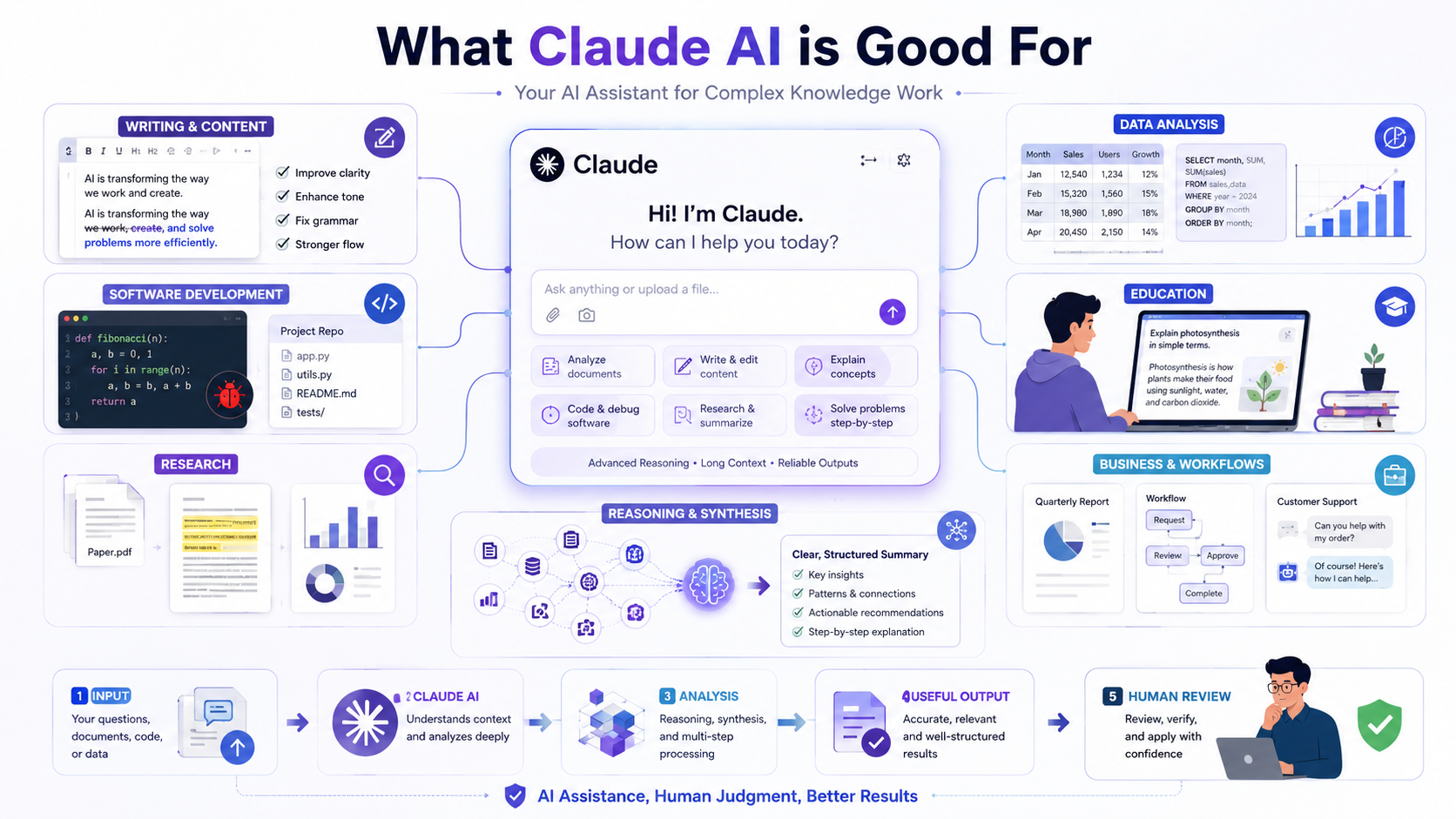
Claude is particularly useful for complex knowledge work, software development, research, and long-form content creation. Its ability to follow detailed instructions makes it practical for tasks that require several stages.
Writers can use Claude to create drafts, improve existing content, summarize research, and adapt material for different audiences. Editors can use it to review structure, clarity, tone, and consistency.
Developers can use Claude for coding, debugging, documentation, refactoring, and architecture discussions. Claude Code also extends its usefulness into software development workflows.
Researchers can provide large documents and ask Claude to identify themes, compare findings, or organize information. Students and educators can use it to explain difficult concepts in simpler language.
Businesses can also apply Claude to reports, customer-support workflows, internal documentation, and other text-heavy processes, similar to the broader applications covered in AI chatbots for business automation.
The strongest use cases usually involve reasoning, transformation, synthesis, and structured writing. Claude is less useful when a task requires guaranteed factual accuracy without verification.
Its capabilities also vary by model. Users should choose a model and plan based on the complexity, speed, context, and usage requirements of their work.
One major finding from this Anthropic Claude Review is Claude’s flexibility. It can support many workflows without being limited to one specific type of task.
Advanced Coding and Data Analysis
Claude is a strong option for technical workflows because it can reason through code and explain its suggestions. Developers can use it to generate functions, identify bugs, refactor existing code, and improve documentation.
Claude Code further expands these capabilities by providing an agentic coding workflow designed for software development. Anthropic describes Claude Code as a coding agent that can work across real development tasks, with newer model capabilities also discussed in this Claude Sonnet 5.0 guide.
Claude can also assist with data analysis. Users can provide structured information and ask for summaries, transformations, calculations, or explanations. It can help write SQL queries and interpret trends.
However, AI-generated code still requires testing. Claude may produce incorrect logic, overlook edge cases, or misunderstand an unfamiliar codebase.
The same principle applies to data analysis. Calculations and conclusions should be checked before they influence important business decisions.
For technical professionals, Claude’s biggest benefit is speed. It can reduce the time spent on repetitive coding and analysis tasks.
The findings in this Anthropic Claude Review suggest that Claude works best as a technical collaborator. It can accelerate development and analysis while leaving final testing and human judgment to the user.
Used carefully, it can improve productivity without replacing professional review.
Why Is Claude So Expensive?
Premium AI services can cost more because advanced models require substantial computing resources. Training frontier models involves large-scale infrastructure, specialized processors, engineering, research, and extensive safety testing.
Running these models also creates ongoing costs. Every user request requires computing resources, and complex tasks can require significantly more processing than simple questions.
Context size can influence costs as well. Models designed to process very large inputs need infrastructure capable of handling those workloads efficiently, while optimizing tokenization for AI performance and cost can also affect how efficiently AI systems process information.
Anthropic’s current model lineup also includes different pricing structures. API usage is generally charged according to input and output tokens, while consumer and enterprise plans use different subscription or usage models.
That means Claude may appear expensive compared with basic AI services. However, the value depends on how much work it can save.
For professionals, the cost can be reasonable when Claude reduces hours of writing, coding, research, or analysis. Casual users may find the free tier sufficient.
Ultimately, Claude’s price makes the most sense when measured against productivity gains, not against the cost of ordinary software subscriptions.
Infrastructure and Safety Research Costs
Operating an advanced AI assistant involves more than paying for servers. Anthropic must maintain computing capacity, improve model performance, monitor safety risks, and develop safeguards as capabilities increase.
Infrastructure costs can be significant because frontier models require large amounts of specialized computing power. Anthropic has continued expanding its relationship with Amazon Web Services to secure additional capacity for training and deploying Claude.
Safety research adds another layer of investment. Anthropic develops safeguards designed to reduce harmful or misused outputs while maintaining useful model capabilities.
Large context windows also require efficient infrastructure. Processing lengthy documents or complex codebases can demand more resources than short conversations.
These expenses help explain why premium AI plans and API usage can cost more than conventional software.
However, price alone does not determine value. A developer may recover the subscription cost through faster coding. A writer may save hours during research and editing.
For businesses, the calculation should include usage, productivity, security requirements, and administrative controls. That provides a more realistic picture than comparing subscription prices alone.
Frequently Asked Questions
How do I sign up for an account?
Signing up for an account is a straightforward process that takes only a few minutes. Users can visit the official website, enter an email address, or authenticate quickly using a preferred Google account. Once verified, you gain immediate access to the free tier to test out core features.
Can the tool browse the live internet?
The platform features built-in web search capabilities that allow it to retrieve up-to-date information from online sources. When answering queries that require current facts or recent news, it queries the web dynamically to provide accurate and timely responses.
Is my uploaded data kept private?
Privacy remains a core focus for the platform, with strict data protection policies governing user inputs. Data submitted through consumer interfaces is handled securely, and enterprise customers benefit from even stricter data governance and confidentiality agreements.
What are the main subscription tiers available?
The platform offers a free tier for casual users alongside paid plans designed for heavy individual users and teams. Paid tiers provide significantly higher usage limits, priority access during peak traffic hours, and early access to newly released features.
Conclusion
Choosing the right artificial intelligence assistant can significantly improve how you write, research, code, and manage daily work. This Anthropic Claude Review shows why Claude has become a strong competitor in the rapidly changing AI market, alongside other options such as free AI writing tools.
Claude stands out for natural writing, complex reasoning, coding support, and long-form knowledge work. Its large-context capabilities can also help users work with substantial documents and technical projects.
The platform is officially available in India, and Anthropic has expanded its local presence through a Bengaluru office and new partnerships.
Claude is not perfect, though. It can make mistakes, and users should verify important information. Pricing also depends on the plan, model, and amount of usage.
For writers, developers, researchers, and professionals, Claude can be a valuable productivity tool. Its strongest value appears when it becomes part of a repeatable workflow rather than a simple chatbot.
If you are curious about Claude, starting with the free option is a practical way to evaluate it. Test the tasks that matter most to you, compare the results with alternatives, and decide whether the performance justifies the cost.