
How Much RAM Does Your Android Phone Really Need in 2026?
When choosing a smartphone in 2026, understanding your Android phone RAM needs is more important than ever. Modern Android devices are no longer just for calling or browsing. Instead, they now handle AI tools, gaming, and heavy multitasking as standard features.
Moreover, manufacturers often advertise higher RAM numbers to attract buyers. However, more RAM does not always mean better real-world performance. In fact, Android’s memory management system is highly optimized and efficiently allocates resources in the background. You can learn more about how Android manages system memory in the official documentation here: Android Memory Management Guide
Still, app complexity has increased significantly. As a result, social media apps, AI assistants, and high-resolution games now consume more memory than before. Therefore, choosing the right RAM capacity becomes a balance between performance and cost.
In this guide, we break down real usage scenarios. Additionally, you will learn what each RAM tier offers and which one best matches your daily smartphone habits in 2026.
The Shift in Android Phone RAM Needs
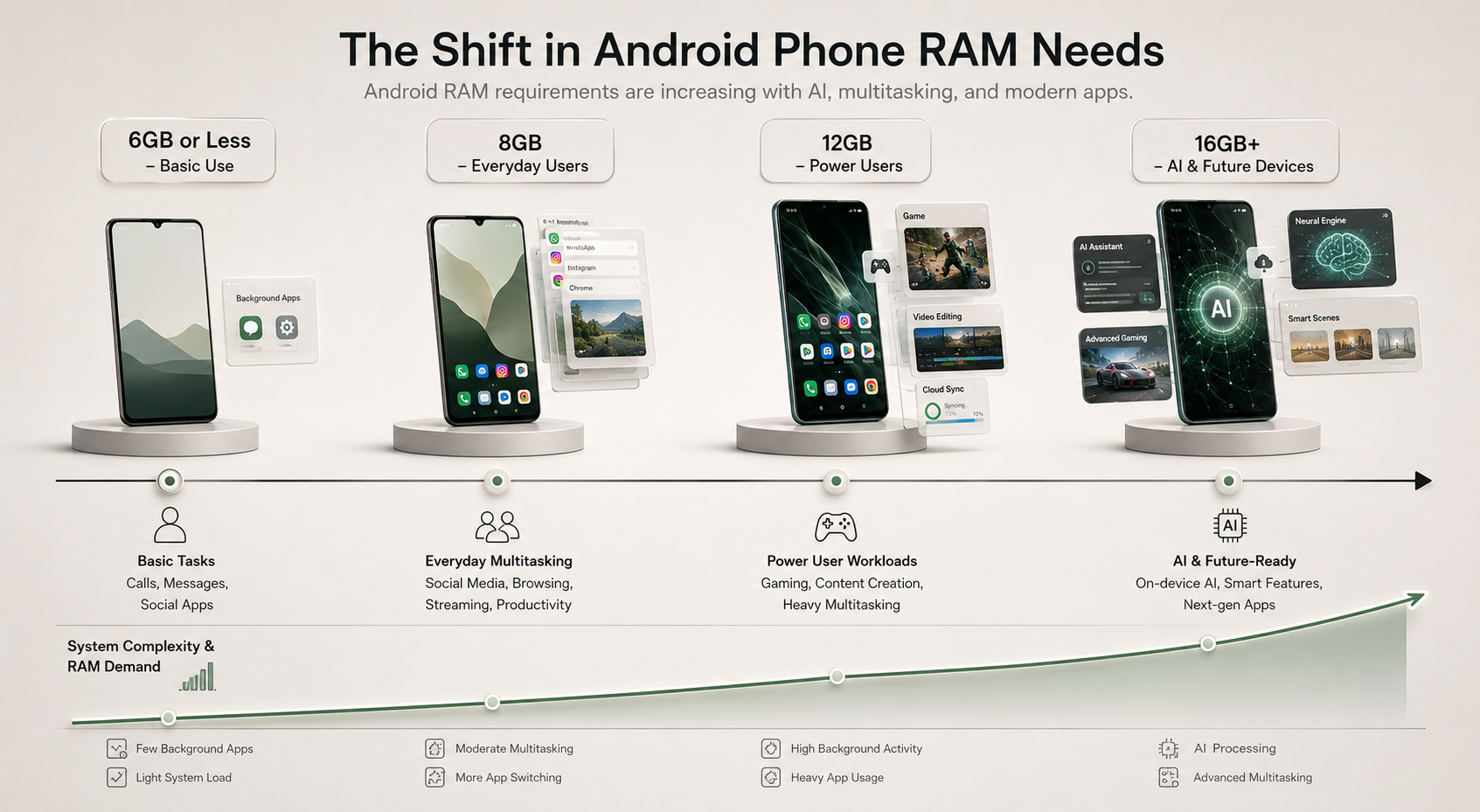
The Android phone RAM needs have changed dramatically over the past few years. Smartphones are now closer to portable computers than simple communication tools. Consequently, operating systems run more background services, AI features, and security processes than ever before.
Furthermore, apps stay active longer in memory. This improves speed; however, it also increases RAM demand. As a result, older memory standards no longer match modern usage patterns.
| RAM Capacity | Ideal User Profile (2026 Standard) |
|---|---|
| 6GB or Less | Basic use: calls, texts, light browsing |
| 8GB | Everyday users, social media, casual gaming |
| 12GB | Power users, multitasking, heavy gaming |
| 16GB+ | AI tasks, future-proofing, advanced editing |
Overall, this shift means users must think beyond simple app usage. In addition, RAM now directly affects multitasking smoothness, app reload frequency, and system responsiveness.
Why Background Tasks Matter
Background tasks play a major role in modern Android phone RAM needs. Every app you open leaves behind active data in memory. Consequently, this allows faster switching between apps without full reloads.
However, when RAM fills up, Android starts closing older processes. As a result, apps may restart when reopened. This can interrupt workflow and reduce smoothness during multitasking.
Key impacts of background activity include:
- Firstly, faster app switching when enough RAM is available
- Secondly, frequent reloads on low-RAM devices
- Additionally, increased battery usage due to repeated loading
- Finally, reduced performance during heavy multitasking
Therefore, efficient RAM management becomes essential. Devices with higher RAM maintain more apps in memory, which significantly improves overall user experience.
The Impact of Modern Operating Systems
Modern Android versions have significantly increased Android phone RAM needs. For instance, systems like Android 14 and Android 15 run more background services than earlier versions. These include security layers, privacy controls, and AI-based optimizations.
Moreover, these services constantly use a portion of system memory. While they improve performance and security, they also reduce available RAM for apps.
Key system impacts include:
- Always-on security and encryption services
- AI-based predictive app loading
- Background synchronization for cloud apps
- Enhanced notification and location services
As a result, even idle devices use more RAM than before. Therefore, baseline RAM requirements in 2026 are naturally higher.
Demystifying Mobile Memory Tiers
Understanding memory tiers is essential when evaluating Android phone RAM needs. Each RAM level is designed for a different type of user. Therefore, choosing the right one ensures smooth performance without overspending.
Lower tiers focus on basic usability, whereas higher tiers support multitasking and AI-driven features. Consequently, the difference becomes more noticeable with heavier apps and long-term usage.
In 2026, RAM tiers generally align like this:
- Entry-level: Basic communication and light browsing
- Mid-range: Balanced daily use and casual gaming
- High-end: Heavy multitasking and advanced apps
- Premium: AI processing and long-term performance stability
Ultimately, selecting the right tier depends on how long you plan to keep your phone and how intensively you use apps.
6GB or Less: The Bare Minimum
Devices with 6GB or less RAM represent the entry point of Android phone RAM needs. These phones are suitable only for very light users. For example, they handle calling, messaging, and basic browsing without major issues.
However, multitasking is limited. Therefore, apps often reload when switching between them, which can feel slow during regular use.
Common limitations include:
- Frequent app reloads
- Limited background app retention
- Slower performance with modern apps
- Reduced gaming capability
In conclusion, these devices are best for minimal smartphone usage and are not ideal for modern heavy app environments.
8GB: The Modern Baseline
8GB RAM is now considered the standard for most Android phone RAM needs. In general, it provides a balanced experience for everyday users. Most apps run smoothly, and multitasking feels responsive.
Additionally, you can comfortably switch between social media, web browsing, and music apps. Light gaming also performs well without noticeable lag.
Benefits include:
- Smooth everyday performance
- Efficient multitasking for common apps
- Stable gaming for casual titles
- Fewer app reloads compared to lower RAM devices
Therefore, for most users, 8GB is the sweet spot between performance and cost.
12GB: The Performance Sweet Spot
12GB RAM is ideal for users with higher Android phone RAM needs. In particular, it supports heavy multitasking, advanced gaming, and productivity apps with ease. Apps also stay active in the background longer, which reduces reloads.
Moreover, this tier is especially useful for professionals and gamers. It ensures smooth performance even under load.
Key advantages include:
- Strong multitasking performance
- Smooth high-end gaming experience
- Better handling of large apps
- Reduced system slowdowns
Overall, 12GB offers the best balance of speed, stability, and future-proofing for most power users.
On-Device AI and Your Smartphone Memory
AI features have significantly increased Android phone RAM needs. Today, smartphones run AI models directly on the device. These include voice assistants, image enhancement tools, and predictive typing systems.
As a result, these processes require continuous memory allocation. Unlike normal apps, they cannot always be fully closed.
Impacts include:
- Higher baseline RAM usage
- Faster AI-powered features
- Reduced free memory for apps
- Improved offline processing capabilities
Therefore, AI integration improves functionality but also increases hardware demands.
Reserved Spaces for Intelligence
On-device AI systems reserve part of the RAM permanently. Consequently, this ensures instant response for intelligent features. However, usable RAM for apps becomes slightly lower than total installed memory.
This reserved space supports:
- Real-time photo processing
- Voice recognition systems
- Predictive system behavior
- Smart notifications
Thus, while it improves user experience, it also increases overall Android phone RAM needs.
Future-Proofing Your Investment
Future-proofing is a key factor in modern Android phone RAM needs. As apps and operating systems continue to grow in complexity, RAM demands also rise each year.
Therefore, choosing higher RAM ensures longer device usability.
Benefits of future-proofing include:
- Longer device lifespan
- Better support for future apps
- Improved performance over time
- Reduced need for early upgrades
If you plan to keep your phone for 3–4 years, higher RAM is strongly recommended.
Smart Memory Allocation Tips
Optimizing memory usage helps improve overall Android phone RAM needs experience. Even with sufficient RAM, poor usage habits can still slow down performance.
Helpful tips include:
- Avoid unnecessary memory cleaner apps
- Keep only essential apps running
- Regularly update system software
- Monitor background-heavy apps
Therefore, good memory management ensures smoother performance and better battery efficiency.
FAQ SECTION
Is 8GB RAM enough for an Android phone in 2026?
Yes, 8GB RAM is generally enough for most Android users in 2026, especially for everyday smartphone usage. To begin with, modern Android optimization has improved significantly, which means the system manages memory more efficiently than older versions. As a result, common tasks like browsing the web, using social media apps, watching videos, and streaming music run smoothly without major performance issues.
In addition, 8GB RAM handles light multitasking quite well. For example, you can switch between apps like WhatsApp, Instagram, YouTube, and Google Maps without noticeable lag in most cases. However, when you push the device harder with heavier multitasking, the limitations start to show. Apps that were running in the background may reload more frequently when you return to them.
Furthermore, gaming performance is generally acceptable on 8GB devices for casual and mid-range titles. Nevertheless, high-end games or long gaming sessions may cause some background apps to close. Therefore, while 8GB is still a solid baseline in 2026, it is best suited for users who do not heavily rely on constant multitasking or advanced AI-based applications. Overall, it offers a balanced experience for average daily use without unnecessary cost.
Does more RAM improve Android phone camera quality?
More RAM does not directly improve the physical camera quality of an Android phone, since camera quality mainly depends on the sensor, lens, and image processing chip. However, it does play an important supporting role in overall camera performance. In particular, modern smartphone photography relies heavily on computational processing rather than just hardware capture.
For instance, features like HDR, night mode, portrait blur, and AI-based enhancements require temporary memory to process multiple image frames at the same time. As a result, higher RAM allows these processes to run more smoothly and quickly. This means you may notice faster photo processing, reduced shutter delay, and quicker saving times when taking multiple pictures in succession.
In addition, more RAM helps the camera app stay stable while other apps are running in the background. This becomes especially useful when you switch between the camera and other applications frequently, such as editing apps or social media platforms.
However, it is important to understand that RAM alone cannot improve sharpness, sensor quality, or optical performance. Instead, it simply ensures that advanced software-based image processing runs efficiently. Therefore, while RAM enhances the experience, it does not replace dedicated camera hardware improvements.
What happens when an Android phone runs out of RAM?
When an Android phone runs out of RAM, the system automatically activates its built-in memory management process. To begin with, Android is designed to handle this situation by prioritizing active applications over background ones. As a result, it starts closing older or unused apps to free up memory for the app you are currently using.
Consequently, you may notice that apps take longer to reopen because they need to reload from storage instead of staying in memory. This can slightly slow down multitasking, especially if you frequently switch between multiple heavy applications like games, browsers, or editing tools.
In addition, when RAM pressure is high, the system may also reduce background processes such as notifications syncing or app updates. This helps maintain stability but can temporarily affect responsiveness. Furthermore, repeated loading of apps can slightly increase battery usage because the device must repeatedly fetch data from storage.
Overall, running out of RAM does not crash the phone, but it does impact smoothness and efficiency. Therefore, devices with higher RAM provide a more stable experience, especially for users who multitask heavily or run demanding applications.
Should I pay extra for a 16GB RAM smartphone?
Whether you should pay extra for a 16GB RAM smartphone depends entirely on your usage pattern and long-term expectations. To start with, 16GB RAM is considered a premium specification designed for heavy users rather than everyday consumers. It is especially useful for people who run resource-intensive applications such as high-end mobile games, 4K video editing tools, or on-device AI models.
In addition, 16GB RAM provides better long-term performance stability. For example, it allows more apps to stay active in the background without reloading, even during intensive multitasking sessions. This can be beneficial for professionals who switch between productivity tools, communication apps, and creative software throughout the day.
However, for average users, the difference between 12GB and 16GB is often minimal in real-world usage. Most daily tasks such as social media, browsing, streaming, and light gaming do not fully utilize more than 12GB RAM. Therefore, spending extra money on 16GB may not provide noticeable improvements for casual users.
Ultimately, 16GB RAM is best seen as a future-proof or enthusiast-level choice. If you plan to keep your phone for several years or use heavy applications regularly, it can be a worthwhile investment. Otherwise, 12GB usually offers a more balanced price-to-performance ratio.
Does virtual RAM expansion actually help performance?
Virtual RAM expansion does provide some benefits, but its impact on performance is often misunderstood. To begin with, virtual RAM uses a portion of the phone’s internal storage to act as temporary memory. This allows the system to keep more apps open in the background when physical RAM is fully utilized.
As a result, users may notice fewer app reloads when switching between applications. This can improve multitasking convenience, especially on lower-RAM devices. However, it is important to understand that internal storage is significantly slower than actual RAM.
Therefore, while virtual RAM helps maintain app availability, it does not deliver the same speed or responsiveness as physical memory. In some cases, apps stored in virtual memory may take longer to resume compared to those stored in real RAM. Additionally, it does not improve gaming performance or heavy processing tasks in a meaningful way.
Overall, virtual RAM should be viewed as a supportive feature rather than a true performance upgrade. It is useful for light multitasking improvements, but it cannot replace the benefits of having more physical RAM.
CONCLUSION
Understanding Android phone RAM needs helps you choose the right smartphone in 2026. Ultimately, each RAM tier serves a different user type.
For example, 8GB suits casual users very well. Meanwhile, 12GB is ideal for power users who need smooth multitasking. On the other hand, 16GB is best reserved for advanced AI and long-term usage.
To understand how memory technology continues to evolve and impacts performance in modern devices, you can read this related guide:DDR5 vs DDR4 in 2026