
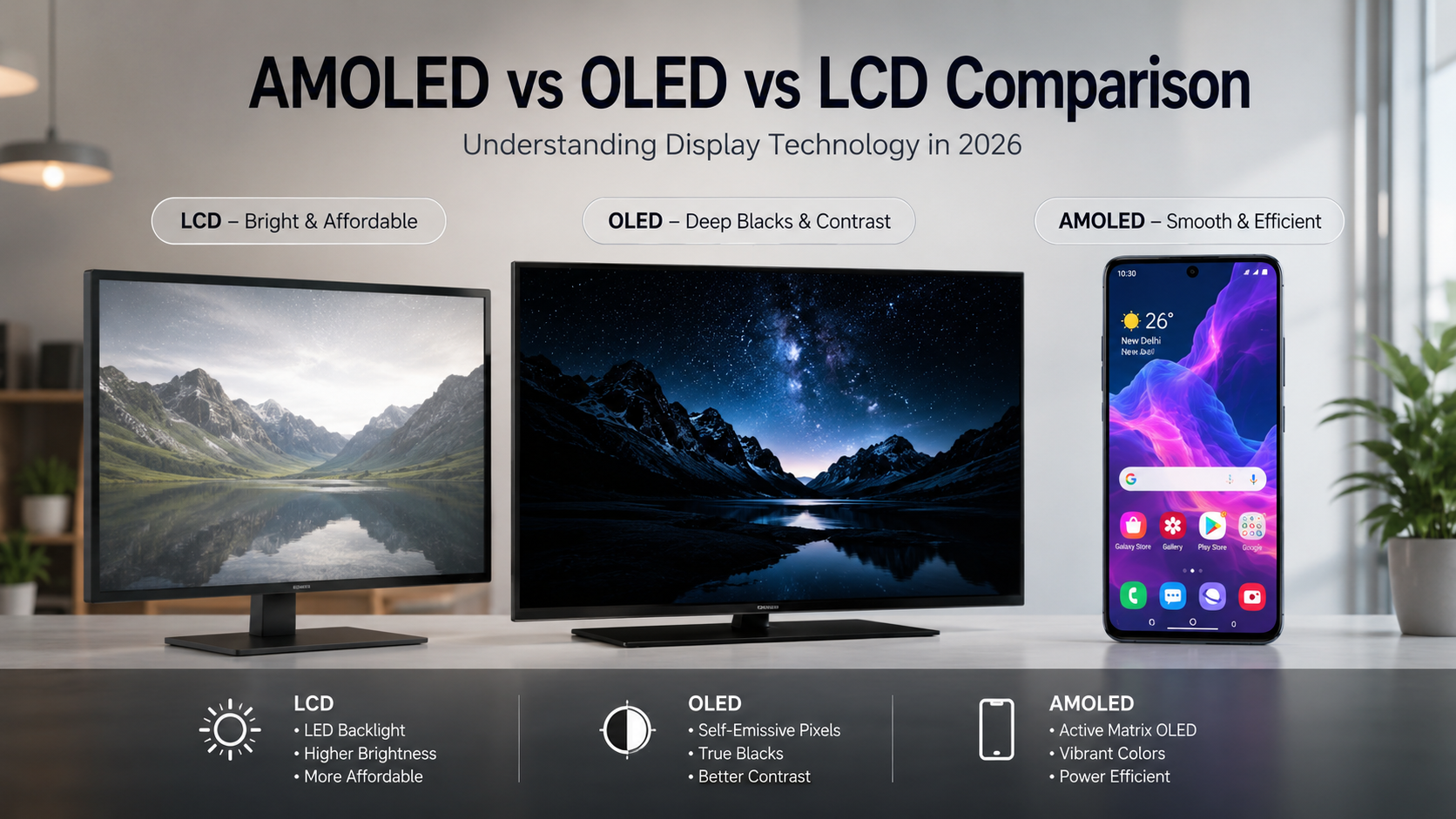
AMOLED vs OLED vs LCD Comparison Guide
The AMOLED vs OLED vs LCD comparison is essential for anyone buying a smartphone, TV, or laptop today. Modern displays define how you experience content, from color accuracy to battery efficiency and eye comfort. Understanding these differences helps you avoid marketing confusion and choose the right screen for your needs.
For technical reference on display behavior in mobile systems, you can explore the official Android graphics documentation at Google Android Developers platform, which explains how software optimizes rendering for different screen types.
Display technology affects daily use more than most people realize. It influences how sharp text looks, how deep blacks appear in movies, and how long your battery lasts during heavy use. In this guide, we break down LCD, OLED, and AMOLED in simple terms. You will also learn which technology suits gaming, streaming, outdoor use, and budget devices so you can make a confident buying decision.
Core Technology Behind Modern Displays
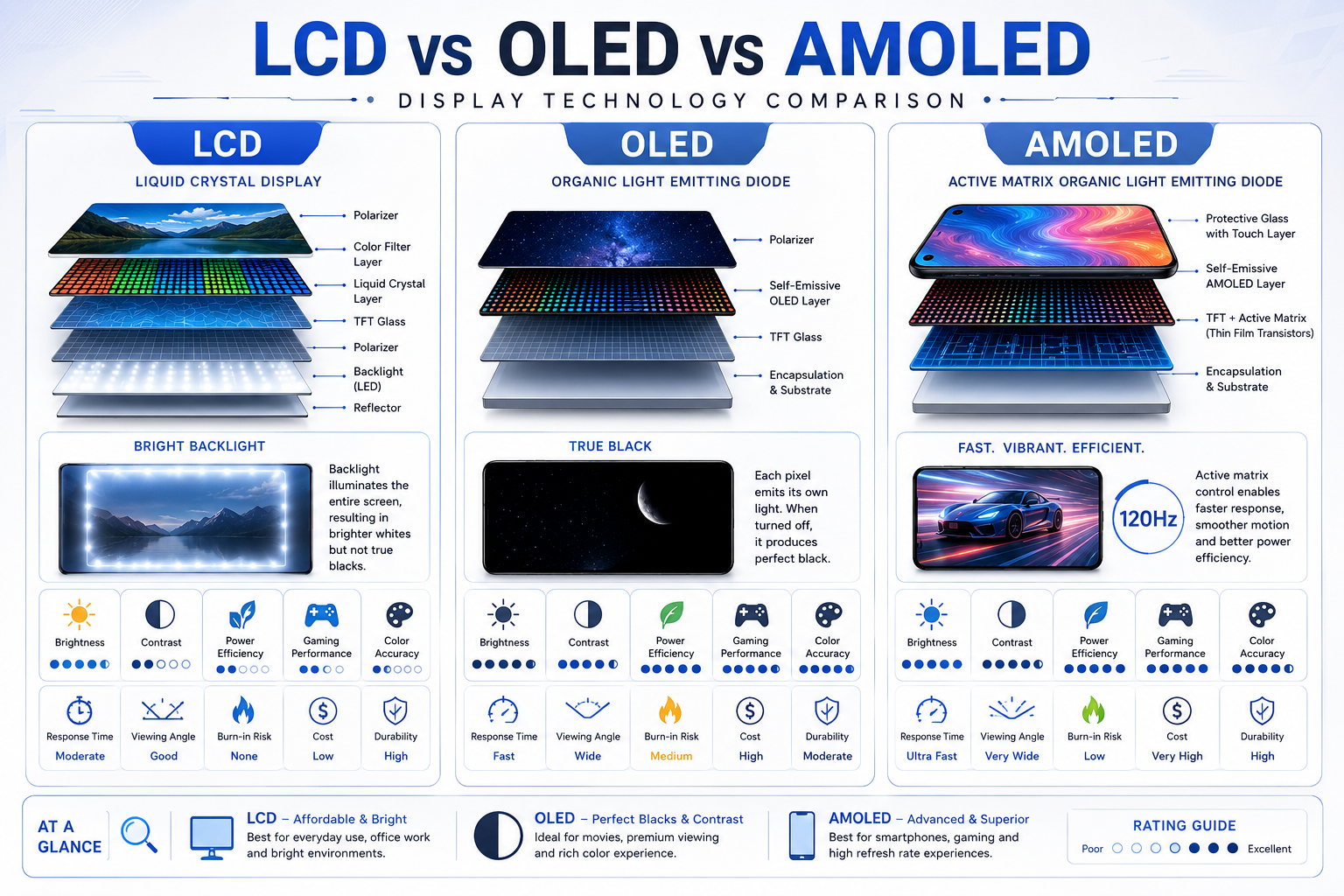
Understanding the AMOLED vs OLED vs LCD comparison starts with how each screen produces light. LCD uses a backlight system, while OLED and AMOLED generate light at the pixel level. This fundamental difference shapes everything from contrast to power efficiency.
LCD panels rely on a constant LED backlight shining through liquid crystals. OLED removes this backlight completely, allowing each pixel to emit its own light. AMOLED enhances OLED by adding an active matrix layer for precise pixel control and faster refresh response.
These structural differences determine performance in real-world usage. LCD focuses on brightness and durability. OLED prioritizes contrast and cinematic visuals. AMOLED improves responsiveness and energy efficiency for mobile devices. Once you understand this foundation, it becomes easier to see why each display behaves differently in everyday tasks like gaming, reading, or watching videos.
LCD Technology Explained
In the AMOLED vs OLED vs LCD comparison, LCD remains the most traditional and widely used display type. It works by using a constant LED backlight that passes through liquid crystal layers and color filters to create images.
Because the backlight is always active, LCD screens struggle to produce true blacks. Instead, dark areas often appear slightly gray. However, this design also brings advantages. LCD panels can achieve very high brightness levels, making them ideal for outdoor visibility and budget-friendly devices.
Key benefits of LCD include:
- Strong brightness in sunlight
- Lower manufacturing cost
- Long-lasting panel stability
- No risk of burn-in
Despite newer technologies, LCD is still common in monitors, TVs, and entry-level smartphones. It offers reliable performance, especially for users who prioritize affordability and durability over deep contrast or cinematic visuals.
OLED Technology Explained
OLED plays a central role in the AMOLED vs OLED vs LCD comparison because it introduces self-emissive pixels. Each pixel generates its own light, which eliminates the need for a backlight entirely.
This structure allows OLED displays to turn off individual pixels completely. As a result, they produce true blacks and extremely high contrast ratios. Dark scenes in movies appear more realistic and immersive compared to LCD panels.
OLED advantages include:
- Perfect black levels
- Infinite contrast ratio
- Vibrant color reproduction
- Thin and flexible design possibilities
However, OLED panels can be more expensive and may face burn-in risks over long-term static usage. Despite this, they are widely used in premium TVs and high-end smartphones because of their unmatched visual quality and cinematic experience.
AMOLED Technology Explained
AMOLED is an advanced version in the AMOLED vs OLED vs LCD comparison. It builds on OLED technology by adding an Active Matrix layer that controls each pixel individually using thin-film transistors.
This improvement allows faster refresh rates and smoother animations, which is why AMOLED is widely used in smartphones and wearables. It also improves power efficiency by adjusting pixel activity dynamically based on screen content.
Key advantages of AMOLED:
- Faster response time for gaming
- Better power efficiency in dark mode
- High refresh rate support
- Superior contrast and color depth
AMOLED screens are especially popular in Android devices. They deliver vibrant visuals while balancing performance and battery life, making them ideal for modern mobile experiences.
Performance Comparison: AMOLED vs OLED vs LCD
When comparing AMOLED vs OLED vs LCD comparison in performance, each technology excels in different areas. OLED and AMOLED dominate in contrast and color quality, while LCD leads in brightness and consistency.
OLED and AMOLED offer perfect blacks because pixels turn off completely. This creates superior viewing experiences in dark environments. LCD, however, performs better in bright sunlight due to its powerful backlight system.
Performance breakdown:
- Contrast: OLED/AMOLED win
- Brightness: LCD wins
- Color accuracy: OLED/AMOLED superior
- Motion smoothness: AMOLED often best
Gamers and media consumers prefer OLED or AMOLED for immersive visuals. Outdoor users and office setups may still prefer LCD for readability and stability.
Battery Efficiency and Power Usage
Battery performance is a major factor in the AMOLED vs OLED vs LCD comparison. Each technology consumes power differently based on how it produces light.
LCD panels use a constant backlight, so power consumption remains steady regardless of screen content. Whether you view dark or bright images, energy usage stays similar.
AMOLED and OLED behave differently. Since pixels turn off in dark areas, they consume less power when displaying dark themes or black backgrounds. This makes dark mode especially effective on AMOLED smartphones.
Key insights:
- LCD = consistent power usage
- OLED/AMOLED = variable power usage
- Dark mode improves AMOLED battery life
For mobile users, AMOLED often provides better battery efficiency in real-world usage, especially when browsing or using apps with dark interfaces.
Pricing and Manufacturing Differences
Pricing in the AMOLED vs OLED vs LCD comparison depends on manufacturing complexity and scale. LCD is the cheapest to produce due to its mature and widely optimized production process.
OLED panels are more expensive because producing large, defect-free organic layers is technically challenging. AMOLED panels, however, benefit from mass production in smartphones, which helps reduce costs for smaller displays.
Key points:
- LCD: lowest cost, high availability
- OLED: premium large-screen technology
- AMOLED: optimized for mobile production
Interestingly, AMOLED is not always cheaper than OLED. Instead, pricing depends on device size and production yield. Large OLED TVs remain expensive, while smartphone AMOLED panels are more cost-efficient due to scale.
Choosing the Best Display for Your Needs
The AMOLED vs OLED vs LCD comparison does not have a single winner. Each technology suits different user needs and budgets.
Choose AMOLED or OLED if you want:
- Deep blacks and high contrast
- Better media consumption experience
- Efficient battery usage in dark mode
- Premium smartphone visuals
Choose LCD if you prefer:
- Budget-friendly devices
- High brightness for outdoor use
- Long-term screen stability
- Reduced burn-in concerns
Your decision should depend on how you use your device daily. Media lovers benefit from OLED or AMOLED, while practical users may find LCD more reliable and cost-effective.
FAQs
Is AMOLED or OLED better for eyes?
AMOLED and OLED displays are often considered more comfortable for the eyes compared to LCD, but the difference is not absolute. The main reason is that both OLED and AMOLED use self-emissive pixels, which means each pixel produces its own light. This allows true blacks, better contrast, and reduced overall screen glow. In low-light conditions, this can reduce perceived eye strain because the screen does not rely on a strong backlight like LCD panels do.
However, eye comfort depends heavily on usage habits and brightness levels. At higher brightness, even OLED-based screens can cause fatigue if used for long periods. Another important factor is PWM (Pulse Width Modulation) flickering, which many AMOLED panels use to control brightness. Some users are sensitive to this flickering and may experience headaches or eye discomfort, especially at low brightness settings.
Overall, neither technology is universally “better” for eyes. Comfort depends on brightness settings, screen quality, and user sensitivity. Using adaptive brightness and enabling dark mode on AMOLED or OLED screens often improves comfort significantly.
Which is better: AMOLED, OLED, or LCD?
There is no single “best” display technology in every situation, but understanding their strengths helps you choose wisely. In most modern smartphones, AMOLED is often considered the most balanced option. It combines OLED’s self-emissive pixel technology with an active matrix system, which improves refresh rate control, touch responsiveness, and power efficiency. This makes AMOLED ideal for mobile devices where battery life and smooth performance matter most.
OLED displays, especially in televisions, are widely regarded as the premium choice for picture quality. They offer excellent color accuracy, infinite contrast ratios, and deep blacks. This makes OLED TVs highly preferred for movie watching and cinematic experiences in controlled lighting environments. However, they can be more expensive, especially for larger screen sizes.
LCD technology remains popular because of its affordability, durability, and consistent brightness. LCD screens perform well in bright outdoor conditions since their backlight can produce strong, uniform illumination. They are also less prone to burn-in, making them reliable for long-term static usage like office monitors or public displays.
In summary, AMOLED is best for smartphones, OLED excels in premium TVs, and LCD remains the most practical and budget-friendly option. The right choice depends on your use case rather than a universal ranking.
Is the Pixel 7 OLED or AMOLED?
The Google Pixel 7 uses an AMOLED display, specifically an OLED panel with an active matrix structure. This means it belongs to the OLED family but includes additional control technology that improves performance, responsiveness, and power efficiency. Google uses this display type to enhance the overall user experience in Android devices, especially when it comes to smooth animations and vibrant color output.
AMOLED technology in the Pixel 7 allows each pixel to emit its own light. This results in deep blacks and high contrast, especially when using dark mode. Since inactive pixels are completely turned off, the display also consumes less power when showing darker interfaces, which helps improve battery life in everyday use.
In practical terms, the Pixel 7’s AMOLED screen delivers a premium viewing experience. It combines sharp text rendering, vivid colors, and efficient power usage. This is why most modern flagship Android phones now prefer AMOLED technology over traditional LCD panels for better performance and visual quality.
What is display burn-in?
Display burn-in is a phenomenon where a faint, permanent image remains visible on a screen even after the content has changed. It is most commonly associated with OLED and AMOLED displays because these screens use organic compounds that degrade over time. When static elements like navigation bars, logos, or status icons remain on the screen for long periods, those pixels age unevenly compared to surrounding areas.
This uneven wear leads to a ghost-like imprint that can become permanent in severe cases. However, modern OLED and AMOLED displays include multiple protection mechanisms to reduce this risk. These include pixel shifting, automatic brightness adjustments, and screen dimming when static content is detected. Software-level protections in Android and other operating systems also help distribute pixel usage more evenly.
In real-world usage, burn-in is uncommon for most users who vary their content and avoid leaving static images at high brightness for extended periods. Watching videos, gaming, and regular app usage typically prevent this issue from occurring under normal conditions.
Why do outdoor displays use LCD?
Outdoor displays still widely use LCD technology because it handles brightness and environmental conditions more reliably over long periods. LCD panels rely on a strong LED backlight that can produce very high and stable brightness levels. This makes them easier to read under direct sunlight, where visibility is a major challenge for most screen technologies.
AMOLED and OLED displays, while excellent for contrast and color quality, face limitations in outdoor environments. When forced to operate at maximum brightness for extended periods, their organic pixels consume more power and generate more heat. Over time, this can accelerate pixel degradation and reduce display lifespan. This makes them less suitable for continuous outdoor signage or public information systems.
Because of these advantages—high brightness, durability, and lower cost—LCD remains the preferred choice for outdoor and industrial display applications, even as OLED and AMOLED dominate premium consumer devices.
Conclusion
The AMOLED vs OLED vs LCD comparison shows that no single display technology is perfect for everyone. Each option offers unique strengths that suit different use cases and budgets.
LCD remains the most practical choice for affordability and brightness. OLED delivers unmatched cinematic quality with perfect blacks. AMOLED refines OLED technology for mobile devices, offering better efficiency and smoother performance.
When choosing your next device, consider how you use your screen daily. If you value media quality and dark-mode efficiency, AMOLED or OLED is ideal. If you prioritize cost and outdoor visibility, LCD is still highly reliable. Understanding these differences helps you make smarter, long-term decisions in today’s display-driven world.
For more helpful tech comparisons and practical buying guides, you can also read this detailed breakdown of cloud storage vs external hard drives here: cloud storage vs external hard drives guide