
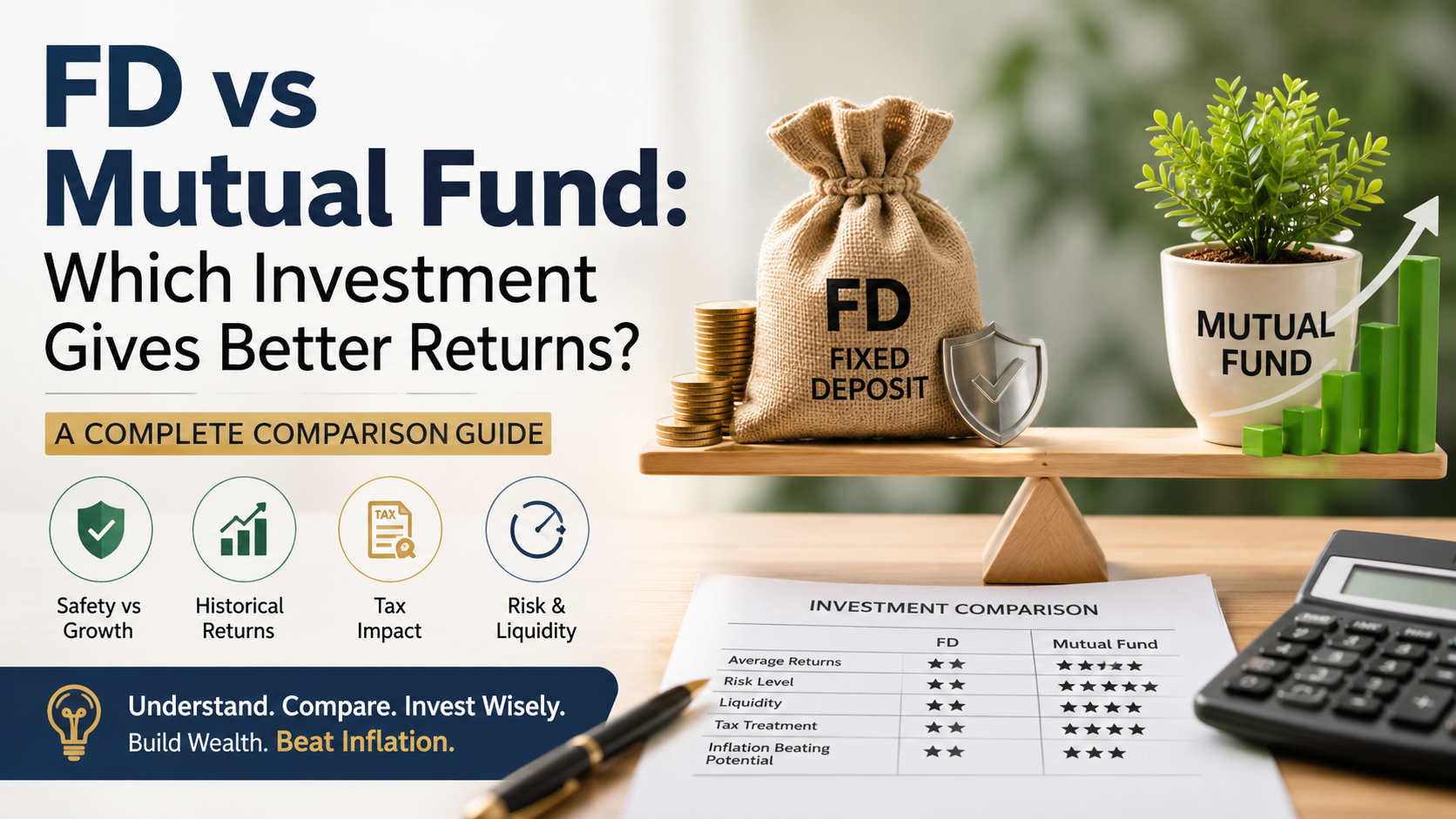
FD vs Mutual Fund: Which Investment Gives Better Returns?
Choosing where to park your hard-earned money often comes down to a classic debate: fixed deposits or market-linked schemes. When evaluating an FD vs mutual fund, investors frequently find themselves torn between guaranteed safety and the potential for higher growth. Navigating this financial crossroads requires a clear understanding of how different asset classes build wealth over time. To make informed choices, smart investors often look at data from authority bodies like the Securities and Exchange Board of India to monitor market standards and regulatory safety measures. Understanding these metrics helps you align your personal financial goals with the right investment vehicles.
This topic matters because inflation quietly erodes the purchasing power of idle cash every single year. Choosing an underperforming asset can set your financial timeline back by decades. In this comprehensive guide, we will break down the structural differences between fixed income and market-linked portfolios. We will analyze historical data, evaluate risk factors, and look closely at tax implications. By the end of this article, you will know exactly which option fits your investment horizon and risk tolerance. We will provide the deep analytical framework required to transform basic savings into a high-performing wealth engine.

Understanding the Core Setup of an FD vs Mutual Fund
A Fixed Deposit (FD) is a traditional financial instrument offered by banks and non-banking financial companies. You invest a lump sum for a specific tenure at a predetermined interest rate. The issuing bank guarantees your principal amount and interest payouts. This makes it a highly predictable choice for conservative savers who cannot afford capital losses. Because the terms are locked at entry, you know exactly how much money you will receive at maturity. This predictability simplifies long-term budgeting and provides a sense of total security.
Conversely, mutual funds pool money from multiple investors to purchase a diversified portfolio of securities. These portfolios can include equities, corporate bonds, and government money market instruments. Professional fund managers oversee these investments to maximize growth based on specific fund objectives. Consequently, the performance of these funds relies directly on market movements rather than a fixed contractual promise. This structure allows ordinary individuals to access diversified commercial opportunities that would otherwise require immense capital and deep financial expertise to manage independently.
Comparing Fixed Income Stability and Market-Linked Growth
The core difference between these two paths lies in how they generate earnings. FDs offer absolute certainty because market fluctuations do not affect your interest rate. Even if the stock market crashes, your bank contract remains valid. This stability offers peace of mind but usually delivers modest growth that barely keeps pace with rising living costs. Over reliance on this security can quietly stall your long-term retirement planning goals.
Mutual funds do not offer guaranteed payouts. Instead, they provide market-linked growth, which can fluctuate wildly in the short term. However, history shows that diversified equity portfolios regularly outperform fixed income instruments over longer horizons. By accepting short-term volatility, you position your capital to benefit from compounding corporate profits and economic expansion. This volatility is simply the price investors pay to achieve substantial, inflation-beating capital growth over time.
Deep Dive: Fixed Deposit Interest vs Mutual Fund Performance
When we look at historical performance data over the last decade, a clear performance gap emerges. Traditional bank fixed deposits have offered interest rates hovering between 5% and 7.5% depending on economic cycles. When you factor in inflation and compounding price increases, the real rate of return on an FD often drops close to zero or even becomes negative. This means your money grows in nominal numbers but loses actual purchasing power over time.
In contrast, equity mutual funds have historically delivered average annual compounded growth rates of 12% to 15% over long-term windows. Debt-focused mutual funds, which are more conservative, generally yield between 7% and 9%. While past performance never guarantees future results, the compounding effect of these higher percentages dramatically changes wealth accumulation over a ten-year period. This performance gap makes mutual funds the preferred vehicle for long-term aspirations.
The Power of Compounding in Action
To understand the difference clearly, let us look at a practical example. Imagine investing a single lump sum of $10,000 into both options for ten years. At a steady 6% annual interest rate, your fixed deposit investment grows to roughly $17,908. This is a predictable, safe increase, but it lacks aggressive momentum. It serves well for capital preservation but fails to create significant new wealth.
At an average annual return of 12% in an equity fund, your investment climbs to approximately $31,058. The gap of over $13,150 highlights the significant cost of choosing absolute safety over calculated market risk. Over twenty or thirty years, this wealth gap widens exponentially into hundreds of thousands of dollars. This stark contrast shows why understanding asset allocation is vital for long-term prosperity.
Investment Return Comparison Table (10-Year Horizon)
| Investment Metric | Fixed Deposit (FD) | Equity Mutual Fund |
| Initial Principal | $10,000 | $10,000 |
| Assumed Growth Rate (CAGR) | 6% Annual Interest | 12% Estimated Return |
| Estimated Maturity Value | $17,908 | $31,058 |
| Total Wealth Generated | $7,908 | $21,058 |
| Primary Financial Goal | Capital Preservation | Aggressive Growth |
Risk Profiles and Asset Liquidity Options
Every investment involves a trade-off between risk and reward. FDs carry almost zero risk because government-backed insurance schemes protect bank deposits up to specific statutory limits. Therefore, defaults are incredibly rare, making them ideal for emergency reserves or short-term needs. They provide an unshakeable foundation for your immediate financial survival net.
Mutual funds range from low-risk overnight debt funds to high-risk small-cap equity funds. Diversification helps mitigate this risk by spreading your money across dozens of underlying stocks or bonds. Additionally, mutual funds generally offer superior liquidity. You can redeem most open-ended fund units on any business day, whereas breaking an FD prematurely usually triggers financial penalties and reduces your total interest earnings. This flexibility gives mutual funds a clear operational advantage.
FAQ SECTION
Which investment gives higher returns, FD or mutual fund?
Mutual funds generally give significantly higher returns than fixed deposits over a long-term investment horizon. Historical market data shows that diversified equity mutual funds often deliver compounded annual growth rates between 12% and 15% over periods stretching beyond five years. On the other hand, bank fixed deposits typically offer fixed interest rates between 5% and 7.5%. While fixed deposits provide absolute certainty and safety, they rarely beat inflation effectively.
Mutual funds leverage market growth and corporate earnings to provide superior wealth accumulation, though they do come with market risks. By pooling resources into diverse corporate shares, mutual funds capture economic expansion in ways a fixed bank contract simply cannot match. Therefore, if your primary goal is maximizing long-term wealth rather than protecting immediate cash, mutual funds are historically the much more effective choice. They consistently convert small, disciplined contributions into substantial nest eggs over time.
Is it safe to invest all my savings in mutual funds?
No, it is generally unwise to invest all your savings in mutual funds, especially if you need immediate cash accessibility. Welfare planning requires a tiered approach to asset safety. While mutual funds offer excellent growth potential, they remain vulnerable to market volatility and short-term downturns. If an economic emergency hits during a market correction, you might be forced to liquidate your fund units at a heavy loss. This destroys your compounding progress and locks in negative returns permanently.
A balanced financial strategy involves keeping an emergency fund in a highly secure, predictable avenue like a bank fixed deposit. Fixed deposits guarantee that your emergency money is available down to the exact penny whenever you face unexpected hardships. After securing your short-term survival needs, you can safely allocate your remaining surplus to diversified mutual funds to pursue aggressive wealth generation without fear.
What are the tax implications on FD vs mutual fund returns?
Taxation differs drastically between these two investment vehicles and can impact your final net earnings significantly. The interest earned from a fixed deposit is added directly to your annual income and taxed according to your applicable income tax slab rate. For individuals in high-income brackets, this treatment can wipe out a massive portion of their interest gains every fiscal year. It makes the real, post-tax return of fixed deposits look even less attractive against inflation.
Conversely, mutual fund returns face capital gains taxation based on your holding period. Equity funds held for over a year incur long-term capital gains tax, which often features lower tax rates compared to high income tax slabs. Additionally, you only pay this tax when you actually sell your mutual fund units, allowing your money to compound tax-free in the meantime. Consequently, mutual funds generally offer much better long-term tax efficiency for most investors.
Can I lose my principal money in a fixed deposit?
Losing your principal money in a bank fixed deposit is extremely unlikely because these products are designed primarily for capital preservation. Most national banking systems include robust government-backed deposit insurance corporations that safeguard individual account balances up to specific statutory limits. Unless the issuing financial institution undergoes a complete, unbacked collapse that exceeds government insurance thresholds, your principal remains entirely safe. This structural protection makes fixed deposits one of the most secure financial instruments available.
However, you must remember that while your nominal principal is completely secure, you face a hidden risk called inflationary loss. If inflation runs at 7% and your fixed deposit only pays 6% interest, your money is technically losing purchasing power every single day. So while you will never see a lower number on your bank statement, the actual real-world value of your savings will diminish over long periods.
How long should I hold a mutual fund to see good returns?
You should ideally hold equity mutual funds for a minimum of five to seven years to achieve strong, stable returns. Short-term market cycles are inherently unpredictable and can show sharp negative movements due to macroeconomic changes, political shifts, or global supply chain issues. However, extending your investment horizon allows the underlying companies to grow their corporate earnings and recover from temporary market corrections. Time dampens volatility and unlocks the true power of compounding growth.
If you try to trade mutual funds over months or weeks, you are essentially gambling on short-term market psychology. For shorter horizons under three years, conservative options like debt mutual funds or traditional fixed deposits are much more appropriate choices because they protect your timeline. Giving your equity mutual funds at least five years ensures that temporary downturns become minor blips on a long, upward trajectory of wealth.
CONCLUSION
Choosing between an FD vs mutual fund ultimately depends on your personal financial goals, time horizon, and emotional tolerance for market volatility. Fixed deposits provide an irreplaceable layer of safety and predictability, making them perfect for short-term goals and emergency funds. However, relying solely on fixed income products can leave your capital vulnerable to inflation over time. It can severely restrict your financial freedom during your retirement years if your money fails to grow.
For long-term wealth creation, mutual funds offer a powerful engine fueled by economic growth and compounding interest. If you want to dive deeper into fixed payments versus dynamic systematic plans, you can review this analysis on SIP vs FD which is better to optimize your monthly capital outlays. By matching your investment timeline with the right mix of stable and growth-oriented assets, you can protect your current financial security while building future wealth. Balance remains the absolute key to financial success. Utilizing both instruments strategically ensures you enjoy both short-term peace of mind and long-term financial abundance.