

Why Is the World Losing Color?
Why is the world losing color? Look around your living room, walk down a city street, or browse a car dealership. You may notice a growing preference for neutral colors. Shades of grey, white, black, and beige dominate many modern products, buildings, and interiors. Meanwhile, vibrant greens, mustard yellows, and deep burgundies often receive less attention in mainstream design.
The question of why is the world losing color involves changing consumer preferences, global manufacturing, modern architecture, and cultural trends. Research from the Science Museum Group provides background on how materials, technology, and design have shaped everyday life. However, this trend does not affect every industry or region equally. Bright colors remain popular in fashion, entertainment, and many consumer products.
In this guide, we explore why modern design often favors neutral shades and why cities can appear increasingly grey. We also examine whether the natural world is losing its vibrant colors, drawing on information from the National Oceanic and Atmospheric Administration (NOAA) about coral bleaching. Finally, discover whether science can create new colors, which pigments are historically rare, and how to protect fabrics, artwork, and household materials from fading.
Why is everything losing its color?
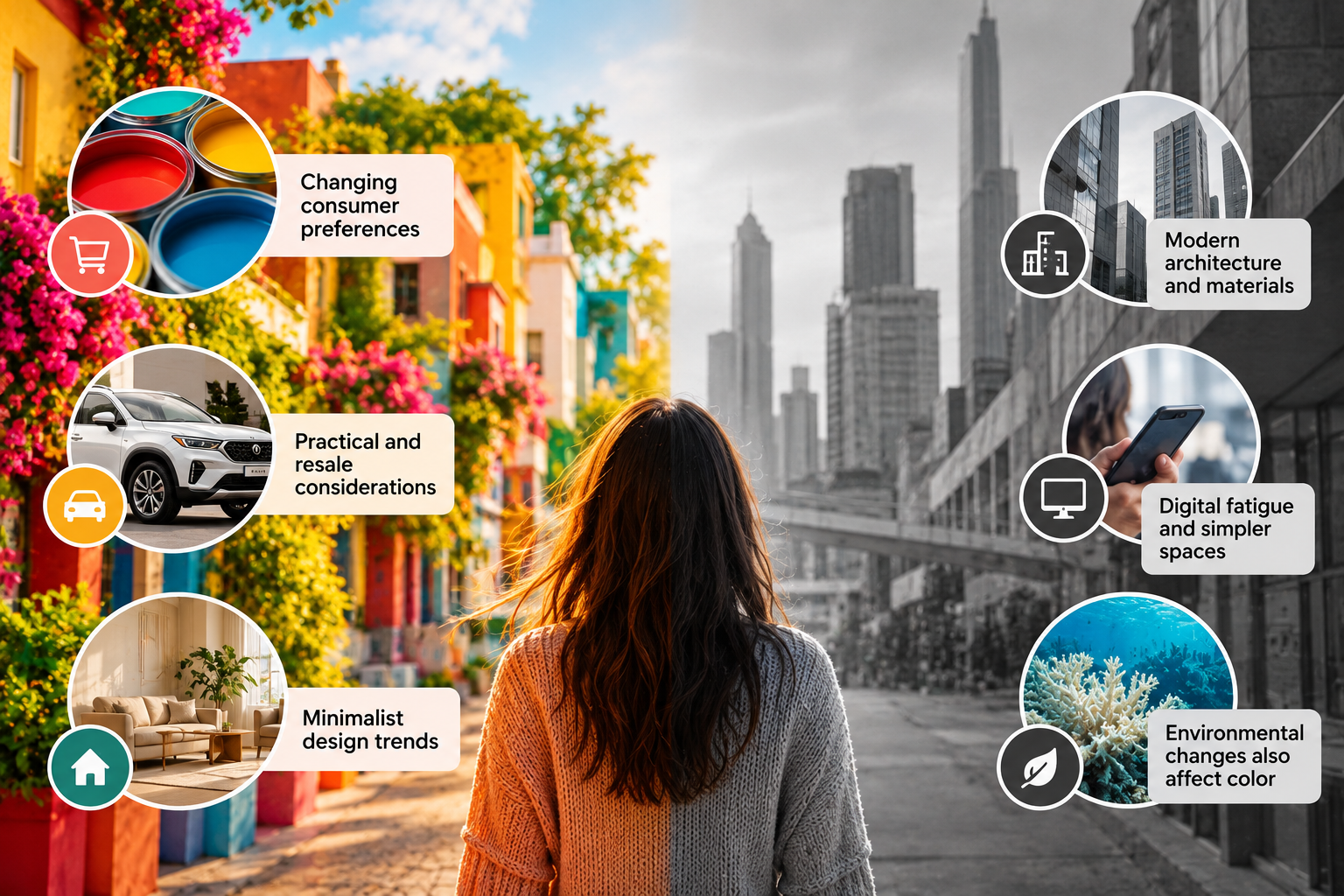
The world may appear less colorful because many modern products favor neutral shades. Global manufacturing, changing consumer preferences, and practical business decisions all contribute to this trend. Companies often sell products across different countries and cultures. Neutral colors, such as black, white, and grey, can appeal to a wider range of customers.
Manufacturers also benefit from standardized finishes. Producing fewer color variations can simplify inventory management and reduce the complexity of manufacturing and distribution. However, these savings depend on the product and production process.
Consumer behavior reinforces the trend. Many buyers choose neutral furniture, vehicles, and electronics because these colors fit different styles and remain appealing for longer. This does not mean bright products have disappeared. Instead, neutral colors often serve as safer choices for everyday purchases. Businesses also consider colors that complement their company’s branding when selecting product designs and visual identities.
The result is a visual environment where many mass-produced objects share similar shades. The world is not necessarily losing every color; modern markets are often choosing fewer colors for the products we see most frequently. Understanding which colors suit your personal style can also help you make more intentional choices when selecting colorful products and accessories.
The Role of International Resale Markets
Resale value can influence color choices, particularly when people buy expensive products. Vehicles provide a useful example. Buyers may prefer neutral car colors because they are versatile and familiar to a broad audience. Some neutral shades can also make a vehicle easier to market to different potential buyers.
However, resale performance depends on several factors. Vehicle condition, mileage, brand, model, local demand, and maintenance history often matter more than color alone. Bright colors can also attract buyers when they suit a particular model or market.
Similar considerations influence furniture and other household purchases. People may choose neutral designs because they match different interiors and remain usable after a move. This preference encourages manufacturers to offer familiar shades across their product ranges.
The effect becomes more noticeable when millions of people make similar decisions. Companies respond to demand, and buyers encounter fewer unusual color options in mainstream stores. Resale considerations can reinforce neutral design trends, although they do not explain every purchasing decision or establish that colorful products always lose value.
Why is the world so grey now?
Modern architecture and urban design help explain why many places appear increasingly grey. Concrete, steel, asphalt, and glass dominate numerous contemporary buildings and public spaces. These materials often create neutral visual environments, especially when architects leave concrete and metal surfaces exposed.
Minimalist design has also influenced homes, offices, shops, and commercial buildings. Grey walls, white surfaces, and muted furnishings can create a clean, understated appearance. Designers frequently use these shades because they work with different materials and decorative styles. If you prefer a more expressive look, learning how to add color to your wardrobe offers another way to introduce vibrant shades into everyday life.
Urban infrastructure adds to the effect. Roads, parking areas, sidewalks, and large buildings occupy substantial visual space in many cities. When these surfaces dominate the landscape, colorful plants, signs, and architectural details can become less noticeable.
This does not mean every modern city is becoming less colorful. Some architects use bold facades, public art, landscaped spaces, and colorful lighting to create visual variety. The perception of a greyer world often reflects the materials and design choices surrounding us, rather than a universal decline in color.
Digital Fatigue and Minimalist Spaces
Digital screens expose people to a constant stream of colorful images, advertisements, videos, and notifications. Many websites and applications also use bright accents to attract attention. After spending hours in these environments, some people may prefer quieter visual surroundings.
Minimalist interiors offer one way to create that contrast. Neutral walls, simple furniture, and limited decoration can make a room feel organized and less visually busy. Designers may use these choices in homes, offices, and commercial spaces to establish a calm atmosphere.
However, the connection between screen exposure and neutral interior design requires caution. It is reasonable to suggest that some people prefer simpler spaces after busy days, but there is no universal evidence that digital fatigue directly causes society to choose grey interiors.
Other factors also influence these decisions. Interior trends, property marketing, maintenance requirements, and personal taste can all encourage neutral palettes.
As a result, digital culture may contribute to the appeal of minimalist spaces, but it is only one possible explanation. The popularity of neutral interiors reflects several overlapping preferences rather than a single psychological cause.
Is the world losing colours?
To understand why the world is losing color, we must distinguish changes in human-made environments from changes in nature. Buildings, vehicles, and consumer products may look increasingly neutral because of design trends. Natural ecosystems, however, follow different processes.
Climate change, pollution, and habitat destruction can affect the colors of living organisms and landscapes. For example, coral bleaching occurs when stressed corals lose much of the algae that provide their color and energy. Rising ocean temperatures are a major cause of mass bleaching events. Other environmental pressures can also damage coral reefs.
Changes in land use can alter the colors of entire landscapes. Forests may be replaced by roads, buildings, or agricultural fields. Large monoculture farms can also reduce the visual variety found in more diverse habitats.
However, the planet is not uniformly losing color. Seasonal changes, plant growth, flowering events, and natural disturbances can create new colors in different places. The evidence supports specific environmental changes, not a simple global disappearance of color.
The natural world can lose biodiversity and visual richness in some locations, but that process is different from the neutral design trends affecting manufactured products.
Could a new color exist?
Whether a new color can exist depends on what we mean by new. Human color vision relies on three main types of cone cells in the retina. These cones respond to overlapping ranges of visible light, and the brain interprets their combined signals as different colors.
Most human-visible light falls within an approximate wavelength range of 380 to 750 nanometers. The exact boundaries vary between individuals and viewing conditions. Our visual system combines information from this range to produce a vast variety of perceived colors.
Scientists cannot simply add a new visible wavelength outside the human eye’s sensitivity and expect people to see it as an ordinary color. However, they can create new pigments, optical materials, and combinations of light that produce unusual visual effects. Understanding how AMD GPU names and numbers work can also help readers explore the technology behind modern graphics and digital color rendering.
Researchers have also investigated ways to stimulate particular cone cells directly. Under specialized experimental conditions, this approach can produce color perceptions that ordinary viewing does not normally allow.
These findings show that human color perception has interesting limits. Science can create novel color experiences and materials, although a genuinely new perceptual color is different from inventing a new pigment or discovering another visible wavelength.
The Physics of Synthetic Light Traps
Scientists can manipulate how materials absorb, reflect, and scatter light. These properties determine how surfaces appear to the human eye. Some advanced materials absorb exceptionally high percentages of incoming visible light, producing an extremely dark appearance. Similar technical considerations arise when exploring how Apple’s Thunderbolt ports differ from USB-C, where understanding hardware capabilities helps explain the technology behind modern devices.
Vantablack is a well-known example of a material designed to absorb light using vertically aligned carbon nanotubes. Its structure traps much of the incoming light, reducing the amount that returns to the observer. This creates a strikingly dark surface that can make ordinary details difficult to distinguish.
Such materials do not introduce a new color into the visible spectrum. Instead, they change how existing light interacts with a surface. Their unusual appearance comes from their optical properties rather than from a new type of human vision.
Scientists and engineers continue to develop specialized coatings and nanostructures for optical instruments, scientific equipment, and other technical applications. These materials demonstrate how manipulating light can change the colors and textures we perceive.
What is the rarest color ever?
There is no single, universally accepted answer to the question of the rarest color. Rarity can refer to a naturally occurring pigment, the difficulty of producing a particular shade, or how often a color appears in nature. One historically important example is natural ultramarine, a prized blue pigment made from the mineral lapis lazuli.
Historically, artists obtained high-quality lapis lazuli from deposits in the Badakhshan region of present-day Afghanistan. Producing ultramarine required careful processing to separate the desired blue pigment from other minerals. This labor-intensive process limited the supply and made high-quality natural ultramarine extremely expensive.
During the European Renaissance, artists sometimes reserved the pigment for important parts of religious paintings, including the robes of the Virgin Mary. Its rich blue appearance, durability, and high cost contributed to its prestigious reputation.
However, ultramarine was not the only rare or expensive colorant in history. Certain red, purple, and other pigments also required scarce materials or difficult production methods.
Today, synthetic ultramarine offers a more accessible alternative. The historical example demonstrates how a color’s rarity can depend on geography, chemistry, production methods, and economic demand rather than its appearance alone.
How to stop color from fading?
Understanding why is the world losing color also means learning how to protect colors in everyday life. Preventing fading starts with limiting exposure to sunlight, heat, moisture, and unsuitable cleaning products. Different materials react differently, but ultraviolet radiation is a major cause of fading in fabrics, photographs, artwork, and furniture.
Sunlight can trigger chemical reactions that break down dyes and pigments. Visible light can also contribute to fading, depending on the material and exposure level. Reducing direct sunlight is one of the simplest ways to preserve colorful objects.
For clothing, follow the care label and use a suitable detergent. Washing colored garments inside out and using cooler water when recommended can help reduce wear and color loss. Avoid excessive heat during drying, especially for delicate fabrics. Choosing the right accessories and shades through simple ways to add color to your wardrobe can also help you maintain a colorful personal style.
For artwork and furniture, keep valuable items away from direct sunlight and strong artificial lighting. Store sensitive textiles and keepsakes in dark, dry conditions when they are not in use. Maintain stable indoor conditions and avoid excessive humidity.
These measures cannot prevent every type of fading, but they can slow deterioration. Protecting objects from excessive light, heat, and harsh cleaning helps preserve their original colors for longer.
Shielding Possessions from Ultraviolet Damage
Another part of understanding why is the world losing color is recognizing how ultraviolet radiation affects everyday materials. UV radiation can damage dyes, pigments, plastics, and fabrics. Window treatments and UV-filtering films can reduce the amount entering a room, although effectiveness varies by product and glazing type.
Before installing a film, check its UV-blocking specifications and compatibility with your windows. UV protection does not eliminate fading caused by visible light, heat, or other environmental factors.
Lighting choices also matter. LEDs generally emit little ultraviolet radiation compared with some traditional light sources. However, visible light can still fade sensitive materials over time, particularly with intense or prolonged exposure.
For valuable paintings, photographs, and textiles, consider UV-filtering glazing and professional conservation advice. You can also rotate displayed objects, close curtains during strong sunlight, and move vulnerable items away from bright windows.
Combining these precautions is more effective than relying on a single product. These practical steps help preserve colors and explain why fading prevention matters when considering why is the world losing color.
Frequently Asked Questions
Did historical eras actually have more colorful clothing than today?
Yes, historical eras frequently showcased brighter personal attire among common populations than modern wardrobes suggest. Natural dyes derived from madder root, woad, weld, and crushed cochineal insects produced deeply saturated reds, rich blues, and vivid yellows across everyday folk clothing. While wealthy aristocrats historically reserved rare imported dyes for formal court ceremonies, everyday working communities consistently embraced local natural pigments. In contrast, modern fast-fashion manufacturers prioritize mass-dyed black, navy, and charcoal textiles to simplify supply chains, reduce inventory overhead, and streamline seasonal warehouse stock worldwide.
Why do most modern cars come only in white, black, or grey?
Modern automotive manufacturers prioritize neutral finishes because monochromatic vehicles account for roughly 80% of global vehicle sales. White, black, grey, and silver automobiles carry substantially higher residual trade-in values and attract larger pools of prospective second-hand buyers. Dealerships prefer ordering neutral vehicles because they spend fewer days sitting on commercial lots compared to bold yellow, green, or bright orange cars. Furthermore, neutral base paints streamline automated factory spray lines, reducing expensive downtime associated with frequent paint formulation swaps during vehicle assembly.
Why does sunlight cause fabrics and furniture to lose pigment?
Sunlight causes rapid pigment fading through an irreversible chemical reaction known as photodegradation. Solar energy contains invisible ultraviolet and high-energy visible radiation that directly bombards the chromophores responsible for reflecting color inside dye molecules. These energetic photons sever vulnerable chemical double bonds within the dye, altering its molecular configuration so it can no longer absorb and reflect light wavelengths properly. Once these molecular structures fracture, the material permanently loses its vibrant hue, appearing bleached, chalky, and visibly aged under prolonged daytime sun exposure.
Conclusion
The visual transformation of our surroundings is undeniable: contemporary life has embraced a distinctly muted, monochrome palette. From commercial automotive lots and industrial corporate towers to cozy living rooms, vibrant shades have steadily surrendered ground to practical greys, whites, and blacks. As we have explored, this design trend stems largely from international market demands, modern manufacturing efficiencies, and a collective psychological retreat from sensory overload. At the same time, shifting natural ecosystems remind us of the immense value carried by the delicate hues of the natural world.
Understanding the mechanics of color enables you to make deliberate, inspired aesthetic choices. You do not have to accept a completely desaturated world. By learning how light behaves, understanding why is the world losing color, and using protective steps like UV-filtering films, you can protect the brilliant pigments in your daily life. Choose to reintroduce rich, expressive color into your home, clothing, and personal creative pursuits to keep your daily environment vibrant and engaging.