Google Pixel 10 vs OnePlus 15 Battery Life: Which Phone Lasts Longer?
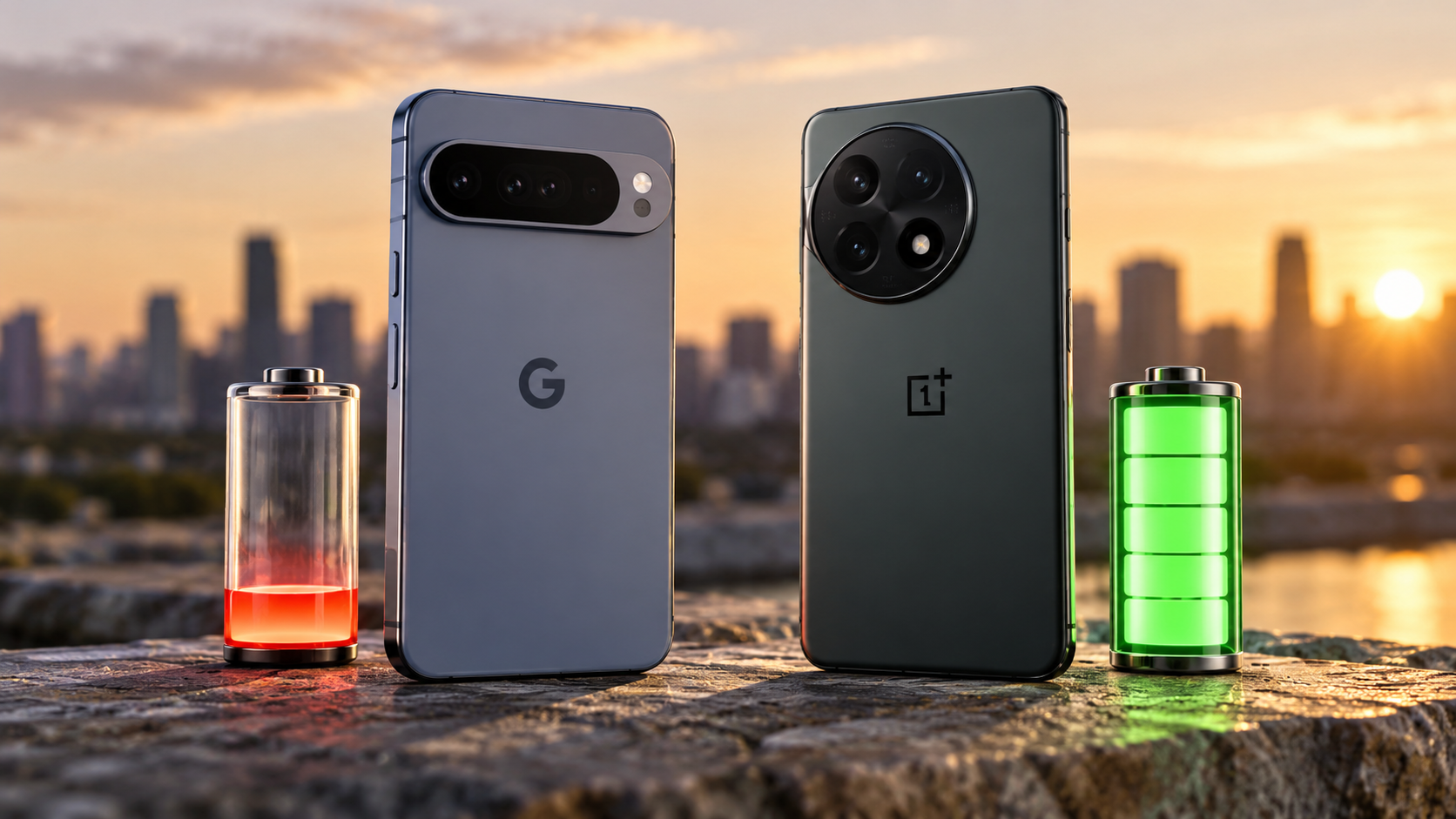
The Google Pixel 10 vs OnePlus 15 battery life comparison highlights two different approaches to smartphone endurance. The OnePlus 15 focuses on a much larger battery, fast charging, and high-performance hardware. The Google Pixel 10 combines a smaller battery with Google’s Tensor G5 processor and software optimization.
Battery capacity is important, but it does not tell the whole story. Display settings, processor efficiency, network strength, background apps, and usage habits can all affect daily battery life.
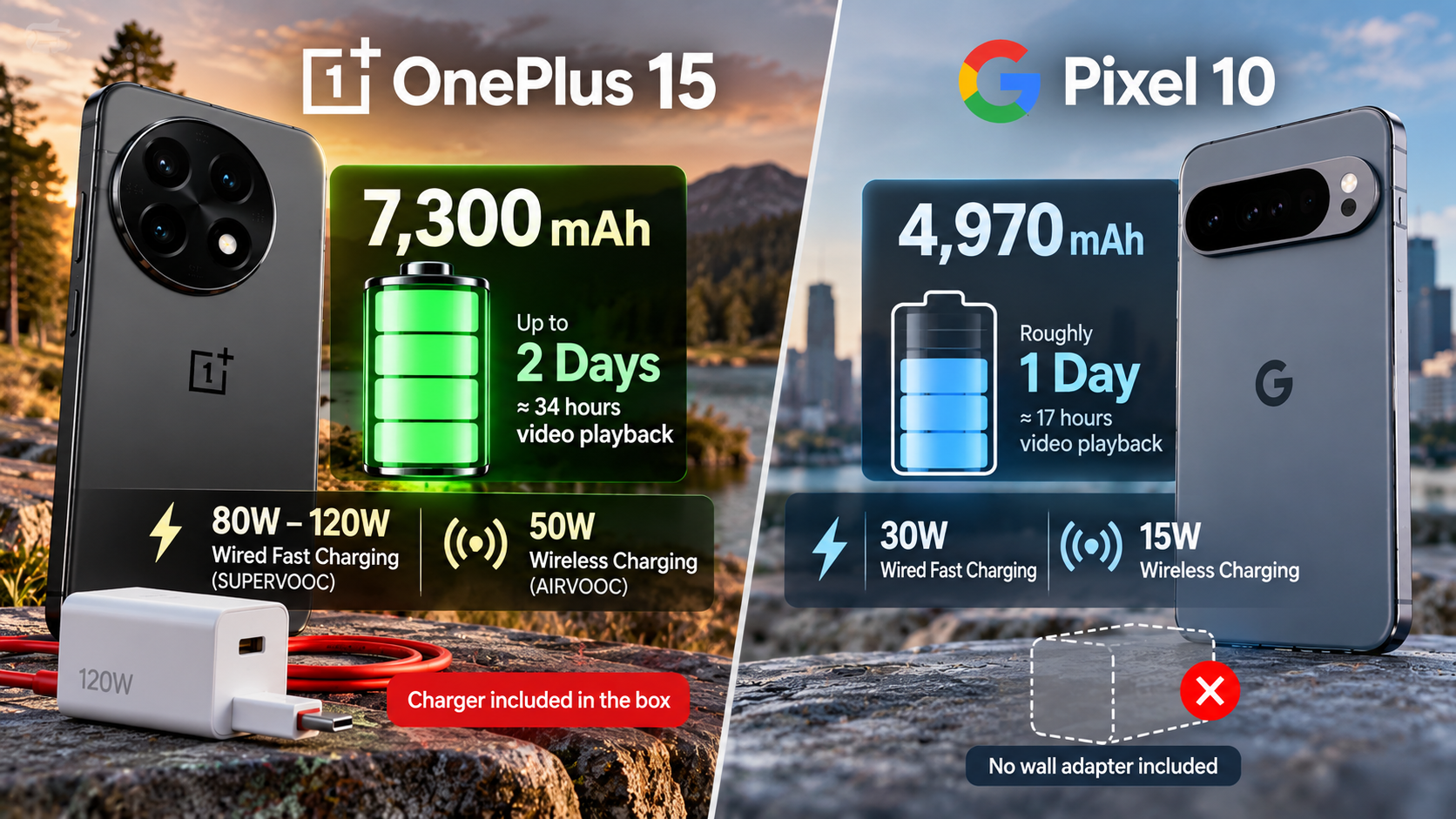
Google rates the Pixel 10 for 24+ hours of battery life and lists a 4,970mAh typical battery with 30W USB-C PPS charging. You can check Google’s official Pixel 10 specifications for the complete battery and charging details.
The OnePlus 15 has a significant hardware advantage in battery capacity and charging speed. The Pixel 10 takes a different approach by focusing on software integration, AI features, camera processing, and long-term updates.
If battery endurance and fast charging are your main priorities, the OnePlus 15 has the stronger battery-focused specifications. However, the Pixel 10 can still provide dependable everyday battery life for users who prefer Google’s software experience.
Which One Is Better, OnePlus 15 or Pixel 10?
The answer depends on what you expect from your phone. The OnePlus 15 and Pixel 10 are both flagship-class smartphones, but they emphasize different areas. OnePlus focuses heavily on battery capacity, charging, performance, and gaming. Google focuses more on software integration, photography, AI features, and long-term support.
For the Google Pixel 10 vs OnePlus 15 battery life comparison, the hardware difference is particularly important. The OnePlus 15 uses a substantially larger battery than the Pixel 10. It also offers much faster wired charging in supported markets. If you want to understand how charging habits can affect battery health, see our guide to overnight charging and smartphone batteries. That combination can be useful for heavy users who frequently need to recharge during the day.
The Pixel 10 uses a smaller battery, but Google’s software optimization helps it deliver all-day use under normal conditions. Its lower charging speed means it is less focused on rapid battery recovery.
| Feature | OnePlus 15 | Google Pixel 10 |
|---|---|---|
| Battery technology | Silicon NanoStack | Lithium-ion |
| Battery capacity | 7,300mAh | 4,970mAh typical |
| Wired charging | Up to 120W in supported markets | 30W USB-C PPS |
| Wireless charging | Up to 50W in supported markets | Up to 15W |
| Processor | Snapdragon 8 Elite Gen 5 | Google Tensor G5 |
| Display | Adaptive high-refresh-rate display | 60–120Hz OLED |
| Software | OxygenOS | Pixel software experience |
Performance and Daily Endurance: OnePlus 15
The OnePlus 15 is designed for users who demand strong performance throughout the day. Its large battery gives it considerably more capacity than the Pixel 10. That extra capacity can be useful during gaming, video streaming, navigation, photography, and extended mobile data use. OnePlus users can also explore useful accessories for OnePlus phones to make everyday use more convenient.
The phone also combines its large battery with flagship-level processing hardware. This makes it suitable for demanding applications and games. Its high-refresh-rate display can make scrolling and gaming feel smoother, although higher refresh rates can increase power consumption.
Charging is another major part of the OnePlus approach. The phone supports very fast wired charging in supported markets. This means users can recover a significant amount of battery in a relatively short period.
The Google Pixel 10 vs OnePlus 15 battery life difference becomes especially noticeable for heavy users. A larger battery provides more capacity before the phone needs a charger. Fast charging also reduces the amount of time spent connected to a power outlet.
For users who frequently game, stream, travel, or use demanding applications, the OnePlus 15’s battery hardware is an important advantage.
Daily Software and Camera Experience: Google Pixel 10
The Pixel 10 takes a more software-focused approach to the smartphone experience. Its battery is smaller than the OnePlus 15’s, but Google combines it with the Tensor G5 processor and Android software designed specifically for Pixel devices.
Google claims the Pixel 10 can provide more than 24 hours of battery life under its testing conditions. Extreme Battery Saver can extend the claimed runtime significantly when enabled. Actual results depend heavily on how the phone is used.
The Pixel 10 also focuses strongly on photography and artificial intelligence. Google’s image-processing system is designed to improve photos without requiring users to manually adjust many camera settings.
The phone also benefits from Google’s software ecosystem. Pixel-exclusive features, AI tools, and long-term software support are important parts of its overall appeal.
For the Google Pixel 10 vs OnePlus 15 battery life comparison, the Pixel 10 does not compete through battery capacity. Instead, it combines a smaller battery with software optimization and a broader software experience.
Users who mostly browse the web, use messaging apps, take photos, stream content, and perform everyday tasks may find the Pixel 10’s battery sufficient for a full day.
Is the OnePlus 15 Battery Draining Fast?
A large battery does not guarantee that every user will experience excellent battery life. If your OnePlus 15 battery is draining quickly, the cause may be related to settings, applications, network conditions, or demanding workloads. Features such as bypass charging can also be useful when managing battery heat and charging during demanding tasks.
The display is one of the first things to check. High brightness and frequent use of high refresh rates can increase power consumption. Gaming can increase consumption even further because the processor, graphics hardware, display, and cooling system remain active for extended periods.
Mobile network conditions can also affect battery life. A phone operating in an area with weak cellular coverage may use additional power while maintaining a stable connection.
Background applications are another common cause. Social media, navigation, cloud services, and other applications may continue working after you stop actively using them.
Software updates can temporarily change battery behavior as well. Background optimization and application processing may increase activity for a short period.
Before assuming there is a hardware problem, check the phone’s battery-usage information. It can help identify whether a particular application or system feature is consuming an unusual amount of power.
Primary Causes of Battery Drain on OnePlus Devices
Several factors can cause faster-than-expected battery drain on the OnePlus 15. Understanding these causes makes it easier to identify the problem instead of changing random settings.
Display brightness is one of the most obvious factors. Keeping the display near maximum brightness for long periods can significantly increase power consumption. A high refresh rate can also use additional energy during demanding activities.
5G connectivity can affect battery life when coverage is weak. The modem may work harder when the phone repeatedly searches for or maintains a connection.
Gaming and demanding applications are another major factor. Graphics-intensive games place sustained demands on the processor and display. Video recording and editing can also increase power usage.
Background applications may continue syncing, tracking locations, or processing data when you are not actively using them.
After a major software update, temporary background activity may also increase consumption. However, not every battery problem is caused by an update.
The easiest way to identify the actual cause is to check the battery statistics. Look for applications that consume unusually high amounts of power compared with your normal usage.
How to Diagnose and Reduce High Battery Drain
Start by opening the phone’s Battery Usage section. Check which applications and system functions have consumed the most power. An application using an unusually large percentage may need attention. You can also explore hidden features on OnePlus phones that may help you get more from the device.
Next, review the display settings. Use adaptive brightness instead of keeping brightness manually near maximum. Adaptive refresh behavior can also help reduce unnecessary power consumption during lighter tasks.
You should also review background activity. Applications that do not need constant synchronization may not need unrestricted background access. However, avoid restricting essential messaging or communication applications if you rely on immediate notifications.
Network conditions can also influence battery life. If you frequently use your phone in an area with weak cellular coverage, higher power consumption may be unavoidable.
Gaming is another area where expectations matter. Long gaming sessions can consume battery quickly, even on phones with very large batteries.
Avoid regularly draining the phone to extremely low levels simply to calibrate the battery. Modern battery-management systems generally do not require routine full discharge cycles.
If battery drain remains unusually high after checking these factors, restart the phone and check for software updates. Persistent problems may require manufacturer support.
Which Phone Is Better, the Google Pixel or the OnePlus?
The broader Pixel-versus-OnePlus comparison involves more than battery life. Both brands offer different approaches to Android, and those differences can affect which phone fits your needs.
OnePlus places considerable emphasis on hardware performance. Its flagship phones typically focus on fast processors, high-refresh-rate displays, large batteries, rapid charging, and gaming features.
Google takes a more integrated approach. Pixel phones combine Google’s Android software with custom Tensor processors, computational photography, AI tools, and Pixel-exclusive features.
The Google Pixel 10 vs OnePlus 15 battery life comparison therefore represents only one part of the decision. The OnePlus 15 has a substantial battery-capacity advantage, while the Pixel 10 offers a software-focused experience.
Camera performance is another important difference. Google has built much of the Pixel identity around computational photography. OnePlus instead combines high-end camera hardware with its own processing and software features.
Software support is also important. Google has committed to long-term updates for the Pixel 10.
Your choice should therefore depend on your daily priorities. Battery capacity, charging speed, gaming, cameras, software features, and update support can all matter differently depending on how you use your phone.
Google Pixel Ecosystem: Software Integration and Imaging
Google’s Pixel strategy focuses on integrating hardware, Android, artificial intelligence, and photography. The Pixel 10 uses Google’s Tensor G5 processor and provides several features designed around Google’s software ecosystem.
Photography is one of the major Pixel strengths. Google’s computational photography processes images automatically to improve exposure, detail, color, and other aspects of everyday photos.
The Pixel 10 also includes AI-powered features designed to make everyday tasks easier. These features are integrated directly into the Pixel software experience rather than being treated as separate applications.
Another important consideration is software support. Google provides long-term software and security updates for Pixel devices, which can help users keep their phones for several years.
The Pixel approach is therefore different from simply maximizing hardware specifications. Google emphasizes how the processor, operating system, camera system, and AI tools work together.
For users who value a clean Android experience and Google’s software ecosystem, these features can be more important than having the largest possible battery.
However, the Pixel 10’s smaller battery and slower charging mean that it is not designed around maximum charging speed. Users who frequently need rapid top-ups may prefer the OnePlus approach.
The Google Pixel 10 vs OnePlus 15 battery life difference is therefore only one part of the larger ecosystem comparison.
OnePlus Ecosystem: Raw Speed and Power Engineering
OnePlus has traditionally focused on speed, responsiveness, charging, and performance. The OnePlus 15 continues that approach with a large battery, high-end processing hardware, and fast charging.
Its 7,300mAh battery provides substantially more capacity than the Pixel 10. OnePlus also supports high-speed wired charging in supported markets. This combination is particularly useful for people who spend long periods away from a charger.
The phone also focuses on gaming performance. Its high-refresh-rate display can provide smoother motion during supported gaming scenarios. However, using higher refresh rates and demanding graphics settings can increase power consumption.
Thermal management is another important part of the design. Sustained workloads generate heat, so cooling hardware helps the phone maintain performance during demanding activities.
OxygenOS also provides customization and multitasking features. Users who like changing interface settings or managing several applications may appreciate this flexibility.
For battery-focused users, the most important difference is simple: OnePlus prioritizes battery capacity and charging speed more heavily than Google does.
This does not mean every user will see the same battery results. Network strength, brightness, applications, refresh rate, and usage patterns still influence endurance.
Still, the hardware specifications make the OnePlus 15 particularly relevant for users who prioritize large battery capacity, fast charging, gaming, and sustained performance.
Which Is Better, OnePlus 15 or Google Pixel 10a?
The OnePlus 15 and Google Pixel 10a belong to different smartphone categories. The OnePlus 15 is a flagship model designed around high-end performance, battery capacity, charging, and gaming. The Pixel 10a targets users who want Google’s software experience at a lower price point.
That makes a direct comparison less straightforward. The OnePlus 15 has considerably more performance-focused hardware and a much larger battery. The Pixel 10a instead focuses on delivering Google’s core software and camera experience in a more affordable package.
Battery capacity is one of the clearest differences. The OnePlus 15 uses a 7,300mAh battery, while the Pixel 10a uses a smaller battery designed around its own hardware and software configuration.
Charging also differs between the two product categories. OnePlus focuses heavily on rapid charging, while Google’s A-series phones are generally positioned around more moderate charging speeds.
The Pixel 10a can still appeal to users who do not need flagship performance. Its camera processing, software features, and Google ecosystem remain important selling points.
Therefore, the comparison should focus on priorities rather than treating the two phones as direct competitors. The OnePlus 15 emphasizes hardware performance and endurance. The Pixel 10a emphasizes value and Google’s software experience.
Where the OnePlus 15 Outperforms the Pixel 10a
The biggest difference between the two phones is their hardware positioning. The OnePlus 15 is a flagship designed for demanding workloads, while the Pixel 10a is positioned as a more affordable Pixel device.
Battery capacity is one of the most obvious differences. The OnePlus 15 has a 7,300mAh battery, giving it substantially more capacity than the Pixel 10a.
Charging is another major difference. OnePlus supports much faster wired charging in supported markets. This can make a significant difference for users who regularly need to recharge their phone quickly.
Processing performance is also an important consideration. The OnePlus 15 uses Qualcomm’s flagship Snapdragon 8 Elite Gen 5 platform. The Pixel 10a uses Google’s Tensor G4 processor.
The OnePlus 15 also has a high-refresh-rate display and hardware designed for demanding workloads. These features make it more suitable for gaming and intensive multitasking.
However, higher performance can also mean higher power consumption during demanding tasks. Battery life still depends on how the phone is used.
For users who prioritize:
- Large battery capacity
- Fast charging
- Gaming performance
- High-refresh-rate display
- Sustained hardware performance
the OnePlus 15 offers a more hardware-focused configuration.
Where the Google Pixel 10a Remains Compelling
The Pixel 10a focuses on delivering Google’s software experience without requiring users to purchase its most expensive flagship models. That makes it a different proposition from the OnePlus 15.
Camera processing is one of the Pixel A-series’ important features. Google’s computational photography can help the phone produce strong everyday photos without relying entirely on expensive camera hardware.
Software is another major consideration. Pixel devices provide Google’s Android experience and access to Pixel-specific features. Users who already prefer Google’s ecosystem may find this more important than raw specifications.
The Pixel 10a also targets users who do not need the highest processor performance. Browsing, messaging, social media, photography, streaming, and everyday applications do not always require flagship-level hardware.
Its lower position in Google’s product range can also make it more accessible to buyers who want Pixel features without moving to a flagship price.
The OnePlus 15 has advantages in battery capacity, charging, and performance hardware. However, those features may not justify choosing a flagship for someone with lighter usage needs.
The Pixel 10a is therefore better understood as an affordable Pixel experience, rather than a direct competitor to the OnePlus 15.
For buyers comparing these phones, price, camera features, software preferences, performance requirements, and battery expectations should all be considered together.
Google Pixel 10 vs OnePlus 15 Battery Life: Final Comparison
The Google Pixel 10 vs OnePlus 15 battery life comparison shows a clear difference in hardware strategy. OnePlus gives the 15 a much larger battery and significantly faster charging capability. Google uses a smaller battery and focuses more heavily on software integration and Pixel features.
The OnePlus 15’s 7,300mAh battery gives it a substantial capacity advantage over the Pixel 10’s 4,970mAh typical battery. Its high-speed wired charging also makes quick top-ups a major part of the phone’s design.
The Pixel 10 still targets dependable everyday battery life. Google claims more than 24 hours of battery life under its testing conditions, while Extreme Battery Saver can extend usage considerably in supported scenarios.
Real-world results will vary. Gaming, camera use, mobile data, brightness, refresh rate, background applications, and network strength can all change battery performance.
For this reason, battery capacity should not be treated as a guaranteed number of hours.
The practical difference is easier to understand through priorities:
- OnePlus 15: Larger battery, faster charging, gaming-focused hardware, and high performance.
- Google Pixel 10: Software integration, AI features, computational photography, and long-term updates.
If your main concern is battery capacity and charging speed, the OnePlus 15’s specifications are clearly designed around that requirement. If you care more about Google’s software ecosystem and Pixel features, the Pixel 10 offers a different balance.
Ultimately, the best choice depends on how you use your phone rather than battery capacity alone.