
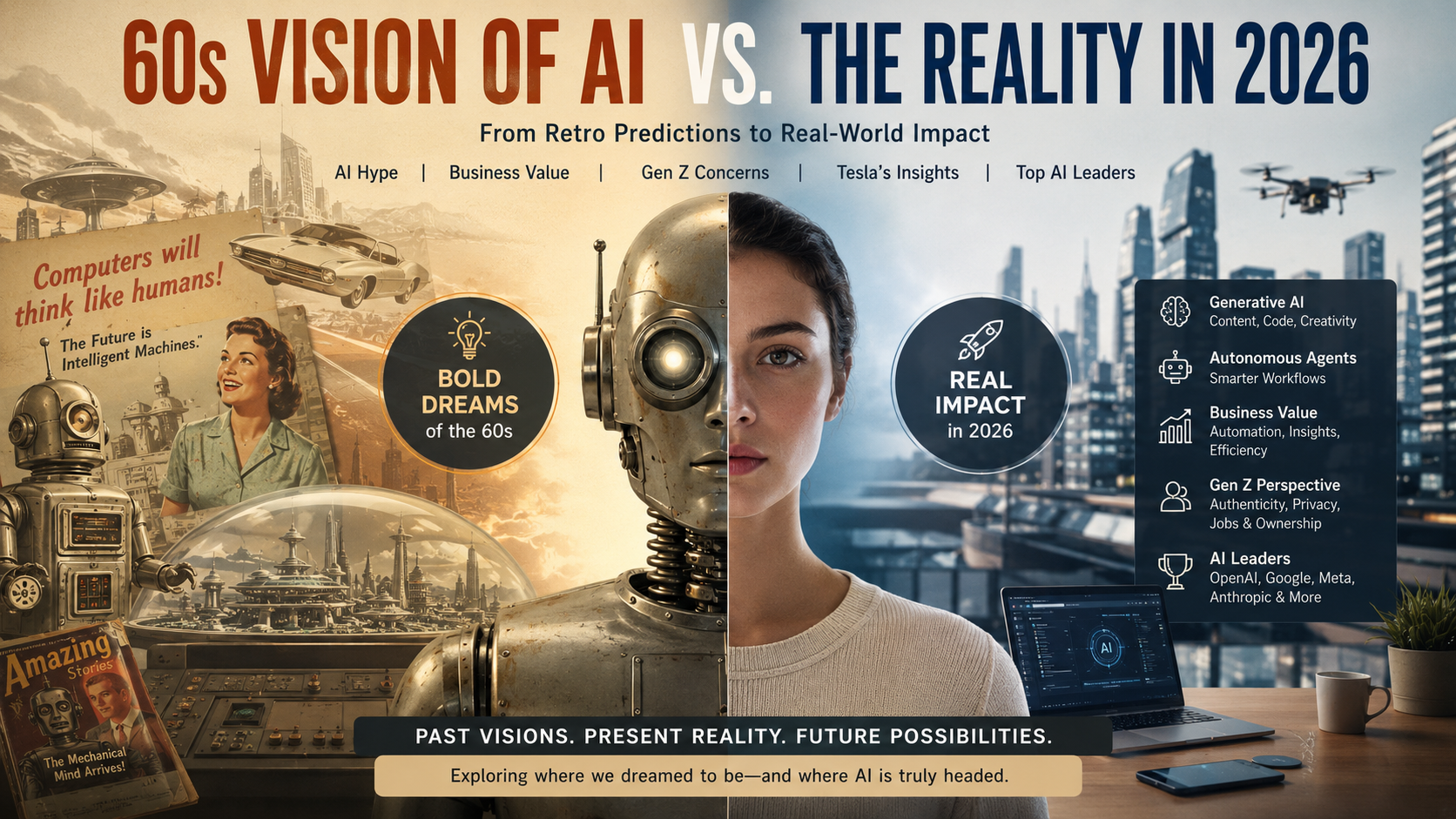
60s Vision Of AI Vs. The Reality In 2026
Long before modern neural networks transformed everyday technology, scientists and science fiction writers imagined a bold 60s vision of AI. They pictured intelligent robots, flying cars, and computers that could communicate naturally with humans.
In 2026, technology looks different, but some of those ambitions remain familiar. We still have not achieved proven human-level artificial general intelligence or machine consciousness. However, generative AI, autonomous agents, and machine learning now influence almost every major industry.
This article compares the 60s vision of AI with reality in 2026. It explores modern AI hype, business value, Gen Z concerns, historical predictions, and highlights the current heavyweights leading the field according to updates from OpenAI. It also examines whether today’s technology matches the expectations created decades ago.
Is AI Overhyped in 2026?
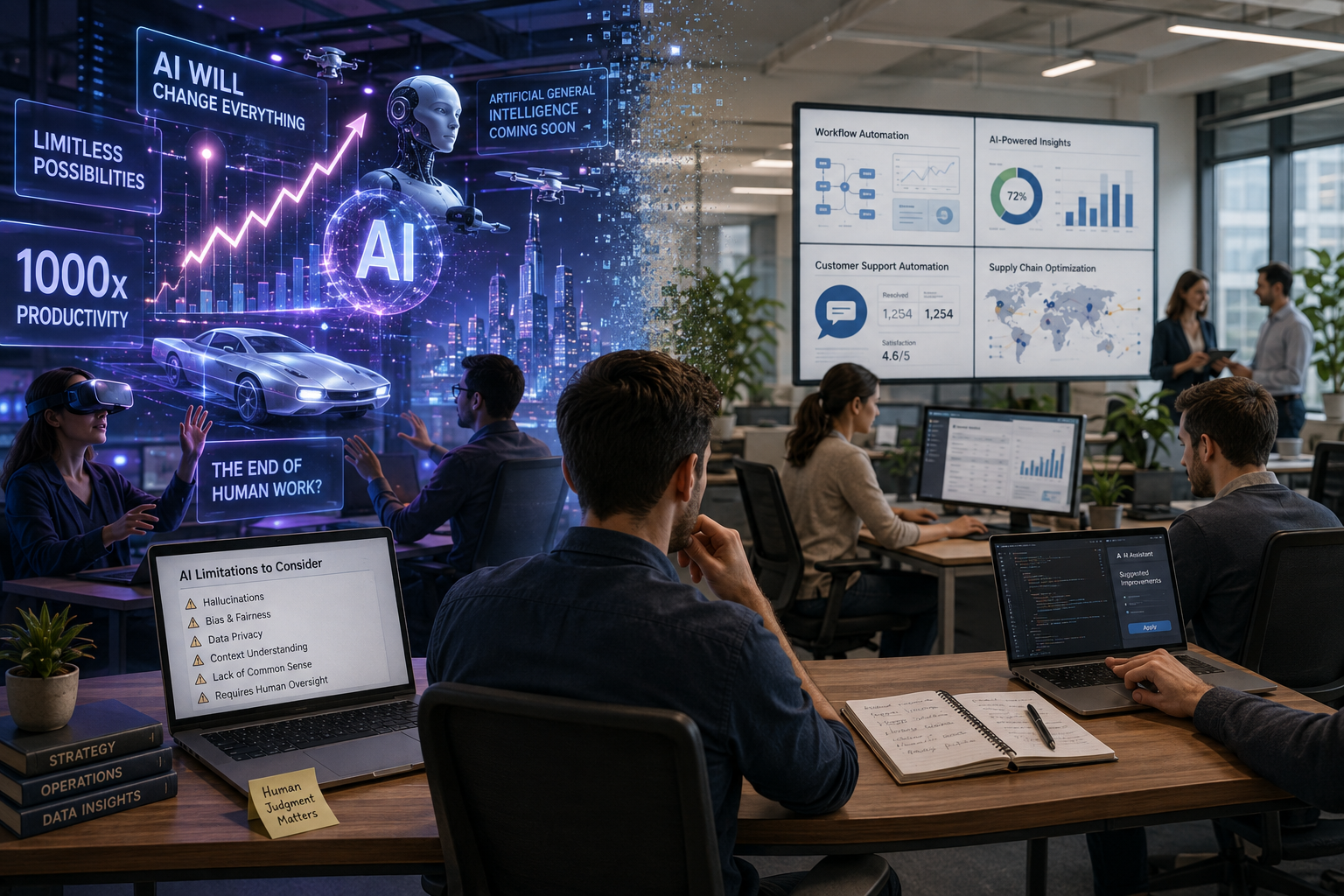
The debate over whether AI is overhyped in 2026 centers on the gap between bold promises and practical results. Millions of users gain real value from AI-assisted coding, content creation, research, and data analysis. These applications show that AI has moved beyond science fiction and into everyday workflows.
However, important limitations remain. AI systems can produce inaccurate information, misunderstand context, and struggle with unpredictable real-world situations. Businesses also face high implementation costs, integration challenges, and concerns about reliability. These issues make some claims about AI’s near-term capabilities seem unrealistic.
The Real Business Value
The strongest business value often comes from automating repetitive tasks. AI can help companies analyze information, improve workflows, support customer service, and optimize operations through AI chatbots and business automation. Specialized machine learning systems can also improve forecasting and supply-chain planning.
The real opportunity is not replacing every worker with a machine. It is improving how people complete routine and information-heavy tasks. AI can reduce manual work and help employees focus on higher-value decisions.
Therefore, the hype should not obscure the technology’s practical impact. AI remains economically significant, even when individual predictions fail to match reality.
Why Is Gen Z Against AI?
Gen Z’s relationship with AI is more complicated than simply being against the technology. Many younger users actively use AI for research, education, productivity, and entertainment. At the same time, they often question how companies develop and deploy these systems.
Concerns about authenticity, privacy, employment, and creative ownership are especially important. Some young creators believe mass-produced AI content can weaken the value of human-made art, particularly as questions around AI and copyright become more important. Others worry that automation could reduce opportunities in entry-level creative and administrative careers.
Privacy also remains a major concern. Large-scale data collection and model training can raise questions about consent, ownership, and transparency. These concerns become stronger when users feel they have little control over how their work or personal information is used.
Authenticity in Creative Spaces
Human-made content has therefore become a stronger cultural preference in some online communities. Certain creators and platforms actively discourage or restrict generative AI content.
This movement reflects more than technological skepticism. It highlights a desire to protect human creativity, emotion, imperfection, and lived experience.
The debate will likely continue as AI-generated images, music, writing, and video become more sophisticated. Rather than rejecting every AI tool, many young users are pushing for clearer boundaries between human and machine creation.
What Did Nikola Tesla Say About AI?
Nikola Tesla discussed automation and machines long before modern artificial intelligence existed. He did not use today’s terminology for neural networks, generative models, or artificial general intelligence. However, some of his writings and interviews explored the possibility of increasingly autonomous machines.
Tesla imagined automated devices that could perform complex tasks with limited human intervention. His ideas reflected a broader belief that electricity, wireless communication, and automation could dramatically change society. These concepts were remarkably forward-looking for the early twentieth century.
However, modern claims about Tesla predicting conscious AI should be treated carefully. His writings do not provide a direct prediction of today’s artificial intelligence systems. Instead, they reveal an early interest in machines becoming increasingly independent and capable.
The Dawn of Mechanical Minds
Tesla believed automation could reduce the burden of manual labor. He expected technological progress to increase productivity and reshape human work.
That idea connects naturally with today’s AI discussion. Modern systems can perform tasks that once required considerable human effort. Yet they remain fundamentally different from the conscious mechanical beings imagined in science fiction.
Tesla’s legacy is therefore most useful as historical context. His work demonstrates how long humans have imagined machines gaining greater autonomy.
Which AI Model Is the Most Powerful in 2026?
There is no single answer to which AI model is the most powerful in 2026. Performance depends on the task, benchmark, model version, and deployment environment, much like the comparison between SLMs and LLMs in enterprise AI. A system that excels at coding may not lead in creative writing or multimodal reasoning.
Today’s frontier models compete across areas such as mathematics, software development, long-context processing, image understanding, audio, and reasoning. Some models focus on general-purpose assistance, while others target specific professional applications.
Model size also does not automatically determine performance. Smaller systems can achieve strong results through better training, optimization, specialized datasets, and efficient inference. Reliability and consistency can matter as much as raw benchmark scores.
Multimodal Mastery and Efficiency
Modern AI capability increasingly depends on multimodal performance. Leading systems can work with combinations of text, images, audio, and other forms of information, which is central to understanding what multimodal AI can do.
This flexibility allows organizations to use AI across several departments. A single system might support customer service, document analysis, software development, and research.
However, impressive demonstrations should not be confused with universal intelligence. Models still make mistakes and require appropriate oversight.
For businesses, the most powerful model is often the one that delivers reliable results at a reasonable cost. Efficiency, accuracy, security, and integration can matter more than leaderboard position.
Which AI Is Smarter Than ChatGPT?
Asking which AI is smarter than ChatGPT requires a clear definition of intelligence. Different systems can outperform one another on specific benchmarks without being universally superior, making the broader ChatGPT vs Gemini comparison useful when evaluating general-purpose AI.
Some AI models perform especially well in software development, mathematics, research, or long-form reasoning. Specialized tools may also provide better results for particular professional workflows. Meanwhile, general-purpose assistants remain valuable because they combine multiple capabilities in one interface.
Benchmark results can provide useful comparisons, but they do not capture every aspect of real-world performance. Accuracy, consistency, speed, context handling, tool use, and ease of integration can all affect the user experience.
Specialized Competitors in Action
Rival AI laboratories increasingly focus on specialized capabilities. Some models target coding, scientific research, enterprise analysis, or complex reasoning. These systems can outperform broader assistants on carefully designed tasks.
That does not necessarily make them smarter than ChatGPT overall. It shows that AI performance is becoming increasingly task-specific.
The best choice depends on what the user needs. A developer may prioritize coding accuracy, while a researcher may value long-context reasoning. A general user may prefer versatility and ease of use.
Frequently Asked Questions About the 60s Vision Of AI
Is artificial intelligence safe for everyday use?
Most consumer platforms implement strict safety filters and content moderation guidelines to protect users from harmful outputs. However, risks like data privacy leaks, AI phishing attacks, and sophisticated misinformation campaigns remain prevalent. Users must exercise caution, verify critical outputs independently, and avoid sharing sensitive personal information with public-facing conversational platforms to ensure safe daily interactions.
Will automation replace all human jobs by 2030?
Complete job replacement remains unlikely, though workforce restructuring is already happening rapidly. Routine administrative tasks, data entry, and basic coding face heavy automation. Conversely, roles requiring emotional intelligence, complex physical dexterity, strategic oversight, and genuine human empathy will continue to grow in demand, creating entirely new employment categories globally.
How do modern language models actually learn?
Modern models learn by processing massive datasets containing billions of text pages, images, and code repositories. Using neural network architectures, they identify complex statistical patterns between words and concepts, with tokenization playing an important role in AI performance and cost. Through massive computational training and human feedback reinforcement, they learn to predict the most accurate subsequent words in response to user prompts.
What is the difference between narrow and general intelligence?
Narrow intelligence refers to systems designed to excel at one specific task, such as playing chess or translating languages. Artificial general intelligence represents a hypothetical future milestone where a machine matches or exceeds human cognitive capabilities across all economically valuable domains, possessing independent reasoning, adaptability, and self-awareness.
Conclusion: From the 60s Vision Of AI to 2026
The journey from the 60s vision of AI to the reality of 2026 reveals both remarkable progress and significant differences. Earlier generations imagined conscious robots, household automation, and machines that could communicate naturally with people.
Some elements of those predictions have arrived in unexpected forms. Generative AI can write, analyze, create images, assist with programming, and communicate through natural language. Autonomous systems are also becoming more capable across business and consumer applications.
Yet the biggest science fiction promises remain unfinished. Today’s systems do not provide conclusive evidence of machine consciousness or universally capable human-level intelligence.
The social response has also become an important part of the story. Businesses see opportunities for productivity, while many users remain concerned about privacy, authenticity, employment, and misinformation.
The most useful approach is neither blind optimism nor complete rejection. AI works best when its capabilities and limitations are understood clearly.
As technology continues to develop, human judgment will remain essential. The future may not look exactly like the 60s vision of AI, but its central question remains unchanged: how far can machines go in augmenting human intelligence and work?