
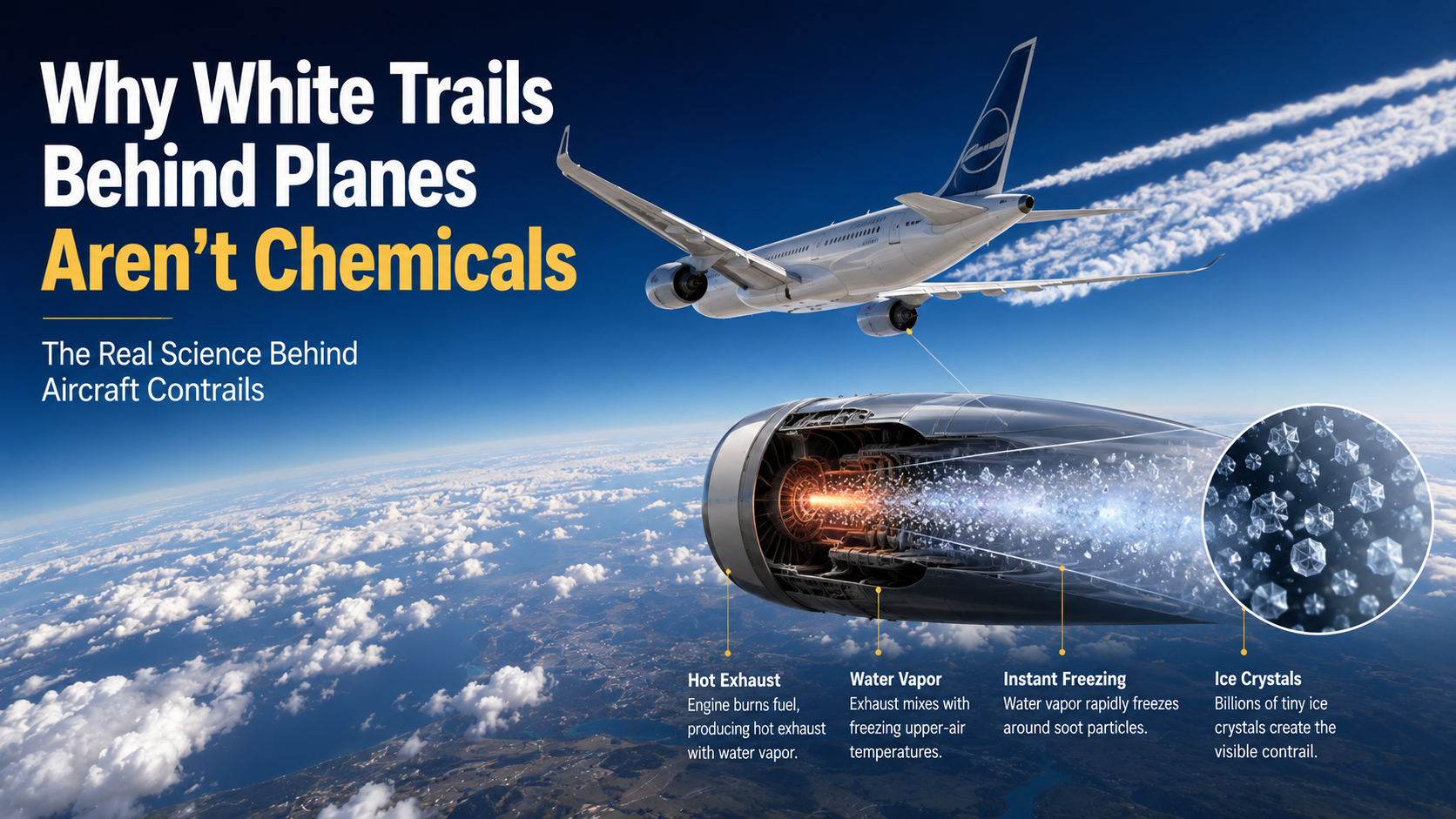
Why White Trails Behind Planes Aren’t Chemicals

Links

Why White Trails Behind Planes Aren’t Chemicals

Have you ever looked up at a clear blue sky and wondered about those long, chalky lines stretching across the horizon? You certainly are not alone. Many people assume that the white trails behind planes contain dangerous chemical sprays. However, this is a widespread misconception that ignores basic atmospheric science. These distinct streaks are actually condensation trails, more commonly known as contrails. To understand exactly what is happening above us, we can look at the extensive atmospheric research provided by NASA, which studies how aircraft exhaust interacts with high-altitude environments.

The internet remains full of wild theories regarding these aviation vapor trails. Some groups claim they contain weather-modifying substances. Others truly believe they carry harmful toxins designed to affect the population. The reality is far less sinister and deeply rooted in everyday physics and chemistry. When commercial jet engines burn aviation fuel, they naturally release water vapor, carbon dioxide, and small soot particles. In the freezing, low-pressure environment of high altitudes, this hot vapor instantly freezes into billions of tiny ice crystals.

This article will debunk the popular myths surrounding aircraft exhaust and explain the fascinating science behind contrail formation. We will explore why some trails disappear in seconds while others linger for hours, spreading across the sky. We will also discuss how humidity and temperature play a critical role in creating these cloud-like formations. By the time you finish reading, you will understand the real physics of modern flight and recognize these trails for what they truly are.
white trails behind planes

Why Do Planes Have White Trails Behind Them?

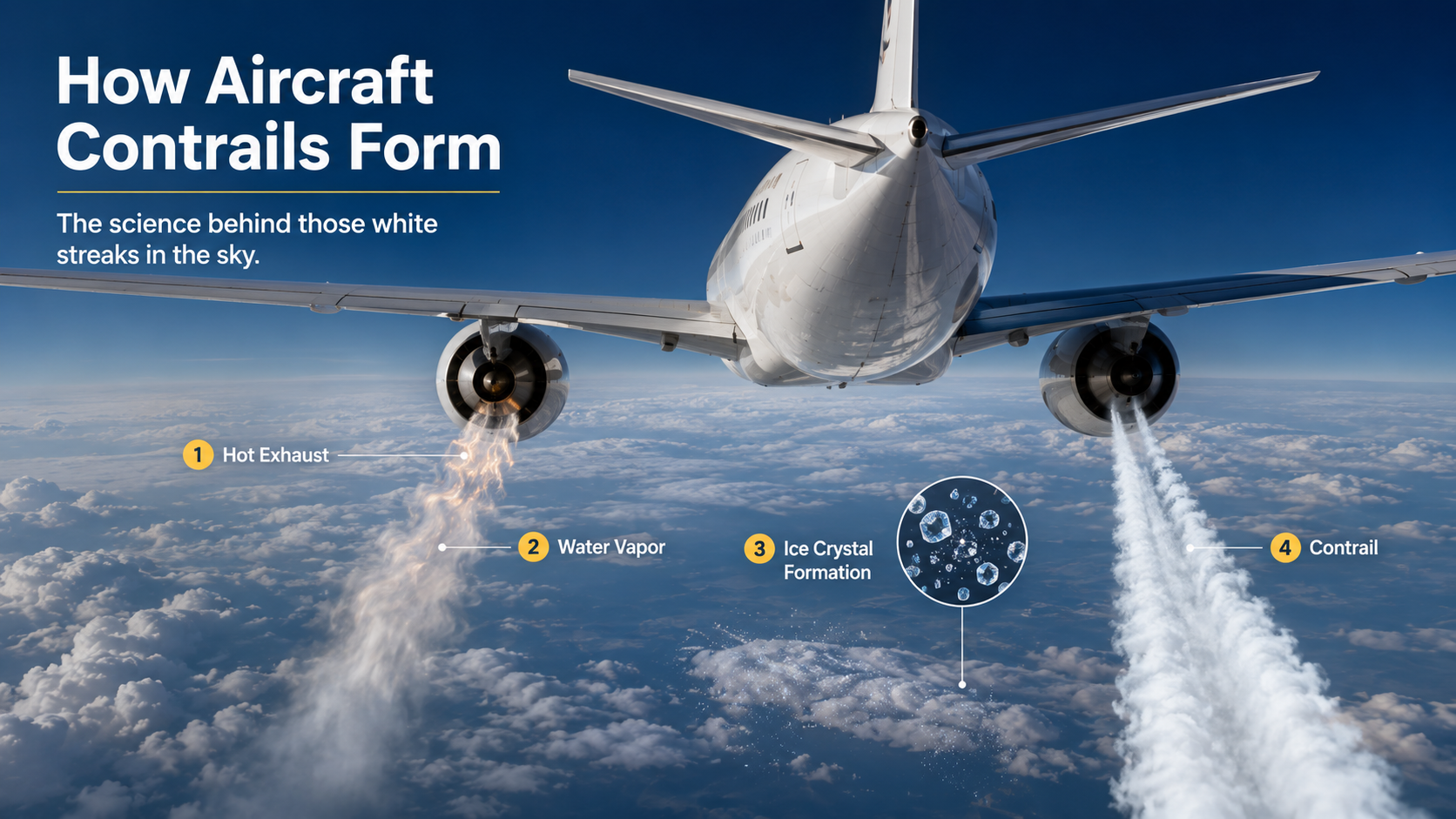
Planes leave white trails behind them because of a natural atmospheric process called condensation. It is similar to seeing your breath on a freezing winter morning. When jet engines burn fuel, they produce water vapor, hot gases, carbon dioxide, and tiny soot particles. At cruising altitudes, typically above 30,000 feet, outside temperatures often fall below -40°F (-40°C).

The hot exhaust mixes with the extremely cold air almost instantly. As a result, the water vapor condenses and freezes around microscopic particles in the exhaust, forming millions of tiny ice crystals. These ice crystals create the long white lines visible from the ground, known as contrails.

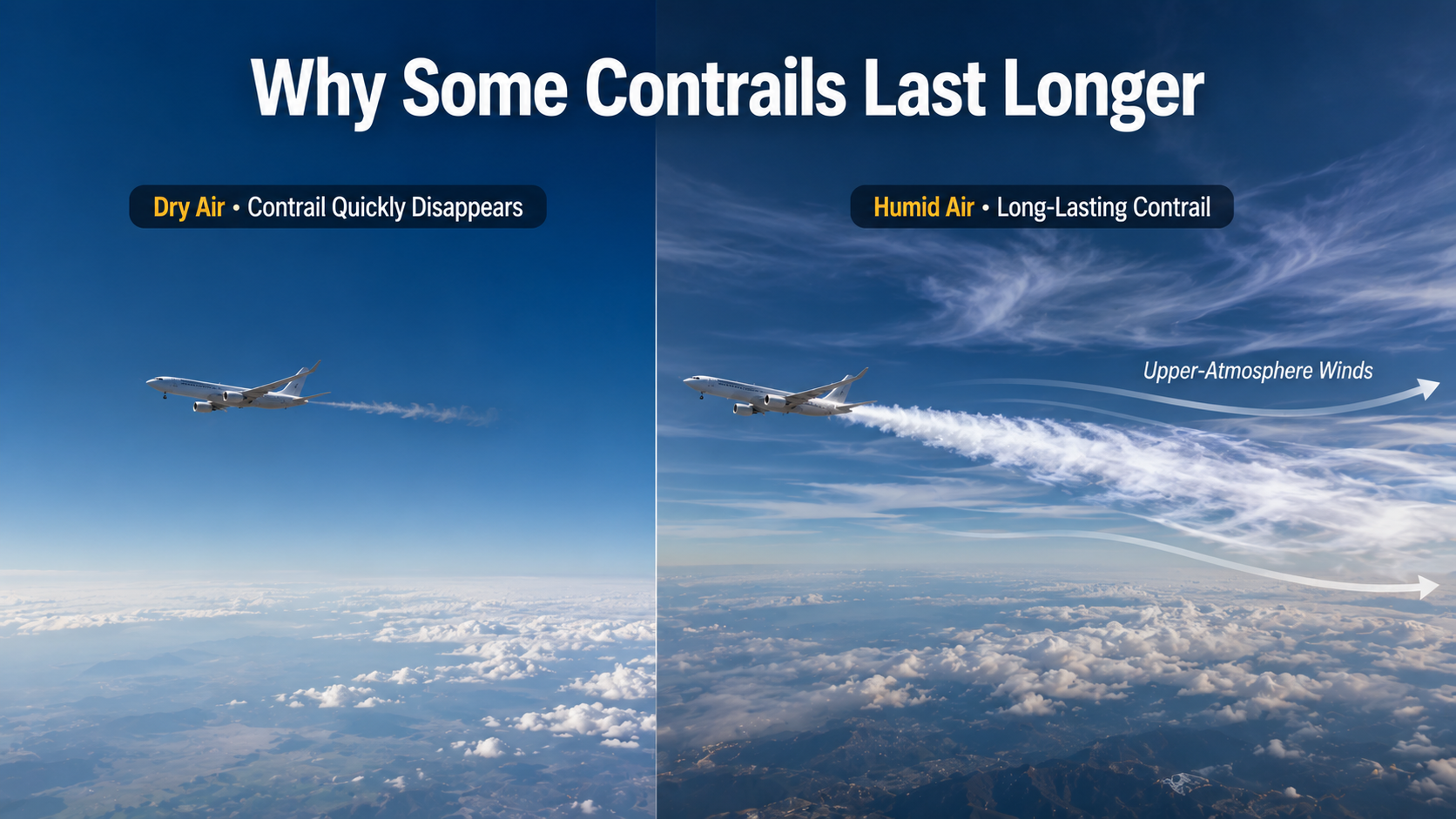
How long these trails remain visible depends mainly on atmospheric humidity. In dry air, the ice crystals evaporate within seconds. In humid air, they absorb additional moisture, grow larger, and can remain visible for hours. Over time, persistent contrails may spread across the sky and resemble thin cirrus clouds, making them appear like naturally occurring cloud formations.

The Role of Atmospheric Humidity

white trails behind planes

Atmospheric humidity plays the biggest role in determining whether a contrail disappears quickly or remains visible for hours. Even when two aircraft fly at the same altitude, the surrounding air can have very different moisture levels. That difference directly affects how long the ice crystals survive.

When the upper atmosphere is dry, the ice crystals evaporate rapidly, causing the white trail to fade within seconds. However, when humidity is high, the crystals absorb additional moisture instead of evaporating. They become larger and remain suspended in the atmosphere for much longer.

Persistent contrails can gradually spread outward due to high-altitude winds. Over time, they may transform into thin sheets of cirrus clouds that cover large portions of the sky. This is why some aircraft leave short-lived trails, while others create long white streaks that remain visible long after the plane has disappeared.


Are Contrails Harmful to the Environment?

Contrails are not considered a major source of local air pollution, but they can contribute to climate change. The greatest environmental impact occurs when persistent contrails spread into extensive cirrus cloud layers. These clouds influence how heat moves through Earth’s atmosphere.

During the day, they reflect a portion of incoming sunlight back into space. At night, however, they trap heat that would otherwise escape from Earth’s surface. Research shows that this warming effect is generally greater than the daytime cooling effect, creating a small but measurable contribution to global warming.

To reduce this impact, researchers and aviation authorities are exploring several solutions, including:

  • Adjusting flight paths to avoid humid atmospheric layers
  • Developing more fuel-efficient aircraft engines
  • Using sustainable aviation fuels (SAF)
  • Improving weather forecasting for flight planning

Reducing persistent contrail formation is becoming an important part of making commercial aviation more environmentally sustainable.

Climate Impact of Spreading Clouds

When contrails persist, they can gradually spread into large sheets of thin cirrus clouds. These clouds act like an insulating blanket by trapping outgoing heat, especially during the night. Although they also reflect some sunlight during the day, scientific studies indicate that their overall effect produces more warming than cooling. Because of this, reducing long-lasting contrails has become an active area of aviation and climate research aimed at lowering the industry’s environmental footprint.


Why avoid seat 11A on a plane?

Travelers often hear quirky superstitions about specific rows, but seat 11A carries no actual physical curse or mechanical hazard during normal flight operations. Some frequent flyers jokingly avoid this window seat due to urban legends or minor airline layout quirks, such as a missing window alignment on specific aircraft models. In reality, every passenger seat undergoes rigorous safety certification by aviation authorities. Whether you sit near the front, middle, or rear, your flight safety remains entirely unaffected by your row number. Choosing where to sit usually comes down to personal preference regarding legroom, proximity to the galley, or a clear view of the engine.

Understanding Airline Seating Myths and Window Alignments

Airlines configure cabin layouts based on structural frames and emergency exit placements rather than superstitions. Passengers sometimes complain that row eleven lacks a proper view because structural ribs block the glass. Choosing a seat near the front or back simply affects your deplaning speed rather than your overall in-flight safety.


Why do military jets not always leave contrails?

Fighter jets and bombers frequently change altitude, speed, and engine output, which directly alters whether condensation forms behind them. When these high-performance aircraft fly at lower altitudes or through dry air masses, exhaust moisture evaporates instantly without forming ice crystals. Furthermore, military pilots often use specialized technology or fly specific profiles to avoid detection during training missions. Even when combustion creates water vapor, atmospheric conditions dictate whether that moisture becomes visible from the ground. Therefore, missing vapor trails simply mean the surrounding air lacks the extreme humidity required to freeze exhaust droplets into lasting clouds.

Operating at Altitudes With Low Atmospheric Moisture

Dry air layers prevent ice crystals from forming behind fast-moving aircraft engines. If surrounding humidity levels sit below the saturation threshold, hot exhaust gases dissipate invisibly into the sky. Military aviators understand these atmospheric nuances well, utilizing varying flight levels to manage their visual footprint during daily operations.


Why Do Some Jets Leave Contrails and Others Don’t?

The appearance of vapor lines depends entirely on local atmospheric humidity, ambient temperature, and engine efficiency at cruising altitude. When a commercial airliner flies through air with high relative humidity, the water vapor in its exhaust instantly freezes onto tiny soot particles. This rapid freezing process creates visible ice clouds. If another jet flies right beside it through a dry air pocket, no trail appears because the surrounding atmosphere absorbs the moisture immediately. Why white trails behind planes aren’t chemicals becomes obvious when you realize these formations consist purely of frozen water droplets and natural atmospheric moisture reacting to jet exhaust temperatures.

The Role of Atmospheric Humidity and Engine Exhaust

Cruising altitudes feature sub-zero temperatures where water vapor readily transforms into ice crystals. Engine bypass ratios and fuel composition also influence how much moisture enters the air stream. When conditions align perfectly, these artificial clouds linger for hours, spreading out into wide cirrus formations driven by high-altitude winds across the sky.


What Is the White Trail From a Plane Called?

The white trail behind a plane is called a contrail, which is short for condensation trail. The name accurately describes how the trail forms through the condensation and freezing of water vapor in the aircraft’s exhaust. Contrails are not smoke, nor are they evidence of chemicals being intentionally sprayed into the atmosphere.

Instead, they are temporary man-made clouds consisting mainly of tiny ice crystals. Their appearance depends entirely on weather conditions at high altitude. Under favorable conditions, they may disappear almost immediately or remain visible long enough to spread into cirrus clouds.

Understanding the correct scientific term helps eliminate common misconceptions. Contrails are a well-understood meteorological phenomenon that has been studied for decades. They are a normal byproduct of modern jet aircraft operating in extremely cold sections of the atmosphere.

Scientific Origin of the Term

The word contrail combines the words condensation and trail. Meteorologists created the term to describe the ice-crystal clouds formed behind high-altitude aircraft. Using this scientific terminology distinguishes contrails from smoke, ordinary exhaust, fog, or other atmospheric phenomena. The name reflects the physical process responsible for their formation rather than their appearance alone.


Frequently Asked Questions

Do contrails contain toxic chemicals?

No. Contrails are not made of toxic chemicals or substances intentionally released into the atmosphere. They consist primarily of water ice crystals, water vapor, carbon dioxide, and tiny amounts of exhaust particles produced during normal jet engine combustion. Their white appearance comes from frozen moisture reflecting sunlight.

How long can a contrail stay in the sky?

A contrail may last anywhere from a few seconds to several hours. The duration depends almost entirely on humidity, temperature, and wind conditions at high altitude. Dry air causes the ice crystals to evaporate quickly, while humid air allows them to persist and gradually spread into cirrus clouds.

Can contrails predict upcoming weather changes?

Persistent contrails can sometimes indicate increased moisture in the upper atmosphere. When they remain visible for long periods and spread rapidly, they may suggest that a weather system or frontal boundary is approaching. However, they should be viewed only as an informal weather indicator rather than a reliable forecasting method.

Why do some contrails look wider than others?

Contrails become wider because high-altitude winds spread the ice crystals over a larger area. High humidity also allows the crystals to grow, causing the trail to expand gradually. What begins as a narrow white line can eventually develop into a broad, hazy layer of thin cirrus cloud covering a significant portion of the sky.


Conclusion

Understanding the actual science above our heads helps dispel unnecessary fears and rumors. The white trails behind planes simply represent a fascinating interaction between modern aviation technology and extreme atmospheric conditions. When jet engines release incredibly hot, moist exhaust into the freezing, thin air of the upper atmosphere, basic physics takes over. The water vapor instantly freezes into tiny ice crystals, creating the beautiful white streaks we know as contrails. If you’re fascinated by atmospheric and space-related phenomena, you may also enjoy exploring some of the wildest planets in the Milky Way and the incredible science behind them.

Whether these trails disappear within seconds or spread across the sky depends almost entirely on atmospheric humidity, not a secret chemical mixture. While the aviation industry continues to study and reduce the climate impacts of persistent contrails, there is no credible scientific evidence supporting claims of widespread toxic spraying operations.

The next time you look up and see a long white streak crossing a bright blue sky, you can appreciate the remarkable science of condensation, ice crystal formation, and Earth’s atmosphere in action. Share this knowledge with curious friends and family to encourage evidence-based discussions and inspire a deeper interest in aviation, weather, and space science.


Leave a Reply

Your email address will not be published. Required fields are marked *