5V 1A Vs. 5V 2A: Which Is Better For Charging?
Choosing the right power adapter can feel confusing. Small labels often list voltage and current ratings that seem difficult to understand. The difference between a 5V 1A vs. 5V 2A charger is especially common.
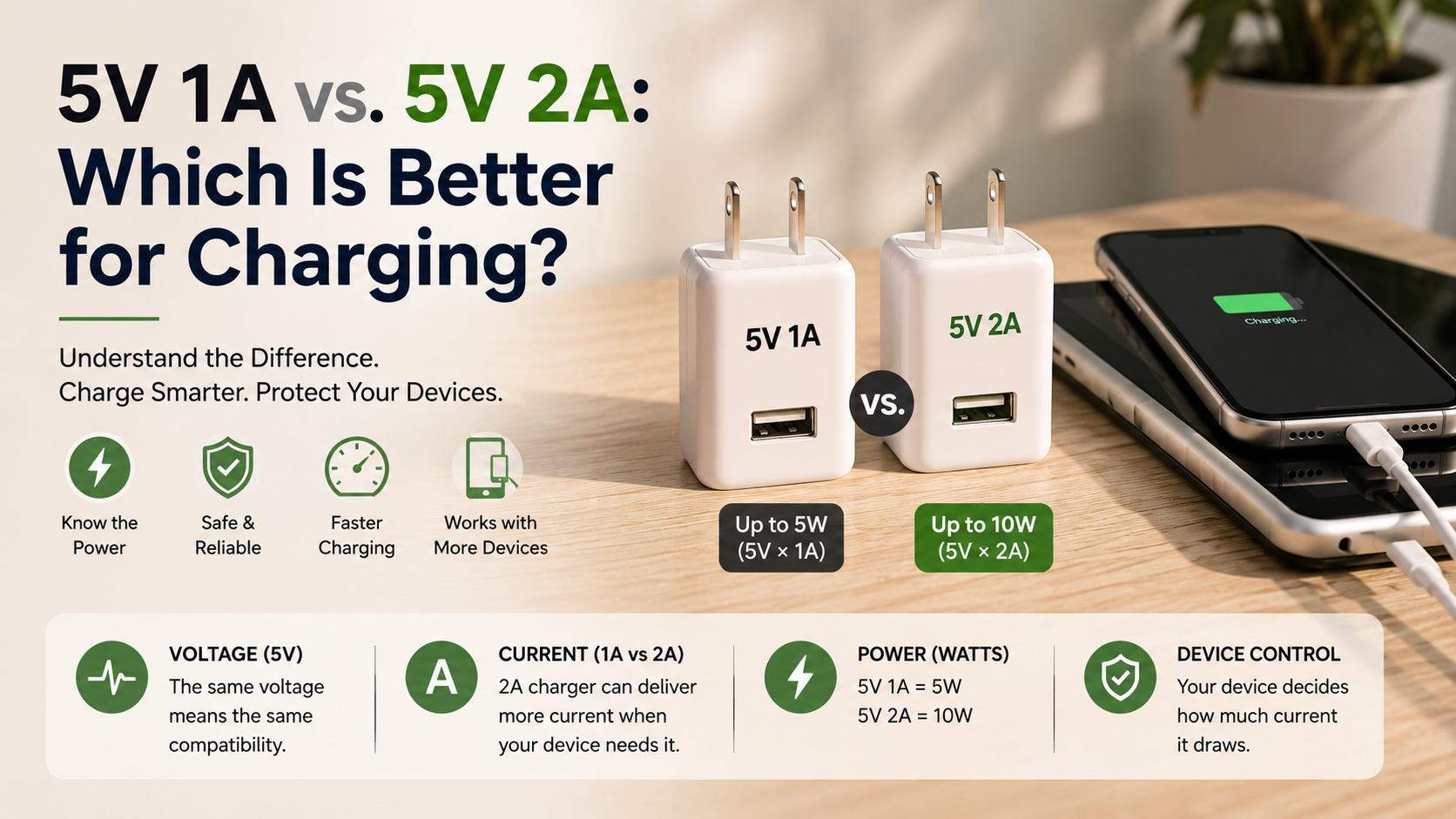
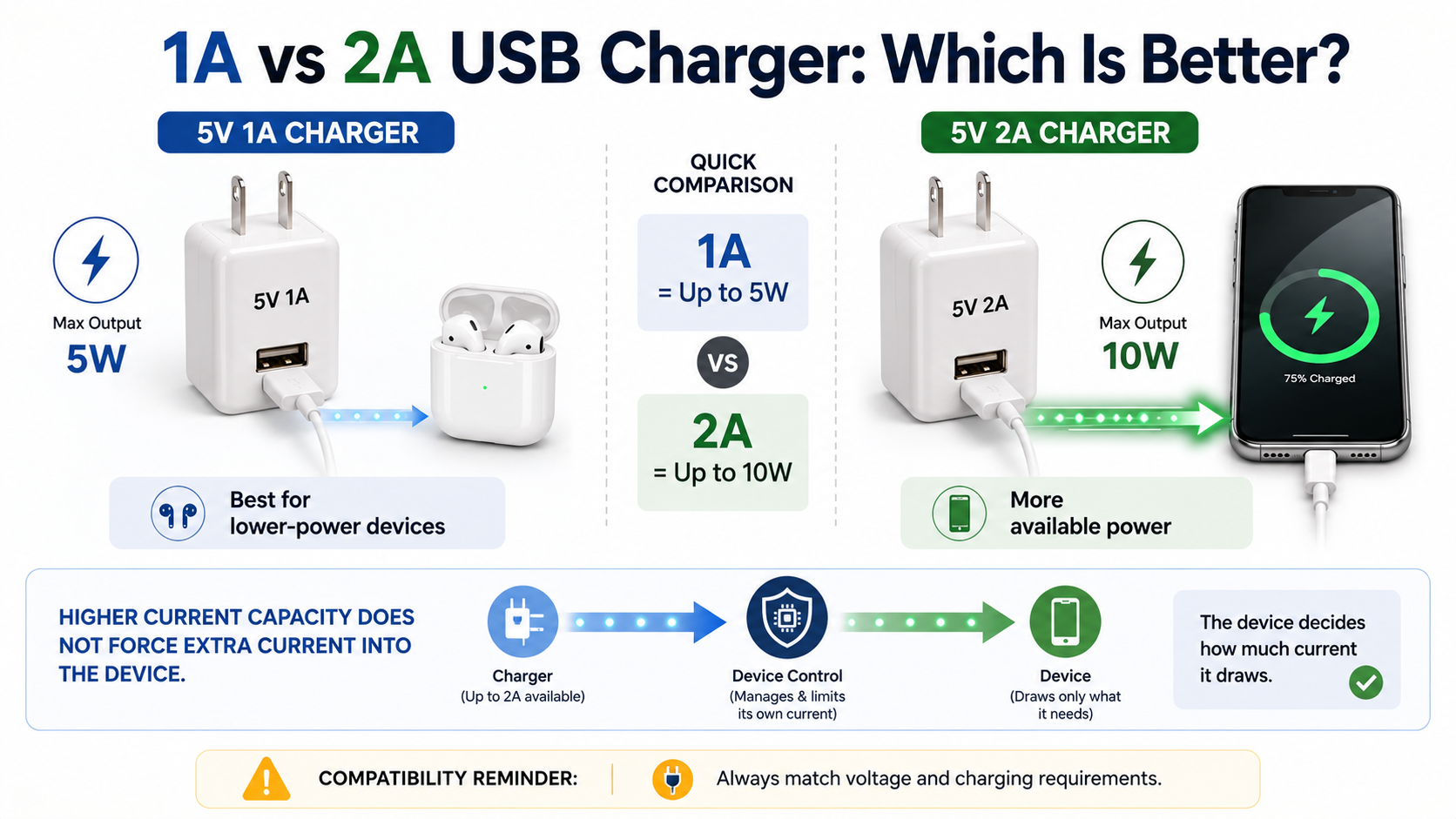
Voltage and current affect how much power an adapter can provide. A 5V 1A charger can supply up to 5 watts. A 5V 2A charger can supply up to 10 watts.
However, a higher current rating does not force extra current into your device. The device controls how much current it draws, provided the charger and connection meet the required standards. According to USB-IF Specifications, understanding power delivery standards helps protect electronic hardware from overdraw issues.
This guide explains the practical differences between 5V 1A and 5V 2A chargers. You will also learn whether a 2A charger can power a 1A device. We will explain whether 5V 2A counts as fast charging today.
Which Is Better: A 5V 1A Charger or a 5V 2A Charger?
A 5V 2A charger can be the better choice when your device supports the additional current. It has a maximum output of 10 watts. By comparison, a 5V 1A charger can provide up to 5 watts.
This does not mean every device will charge twice as fast. Charging speed depends on the device, battery, charging circuit, cable, and charging protocol. The device decides how much current it can safely draw.
A 5V 2A adapter offers more available power for compatible devices. It can also provide greater flexibility for different USB-powered accessories.
For example, a low-power accessory may draw far less than 1A. A larger device may benefit from the higher available current.
When choosing between the two, check your device’s required input rating first. If it supports 2A at 5V, a suitable 5V 2A adapter can provide faster charging than a 1A adapter.
Understanding Electrical Current Output
Amperage describes the rate of electrical current that can flow from a power source. A 5V 1A charger can supply up to 1 ampere at 5 volts. That equals a maximum rated power of 5 watts.
A 5V 2A charger can supply up to 2 amperes at the same voltage. Its maximum rated output is therefore 10 watts.
The important point is that the charger does not automatically push its full current into the device. The connected device determines its current demand within the limits of the charging system.
This is why a higher current rating is not automatically dangerous. A compatible device can draw less current than the adapter’s maximum rating.
However, voltage compatibility matters. You should not assume that any adapter is safe simply because its current rating looks suitable.
Always check the device specifications and charger output. USB charging can also involve negotiation and specific charging standards.
Understanding these ratings makes it easier to compare chargers and avoid unsuitable power supplies.
Can I Use a 5V 2A Charger for a 5V 1A Device?
Yes, a suitable 5V 2A charger can normally power a 5V 1A device. The key is that the voltage and charging connection must be compatible.
The 2A rating describes the maximum current the charger can supply. It does not mean the charger forces 2A into every connected device.
A device designed to draw 1A can normally take only the current its charging circuit requires. The remaining capacity of the adapter simply remains available.
This makes a 5V 2A adapter useful for many lower-current USB devices. You can use one adapter for several compatible accessories without automatically increasing their current intake.
However, do not rely only on the current rating. Check the device manufacturer’s specifications and the charger’s output characteristics.
USB charging standards can also affect compatibility. Some devices require specific charging methods or communication between the charger and device.
So, when comparing 5V 1A vs. 5V 2A, the higher current rating is generally safe when the voltage and charging standard are appropriate.
Safe Power Draw Mechanics
Modern electronic devices usually include charging and power-management circuits. These circuits help control how much current the device draws from a compatible power source.
A charger’s current rating represents its available capacity, not a fixed amount that it always delivers. For example, a 5V 2A adapter can provide up to 2A. A compatible device may request much less.
This principle explains why using a higher-rated current adapter does not automatically damage a lower-current device. The device manages its own power intake within its supported limits, while smartphone charging habits can also affect battery health.
However, this protection does not make every charger interchangeable. Incorrect voltage, poor-quality adapters, damaged cables, or incompatible charging standards can create safety risks.
For reliable charging, use a reputable adapter with the correct voltage and suitable specifications.
Keep these points in mind:
- Current rating: Shows the maximum available current.
- Device demand: Determines how much current is actually drawn.
- Voltage: Must remain compatible with the device.
- Charging standards: Can affect power delivery and compatibility.
This approach helps explain why a 5V 2A charger can safely support many 5V 1A devices.
Which Is Better: A 1A or 2A USB Charger?
A 2A USB charger is generally more versatile than a 1A charger when both provide the same 5V output. It offers up to twice the available current and can deliver up to 10 watts.
A 1A charger may still work well for smaller accessories. Devices such as basic trackers, simple electronics, or older gadgets may not need much current.
Larger devices can benefit from a higher-current adapter. However, the actual charging speed depends on the device’s charging circuit and supported input rating.
A 2A charger also does not guarantee faster charging for every device. If a device is limited to 1A, it will not automatically charge at 2A.
The best choice depends on your equipment. A suitable 5V 2A adapter can be a practical everyday option because it provides more available power.
Before buying, check the original adapter or manufacturer’s specifications. Make sure the replacement provides compatible voltage and charging support.
For most basic USB charging needs, 5V 2A offers greater capacity, while 5V 1A remains suitable for lower-power devices.
Powering Accessories and Gadgets
Small electronics often need less current than larger devices. Their compact batteries and simpler circuits may require only a fraction of the power available from a 5V 2A adapter.
Using a compatible 5V 2A charger does not automatically make these devices draw 2A. Their internal charging circuits determine the current they require.
This can make a higher-rated adapter convenient for households with several USB-powered accessories. One suitable charger may support both low-power accessories and devices that need more current, including accessories such as those covered in this guide to the best iPad accessories.
For example, an accessory designed for 5V 1A can generally use a compatible 5V 2A supply. It will draw only the amount supported by its charging system.
Still, compatibility should always come first. Check the device label, manual, or manufacturer’s specifications before replacing its original charger.
Avoid assuming that every USB power source works with every device. Some products use proprietary charging systems or require specific power profiles.
The safest approach is simple: match the voltage and charging requirements, then choose an adapter with enough current capacity for the device.
Is 5V 2A a Fast Charger?
A 5V 2A charger provides up to 10 watts, which is faster than a basic 5V 1A adapter rated at 5 watts. However, it is generally not considered modern fast charging for smartphones.
Older USB charging systems commonly operated around the 5W range. A 10W output represented a useful improvement for many devices.
Modern fast-charging technologies can deliver substantially more power. Depending on the device and protocol, they may use higher voltages, higher currents, or both.
Some modern systems can deliver 20W, 30W, or much more to compatible devices. The actual charging rate still depends on the phone, charger, cable, battery condition, and charging protocol.
Therefore, 5V 2A is better described as a standard 10W charging setup rather than a modern fast charger.
It can still be useful for everyday charging. Lower power can also mean less heat during charging, although battery temperature depends on many factors.
Always check whether your phone supports a specific fast-charging standard before buying a higher-power adapter, and consider how your charging habits affect iPhone battery life over time.
Evolution of Charging Speeds
Charging technology has moved well beyond basic 5W USB adapters. Modern smartphones can use advanced charging systems that manage voltage, current, and temperature more intelligently.
Early USB chargers often provided relatively low power. A 5V 1A adapter delivered up to 5 watts. A 5V 2A adapter increased that limit to 10 watts.
Modern charging systems can deliver much higher power when the device, charger, and cable support the same standard. Some technologies use higher voltages, while others increase current or dynamically adjust both.
This allows compatible devices to charge much faster than traditional 5V adapters. However, higher charging power does not mean a device always receives the maximum advertised output.
The phone or other device controls the charging process. It can reduce power when the battery becomes warmer or approaches a high charge level.
Battery longevity also depends on heat, charging habits, battery age, and device design.
As a result, fast charging is a coordinated system, not simply a charger with a larger amp rating.
Is 5V 1A Fast-Charging?
No, 5V 1A is generally not considered fast charging by modern standards. When comparing 5V 1A vs. 5V 2A, the 5V 1A option provides up to 5 watts, while 5V 2A can provide up to 10 watts.
A 5V 1A charger can safely charge compatible smartphones and accessories. However, charging will usually take longer than with a higher-power adapter. Actual charging speed also depends on the device, battery, cable, and charging protocol.
Modern fast-charging technologies typically deliver more power than a basic 5W setup. They may use higher voltage, higher current, or advanced charging standards to increase charging speeds.
A 5V 1A adapter can still work well for smaller accessories and older electronics. It may also be suitable when slower charging is sufficient.
If you want faster charging, check your device’s supported charging specifications. Then choose a compatible adapter that provides the required power.
In short, 5V 1A is standard, low-power charging rather than modern fast charging. It remains suitable for devices that do not require higher charging speeds.
Frequently Asked Questions
Will using a 2A charger degrade my phone battery faster?
Using a 2A charger will not degrade your phone battery faster as long as the device is designed to handle that current input. Smartphones feature advanced internal power management systems that regulate current flow and prevent overcharging. Battery degradation is primarily caused by heat, aging, and extreme discharge cycles rather than standard 2A power adapters. You can use a 2A brick daily without worrying about harming your battery life prematurely.
Can a 1A charger safely charge a 2A device?
A 1A charger can safely power a 2A device, but the charging process will be noticeably slower. Because the power brick supplies less current than the device desires, the gadget simply draws the maximum 1A available. This forces your phone or tablet to take twice as long to reach a full charge. While safe, this setup can strain older chargers if they run at maximum capacity for extended periods.
What happens if I mix different USB charger ratings?
Mixing different USB charger ratings is generally safe as long as the voltage matches standard specifications, such as 5V USB outputs. Modern devices and chargers feature smart chipsets that negotiate safe power exchanges automatically. If you plug a low-power device into a high-power charger, it safely takes what it needs. Conversely, plugging a high-power device into a weak charger just results in much slower charging speeds.
How do I know what charger my device needs?
You can determine your device’s charging requirements by checking the tiny text printed directly on the original power adapter or user manual. Look for the output rating listed in volts and amperes, such as 5V 1A or 5V 2A. Alternatively, you can check the manufacturer’s official website or specifications page for your specific gadget model. Matching these recommended ratings ensures optimal charging performance and long-term device safety.
Conclusion
Understanding 5V 1A vs. 5V 2A charging is easier once you know what the ratings mean. A 5V 1A adapter provides up to 5 watts. A 5V 2A adapter provides up to 10 watts.
5V 2A charger can be the better option when your device supports that level of power. It offers greater current capacity and can charge compatible devices faster than a 1A adapter.
However, a higher current rating does not force extra current into your device. The device controls its power intake within the limits of the charging system.
A 5V 1A adapter can also charge a higher-rated device, but charging may take longer. Modern fast-charging systems go beyond basic 5V 2A charging by using advanced power-delivery technologies.
Before choosing a charger, check the device’s voltage, current, wattage, and charging protocol requirements. Using a compatible, reputable adapter is the best way to balance charging speed, reliability, and battery care.