

Apple Price Hike: MacBook and iPad Costs Explode by Up to 1 Lakh in India
Apple has introduced massive, unexpected price revisions across its entire computing and tablet portfolio in India, stunning consumer tech buyers nationwide. This sudden hardware price shock hits premium device configurations hardest, leaving many buyers scrambling to adjust their technology budgets. The major apple price hike means that high-end models like the M5 Max MacBook Pro have seen their retail costs spike by up to ₹1,00,00aw0 overnight. According to official product listings updated on the official Apple India digital storefront, this drastic price inflation stems directly from shifting global economic dynamics and a massive reallocation of semiconductor manufacturing resources.
For years, local consumers expected retail pricing to hold steady over a device generation’s lifecycle. However, the changing economics of high-performance components have forced the tech giant to abandon its historic local price caps. This streamlined guide breaks down the updated baseline retail rates for all affected MacBooks, desktop Macs, and iPads. We will also analyze the underlying structural factors behind this premium market shift and offer strategic buying advice to help you maximize your value.
Why Is the Apple Price Hike Happening Now?
Apple’s latest price increases are the result of multiple factors affecting the global technology industry rather than a single event. Rising component costs, supply chain challenges, currency fluctuations, and increased investment in next-generation hardware have all contributed to higher production expenses. As these costs continue to rise, companies often adjust retail prices to maintain profitability and support future product development.
Several key factors behind the latest price hike include:
- Higher semiconductor costs: The growing demand for advanced AI hardware has increased competition for premium memory chips and semiconductor components used across the technology industry.
- Supply chain constraints: Manufacturers continue to face pressure from limited production capacity and higher logistics costs, making electronic devices more expensive to build.
- Rising manufacturing expenses: Labor costs, raw materials, and assembly expenses have increased over the past few years, affecting the overall cost of producing Apple devices.
- Currency exchange fluctuations: In markets such as India, changes in exchange rates and import-related costs can further increase retail prices compared to global markets.
- Investment in new technologies: Apple continues to invest heavily in custom silicon, AI features, research and development, and premium hardware, all of which contribute to higher production costs.
While Apple has absorbed some of these costs in previous years, the latest revisions suggest that maintaining older pricing has become increasingly difficult. As a result, consumers are now seeing higher prices across several product categories, including iPads, MacBooks, Macs, HomePods, and Apple TV devices.
Apple Price Hike: Updated Mac and MacBook Prices in India
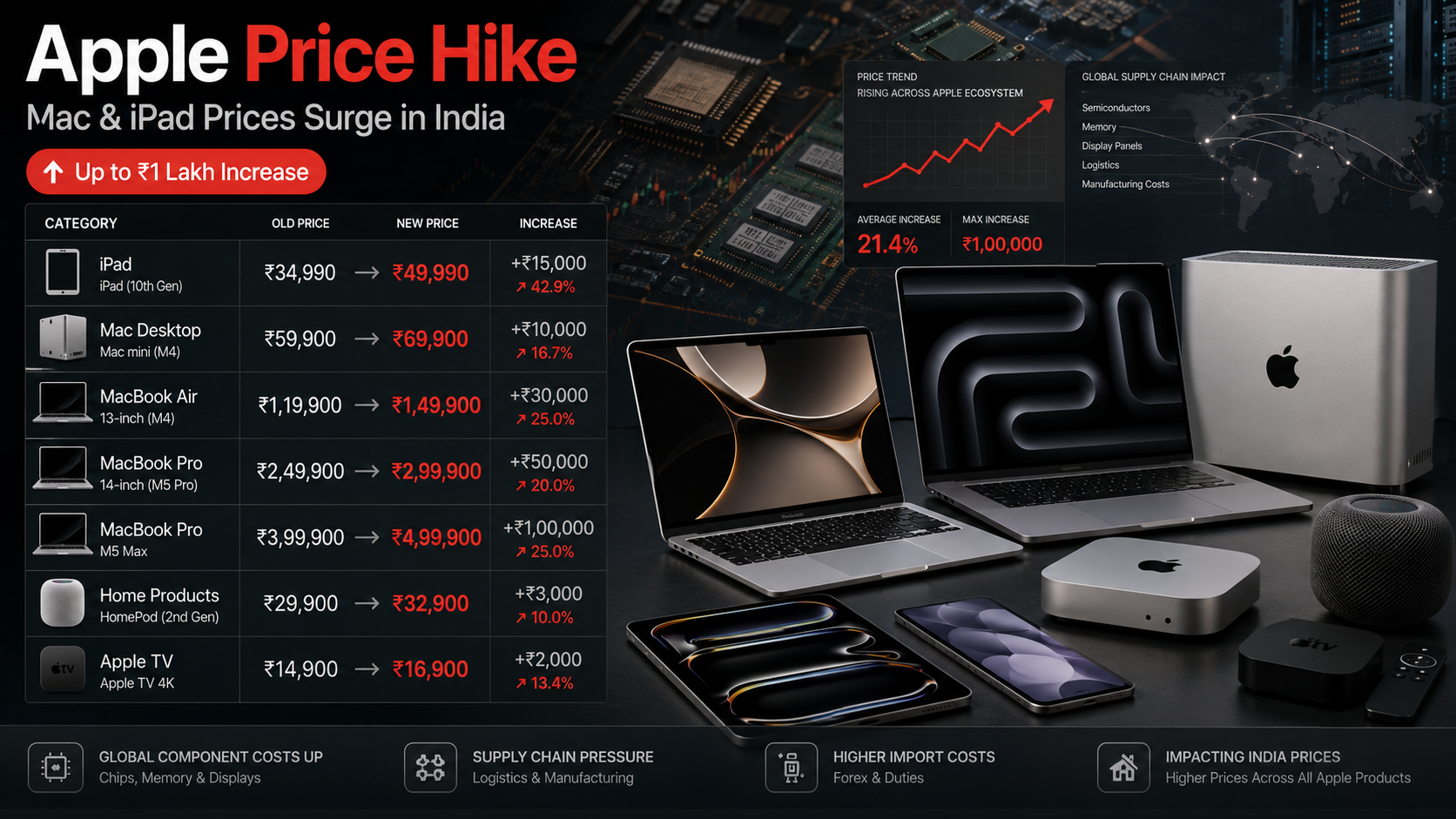

Apple’s latest Apple price hike has significantly increased the cost of Mac desktops and MacBook laptops in India, making the country one of the most expensive markets for Apple’s computing devices. The revised pricing affects both entry-level and premium models, with high-end professional systems seeing the largest jumps.
The budget-friendly MacBook Neo now costs ₹10,000 more than before, while the MacBook Air M5 has received a ₹30,000 increase. Professional users face even steeper hikes, as the 14-inch MacBook Pro with the M5 chip is now ₹70,000 more expensive, and the flagship MacBook Pro M5 Max has crossed the ₹4.99 lakh mark after a massive ₹1 lakh price increase.
Apple Price Hike: Complete Price Revision Table (India)
The table below compares the old and revised prices of Apple products in India, including iPads, Macs, MacBooks, HomePods, and Apple TV models. It also shows the exact price increase for each device, giving buyers a clear overview of how Apple’s latest pricing changes affect its entire product lineup in the Indian market.
| Product Category | Apple Device Model | Old Price (INR) | New Price (INR) | Net Price Increase (INR) |
| IPAD | Base iPad | ₹34,990 | ₹49,990 | +₹15,000 |
| iPad Mini | ₹49,900 | ₹69,900 | +₹20,000 | |
| iPad Air | ₹64,900 | ₹89,900 | +₹25,000 | |
| iPad Pro | ₹99,990 | ₹1,39,900 | +₹39,910 | |
| MAC (DESKTOPS) | Mac Mini M4 | ₹59,900 | ₹94,900 | +₹35,000 |
| Mac Studio M4 Max | ₹2,14,900 | ₹2,79,900 | +₹65,000 | |
| Mac Studio M3 Ultra | ₹4,29,900 | ₹5,89,900 | +₹1,60,000 | |
| iMac M4 | ₹1,34,900 | ₹1,74,900 | +₹40,000 | |
| MACBOOK | MacBook Air M5 | ₹1,19,900 | ₹1,49,900 | +₹30,000 |
| MacBook Pro M5 | ₹1,69,900 | ₹2,39,900 | +₹70,000 | |
| MacBook Pro M5 Max | ₹3,99,900 | ₹4,99,900 | +₹1,00,000 | |
| MacBook Neo | ₹69,900 | ₹79,900 | +₹10,000 | |
| HOME PRODUCTS | HomePod | ₹32,900 | ₹44,900 | +₹12,000 |
| HomePod Mini | ₹10,900 | ₹15,900 | +₹5,000 | |
| APPLE TV | Apple TV 4K 64GB | ₹14,900 | ₹25,900 | +₹11,000 |
| Apple TV 4K 128GB + Ethernet | ₹16,900 | ₹31,900 | +₹15,000 |
Apple Price Hike FAQ
Is Apple going to increase prices?
Apple has already implemented a sweeping global price adjustment across all official sales channels. Primarily, the increase has been driven by rising memory chip costs and updated currency conversion rates in several markets. As a result, customers in many regions are now paying more for selected Apple products. However, the flagship iPhone lineup has not been affected by these price changes so far. Nevertheless, industry analysts believe this situation could change in the coming months.
Furthermore, continued inflation in component prices is placing additional pressure on manufacturing costs. Consequently, Apple may need to adjust prices again if production expenses continue to rise. In addition, fluctuating exchange rates are making it more difficult for the company to maintain consistent pricing worldwide. Therefore, localized price revisions may become more common throughout the fiscal year.
Meanwhile, consumers who are planning to purchase Apple devices should keep a close eye on future announcements. Similarly, buyers in regions with weaker currencies may experience larger price increases than others. Overall, while iPhones have avoided these adjustments for now, other consumer hardware categories remain vulnerable. Ultimately, if global component inflation persists, Apple could introduce further price increases to protect its profit margins and offset higher manufacturing costs.
Why is Apple raising prices?
Apple is raising prices primarily because the rapid global expansion of artificial intelligence (AI) infrastructure has significantly increased demand for advanced memory components. As a result, semiconductor manufacturers are facing intense pressure to meet the needs of both enterprise and consumer markets. In particular, many fabrication plants are prioritizing high-margin memory orders for AI data centers, which has reduced the availability of components used in consumer electronics.
Consequently, the cost of dynamic random-access memory (RAM) and NAND flash storage has risen considerably. Furthermore, these memory components are essential for Apple devices that rely on unified memory architectures, making higher production costs difficult to avoid. In addition, increased demand from cloud computing providers has further strained the semiconductor supply chain. Therefore, Apple and other technology companies are experiencing higher manufacturing expenses.
However, memory costs are only one factor influencing pricing decisions. Additionally, exchange rate fluctuations, regional market conditions, and broader economic pressures can also affect retail prices in different countries. Meanwhile, Apple continues to balance rising production costs with maintaining competitive pricing. Overall, the combination of strong AI-driven demand, limited memory supply, and increasing manufacturing expenses has contributed to the company’s decision to adjust prices in selected markets.
Did Apple prices just go up?
Yes, Apple prices have recently increased across official digital and physical retail channels in India. Specifically, the latest price revisions affect several popular product categories, including the MacBook Air, MacBook Pro, Mac mini, iMac, and the complete iPad lineup. As a result, customers purchasing these devices may notice noticeably higher prices than before. In general, entry-level consumer models have seen price increases starting at approximately ₹10,000. Meanwhile, high-end customized professional configurations, particularly those with upgraded processors and expanded memory, have experienced much larger increases.
Furthermore, some premium workstation models now cost up to ₹1,00,000 more than their previous prices, depending on the selected processor, storage, and memory configuration. Additionally, these adjustments reflect changes across multiple product families rather than a single device category. However, the exact increase varies according to the model and customization options chosen. Therefore, buyers considering a new Apple device should carefully compare current prices before making a purchase. Overall, the latest pricing changes represent a significant adjustment across Apple’s product portfolio in India, especially for customers interested in premium or professionally configured devices.
Are older Mac and iPad inventories more expensive now?
Official Apple digital channels modified their retail pricing matrices instantly. However, independent authorized local dealers, offline electronics chains, and third-party e-commerce platforms may still carry existing retail inventory at older distribution prices. If you need an immediate hardware upgrade, purchasing from existing offline retail stock before inventory replenishment occurs is highly recommended to bypass the surge.
Are iPhone models included in this price hike?
Fortunately, the current iPhone lineup is not included in this particular round of Apple price increases. At present, core iPhone models continue to be sold at their standard launch prices across India. As a result, customers interested in purchasing a new iPhone should not expect additional costs related to this specific pricing adjustment. However, several other Apple product categories have experienced price revisions due to changing market conditions.
Furthermore, ongoing increases in component costs and supply chain pressures continue to affect the broader technology industry. Consequently, Apple may need to reassess its pricing strategy if these challenges persist. In addition, prolonged microchip shortages could place further pressure on manufacturing expenses, especially for devices that rely on advanced memory and processing technologies. Therefore, future pricing decisions will likely depend on production costs, market demand, and overall economic conditions.
Meanwhile, industry analysts suggest that if supply constraints continue for another two quarters, upcoming flagship iPhone models could face similar price adjustments. Nevertheless, there has been no official confirmation that future iPhones will become more expensive. Overall, while the current iPhone lineup remains unaffected, buyers should monitor future announcements because pricing policies may change if manufacturing costs continue to rise.
Conclusion
This sudden retail realignment across the Apple portfolio marks a profound turning point for the local technology market. As enterprise AI data centers continue to siphon the global supply of premium storage and memory components, regular buyers are experiencing the true financial cost of the machine learning boom. The current apple price hike forces a complete reassessment of consumer budgets, making it essential to cross-check retail avenues before committing to a purchase. Navigating this hardware inflation requires careful strategic planning, exploring certified refurbished channels, or looking for remaining distributor stock at legacy launch prices to safeguard your investment.
For more useful Apple-related tips and device optimization guides, check out our detailed guide on how to speed up your iPhone in 2026