
Why Children Need Boredom to Thrive and Grow
Hearing the dreaded phrase “I’m bored” often sends parents searching for tablets, organized activities, or instant entertainment. However, children do not need constant stimulation to stay engaged. Understanding why children need boredom can help parents support their emotional, social, and cognitive development.
Unstructured play and quiet downtime give children opportunities to explore their interests, solve problems, and practice self-regulation. The American Academy of Pediatrics provides guidance on the importance of play in healthy childhood development. When every moment is scheduled, children have fewer opportunities to discover what interests them independently.
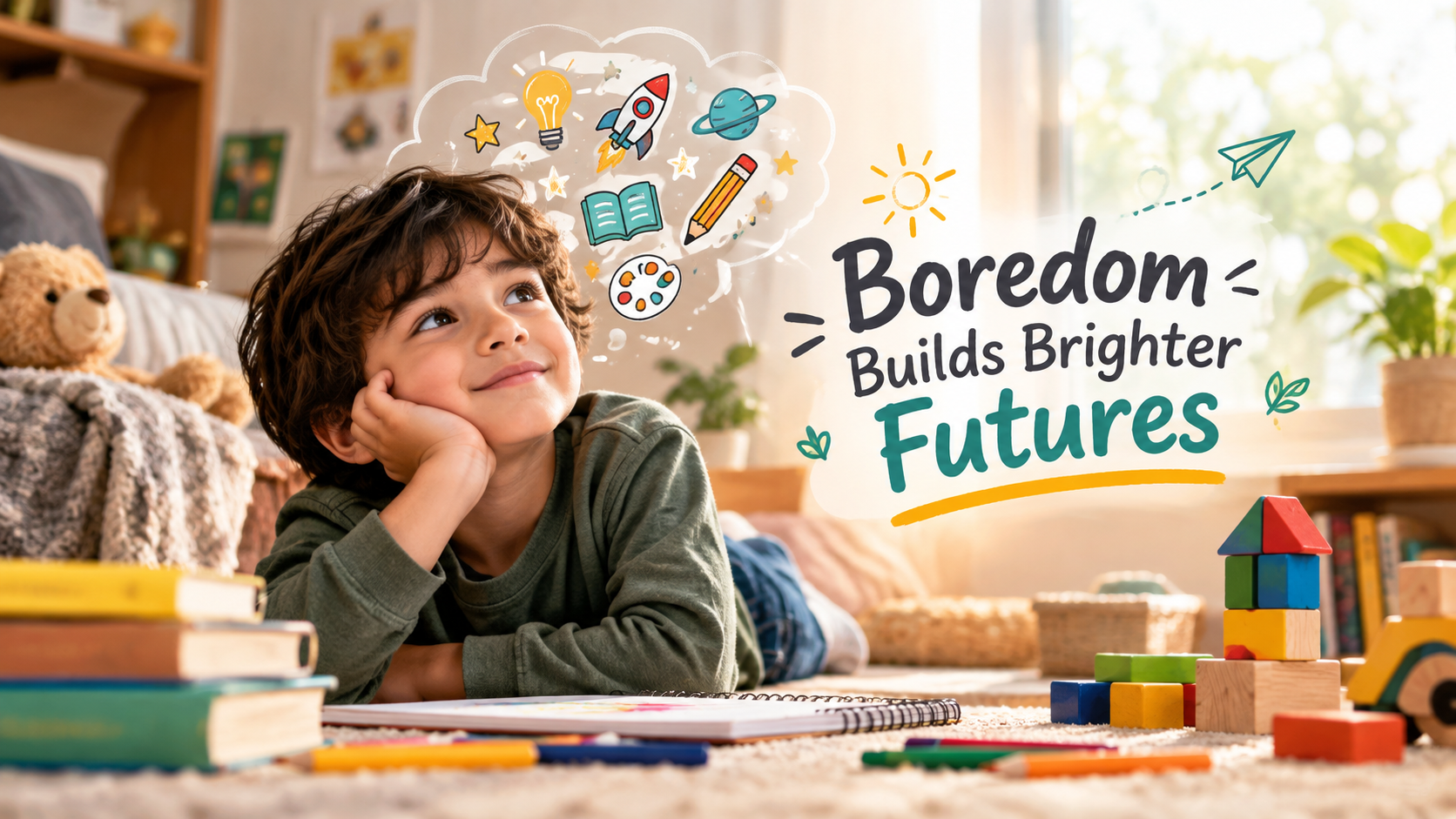
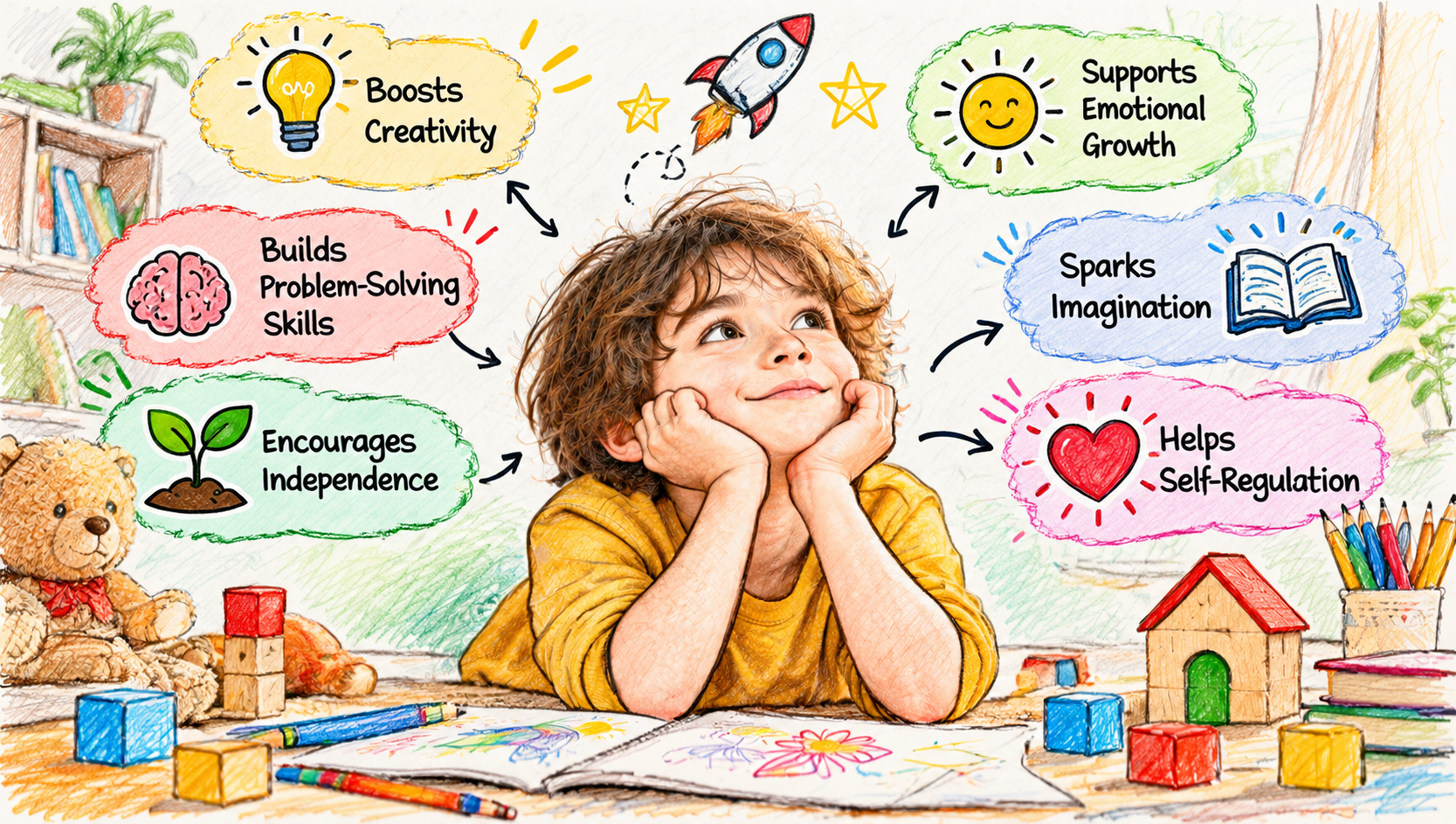
When children experience unstructured time, they must find ways to occupy themselves. They might invent games, explore everyday objects, or imagine new stories. These experiences encourage curiosity, creativity, and independent thinking.
Rather than treating boredom as a problem that requires an immediate solution, parents can view it as an opportunity for growth. This guide explores why children become bored, what Einstein’s ideas about creativity can teach us, and what the 7 7 7 parenting rule means. It also examines boredom and ADHD, practical ways to encourage independent play, and the challenges children face at different developmental stages.
Why do children get bored so easily?
Children can become bored quickly because they naturally seek novelty while still developing the skills needed to manage their attention independently. Young children often rely on adults to organize activities, provide instructions, and maintain engagement. Without these external cues, they may struggle to decide what to do next.
Digital entertainment can make this challenge more noticeable. Fast-paced videos, interactive games, and frequent rewards offer immediate stimulation. After extended screen time, slower activities may initially seem less exciting. However, this does not mean children have lost their ability to enjoy simple experiences.
Children also need time to develop self-directed play, which involves choosing activities without constant adult guidance. They might complain about having nothing to do because they have not yet learned how to turn an empty afternoon into an enjoyable experience. Exploring ways to encourage children’s curiosity can also help parents understand how to nurture their natural desire to learn.
Parents can help by offering a safe environment, accessible play materials, and opportunities to make independent decisions. Over time, children can become more comfortable with quiet moments and learn to generate their own ideas.
The Impact of Rapid Dopamine Spikes
Digital games and apps often provide frequent rewards, bright visuals, and immediate feedback. These features can make screen-based entertainment highly engaging. However, it is inaccurate to assume that every digital activity permanently changes a child’s dopamine levels or makes ordinary play unrewarding.
When children spend considerable time with fast-paced media, they may initially find quieter activities less appealing. Reading, drawing, building blocks, and outdoor exploration require patience and sustained attention. Children may need time to adjust when switching between these different experiences.
Parents can encourage a healthier balance by creating regular opportunities for screen-free play. Instead of removing every digital activity, establish predictable screen boundaries that suit the child’s age and needs.
Offer appealing alternatives, such as puzzles, art supplies, building toys, or simple household projects. Avoid expecting children to become immediately enthusiastic about these activities. Independent play develops through practice, and some children need more guidance than others.
What did Einstein say about boredom?
Albert Einstein is often associated with ideas about imagination, solitude, and creative thinking. However, popular quotations about his views on boredom are not always supported by reliable historical sources. Parents should distinguish between verified statements and inspirational quotes frequently attributed to famous scientists.
Einstein’s scientific work demonstrates the importance of imagination and exploring ideas beyond conventional assumptions. His thought experiments helped him investigate complex questions about space, time, and physical reality. Such work illustrates how sustained reflection can contribute to original thinking.
Quiet time can provide children with opportunities to develop similar habits of curiosity. Without constant instructions or entertainment, they can experiment with possibilities, invent stories, and explore questions that interest them.
This does not mean boredom automatically produces creativity or that children must remain unhappy to develop intellectually. The benefits depend on what happens during that time. A child who receives encouragement, access to suitable materials, and freedom to experiment may gradually learn to turn restlessness into meaningful activity.
Solitude as a Creative Catalyst
Quiet moments can give children room to reflect, imagine, and develop ideas without external pressure. Solitude does not mean isolating children or expecting them to entertain themselves all day. It simply means allowing occasional periods when adults do not direct every activity.
During these moments, a child might invent an imaginary world, create a story, or experiment with building materials. These activities encourage flexible thinking and allow children to follow their curiosity. They also provide opportunities to make decisions without worrying about getting everything right.
Parents can support this process by resisting the urge to interrupt whenever a child becomes quiet or appears unsure what to do. Offer materials such as paper, crayons, blocks, or recycled cardboard, then allow the child to decide how to use them.
Some children will need occasional suggestions before becoming comfortable with independent exploration. Others may prefer reading, drawing, or imaginative movement. Activities such as fun English games for children at home can combine learning with play while encouraging children to explore new ideas. The goal is not to reproduce Einstein’s experiences but to nurture curiosity, reflection, and creative problem-solving through everyday opportunities.
What is the 7 7 7 rule for kids?
The 7 7 7 rule for kids is a phrase used in different parenting contexts, so its meaning depends on the source. It does not refer to one universally established child-development method. Some versions describe dividing a child’s routine into three short periods of connection, movement, and relaxation. Other interpretations use the numbers to discuss screen-time boundaries or age-related parenting practices.
Before following a particular version, parents should check how the source defines the rule. A routine involving seven-minute activities may provide a useful reminder to make time for focused attention. However, there is no universal evidence that precisely seven minutes of each activity is necessary for healthy development.
Families can adapt daily routines to their children’s ages, interests, and needs. For example, parents might spend focused time talking with their children, encourage outdoor movement, and establish a calm bedtime routine.
These habits can support family connection without turning parenting into a rigid checklist. Children also need flexible time for exploration, rest, and independent play. The most useful routine is one that fits the family consistently, rather than one that follows an arbitrary number.
Is boredom part of ADHD?
Boredom can be especially challenging for some children with attention-deficit/hyperactivity disorder (ADHD). However, boredom alone does not indicate ADHD, and not every child with ADHD experiences it in the same way. The condition involves differences in attention regulation, impulse control, and activity levels that can affect everyday functioning.
Some children with ADHD find repetitive or low-interest tasks difficult to sustain. They may seek movement, stimulation, or activities that provide immediate rewards. This can explain why a child remains deeply engaged with a favorite game but struggles to complete routine homework or household tasks.
ADHD is more complex than a simple lack of dopamine or a constant need for excitement. Motivation, executive functioning, sleep, emotional regulation, and environmental demands can all influence a child’s behavior.
Parents should avoid interpreting every complaint of boredom as laziness or deliberate misbehavior. Instead, observe when the difficulty occurs and whether it affects schoolwork, relationships, or daily routines.
If attention difficulties, impulsivity, or restlessness persist across settings and interfere with everyday life, consult a qualified healthcare professional. Appropriate support may include structured routines, suitable learning strategies, behavioral interventions, and other individualized approaches. Children with ADHD can benefit from independent play, but they may need more structure and support to get started.
How to stop kids from being bored?
You do not need to eliminate boredom by becoming your child’s constant entertainer. Instead, help children develop the confidence to choose activities and explore their interests independently. When a child says, “I’m bored,” acknowledge the feeling without immediately supplying a solution. You might respond, “I understand. What could you try doing?”
If the child struggles to generate ideas, offer two or three simple choices. These could include drawing, building something, playing outside, or helping prepare a meal. Gradually reduce your involvement as the child becomes more comfortable making decisions.
You can also prepare an open-ended activity basket with materials that support different kinds of play. Consider including:
- Paper, crayons, and washable markers for drawing.
- Cardboard boxes, tape, and child-safe scissors for building.
- Blocks, puzzles, and simple construction toys.
- Dress-up clothes, puppets, and objects for imaginative storytelling.
- Reusable household materials for supervised creative projects.
Everyday responsibilities can also provide meaningful engagement. Invite children to sort laundry, water plants, or help prepare age-appropriate meals. These activities build practical skills and may inspire new games. Parents can also introduce creative activities that make boredom more enjoyable to help children discover new interests.
Avoid forcing children to remain bored for long periods simply to teach independence. Some children need connection, reassurance, or help finding an activity. Balance support with freedom, and allow children to decide how to use their unstructured time.
What is the hardest age of a child?
There is no single age that is universally the hardest for parents. The most challenging stage depends on a child’s temperament, developmental needs, family circumstances, and available support. Some parents struggle most with toddler tantrums, while others find adolescence more demanding.
Early adolescence, particularly between ages eleven and fourteen, can bring significant changes. Children begin exploring their identities, seeking greater independence, and placing more importance on friendships. Puberty can also affect sleep, emotions, and physical development. Meanwhile, the brain systems involved in planning, decision-making, and emotional regulation continue to mature.
These changes may lead to disagreements about privacy, responsibilities, friendships, and household rules. Parents must balance growing independence with appropriate boundaries and safety. Maintaining open communication becomes especially important during this period.
However, younger children face their own challenges. Toddlers are learning to manage strong emotions, while preschoolers are developing language, patience, and social skills. Each stage requires a different approach.
Understanding developmental expectations can help parents respond more effectively. Instead of comparing one age with another, focus on the child’s current needs. Consistent boundaries, emotional support, and age-appropriate independence can help children navigate difficult periods.
Boredom can play a useful role at every stage of childhood when children have safe opportunities to explore their interests. Younger children may need more guidance, while older children can gradually take greater responsibility for their free time. The aim is not to make every moment productive but to help children become comfortable with curiosity, rest, and independent decision-making.
Frequently Asked Questions
How long should parents let a child stay bored before stepping in?
You should let children work through boredom independently for at least twenty to thirty minutes before offering light scaffolding. Whining peaks during the first ten minutes as the brain searches for quick dopamine. If a child remains emotionally distressed after this window, suggest two broad, open-ended activities or invite them to help with a household chore.
What are the main cognitive benefits of unstructured downtime?
Unstructured downtime builds executive functioning, cognitive flexibility, and internal motivation. When external agendas disappear, children learn to set goals, plan small projects, and manage their time independently. This reflective mental space also activates the brain’s default mode network, which processes emotional memories and develops authentic creative problem-solving skills across various academic and social domains.
Can chronic boredom in school signal advanced giftedness?
Yes, persistent complaints of school-related boredom often highlight a significant mismatch between a gifted child’s rapid processing speed and the standard classroom curriculum. When students master educational material long before peers, waiting for new instruction feels agonizing. Evaluating a student’s academic placement or introducing enrichment projects ensures their cognitive curiosity stays engaged.
Conclusion
Embracing unstructured time is one of the most generous developmental gifts you can offer a modern child. In a world driven by constant sensory overload and tightly packed schedules, stepping back requires intentional courage. Allowing open spaces on the calendar teaches children that daily life does not demand endless entertainment or adult curation.
Throughout this guide, we explored how over-stimulation triggers restlessness, why visionaries like Einstein treasured quiet contemplation, and how predictable daily rhythms foster emotional security. We also uncovered the neurological connection between low dopamine and ADHD, alongside the developmental storms of early adolescence.
Ultimately, understanding why children need boredom shifts your parenting approach from frantic problem-solving to calm, grounded confidence. The next time your child sighs and claims they have nothing to do, resist the urge to hand over a tablet or invent an elaborate activity. Simply offer a warm, patient smile, validate their feelings, and give them the space to direct their own attention. When you allow that brief moment of discomfort to pass, you will watch their inner creativity, resilience, and independent focus blossom naturally.